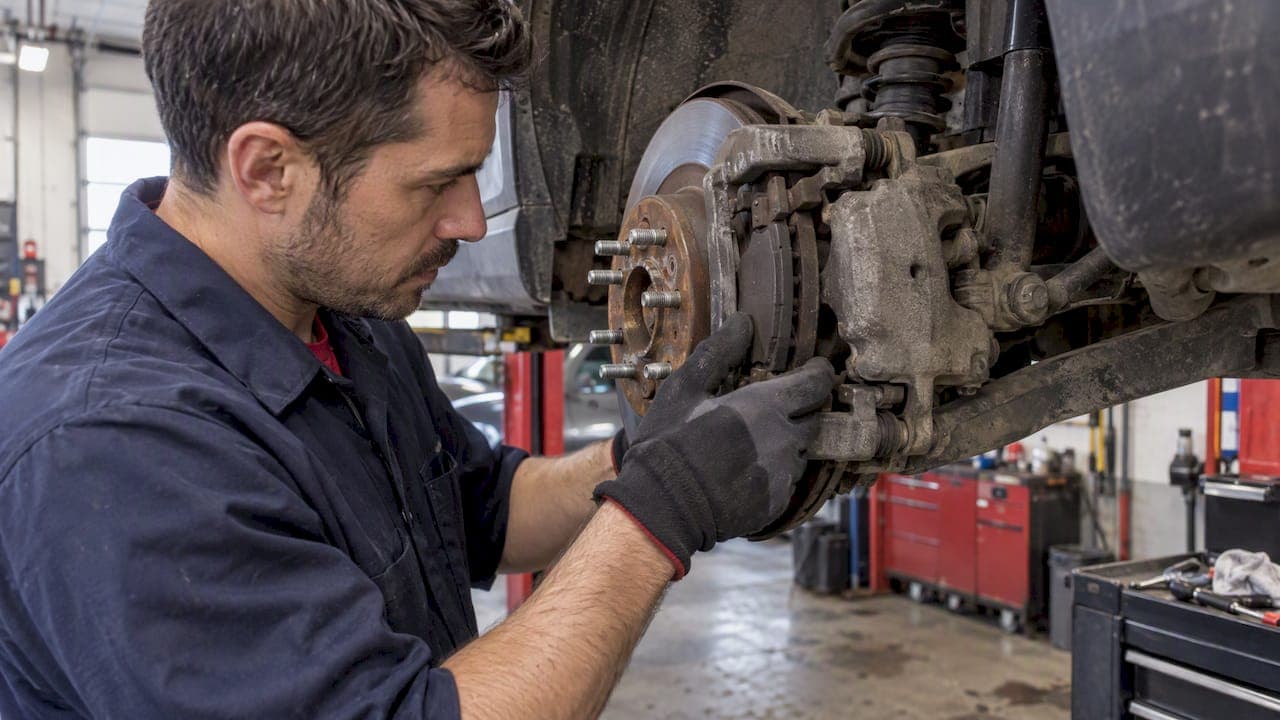
A clunk when braking in reverse is most often brake pad movement. The pads shift inside the caliper bracket when the wheel changes direction. In many cases this is a normal trait of the brake system. Phoenix Systems reports that the noise usually has no effect on brake performance. A clunk is not always harmless, though. Loose hardware, a loose caliper, worn suspension bushings or a recent brake job done wrong can produce the same sound.
This guide sorts the harmless clunk from the one that needs a shop. It lists the checks in order, the fixes that work, and the cases where driving should stop.
TL;DR
- A single clunk when braking after a direction change is usually pad movement in the caliper bracket. Often it is normal.
- Worn or missing pad clips, loose caliper bolts, worn control arm bushings and drivetrain slack can cause the same sound.
- A clunk that starts right after a brake service, or comes with a pull or a soft pedal, means stop driving and inspect.
- New hardware, correct pad fit and the right brake lubricant fix most cases.
- Never use petroleum-based grease on caliper slides or rubber parts.
Table of Contents
- What the clunk is
- Normal clunk or fault?
- Causes, from most to least common
- Checks to run, in order
- Fixes that work
- When to stop driving
- New brakes, new clunk
- Our view
- Brake kits built to fit
- Quick reference
- FAQ
- Sources
What the clunk is
Brake pads sit in a bracket. They need a small gap to slide. That gap lets the pads release and keeps debris from jamming them.
When the car rolls forward and the brakes are applied, rotor friction pushes the pads to one side of the bracket. When the car rolls backward, friction pushes them to the other side. The first brake application after a direction change moves the pad across the gap. The pad then hits the bracket. That is the clunk.
This is why the noise follows a pattern:
- Reverse and brake: one clunk.
- Shift to drive and brake: another clunk.
- Keep braking in the same direction: no clunk.
Owners describe the same pattern on forums. One Tesla Motors Club thread describes a small bang on the first forward stop after braking in reverse. A mechanics forum post describes the same thing on a 2015 Golf after new rear pads. The pattern is common across makes.
Some makers have documented it. An Acura technical tip describes rear calipers that clunk on the first brake application after a direction change. The cause given is the shims on the outer pad, which limit pad sliding.
Normal clunk or fault?
Use this table first.
| What happens | Likely cause | Urgency |
|---|---|---|
| One clunk per direction change, brakes feel normal | Normal pad movement in the bracket | Low. Monitor |
| Clunk on every stop, forward or reverse | Worn clips or hardware, loose pad fit | Medium. Inspect soon |
| Clunk over bumps while braking | Worn control arm bushing or ball joint | Medium. Inspect soon |
| Clunk began right after a brake job | Loose caliper bolts, missing hardware, wrong pads | High. Stop driving and recheck |
| Clunk with pull, soft pedal or wheel play | Loose caliper or suspension wear | High. Stop driving |
| Clunk when shifting into reverse, brakes not applied | Motor mount, drivetrain slack, CV joint | Medium. Not a brake fault |
The last row matters. A clunk when the gear is selected, without touching the brake pedal, points away from the brakes. Engine and transmission mounts, driveline play and CV joints are the usual places to look.
Causes, from most to least common
Pad movement in the caliper bracket
This is the most common cause. A mechanic writing for Phoenix Systems names pad movement within the caliper bracket as the number one cause of clicking when reversing.
Pad movement is more noticeable when:
- The pads are new and the bracket is clean, so there is more free travel.
- The pad ears are thinner than the original, or the pad is a looser fit.
- The anti-rattle clips are worn, bent or missing.
- The car is light at the rear, so the sound carries.
Some carmakers add high-temperature VHB tape to the back of the pads. Enthusiasts in that forum thread note it damps vibration and holds the pad more firmly against the piston, which reduces the clunk. This is an owner technique, not an approved fix for every pad. Use only tape rated for brake temperatures, and only on the pad back, never on the friction surface.
Worn or missing pad clips and hardware
Clips and shims hold the pad against the bracket and keep it from rattling. They wear and rust. A worn clip lets the pad travel further, so the clunk gets louder. A brake noise guide from DoItYourself.com says any brake noise deserves investigation, whether the cause turns out to be minor or severe.
Fixing this is cheap. Replace the hardware every time the pads are replaced. See our pages on what brake hardware kits do and how to install brake pad clips.
Loose caliper or caliper bracket bolts
A loose bolt allows the whole caliper or bracket to shift. This clunk is louder and sharper than normal pad movement. It is a safety fault. The caliper must be checked at once. A troubleshooting guide on brake clunking lists a clunk that starts after brake service as a reason to recheck caliper bolts, pad hardware and wheel lug torque, and to stop driving until that is done.
Dry or seized caliper slide pins
Slide pins let the caliper float. If they are dry, corroded or seized, the caliper does not centre properly. Pads wear unevenly and move more. Clean the pins and apply the correct lubricant.
Do not use ordinary grease. Phoenix Systems warns that petroleum-based lubricants can swell rubber seals and boots, which can lead to seized calipers. Use a high-temperature, silicone-based brake lubricant made for the job.
Worn suspension parts
Braking shifts load onto suspension parts. Worn control arm bushings, caster arm bushings or ball joints let the wheel move. The result is a clunk that can look like a brake noise. A forum discussion on this symptom points to deteriorated caster arm bushings as a common cause. Suspension clunks often appear over bumps as well as during braking.
Wheel bearings
A worn bearing can knock or rumble. It usually changes with speed or when turning. Compare it with brake noise using our six quick checks for wheel bearing vs brake noise.
Drivetrain and mounts
If the clunk happens at shift-in, before the brake is touched, check engine and transmission mounts, driveline slack and CV joints. Brake work will not fix these.
Checks to run, in order
Work on level ground. Use jack stands, never a jack alone. Torque values differ by vehicle, so use the service manual.
- Repeat the test. Reverse slowly, brake, then shift to drive and brake. Note which wheel and which direction. Note if the noise is one clunk or several.
- Test without the brake. Shift between drive and reverse with a foot on the brake and the car stopped. A clunk here points to mounts or drivetrain.
- Check wheel play. Raise the wheel. Grip at 12 and 6 o'clock and rock it. Repeat at 3 and 9. Play suggests a bearing or suspension wear.
- Inspect the pads. Remove the wheel. Look for pads that rock by hand, worn ears, rust on the bracket and clips that are bent, missing or loose.
- Check the caliper bolts and bracket bolts. Confirm they are present and tightened to spec.
- Check the slide pins. They should move freely. Boots should be intact.
- Check the pad wear. Uneven wear can show a sticking caliper. Our guide on what brake pad wear tells you explains the patterns.
- Check suspension. Look at control arm bushings and ball joints for cracks or play.
For symptoms that go beyond a single clunk, a guide to brake problem symptoms helps separate the signs that can wait from the ones that cannot.
Fixes that work
Replace the hardware
New clips and shims restore the pad fit. This is the first fix for most clunks. Many pad sets include a hardware kit. If the old kit is reused, the clunk often returns.
Clean and lubricate the contact points
Remove rust and debris from the bracket where the pad ears sit. Clean the slide pins. Apply a thin film of silicone-based brake lubricant to the contact points and pins. Keep it off the friction surface, the rotor and the rubber parts that are not rated for it. A technical service bulletin for rear brake squeal from a European maker follows the same logic: clean the pad area of the caliper, then apply the maker's brake lubricant to the pad guides.
Check pad fit
Pads must match the bracket. A pad that is slightly undersize or has worn ears moves more. Replace it with a pad of the correct shape for the vehicle. Match rotors and pads as a set where possible: see our guide to matching pads and rotors.
Torque the bolts
Tighten caliper and bracket bolts to the factory value. Use a torque wrench. Replace single-use bolts if the manual calls for it. Recheck wheel lug nuts too.
Accept a small residual clunk
After all of this, some cars still make a small, single clunk at direction change. If the brakes work and all parts are tight, that is normal pad travel. Some designs have more clearance by intent.
When to stop driving
Stop and have the car inspected before further driving in these cases:
- The clunk began right after brakes, wheels or tires were serviced.
- The car pulls to one side under braking.
- The pedal feels soft, low or spongy.
- The steering wheel shakes under braking.
- A wheel has visible play.
- There is grinding, a burning smell or smoke from a wheel.
Take the vehicle to a licensed technician. A loose caliper or wheel can fail without further warning.
New brakes, new clunk
New pads often make more noise than worn ones. The bracket is clean and the pad edges are sharp, so there is more movement. Many noises fade as parts bed in. For a post-service checklist, see new brake noise after 200 to 300 miles.
If the clunk is still there after bedding in, check the hardware. Check that the pads are the right fit. Check bolt torque.
Pad and rotor choice also affects noise. Performance parts often trade a little noise for stopping performance. That balance is covered in brake noise vs performance trade-off. Drilled rotors have their own noise patterns, covered in diagnosing drilled rotor noise.

Our view
We build and sell brake kits in Canada. Most clunk questions that reach us have the same root: the hardware was reused, skipped or mismatched.
We see three habits that prevent most clunks.
Replace the hardware with the pads. Clips cost little compared with the labour to redo a brake job. A pad set that ships with a hardware kit removes the choice.
Match the parts. Pads, rotors and hardware should be made for the same vehicle. Fitment problems show up as noise first.

Do not chase a normal sound. Some pad movement is part of how floating pads work. If the brakes stop straight, the pedal is firm and everything is tight, the right answer can be to leave it.
We also hold the opposite line. A clunk after service is never normal. Recheck it before the next drive.
— Sam
Brake kits built to fit
A clunk is often a sign that parts do not fit together well, or that old hardware stayed in service. DBC kits are made for specific vehicles, and the brake kits collection lists them by make and model. Pads with hardware are listed under brake pads, and rotors under brake rotors. Prices are inclusive, with no hidden fees. Shipping is free in Canada on orders over $100. Expedited shipping is $29.99 per order. Details are on the shipping information page.
Quick reference
| Item | Action |
|---|---|
| Pad clips and shims | Replace with every pad change |
| Slide pins | Clean, check movement, lubricate with silicone-based brake lubricant |
| Bracket contact points | Remove rust, apply thin lubricant film |
| Caliper and bracket bolts | Torque to manufacturer spec |
| Wheel lug nuts | Torque to manufacturer spec |
| Control arm bushings and ball joints | Inspect for play and cracks |
| Petroleum-based grease | Do not use on brake parts |
FAQ
Why do my brakes clunk when I reverse and then brake?
The pads shift in the caliper bracket when the wheel changes direction. The pad moves across its small gap and hits the bracket. This is the most common cause and is often normal. Worn clips or loose pad fit make it louder.
Is a brake clunk in reverse dangerous?
Not always. A single clunk at a direction change with normal braking is usually harmless. A clunk that began after brake work, or that comes with pulling, a soft pedal or wheel play, is not. Stop driving and have a technician inspect the car.
Why does the car clunk when shifting into reverse?
If the noise happens before the brake is applied, the brakes are probably not the source. Check engine and transmission mounts, driveline slack and CV joints. A technician can test these on a hoist.
Can I fix the clunk with grease?
Only with the right product. Use a high-temperature, silicone-based brake lubricant on slide pins and pad contact points. Ordinary petroleum-based grease can swell rubber seals and boots and may cause a seized caliper.
Will new pads stop the clunk?
Sometimes. New pads with new hardware restore the correct fit. New pads alone, with old clips, often do not. New pads can also clunk more at first because the bracket is clean and the pads have more free travel.
Sources
- Why do my brakes make a clicking noise when I reverse? (Phoenix Systems)
- Brakes Making Noises When Changing Direction (Tesla Motors Club)
- Brake pads sliding between reverse and forward (Mechanics Stack Exchange)
- Acura Tech Tip: Rear Brake Clunking Noise (UnderhoodService)
- Common Causes of Brake Noises While in Reverse (DoItYourself.com)
- Brake Clunking Noise: Top Causes, Fixes and What to Do (Vehicleruns)
- Technical service bulletin P-B-42.10/68c, rear brake squeal