
If your car pulls to one side while braking, or one wheel feels hot after a drive, you likely have a sticking or seized caliper. Check for visible fluid leaks around the wheel first. Then, after a short, careful drive, check whether one wheel is noticeably hotter than the others.
- Fluid leak check: Look at the inside of each wheel for wet, dark residue near the caliper.
- Heat check: After driving, carefully hold the back of your hand near (not on) each wheel and compare.
If a wheel is dramatically hotter or you smell burning, stop driving and arrange a tow or a short, slow trip to a shop.
Key Takeaways
Sticking or seized calipers cause uneven braking, and catching the hot-wheel and pad-wear signs early keeps repair costs in the hundreds, not thousands, of dollars.
| Point | Details |
|---|---|
| Hot wheel is the clearest sign | A wheel running 50 to 100°F hotter than the others after a drive points straight at a dragging caliper. |
| Slide pins fail most often | Dried or contaminated grease seizes slide pins before pistons corrode, so service pins first. |
| Bleeder test isolates the cause | Cracking the bleeder valve tells you whether a collapsed hose or a stuck piston is trapping pressure. |
| Fluid flush prevents corrosion | Replacing brake fluid every 2 to 3 years slows the moisture damage that seizes pistons and seals. |
| Costs escalate with delay | Slide-pin service starts around $80, but a delayed fix can grow into a $450 to $650 per-axle repair. |
If your inspection points to a worn rotor or a caliper too far gone to rebuild, DBC Brakes' performance brake kits pair cross-drilled rotors engineered against warping with inclusive pricing and no hidden fees, plus free shipping on orders over $100. Contact DBC Brakes support for fitment help before you order.
Table of Contents
- Symptoms of caliper problems you shouldn't ignore
- What causes caliper problems in the first place
- Simple checks to confirm a sticking or seized caliper
- Fixing caliper problems: DIY options and shop repairs
- Preventing caliper failure before it starts
- What caliper repairs typically cost, and when to stop driving
- What to ask and expect at the repair shop
- Author and publisher notes
- A field mechanic's honest take on caliper repairs
- Sources
Symptoms of caliper problems you shouldn't ignore
A caliper that drags keeps brake pad material pressed against the rotor even when your foot is off the pedal, and the signs show up fast.
- Pulling to one side. If the car veers left or right under braking, or even while coasting, one caliper is likely dragging and creating uneven resistance.
- Uneven pad wear. Pull a wheel or shine a light through the rim spokes. If the inner pad is worn far more than the outer, or one side's pads are thinner than the other axle end, that's a caliper problem, not just normal wear.
- A hot wheel after driving. This is the clearest field signature of all. A dragging caliper generates constant friction, and the signature is a wheel noticeably hotter than the rest, often paired with a faint burning smell right after you park.
- Burning odour, grinding or squealing noises, a spongy pedal, or fluid stains around the wheel. Any one of these on its own is worth investigating; two or more together usually mean a caliper needs attention now.
Statistic callout: A dragging caliper commonly runs 50 to 100°F (about 28 to 56°C) hotter than the opposite wheel after a normal drive. That gap is large enough to feel with the back of your hand, which is exactly why the hot wheel check works so well as a first pass.
What causes caliper problems in the first place
Caliper failures almost always trace back to moisture, dirt, or age working on parts that need to move freely.
- Seized slide pins. These pins let the caliper float side to side as pads wear. Dried-out or contaminated grease lets them corrode in place, and seized slide pins are the most common reason a caliper drags.
- Corroded pistons and failed seals. Brake fluid absorbs moisture over time, and that moisture pits the piston bore or damages rubber seals from the inside out.
- Collapsed brake hoses. A hose that has broken down internally can act like a one-way valve, trapping pressure and holding the pad against the rotor even after you release the pedal.
- Worn hardware and environmental exposure. Torn dust boots let grit in, extreme heat cycles break down grease faster, and winter road salt accelerates corrosion on exposed metal parts.
Simple checks to confirm a sticking or seized caliper
Before you replace parts, run a short sequence of checks. Each one rules something in or out.
- Hot rotor test. Drive a few kilometres at moderate speed, then check each wheel. Hovering a hand near the rotor works, but an infrared thermometer gives you an actual number and removes the guesswork.
- Pad wear inspection. Compare pad thickness side to side and inner versus outer. A backing plate showing through on one side only points straight at that caliper.
- Bleeder valve test. This is how a mechanic separates a seized piston from a collapsed hose: crack the bleeder valve open and see if the pad releases. If it does, pressure was trapped in the hose. If the pad stays clamped, the piston itself is stuck.
- Drive feel. Note whether the pull happens only under braking or all the time. Constant drag even at highway speed with no pedal pressure usually means the caliper isn't releasing at all.
Pro Tip: Don't skip the bleeder test if you're about to buy a whole new caliper. A $15 brake hose is a much cheaper fix than a caliper you didn't need.
Fixing caliper problems: DIY options and shop repairs
Repair options range from a quick clean and regrease to a full caliper swap, and matching the fix to the actual cause saves money.
- Slide-pin service. Removing, cleaning, and regreasing the pins with high-temperature brake grease often solves a dragging caliper outright, typically for $80 to $120 in labour and materials.
- Piston rebuild versus replacement. A caliper with a corroded piston can sometimes be rebuilt with a seal kit, but once pitting is deep, a full caliper replacement is more reliable and usually carries a better warranty than a rebuild.
- Hose replacement. If the bleeder test showed trapped pressure, swapping the flexible hose resolves the drag without touching the caliper at all.
- Rotor and pad replacement. Once heat damage has warped a rotor or cooked a pad, both need replacing alongside whatever caused the drag in the first place.
For the DIY-inclined:
- Slide-pin cleaning and regreasing needs basic hand tools, brake cleaner, and caliper grease, well within reach for a confident home mechanic.
- Bleeding a caliper after any of these repairs needs a proper brake bleeding kit and a second set of hands or a one-way bleeder valve.
- Piston rebuilds and any work involving the hydraulic system are best left to a shop unless you're experienced. A poorly seated seal or trapped air can compromise your brakes entirely.
Preventing caliper failure before it starts
Most caliper problems are preventable with a handful of maintenance habits spread across the life of your brakes.
- Flush the brake fluid every 2 to 3 years. Brake fluid pulls moisture from the air over time, and that moisture is what corrodes pistons and seals from the inside.
- Regrease slide pins every time you change pads. Skipping this step is one of the most commonly missed parts of a brake job, and it's why some new rotors warp within weeks.
- Inspect dust boots for tears, and consider a corrosion-resistant coating on hardware if you drive through winter salt regularly.
- If a vehicle sits unused for weeks, rust can form on the rotor surface and cause a caliper to bind on the next start. A short test drive after long storage catches this early.
Pro Tip: Ask your shop to regrease slide pins every time they touch your pads, even if you didn't ask for caliper service specifically. It's a five-minute job that prevents a much bigger one.
What caliper repairs typically cost, and when to stop driving
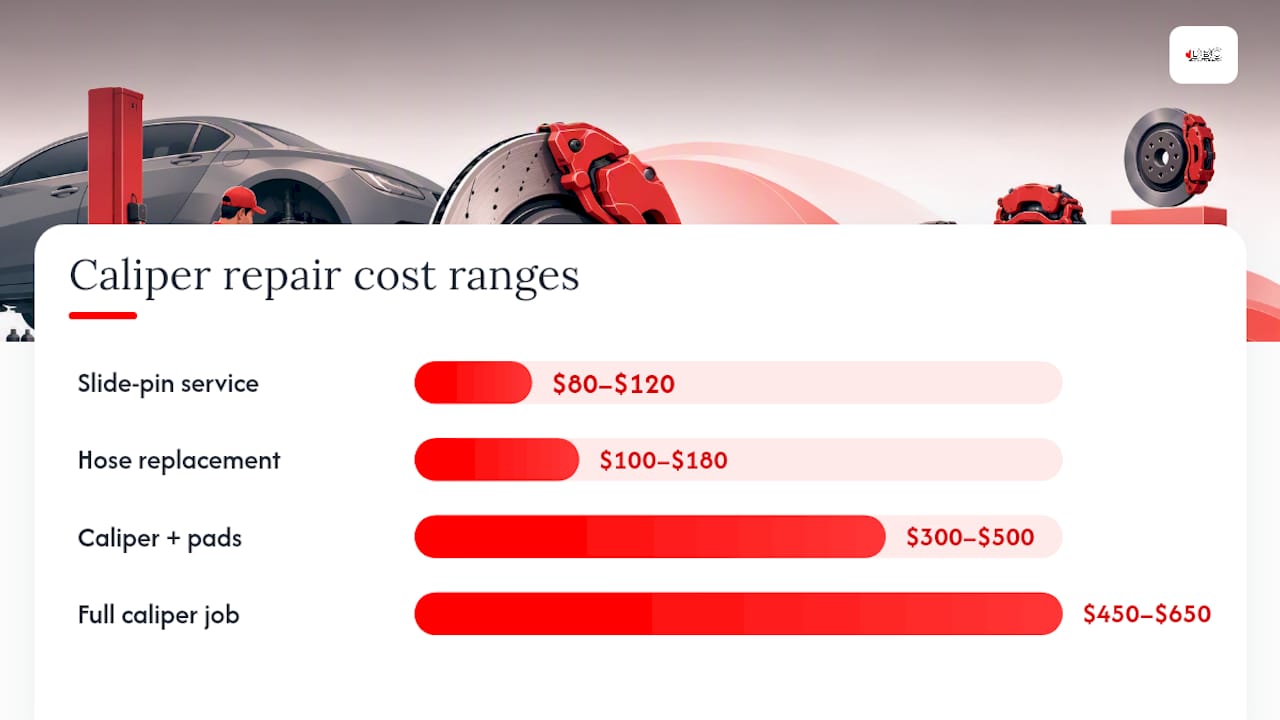
Costs scale with how far the problem has progressed. Slide-pin service runs about $80 to $120; a collapsed hose replacement is roughly $100 to $180; a caliper replaced with new pads runs $300 to $500 per axle; and a full caliper, rotor, and pad job lands around $450 to $650 per axle. Waiting turns a slide-pin fix into a rotor replacement fast, since a dragging caliper can warp a rotor and even boil brake fluid within a few hundred kilometres. If you smell burning, see smoke, or feel the pedal go soft, stop driving and call for a tow.
What to ask and expect at the repair shop
A good shop check goes beyond swapping pads. Expect them to:
- Inspect slide pins, dust boots, and piston movement, and run a bleeder test if drag is suspected.
- Check rotor temperature after a short test drive and photograph pad wear for comparison.
- Provide an itemized quote separating parts and labour, and confirm a post-repair test drive to check brake balance.
Author and publisher notes
Sam's caliper visual guide and uneven braking breakdown back this guide. DBC Brakes builds cross-drilled rotors engineered against warping, backed by real support staff, not automated replies.
A field mechanic's honest take on caliper repairs
The mistake I see over and over: shops replace rotors and pads without touching the slide pins that caused the drag. New parts seize again within weeks. Get the hardware serviced first, every time, and you'll save yourself a second repair bill.
— Sam
Sources
- Sticking Brake Caliper: Causes, Symptoms, and What It Costs
- What causes brake calipers to stick | Firestone Complete Auto Care
- Stuck, Seized, or Leaking: A Complete Guide to Brake Caliper Issues