
The brake noise vs performance trade-off is defined as the engineering tension between how quietly a brake system operates and how effectively it stops a vehicle under real driving conditions. This is not a defect or a quality problem. It is a direct result of the friction materials, pad compounds, and rotor designs that engineers choose when building a braking system. Understanding this trade-off helps you make a better purchasing decision, whether you drive a daily commuter or a performance vehicle.
What causes brake noise and how does it relate to braking performance?
Brake noise originates from a physical process called stick-slip vibration. Stick-slip occurs at low speeds under 15 mph, where the pad grips the rotor surface, releases briefly, then grips again in rapid cycles. The rotor acts like a speaker cone, amplifying those micro-vibrations into the squeal you hear. At higher speeds, friction becomes more stable and the noise typically disappears.
The pad compound determines how much stick-slip occurs. Ceramic pads are hard and lack the damping binders found in softer compounds. Ceramic pads produce higher-frequency vibrations at low speeds or during light braking, especially when cold. This is not a sign of failure. It is a predictable acoustic property of the material.

Semi-metallic and sintered pads behave differently. Their metal content conducts heat away from the friction surface more efficiently, which improves stopping power at elevated temperatures. The trade-off is that metallic pads produce more noise, particularly at low speed or when the brakes are cold. Drivers often misread this as a quality problem. It is actually a signal that the pad is working as designed for aggressive friction.
Not all brake noise carries the same meaning. A continuous squeal that appears consistently, regardless of speed or temperature, often signals wear. Wear indicator tabs activate at 2–3 mm pad thickness, producing a deliberate squeal to prompt replacement. Ignoring that sound can escalate repair costs from roughly $200 to over $700 once metal-on-metal contact begins.
Pro Tip: If your brakes squeal only during the first few stops on a cold morning and then go quiet, that is normal stick-slip behaviour. If the squeal is constant throughout every stop, check your pad thickness.
How do brake pad materials create a noise vs stopping power trade-off?
The brake pad compound categories each represent a different position on the noise-performance spectrum. No single compound wins on every measure. The table below shows where each type lands.
| Pad type | Noise level | Dust output | Fade resistance | Lifespan |
|---|---|---|---|---|
| Ceramic | Very low | Very low | Moderate | 50,000–70,000 km |
| Semi-metallic | Medium to high | Medium to high | High | 30,000–50,000 km |
| Sintered | High | High | Very high | Variable |
Ceramic pads are the quietest option for daily driving. Their softer friction surface generates minimal dust and keeps wheels clean. The cost is performance at the limit. Ceramic pads can increase braking distances by 10–15% at extreme temperatures compared to metallic compounds. For most city and highway driving, that gap never becomes relevant. For track days or heavy towing, it absolutely does.
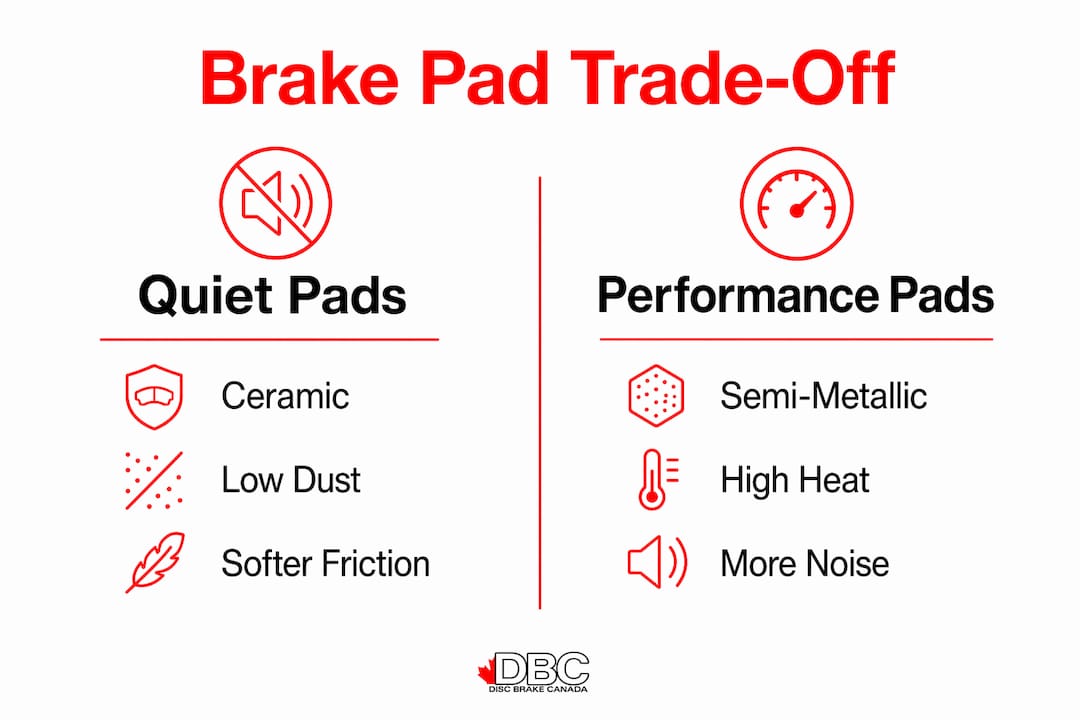
Semi-metallic pads sit in the middle. They handle heat well, deliver consistent friction across a wide temperature range, and cost less than ceramics. The noise and dust output is higher, but the performance trade-off for brakes in demanding conditions is far more favourable. Towing drivers and enthusiasts who push their vehicles regularly tend to prefer this category.
Sintered pads are the most aggressive option. They are common on motorcycles and performance vehicles where fade resistance at sustained high temperatures is the priority. The noise and wear they generate are accepted costs of that capability.
Brake engineering experts confirm that the ideal pad is always a balance among friction performance, noise, and durability. Chasing silence alone can compromise consistent friction at high temperatures. That is the core of the trade-off.
Pro Tip: Every 0.1 drop in friction coefficient can meaningfully lengthen stopping distance from highway speeds. Before choosing a pad based on noise alone, check the manufacturer's friction rating.
What conditions and scenarios affect the noise vs performance balance?
Operational factors shift where a pad sits on the noise-performance spectrum. The same pad can behave very differently depending on temperature, wear state, and how it was installed.
The bedding-in process is the most commonly skipped step in brake installation. Proper bedding creates a uniform transfer film on the rotor surface, which is required for consistent friction and noise reduction. Skipping this step leads to uneven pad deposits, which cause judder, vibration, and noise that drivers often blame on the pad material itself.
Several other conditions regularly shift the noise-performance balance:
- Cold starts: Brake noise on the first few stops of the day is normal for most pad types. The friction surface needs heat to reach its operating range.
- Surface rust: Rotors develop a thin rust layer overnight or after rain. The first few brake applications scrub it off, producing a brief grinding or scraping sound.
- Brake dust accumulation: Dust buildup on the rotor or pad surface can cause intermittent squealing that disappears after a few firm stops.
- Worn pads: Pads below 2–3 mm trigger wear indicators deliberately. This noise is a safety signal, not a material characteristic.
- High-speed fade: Pads that perform quietly at normal temperatures may experience fade at sustained high temperatures, reducing stopping power without any audible warning.
Understanding which category your noise falls into is the first step toward fixing it correctly. A cold-morning squeal needs no action. A constant squeal at all temperatures needs a pad inspection.
How do you choose the right brake pads for your driving needs?
Selecting the right pad comes down to matching the compound to your actual driving conditions, not to an ideal of silence or maximum performance in isolation. Service professionals recommend matching pads to driving needs rather than treating silence as the highest priority.
- Identify your primary use case. Daily city and highway driving rarely generates the heat that exposes ceramic pad limitations. Quieter ceramics are a practical choice for this profile.
- Assess your noise tolerance. If you find any brake noise unacceptable, ceramics are the right starting point. If you can accept occasional low-speed squeal in exchange for better heat performance, semi-metallic pads are worth considering.
- Factor in towing or load. Vehicles that regularly tow trailers or carry heavy loads generate sustained braking heat. Brake components for towing require higher fade resistance, which means accepting more noise.
- Consider rotor design. Cross-drilled and slotted rotors improve heat dissipation and gas venting, which can reduce fade without requiring a more aggressive pad compound. DBC Brakes engineers their cross-drilled rotors specifically to prevent warping and extend rotor life alongside the pad.
- Never prioritise silence over safety. If your current pads are worn, noisy due to metal-on-metal contact, or causing longer stopping distances, replacement is not optional. The impact of brake design on real-world stopping distances is measurable and significant.
The standard stopping distance from 62 mph is approximately 130 feet under normal conditions. Any degradation in pad friction coefficient extends that distance. Choosing a quieter pad that underperforms at the temperatures your vehicle regularly reaches is a safety compromise, not a comfort upgrade.
Key takeaways
The brake noise vs performance trade-off is a material science reality, not a defect. Matching your pad compound to your actual driving conditions is the only way to get both acceptable noise levels and reliable stopping power.
| Point | Details |
|---|---|
| Noise is a design property | Stick-slip vibration is built into high-friction compounds, not a sign of poor quality. |
| Ceramics trade heat performance for quiet | Ceramic pads can increase stopping distances at extreme temperatures compared to metallic compounds. |
| Wear noise is a safety signal | Continuous squeal at 2–3 mm pad thickness means replacement is required immediately. |
| Bedding-in affects both noise and performance | Skipping the bed-in process causes uneven deposits, vibration, and misdiagnosed noise problems. |
| Match pad to use case | Daily drivers benefit from ceramics; towing and performance driving require semi-metallic or sintered compounds. |
Why most drivers get this wrong
Most drivers treat brake noise as a binary problem. Either the brakes are quiet and fine, or they are noisy and broken. That framing leads to poor decisions in both directions.
I have seen drivers swap out perfectly functional semi-metallic pads for ceramics because of low-speed squeal, only to find their stopping distances noticeably longer on a highway emergency stop. The noise was gone. The performance was worse. That is the trade-off made visible.
The more common mistake runs the other way. Drivers ignore a continuous squeal because they assume all brake noise is normal. Brake noise that signals wear is a different category entirely from operational stick-slip noise. Conflating the two is how a $200 pad replacement becomes a $700 rotor and calliper job.
The practical rule is simple. Cold-morning squeal that disappears after two stops is a material characteristic. Squeal that persists across every stop, at every temperature, is a wear or installation problem. Knowing which one you have determines the right response.
Working with a reputable supplier who can tell you the friction rating, heat range, and expected noise profile of a pad before you buy it removes most of the guesswork. DBC Brakes provides that level of detail alongside real human support, which matters when you are trying to match a compound to a specific vehicle and driving profile.
— Sam
Brake kits built for Canadian drivers
DBC Brakes supplies brake kits for Canadian drivers who want reliable stopping power without overpaying or guessing at compatibility. Their cross-drilled rotors are engineered to prevent warping and improve heat dissipation, which directly addresses the fade side of the noise-performance trade-off.
The product range covers daily drivers through to performance and towing applications, with pad compounds matched to each use case. Pricing is transparent with no hidden fees, and orders over $100 ship free across Canada. If you have questions about which compound suits your vehicle and driving profile, their team responds with real answers, not automated replies. Browse by vehicle make to find the right kit for your specific application.
FAQ
What is the brake noise vs performance trade-off?
The brake noise vs performance trade-off is the balance between how quietly a brake pad operates and how effectively it stops a vehicle. Quieter compounds like ceramics sacrifice some heat resistance, while noisier metallic compounds deliver stronger fade resistance.
Why do high-performance brake pads make more noise?
High-performance metallic and sintered pads use stiffer compounds with less vibration damping. This produces stick-slip noise at low speeds, which is a normal acoustic property of aggressive friction materials, not a defect.
Is brake squeal always a sign of a problem?
Not always. Low-speed squeal on cold brakes is normal stick-slip behaviour. Continuous squeal across all temperatures and speeds typically signals worn pads at or below the 2–3 mm wear indicator threshold.
Do ceramic pads stop as well as semi-metallic pads?
Ceramic pads perform comparably to semi-metallic pads in everyday driving conditions. At extreme temperatures, ceramic pads can increase stopping distances by 10–15% compared to metallic compounds, making semi-metallic the better choice for towing or performance use.
How does the bedding-in process affect brake noise?
Proper bedding-in creates a uniform transfer film on the rotor surface. Skipping this step causes uneven pad deposits, which produce vibration and noise that is often mistaken for a material defect rather than an installation issue.