
High-performance brake compounds are friction materials engineered to deliver consistent stopping power under demanding thermal and mechanical conditions that standard pads cannot handle. The term "brake compound" refers to the specific blend of friction materials, binders, and fillers pressed into a brake pad. Choosing the right compound affects not just stopping distance, but also rotor wear, pedal feel, noise, and brake dust. DBC Brakes, a Canadian brake specialist, works with these compound categories daily and the differences between them are significant. Understanding brake friction materials starts with knowing what each compound type is made of and what it is built to do.
What are high-performance brake compounds?
High-performance brake compounds are specially formulated friction materials designed to maintain a stable coefficient of friction across a wide temperature range. Standard organic pads work well for light daily driving, but they lose friction rapidly when heat builds up. Performance compounds address this through material science: specific fibres, metal particles, and resin binders are combined to resist thermal degradation. The result is a pad that brakes predictably whether the rotors are cold at the start of a morning commute or glowing after a track session.
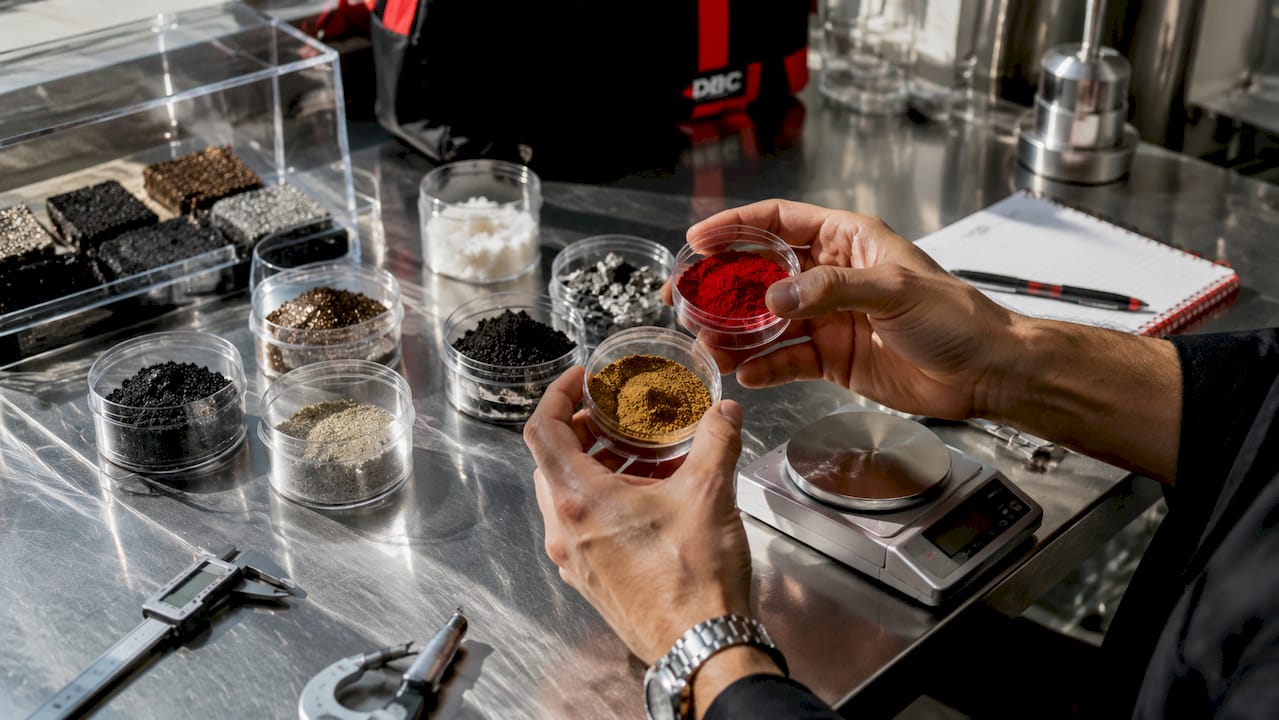
The key performance characteristics to evaluate are friction coefficient, thermal stability, fade resistance, rotor wear rate, dust output, and noise. Each compound family makes different trade-offs across these attributes. No single compound excels at all of them simultaneously. That is why matching the compound to the application matters more than simply buying the most aggressive pad on the shelf.
What are the main types of brake compounds?
Five compound families cover the full range of performance brake pads available today.
Semi-metallic compounds blend steel wool, iron powder, and copper fibres with high-temperature resin binders. Semi-metallic pads offer high friction and strong fade resistance at moderate cost, but they produce more dust and noise than ceramic alternatives. They are the most common choice for spirited street driving and light track use.
Ceramic compounds use ceramic fibres and non-ferrous filler materials bonded with phenolic resins. They run quieter, produce finer and lighter dust, and are gentler on rotors. Their friction coefficient is slightly lower than semi-metallic pads at extreme temperatures, making them better suited to street and occasional performance driving than full track use.
Carbon-ceramic compounds are the top tier for road-legal performance vehicles. Carbon-ceramic systems provide predictable friction coefficients up to 900°C and above. That thermal ceiling is far beyond what semi-metallic or ceramic pads can sustain. The trade-off is cost: carbon-ceramic systems are significantly more expensive to purchase and replace.
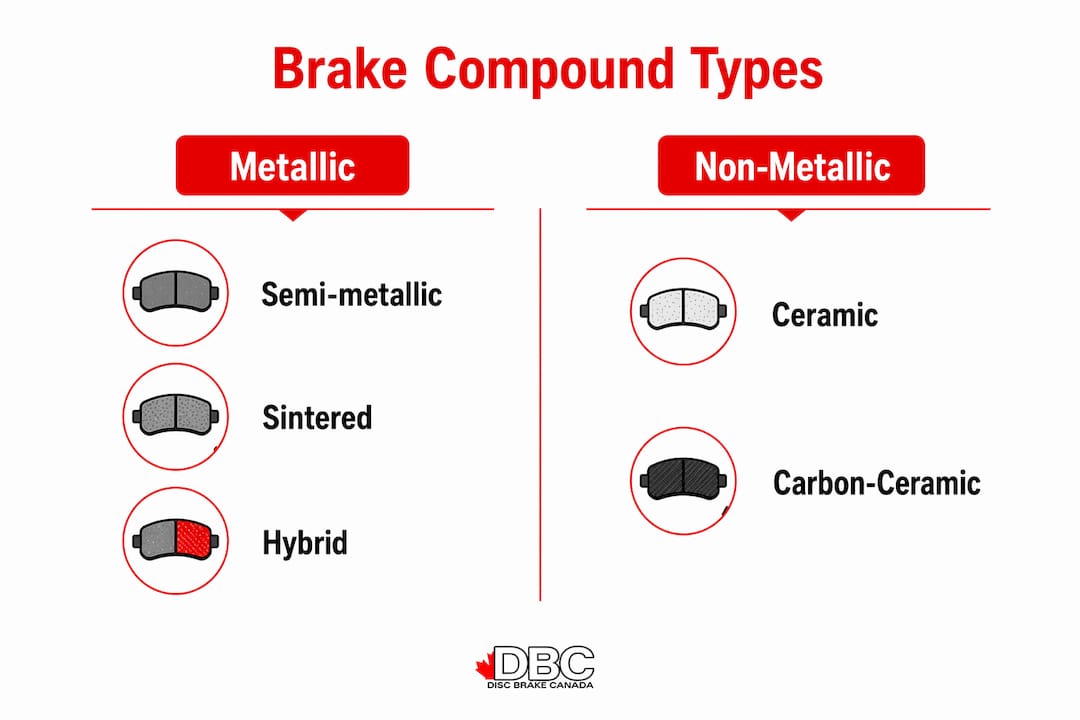
Sintered (full-metallic) compounds are pressed metal powders fused without organic binders. They handle extreme heat but conduct that heat rapidly into the brake fluid. Sintered pads often require high-boiling-point racing brake fluid to prevent the pedal fade caused by fluid boiling. They are standard in motorcycle racing and some motorsport applications, but rarely ideal for street vehicles.
Hybrid semi-metallic compounds combine metallic components with high-temperature resin binders to reduce the heat conduction problems common in sintered pads. This hybrid approach reduces heat transfer to hydraulic systems and mitigates pedal fade, making them a practical choice for enthusiasts who want performance without the fluid management demands of full sintered pads.
| Compound type | Friction level | Noise | Dust | Rotor wear | Temp. range |
|---|---|---|---|---|---|
| Semi-metallic | High | Medium | Medium-high | Medium | Street to light track |
| Ceramic | Medium-high | Low | Very low | Low | Street to spirited |
| Carbon-ceramic | Very high | Low | Low | Low on matched rotors | Up to 900°C+ |
| Sintered/full-metallic | Very high | High | High | High | Extreme track/racing |
| Hybrid semi-metallic | High | Medium-low | Medium | Medium | Street to track |
How do temperature ranges affect brake compound performance?
Thermal stability is the single most important factor separating performance compounds from standard pads. Every compound has an operating window: a temperature range where its friction coefficient stays consistent. Outside that window, friction drops and braking becomes unpredictable.
Standard organic pads begin to fade at relatively low temperatures, which is why they are not suitable for track use. Semi-metallic compounds extend that ceiling considerably. Carbon-ceramic compounds push it furthest, maintaining stable friction by forming a consistent transfer layer on the rotor surface across the full temperature range from cold street conditions to extreme track heat.
Thermal fade occurs when the resin binders in a pad vaporise under heat, creating a gas layer between pad and rotor. That gas layer reduces contact and friction drops sharply. Compounds with higher-temperature binders and more thermally stable fibres resist this process longer. Choosing a compound whose lower temperature threshold is too high creates the opposite problem: poor cold bite, where the pad does not generate enough friction until it reaches operating temperature.
- Carbon-ceramic: stable from cold up to 900°C and beyond
- Semi-metallic: effective across a broad mid-range, degrades at sustained high track temperatures
- Ceramic: excellent for street use, limited at sustained high heat
- Sintered: very high ceiling, but poor cold performance and aggressive heat transfer to fluid
- Hybrid semi-metallic: balanced ceiling with reduced fluid heat transfer
Pro Tip: Bedding procedures directly affect thermal performance. Street compounds generally require 100–200 km of moderate driving to bed correctly, while racing compounds optimise after just 1–3 track laps. Skipping bedding causes glazing, which permanently reduces friction and braking reliability.
What are the trade-offs between noise, dust, rotor wear, and longevity?
Choosing a performance compound always involves trade-offs. Understanding them prevents expensive mistakes.
Noise is generated by pad vibration against the rotor. Semi-metallic and sintered compounds are the loudest because their hard metallic particles create more vibration. Ceramic compounds are the quietest. Carbon-ceramic pads run quietly when properly matched to carbon-ceramic rotors, but produce noise when paired with standard cast iron rotors.
Dust is a real-world concern for enthusiasts who care about wheel appearance and environmental impact. Ceramic pads produce the least dust, and it is lighter in colour. Semi-metallic and sintered pads produce dark, heavy dust that coats alloy wheels quickly. Laser-clad and PEO-treated rotors reduce particulate matter emissions by 60–75% compared to uncoated rotors, which shows that rotor surface treatment works alongside compound choice to manage dust output.
Rotor wear depends heavily on compound hardness. Harder compounds like sintered pads wear rotors faster. Ceramic compounds are gentler. The critical compatibility issue arises with advanced disc materials: metal matrix composite discs shift the wear burden onto the pads rather than the rotor, so using a chemically mismatched compound with an MMC disc causes premature pad failure. Always confirm compound compatibility when upgrading to advanced disc materials.
Longevity follows directly from wear rate. Ceramic pads last longer in street conditions. Aggressive track compounds wear faster by design because they prioritise friction over pad life. For daily drivers who occasionally track their vehicles, a high-quality hybrid semi-metallic or ceramic compound often delivers the best balance of performance and service life.
How do you match brake compounds to different driving applications?
The correct compound selection focuses on matching the pad to the specific thermal and performance demands of the application. Choosing the wrong compound for the driving context is one of the most common and costly mistakes enthusiasts make.
-
Street daily driving. Ceramic or hybrid semi-metallic compounds are the right choice. They operate well from cold, produce minimal noise and dust, and are gentle on rotors. They handle the occasional hard stop without issue.
-
Spirited street and canyon driving. Semi-metallic or hybrid semi-metallic compounds suit this application. They handle higher heat cycles than ceramics without requiring the warm-up time that race compounds demand.
-
Track days and occasional circuit use. High-grade semi-metallic or entry-level carbon-ceramic compounds work here. The key is a compound whose lower temperature threshold is reachable during track sessions but does not leave you with poor cold bite on the drive home.
-
Professional and endurance racing. Full sintered or carbon-ceramic compounds are the standard. These applications generate sustained extreme heat that only the highest-temperature compounds can handle reliably. Sintered pads in this context require compatible brake calipers and high-boiling-point fluid as part of the complete system.
-
Mixed use (street and occasional track). Hybrid semi-metallic compounds are purpose-built for this scenario. They reduce heat transfer to the hydraulic system while maintaining a performance friction level suitable for track conditions.
Pro Tip: Never install race-spec compounds on a street vehicle expecting better daily performance. Race compounds like those designed for extreme track use require excessive heat to reach their operating window. On cold streets, they produce dangerously poor cold bite and erratic braking behaviour.
Key takeaways
High-performance brake compounds deliver consistent friction only when matched to the correct temperature range and driving application.
| Point | Details |
|---|---|
| Compound type determines performance ceiling | Carbon-ceramic handles 900°C+; ceramics and semi-metallics suit street and light track use. |
| Thermal stability defines fade resistance | Compounds outside their operating window lose friction rapidly, increasing stopping distances. |
| Noise and dust follow compound hardness | Sintered pads produce the most dust and noise; ceramics produce the least. |
| Rotor compatibility is non-negotiable | MMC discs shift wear to pads, requiring chemically matched compounds to avoid premature failure. |
| Bedding procedure affects long-term performance | Incorrect bedding causes glazing and permanently reduces friction reliability. |
Why compound selection is more nuanced than most guides admit
I have seen enthusiasts spend serious money on the most aggressive compound they could find, then wonder why their brakes felt worse than stock. The problem is almost always a mismatch between the compound's operating temperature and the actual heat the vehicle generates.
One detail that rarely gets enough attention is the backing plate composite. The friction material gets all the focus, but the backing plate material determines whether the pad holds together under thermal stress. Phenolic resin backing plates, similar in principle to aerospace heat shield materials, are what separate quality performance pads from budget alternatives that delaminate under hard use.
The other overlooked factor is the bedding procedure. Enthusiasts who skip bedding their new pads properly are essentially running unfinished brakes. The transfer layer that forms during bedding is what gives the compound its consistent friction character. Without it, you are not getting the performance the compound was designed to deliver.
My honest recommendation: assess your actual driving conditions before selecting a compound. If 95% of your driving is street use with two track days per year, a hybrid semi-metallic compound will outperform a race-spec sintered pad in your real-world conditions every single time. Match the compound to the application, not to the most impressive specification sheet.
— Sam
Performance brake solutions from DBC Brakes
DBC Brakes is a Canadian brake specialist with a full catalogue of performance brake components for a wide range of vehicles.
Whether you drive a Chevrolet, Ford, or Pontiac, DBC Brakes carries performance brake kits matched to your vehicle's specific requirements. Their cross-drilled rotors are engineered to resist warping and work with compatible performance compounds across the compound types covered in this guide. Pricing is transparent with no hidden fees, and orders over $100 ship free across Canada. The team provides knowledgeable support without automated responses, so you get accurate compound and rotor compatibility advice before you buy.
FAQ
What are high-performance brake compounds made of?
High-performance brake compounds are made from friction materials including metallic fibres, ceramic particles, carbon, and resin binders. The specific blend determines the compound's friction coefficient, thermal ceiling, noise level, and rotor wear rate.
Are ceramic brake pads better than semi-metallic for performance driving?
Ceramic pads are quieter and produce less dust, but semi-metallic pads offer higher friction at elevated temperatures. For track use, semi-metallic or carbon-ceramic compounds outperform ceramics; for street use, ceramics are often the better choice.
Can I use race brake compounds on a street vehicle?
Race compounds require significant heat to reach their operating window and perform poorly from cold. Using them on public roads results in poor cold bite and unpredictable braking, making them unsuitable and potentially unsafe for street driving.
How often should performance brake pads be replaced?
Replacement intervals depend on compound type and driving intensity. Street ceramic pads last longer than aggressive semi-metallic or sintered track compounds, which wear faster by design. Inspect pad thickness after every track event.
Do high-performance brake compounds work with standard rotors?
Most semi-metallic and ceramic performance compounds are compatible with standard cast iron rotors. Carbon-ceramic pads, however, perform best when paired with carbon-ceramic rotors. Using mismatched compounds and rotor materials accelerates wear on both components.