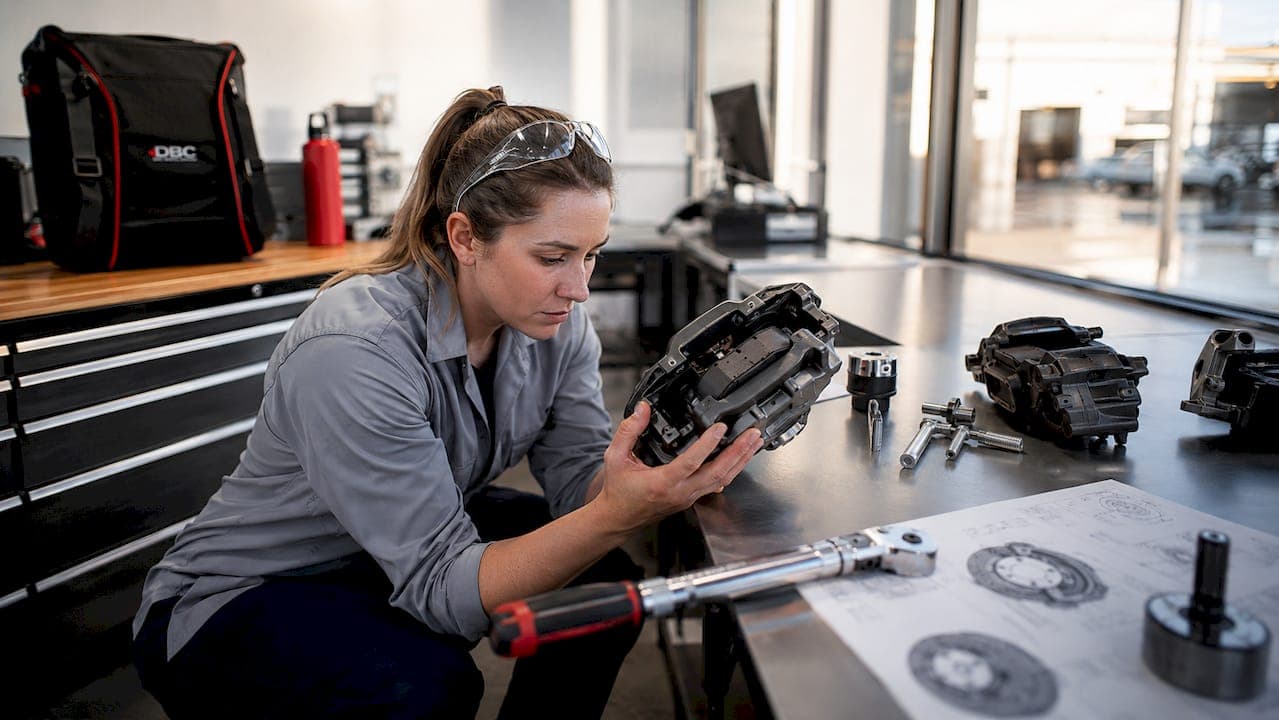
Clamping force is the mechanical pressure a brake caliper applies to press brake pads against the rotor surface, and it is the primary variable that determines braking torque in any disc brake system. Engineers refer to this force in the context of a straightforward relationship: braking torque equals clamping force multiplied by the pad friction coefficient and the effective rotor radius. Understanding the role of clamping force in brake performance means understanding all three variables, not just one. Thermal management, system stiffness, and brake bias each shape how effectively that force translates into controlled deceleration.
How does clamping force impact braking torque and stopping power?
Clamping force drives braking torque, but it does not act alone. The full formula is: Braking Torque = Clamping Force × Friction Coefficient × Effective Radius. Increasing any one variable raises torque, but the system's weakest link sets the ceiling.
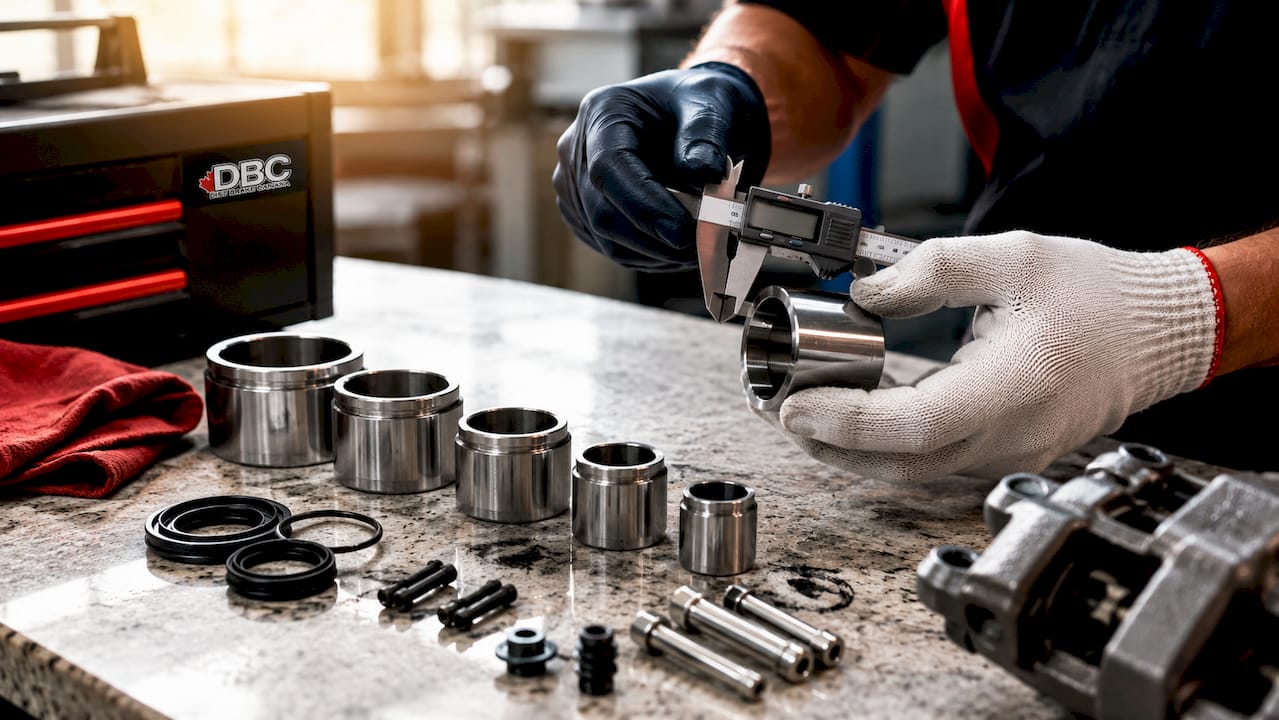
Total piston area, not piston count, determines how much clamping force a caliper generates. A four-piston caliper with small bores can produce less clamping force than a two-piston caliper with large bores. Multi-piston designs distribute force more evenly across the pad face, which reduces taper wear and keeps friction consistent under heat. The raw force number comes from hydraulic pressure multiplied by total piston area.
A common misconception is that more clamping force always means shorter stopping distances. ABS intervention signals the point where tyre grip is saturated. Beyond that threshold, additional clamping force produces wheel lockup rather than faster deceleration. The tyre contact patch, not the caliper, is the final limiting factor.
High clamping forces also generate more heat at the pad-rotor interface. That heat must go somewhere. If the rotor and pad cannot absorb and dissipate it fast enough, friction coefficients drop and pedal feel degrades. This is the thermal consequence that makes raw clamping force an incomplete metric for brake performance.
Key factors that determine effective clamping force output:
- Total piston area: Larger combined bore area produces higher clamping force at a given line pressure.
- Hydraulic line pressure: Set by master cylinder bore size and pedal ratio.
- Caliper stiffness: A flexing caliper body bleeds off applied force before it reaches the pad.
- Pad compressibility: Soft pad backing plates absorb force that should reach the rotor.
- Tyre grip limit: The absolute ceiling for any braking force the system can usefully apply.
Pro Tip: When evaluating a caliper upgrade, calculate total piston area rather than counting pistons. Two 38mm pistons outperform four 25mm pistons on clamping force, even though the piston count is lower.
What role do brake pad materials and thermal management play?
Pad friction behaviour changes with temperature, and that change directly affects how clamping force translates into braking torque. At low temperatures, pads produce abrasive friction by mechanically wearing the rotor surface. As temperature rises, pads shift to adherent friction through a transfer layer deposited on the rotor. That transfer layer improves friction stability and reduces rotor wear when the bedding process is done correctly.
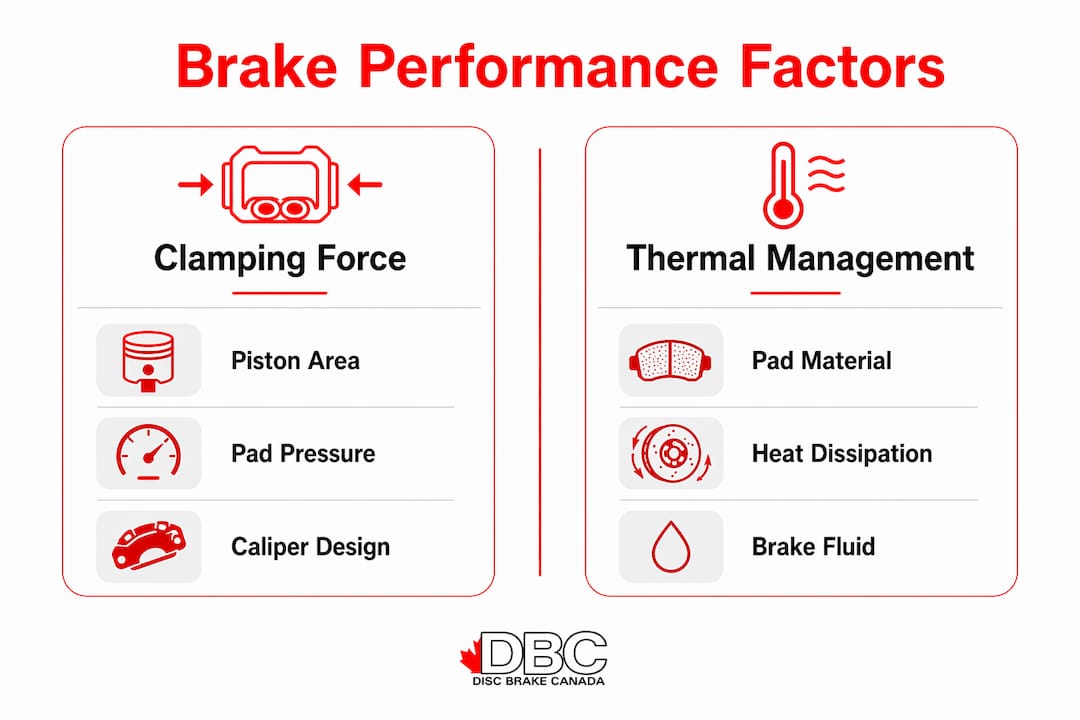
The thermal cliff is where pad performance falls off sharply. Street pads typically reach their thermal limit at 300–350°C, while track-compound pads maintain consistent friction up to 800°C. Exceeding a street pad's thermal ceiling causes fade: the friction coefficient drops, and the same clamping force produces less torque. The caliper is still applying full pressure, but the pad cannot convert it.
| Pad type | Thermal ceiling | Cold bite | Best application |
|---|---|---|---|
| Street compound | 300–350°C | Moderate | Daily driving, light spirited use |
| Street/track compound | 450–550°C | Good | Track days with street commuting |
| Full track compound | Up to 800°C | Low | Dedicated track and competition use |
Brake fluid boiling point matters alongside pad choice. DOT 4 fluid has a dry boiling point of 230°C and a wet boiling point of 155°C. Vapour lock occurs when fluid boils in the caliper, compressing as gas rather than transmitting hydraulic pressure. The result is a soft pedal with no clamping force transfer regardless of how hard you press.
Proper bedding deposits a uniform transfer layer and seats the pad surface to the rotor. Skipping this step leaves uneven deposits that cause vibration, inconsistent pedal feel, and accelerated rotor wear. Uniform pad bedding is not optional for performance applications.
Pro Tip: Match your brake fluid to your pad compound. If you run a street/track pad with a 500°C ceiling, upgrade to a DOT 5.1 or racing fluid with a higher wet boiling point. The fluid is often the first component to fail under sustained heat.
How does system stiffness and brake bias affect clamping force effectiveness?
System stiffness determines how much of the applied clamping force actually reaches the rotor. Stiff brake components including stainless steel braided lines and rigid caliper bodies prevent force loss through flex and fluid expansion. Rubber brake lines expand under pressure, absorbing some of the hydraulic energy that should be generating clamping force. Replacing them with stainless steel lines improves pedal feel and makes force delivery more direct and consistent.
Brake bias describes how clamping force is distributed between the front and rear axles. Most vehicles are biased toward the front because weight transfers forward under braking, increasing front tyre load and grip. Uneven or excessive clamping force at the rear relative to available tyre grip causes premature rear wheel lockup, which destabilises the vehicle. This is not a caliper problem. It is a system balance problem.
ABS and electronic stability control (ESC) interact directly with clamping force distribution. These systems modulate hydraulic pressure at individual wheels to prevent lockup. Upgrading calipers or master cylinders without recalibrating ABS thresholds can cause the system to intervene too early or too late. Balanced clamping forces and recalibrated master cylinders are the foundation of a safe high-performance brake system.
Upgrades that improve system stiffness and bias control:
- Stainless steel braided lines: Eliminate line expansion and sharpen pedal response.
- Adjustable brake bias bars: Allow front-to-rear balance tuning for track applications.
- Matched master cylinder bore: Correct bore sizing maintains proper line pressure for upgraded calipers.
- Rigid caliper mounting: Prevents caliper flex that reduces effective clamping force at the pad.
- ABS recalibration: Aligns electronic intervention thresholds with new system capabilities.
The stiffness of brake components is frequently overlooked during upgrades. Engineers focus on caliper piston area and pad compound while leaving rubber lines and stock master cylinders in place. The result is a system that generates higher peak clamping force but delivers it inconsistently.
What practical steps optimise clamping force for better brake performance?
Optimising clamping force for brake performance requires matching every component in the hydraulic chain. Start with the caliper. High-performance calipers with increased piston sizes amplify clamping force and improve response time, but they require compatible brake fluid and system recalibration to function correctly. Lightweight aluminium caliper bodies also reduce unsprung mass, which benefits suspension response and tyre contact consistency.
Follow this sequence when upgrading for clamping force improvement:
- Calculate required clamping force based on vehicle weight, target deceleration rate, and rotor effective radius. This sets the minimum caliper specification.
- Select pad compounds matched to the expected temperature range. Use brake pad material guides to match compound to application, whether street, street/track, or full competition.
- Upgrade brake fluid to match the pad's thermal ceiling. Higher boiling point fluid prevents vapour lock under sustained clamping force.
- Replace rubber lines with stainless steel to eliminate pressure loss through line expansion.
- Bed pads and rotors correctly using a structured heat cycle sequence. This establishes the transfer layer and seats the pad surface evenly.
- Verify brake bias after any caliper or master cylinder change. Adjust the bias bar or proportioning valve to maintain front-biased balance.
- Recalibrate ABS and ESC if the system allows it. New clamping force levels change the hydraulic pressure at which wheels approach lockup.
Upgrading clamping force without thermal or balance considerations can degrade drivability. A caliper that generates 30% more clamping force on a system with stock rubber lines and DOT 3 fluid will not deliver 30% more stopping power. It will deliver inconsistent pedal feel and early fade.
Pro Tip: Before purchasing a big brake kit, verify that your suspension geometry and tyre compound can handle the increased deceleration forces. A brake system that outperforms the tyre contact patch creates instability, not safety.
Key takeaways
Clamping force determines braking torque, but tyre grip, thermal management, and system stiffness set the real limits of brake performance.
| Point | Details |
|---|---|
| Clamping force formula | Braking torque equals clamping force multiplied by friction coefficient and effective rotor radius. |
| Piston area over piston count | Total piston bore area determines clamping force output, not the number of pistons. |
| Thermal limits define performance | Street pads fade above 300–350°C; track pads maintain friction up to 800°C. |
| System stiffness matters | Stainless steel lines and rigid calipers prevent force loss and improve pedal consistency. |
| Balance before raw force | Brake bias and ABS calibration must match any clamping force upgrade to maintain vehicle stability. |
Why I think raw clamping force is the wrong place to start
Most engineers and enthusiasts I have worked with approach brake upgrades by targeting the caliper first. More pistons, bigger bores, higher clamping force. The logic seems sound. The results are often disappointing.
The real bottleneck in most brake systems is thermal. A street pad hitting its 350°C ceiling during a mountain descent or a track session is not a clamping force problem. It is a pad compound and heat dissipation problem. Adding a six-piston caliper to a system with stock rubber lines and DOT 4 fluid does not solve that. It makes the pedal feel better for the first two laps and then worse than before.
What I have found works is treating the brake system as a chain. The weakest link sets the performance ceiling. Thermal management, through pad selection, rotor design, and fluid choice, almost always needs addressing before caliper upgrades deliver real gains. Cross-drilled and slotted rotors improve heat dissipation and gas evacuation at the pad face, which keeps the friction coefficient stable under sustained clamping force.
The other thing that gets ignored is brake bias. I have seen well-funded builds with Brembo six-piston front calipers and stock rear brakes. The front-to-rear imbalance under hard braking is dangerous. The rear locks before the front reaches its grip limit. More front clamping force made the car less stable, not more.
The correct sequence is: fix thermal management, verify system stiffness, confirm brake bias, then consider caliper upgrades. That order produces consistent, predictable braking. Reversing it produces expensive problems.
— Sam
DBC Brakes: rotors built for thermal and clamping force demands
DBC Brakes offers cross-drilled rotors engineered to handle the heat loads that high clamping force generates. The cross-drilled pattern improves heat dissipation at the pad-rotor interface, which keeps friction coefficients stable and extends pad life under sustained braking. DBC Brakes products are compatible with performance calipers across a wide range of vehicle makes, and the catalogue covers everything from classic Triumph and Porsche applications to modern Ford and Dodge platforms. Pricing is transparent with no hidden fees, and orders over $100 ship free across Canada. Technical support comes from knowledgeable staff, not automated responses. Browse the full selection at CrossDrilledRotors.ca to find the right rotor for your application.
FAQ
What is clamping force in a braking system?
Clamping force is the pressure a brake caliper exerts on the brake pads to press them against the rotor surface. It is the primary input that generates braking torque, calculated as clamping force multiplied by pad friction coefficient and effective rotor radius.
Does more clamping force always improve stopping distance?
No. Once clamping force exceeds available tyre grip, ABS intervenes and additional force produces wheel lockup rather than shorter stopping distances. Tyre contact patch capacity is the absolute ceiling for braking performance.
Why do multi-piston calipers not automatically mean more braking power?
Multi-piston calipers distribute clamping force evenly across larger pad surfaces to reduce taper wear and maintain friction consistency. Total piston bore area, not piston count, determines the actual clamping force output.
What causes brake fade under high clamping force?
Thermal fade occurs when pad temperature exceeds the compound's thermal ceiling, dropping the friction coefficient. Street pads typically fade above 300–350°C. Brake fluid vapour lock under heat also eliminates hydraulic pressure transfer entirely.
How does brake bias relate to clamping force upgrades?
Brake bias controls how clamping force is split between front and rear axles. Upgrading front calipers without adjusting rear bias or recalibrating ABS can cause rear wheel lockup and vehicle instability during hard braking.