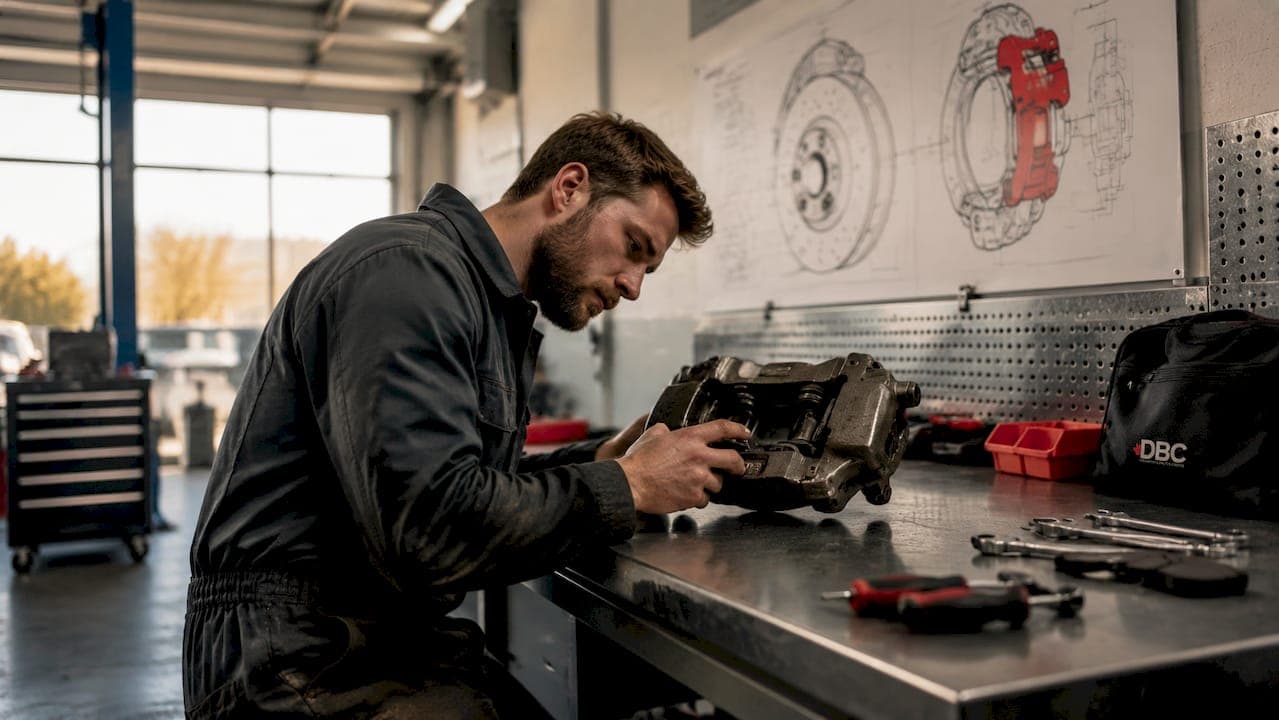
Brake calipers are the hydraulic components that apply clamping force to brake pads, pressing them against the rotor to slow or stop a vehicle. Choosing the right brake caliper types for performance vehicles directly determines stopping power, pedal feel, and pad wear consistency. Fixed multi-piston calipers are the industry standard in high-performance brake systems, scaling from 4 to 8 or more pistons to deliver even pressure across the pad surface. Piston count, caliper material, and body construction all affect heat management and braking efficiency. DBC Brakes engineers performance caliper kits for Canadian drivers who need reliable stopping power without hidden costs or guesswork on fitment.
1. Fixed vs floating calipers: which performs better?
Fixed and floating calipers represent the two fundamental designs in performance brake systems, and the difference matters significantly under hard braking.
Fixed calipers mount rigidly to the upright or carrier and contain pistons on both sides of the rotor. This design applies equal pressure from both faces of the pad simultaneously. Fixed calipers deliver superior clamping force and more uniform pad wear compared to floating designs, scaling to 4, 6, or 8 or more pistons. That even pressure distribution is why fixed calipers are the preferred choice in racing and on heavy performance vehicles.
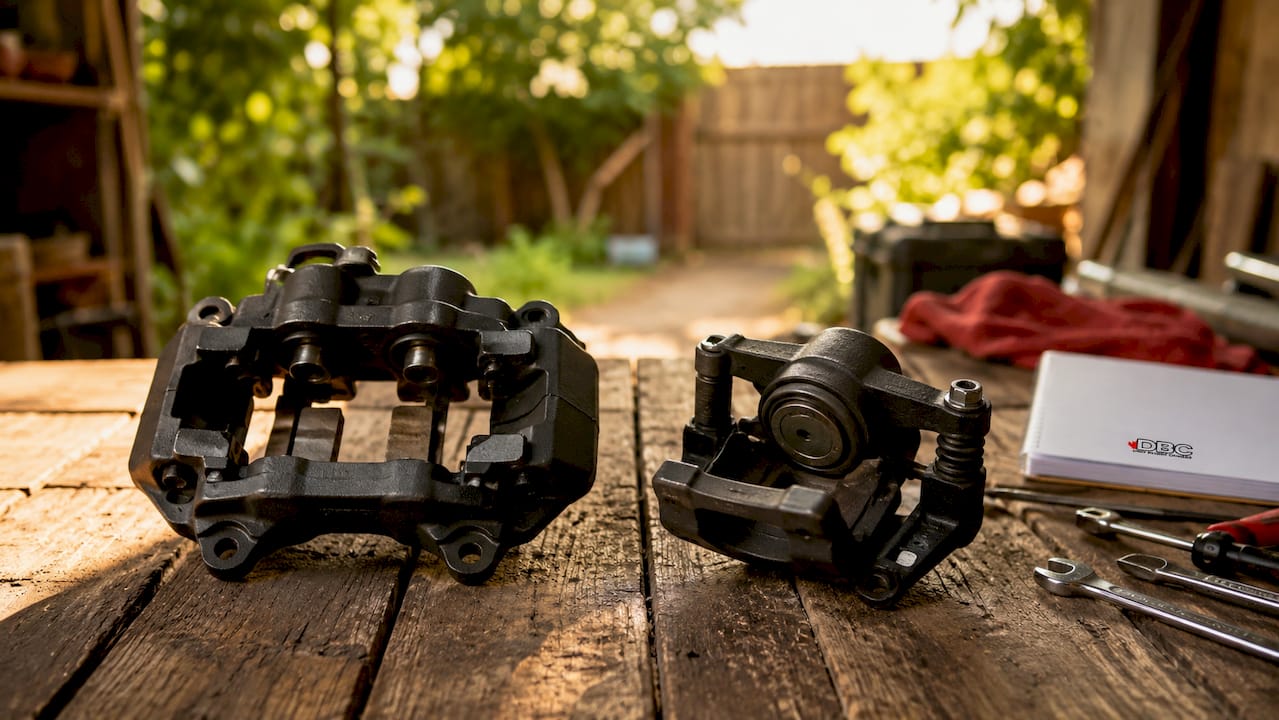
Floating calipers use a single piston on the inboard side. The caliper body slides on guide pins so the outboard pad gets pulled in by the caliper frame reacting against the piston force. This design is lighter and less expensive to produce. The trade-off is reduced consistency under repeated heat cycles, because pin wear and slide friction can cause uneven pad contact over time.
Key differences at a glance:
- Fixed calipers: pistons on both sides, rigid mount, even pad pressure, higher piston counts
- Floating calipers: single or dual pistons, sliding mount, lighter weight, lower cost
- Fixed designs suit racing, track days, and heavy performance vehicles
- Floating designs suit lighter street cars and occasional spirited driving
Pro Tip: If you are upgrading from a floating OEM caliper to a fixed multi-piston unit, check your wheel clearance before purchasing. Fixed calipers are physically larger and many aftermarket wheels require a minimum of 17-inch diameter to clear a 4-piston kit.
2. Caliper materials: cast iron, aluminium, and monobloc
The material a caliper is made from affects its weight, stiffness, heat management, and long-term durability. Three materials dominate performance applications: cast iron, die-cast aluminium, and billet monobloc aluminium.
Cast iron calipers are common on OEM and entry-level performance vehicles. They are heavy but thermally stable and inexpensive to manufacture. Cast iron absorbs heat well but adds significant unsprung weight, which reduces suspension response.
Die-cast aluminium calipers are the mid-tier choice. They are lighter than cast iron and dissipate heat faster. Most factory sport packages use die-cast aluminium two-piece calipers. They are assembled from two halves bolted together, which introduces a small amount of flex at the joint under extreme load.
Monobloc (billet aluminium) calipers are machined from a single block of aluminium. Monobloc calipers offer the best stiffness-to-weight ratio for competitive racing, eliminating the microscopic flex seen in two-piece designs and improving pedal feel. That elimination of flex translates directly into a firmer, more consistent pedal under hard braking. For 2026 performance builds, monobloc aluminium is the top-tier choice for track-focused vehicles.
| Material | Weight | Stiffness | Best use |
|---|---|---|---|
| Cast iron | Heavy | Moderate | OEM, budget street |
| Die-cast aluminium | Medium | Good | Street, occasional track |
| Monobloc aluminium | Light | Excellent | Track, competitive racing |
Pro Tip: Two-piece fixed calipers are sufficiently stiff and more cost-effective for street and occasional track use. Reserve monobloc units for dedicated track cars where every gram and every millimetre of pedal travel counts.
3. Piston materials: steel, aluminium, and phenolic
Piston material is one of the most overlooked variables in a caliper upgrade. The piston sits directly between the brake fluid and the pad, so its thermal properties affect fluid temperature, corrosion resistance, and overall braking reliability.
Steel pistons are the most common in OEM and entry-level performance calipers. They are strong and durable but conduct heat readily from the pad into the brake fluid. Under sustained track use, this heat transfer raises fluid temperature and risks vapour lock if the fluid is not rated for the application.
Aluminium pistons are lighter than steel and conduct heat at a similar rate. For extreme track use, aluminium alloy pistons with thermal barriers reduce heat soak, improving brake fluid reliability under stress. That makes them a strong choice for circuit driving when paired with high-temperature fluid.
Phenolic pistons are made from a glass-reinforced polymer composite. Phenolic pistons isolate brake fluid from caliper heat, reducing the risk of boiling fluid during heavy use. They are also lighter than steel and resist corrosion, making them well suited to daily drivers in wet or salty Canadian conditions.
Piston selection by use case:
- Daily street driving: phenolic or coated pistons for corrosion resistance
- Spirited street and occasional track: coated steel or phenolic
- Dedicated track and racing: aluminium alloy with thermal barrier coatings
Piston material selection should match vehicle use, with phenolic or coated pistons for daily drivers and steel or high-strength alloys for track vehicles. Matching piston material to use case prevents premature wear and protects fluid integrity.
4. How piston count affects braking efficiency and pad wear
Piston count is the most visible spec on a performance caliper, but it is not the whole story. More pistons distribute clamping force across a wider area of the pad, which reduces hot spots and uneven wear.
Multi-piston fixed calipers minimise uneven pad wear and improve brake modulation. That consistency matters most during repeated hard stops, where uneven wear on a single-piston caliper would cause the pad to taper and reduce contact area over time.
Common piston configurations and their applications:
- 1 piston (floating): Standard OEM street cars, light daily drivers
- 2 pistons (floating or fixed): Upgraded street cars, light performance vehicles
- 4 pistons (fixed): Entry-level performance and track-day builds
- 6 pistons (fixed): Mid-range performance, sports cars, light track use
- 8+ pistons (fixed): Heavy performance vehicles, dedicated circuit cars
Differential piston bore sizing is a technique used in high-end fixed calipers. The leading pistons are slightly smaller in diameter than the trailing pistons. As the pad wears and the leading edge contacts the rotor first, the smaller leading pistons apply less force, keeping the pad contact even. Differential piston sizing compensates for mechanical pad wear to maintain smooth braking throughout the pad's service life.
Higher piston count alone does not guarantee better performance. Caliper body stiffness determines how much of the piston force actually reaches the pad. A flexible caliper body with 8 pistons will underperform a stiff 4-piston monobloc unit. Stiffness and piston count must work together for the best pedal feel and stopping power.
5. Choosing the right caliper type for your driving style
Selecting the right caliper comes down to four factors: primary vehicle use, vehicle weight, wheel fitment, and budget. Matching these factors correctly avoids overspending on hardware that delivers no real-world benefit for your application.
Daily driving: A floating or 2-piston fixed caliper with phenolic pistons is the practical choice. Corrosion resistance matters more than outright clamping force for a car that sees rain, road salt, and stop-and-go traffic. Overspending on a 6-piston monobloc caliper for a daily driver adds maintenance complexity without meaningful stopping improvement on public roads.
Spirited street and weekend track days: A 4-piston fixed caliper in die-cast aluminium hits the right balance. It delivers noticeably better pedal feel and pad wear consistency than a floating OEM unit, without the cost or fitment complexity of a full racing setup.
Competitive racing: A 6-piston or 8-piston monobloc fixed caliper is the correct choice. The elimination of flex, combined with high-temperature piston materials, keeps pedal feel consistent lap after lap.
Wheel fitment for big brake kits is critical. Many calipers require specific wheel offset or spacers, and improper management affects suspension geometry and bearing wear. Always confirm caliper-to-wheel clearance with a physical mock-up before finalising a big brake kit purchase.
Professional-grade brake upgrades can reduce unsprung weight by approximately 25 lbs on the front axle compared to OEM setups, improving suspension response and grip. That weight reduction improves how quickly the suspension reacts to road inputs, which is a measurable handling benefit beyond just stopping distance.
| Driving style | Caliper type | Piston count | Material |
|---|---|---|---|
| Daily driving | Floating | 1–2 | Cast iron or die-cast aluminium |
| Street performance | Fixed | 4 | Die-cast aluminium |
| Track days | Fixed | 4–6 | Die-cast or monobloc aluminium |
| Competitive racing | Fixed monobloc | 6–8+ | Monobloc billet aluminium |
Pro Tip: Check your wheel's inner barrel clearance with a cardboard template of the new caliper before ordering. This takes 20 minutes and prevents a costly return or the need for wheel spacers that alter your suspension geometry.
When considering wheel compatibility, resources like the HRE Wheels guide from 3W Distributing cover offset and clearance considerations that apply directly to big brake kit fitment decisions.
Key takeaways
Fixed multi-piston calipers in monobloc aluminium deliver the best braking performance for track use, while phenolic-piston floating calipers suit daily drivers in corrosive Canadian conditions.
| Point | Details |
|---|---|
| Fixed calipers outperform floating | Fixed designs apply even pressure from both sides, reducing pad wear and improving modulation. |
| Monobloc aluminium leads for track use | Single-piece construction eliminates flex, delivering firmer pedal feel under hard braking. |
| Piston material must match use case | Phenolic pistons protect fluid on the street; aluminium alloy pistons handle heat on the track. |
| Piston count needs caliper stiffness | Higher piston counts only improve performance when the caliper body is stiff enough to use the force. |
| Wheel fitment is a primary challenge | Confirm caliper-to-wheel clearance before purchasing any big brake kit to avoid suspension issues. |
Sam's take on caliper upgrades for Canadian drivers
The most common mistake I see Canadian enthusiasts make is buying the most expensive caliper they can find without thinking about the rest of the brake system. A monobloc 6-piston caliper is a genuinely excellent piece of hardware. On a dedicated track car, it earns every dollar. On a car that sees Toronto winters and highway commuting, it is often unnecessary and harder to maintain.
What actually trips people up is the master cylinder. Upgrading calipers requires rebalancing the master cylinder bore size to piston area ratio. Skip that step and you end up with a spongy pedal that travels further than your OEM setup did. The caliper is stiffer, but the system feels worse. That is a frustrating and expensive lesson.
For most Canadian drivers doing occasional track days, a quality 4-piston fixed caliper with phenolic pistons is the right call. It handles the corrosion from road salt better than steel pistons, and it delivers a real improvement in pedal feel over a floating OEM unit. You can read more about brake caliper function to understand how the full system works before committing to an upgrade.
Focus on brake system balance first. The caliper is one part of a system that includes the master cylinder, brake lines, fluid, pads, and rotors. Upgrading one component without considering the others limits the gains you actually feel behind the wheel.
— Sam
Quality brake calipers for Canadian performance builds
DBC Brakes supplies performance brake kits built for Canadian roads and Canadian conditions, with no hidden fees and free shipping on orders over $100.
Whether you are building a weekend track car or upgrading a daily driver for better stopping confidence, DBC Brakes carries fixed multi-piston calipers, cross-drilled rotor kits, and complete brake packages matched to your vehicle. The team provides real technical support, not automated responses, so you get fitment answers before you buy. Browse the full catalogue at CrossDrilledRotors.ca to find caliper kits matched to your make and model. For Ford enthusiasts, the Ford Custom brake options page lists compatible caliper and rotor packages with Canadian pricing included.
FAQ
What is the best caliper type for track use?
Fixed monobloc aluminium calipers with 6 or more pistons are the best choice for track use. They eliminate body flex and maintain consistent pedal feel under repeated hard braking.
Are floating calipers good for performance vehicles?
Floating calipers work well for street-driven performance vehicles but lose consistency under sustained heat. Fixed multi-piston calipers are the better choice for any serious performance application.
What piston material suits Canadian daily drivers?
Phenolic pistons are the best fit for Canadian daily drivers. They resist corrosion from road salt and isolate brake fluid from heat, reducing the risk of fluid boil during heavy use.
Does piston count alone determine braking performance?
Piston count improves force distribution but only when paired with a stiff caliper body. A flexible caliper with many pistons will underperform a stiff 4-piston unit in real braking conditions.
Do I need to change my master cylinder when upgrading calipers?
Yes. Upgrading calipers without rebalancing the master cylinder bore-to-piston area ratio causes spongy pedal feel and longer travel, which negates the performance gains from a stiffer caliper.