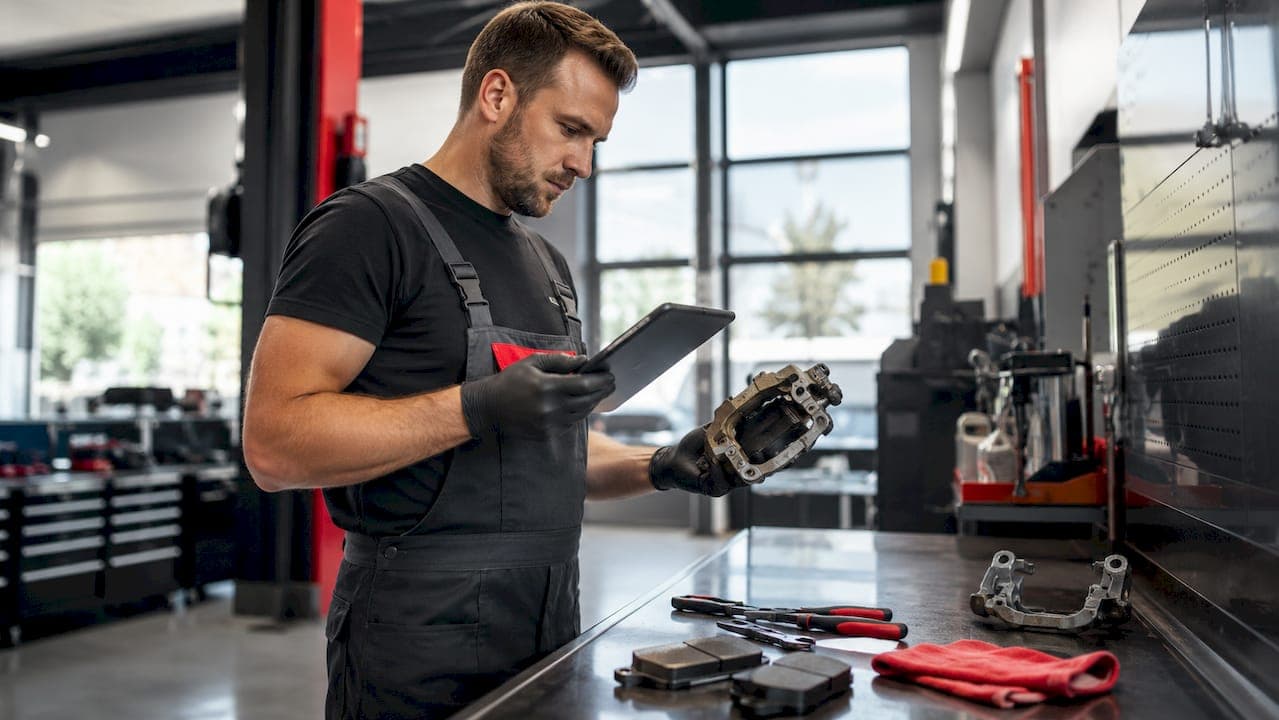
The brake caliper is defined as the hydraulic clamp that converts brake pedal pressure into the mechanical force required to stop a vehicle. The role of brake caliper in stopping is direct: it squeezes brake pads against a spinning rotor, generating friction that transforms kinetic energy into heat and brings the vehicle to a halt. Modern calipers, including those engineered by Brembo, can develop between 2,000 and 4,000 N·m of braking torque per wheel. That figure means a single caliper carries enough mechanical authority to decelerate a passenger car from highway speed in a controlled, repeatable way.
How do brake calipers convert pedal input into stopping force?
Brake calipers convert hydraulic pressure into mechanical force by pushing pistons outward, which press the brake pads firmly against the rotor surface. The process begins the moment a driver presses the brake pedal. That pedal movement compresses brake fluid inside the master cylinder, sending pressurised fluid through steel brake lines directly to each caliper.
Inside the caliper, that fluid pressure acts on one or more pistons. The pistons extend outward and clamp the brake pads against both faces of the spinning rotor. Friction at the rotor surface resists wheel rotation and slows the vehicle. The entire sequence from pedal press to pad contact takes milliseconds.
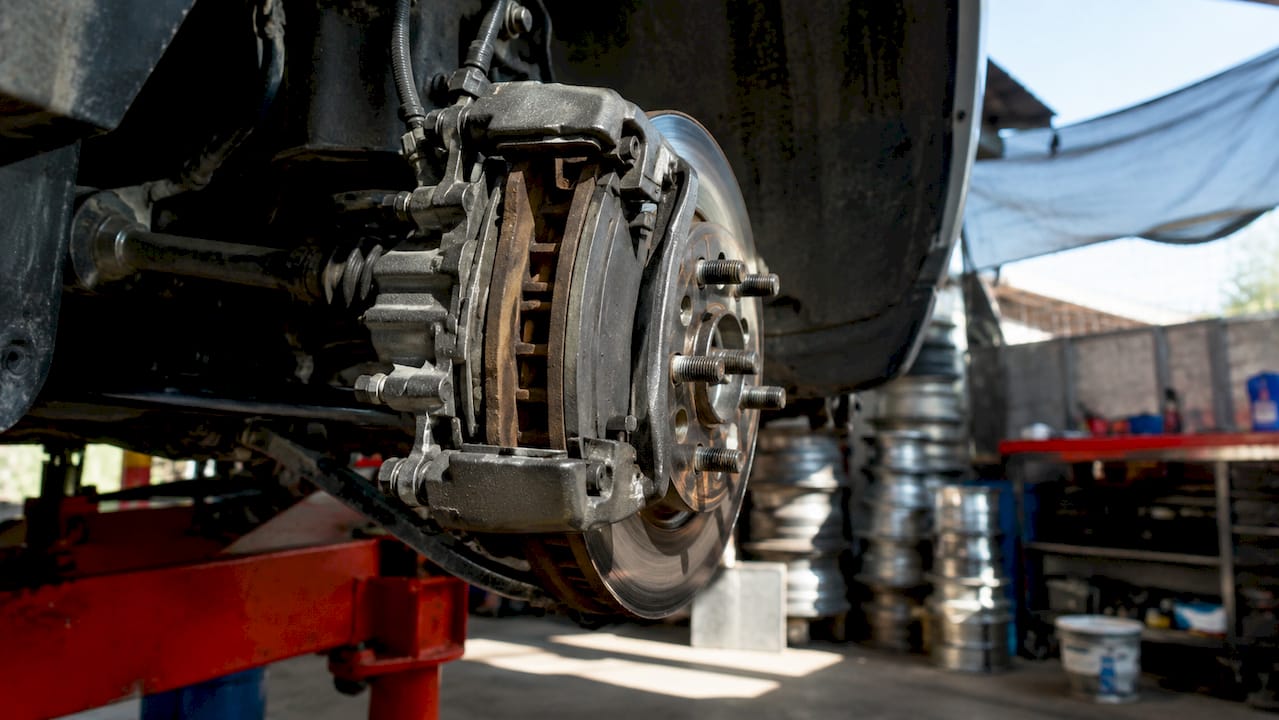
The hydraulic pressure involved is substantial. During hard braking, line pressure typically reaches 60 to 80 bar. That pressure band is engineered to produce a linear, predictable clamping force, which gives drivers consistent pedal feel across a wide range of braking intensities. A caliper operating outside that pressure band, due to a leak or air in the line, produces a spongy or unresponsive pedal.
Heat is the unavoidable byproduct of this process. Every braking event converts kinetic energy into thermal energy at the rotor and pad interface. Calipers must manage that heat load without allowing it to travel back into the brake fluid. Brake caliper pistons are increasingly made of thermally insulating materials, such as phenolic composites, to block heat transfer from the pad to the fluid. If brake fluid absorbs too much heat, it boils and creates vapour pockets that compress under pressure, causing brake fade and a sudden loss of stopping power.
- Pedal depression pressurises the master cylinder
- Fluid travels through brake lines to each caliper
- Pistons extend and clamp pads against the rotor
- Friction converts wheel rotation into heat
- Thermally insulating piston materials protect brake fluid from boiling
Pro Tip: Bleed your brake lines every two years. Moisture accumulates in brake fluid over time, lowering its boiling point and making the system more vulnerable to fade under heavy use.
What are the different types of brake calipers?
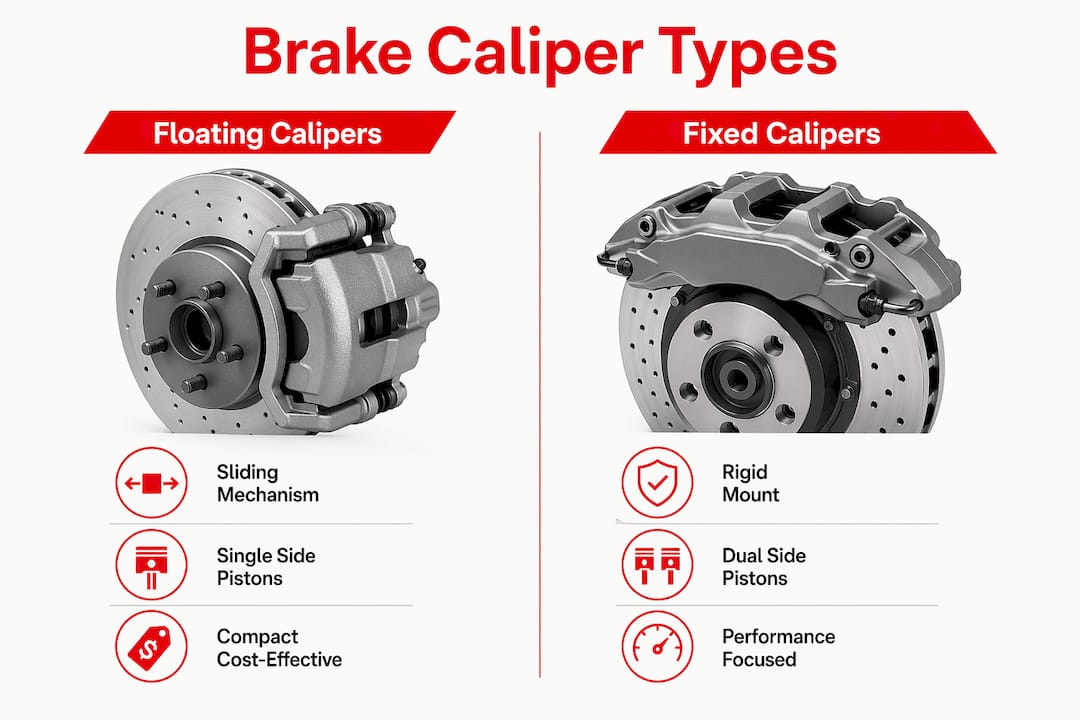
Caliper design falls into two categories: floating (sliding) calipers and fixed calipers. Each type handles the braking task differently, and the choice between them affects pedal feel, pad wear, and overall stopping consistency.
Floating calipers
Passenger cars predominantly use floating calipers because they are compact and cost-effective. A floating caliper has pistons on one side only. When those pistons push the inner pad against the rotor, the caliper body slides along guide pins to pull the outer pad into contact from the other side. The result is a clamping action that uses a single set of pistons to apply force on both pad faces.
The sliding mechanism works well for everyday driving. However, if the guide pins corrode or seize, the caliper body stops moving freely. The outer pad then makes inconsistent contact with the rotor, causing uneven wear, pulling during braking, and reduced stopping power. This is one of the most common caliper failures on passenger vehicles in Canadian winters, where road salt accelerates corrosion.
Fixed calipers
Fixed calipers mount rigidly to the suspension upright and do not slide. They carry pistons on both sides of the rotor, so each side applies force independently and simultaneously. Fixed calipers provide more even brake pad wear, less residual drag torque, and a stiffer pedal feel compared to floating designs. Brembo uses fixed multi-piston calipers on high-performance applications precisely because the simultaneous piston action produces consistent clamping force across the full pad surface.
Fixed calipers are heavier and more expensive to manufacture. That cost is justified on performance vehicles, track cars, and heavy-duty trucks where braking consistency under repeated hard stops is non-negotiable.
| Feature | Floating caliper | Fixed caliper |
|---|---|---|
| Piston arrangement | One side only | Both sides of rotor |
| Common application | Passenger vehicles | Performance and heavy-duty |
| Pedal feel | Softer, progressive | Firm, immediate |
| Pad wear consistency | Moderate | High |
| Weight and cost | Lower | Higher |
| Sensitivity to guide pin wear | High | Not applicable |
Pro Tip: When replacing a floating caliper, always replace the guide pins and boots at the same time. Worn pins are the leading cause of premature pad wear and uneven braking on sliding caliper systems.
Why is caliper design critical for vehicle safety during stopping?
Caliper design determines more than stopping distance. It governs heat management, pad wear consistency, brake fluid integrity, and the balance of braking force between the front and rear axles. Each of these factors directly affects whether a vehicle stops safely or loses control.
-
Heat dissipation. Brake fade occurs when the rotor and pad interface reaches temperatures that reduce friction. Calipers with larger piston bores spread clamping force over a greater pad area, which distributes heat more evenly across the rotor surface. Larger rotors paired with properly sized calipers absorb more thermal energy before fade sets in. A caliper that is undersized for the vehicle's weight forces the pads to work harder, concentrating heat in a smaller area and accelerating fade.
-
Brake fluid temperature. The caliper body sits millimetres from the rotor, which can reach temperatures exceeding 300°C during aggressive braking. Brake calipers must be engineered to manage massive thermal loads by insulating brake fluid from heat to maintain system integrity. If fluid temperature rises above its boiling point, vapour bubbles form in the lines. Those bubbles compress instead of transmitting pressure, and the pedal drops to the floor with no braking force.
-
Even pad and rotor wear. A caliper that applies uneven pressure across the pad face causes the pad to wear at an angle. That angled wear creates a tapered contact patch on the rotor, reducing effective friction area and increasing stopping distance over time. Fixed calipers and properly maintained floating calipers both apply pressure across the full pad width, preserving rotor surface integrity.
-
Front versus rear caliper roles. Front brake calipers handle most of the braking workload due to forward weight transfer during deceleration. When a vehicle brakes, weight shifts to the front axle, increasing the load on the front tyres and requiring greater braking force there. Rear calipers maintain stability and prevent the rear wheels from locking, which would cause the vehicle to spin. Brake systems are engineered with this imbalance in mind, using larger front calipers and rotors to match the workload distribution.
-
Caliper sizing relative to vehicle weight. A heavier vehicle carries more kinetic energy at any given speed. Stopping that energy requires proportionally greater clamping force and heat capacity. Truck and SUV calipers use larger pistons and wider pads to meet this demand. Installing undersized calipers on a heavy vehicle, or failing to upgrade calipers when adding weight, is a direct safety risk.
What are the main brake caliper components?
Understanding caliper anatomy clarifies why each part matters for braking performance. The caliper is not a single block of metal. It is an assembly of several components that each play a specific role in the stopping process.
- Caliper body. The outer housing that contains all other components. It is typically cast from grey iron or aluminium. Aluminium reduces unsprung weight, which improves suspension response and handling.
- Pistons. The hydraulic actuators inside the caliper. When fluid pressure rises, pistons extend and push the brake pads against the rotor. Piston diameter determines how much force is applied for a given hydraulic pressure.
- Brake pads. The friction material that contacts the rotor. Pads are held in the caliper bracket and wear down with use. Pad compound affects both friction coefficient and heat tolerance.
- Guide pins (slide pins). Caliper slide pins allow even sliding movement, ensuring equal pressure application on both brake pads for uniform wear. Seized pins are a frequent cause of one-sided pad wear and brake pull.
- Caliper bracket. The mounting plate that attaches the caliper to the steering knuckle or axle. It holds the brake pads in position and transfers braking torque to the suspension.
- Dust boots and seals. Rubber boots protect the pistons and guide pins from moisture and road debris. Torn boots allow corrosion to enter, which is the primary cause of seized pistons and stuck calipers.
| Component | Function |
|---|---|
| Caliper body | Houses all components; transfers braking torque to suspension |
| Pistons | Convert hydraulic pressure into mechanical clamping force |
| Brake pads | Create friction against rotor surface to slow wheel rotation |
| Guide pins | Allow caliper to slide evenly for consistent pad contact |
| Dust boots and seals | Protect pistons and pins from corrosion and contamination |
Key takeaways
The brake caliper is the single component that converts hydraulic pressure into the mechanical clamping force required to stop a vehicle, making its condition, design, and maintenance directly responsible for stopping distance and driver safety.
| Point | Details |
|---|---|
| Caliper converts pressure to force | Hydraulic pressure from the master cylinder pushes pistons to clamp pads against the rotor. |
| Caliper type affects pedal feel | Fixed calipers deliver firmer, more consistent feedback than floating designs. |
| Heat management is critical | Thermally insulating pistons prevent brake fluid from boiling during heavy use. |
| Front calipers carry the most load | Forward weight transfer during braking places the majority of stopping demand on front calipers. |
| Guide pin condition determines wear | Seized slide pins cause uneven pad wear and brake pull on floating caliper systems. |
Caliper condition is not a maintenance afterthought
Sam here. After years of working with brake systems across a wide range of vehicles, the pattern I see most often is this: drivers replace brake pads on schedule but ignore the caliper hardware entirely. That is a mistake with real consequences.
A fresh set of pads on a caliper with corroded guide pins will wear unevenly within the first few thousand kilometres. The outer pad contacts the rotor at an angle, the inner pad wears faster, and the driver ends up back in the shop well ahead of schedule. Worse, uneven clamping force means the vehicle pulls to one side under braking, which is a handling problem, not just a maintenance one.
The shift toward aluminium caliper bodies and phenolic pistons is genuinely meaningful. Aluminium reduces unsprung weight, which improves how the suspension tracks the road surface during braking. Phenolic pistons block heat transfer far more effectively than steel, keeping fluid temperatures in a safe range during repeated hard stops. These are not marketing details. They are engineering decisions that change how a vehicle behaves at the limit.
The practical advice is straightforward. Inspect caliper boots every time you change pads. Replace guide pins and boots as a set. Check for piston retraction after a long drive. A caliper that does not retract fully drags the pad against the rotor, generating heat and wearing the pad prematurely. None of this requires specialist tools. It requires attention. Brakes are the one system where deferred maintenance has no margin for error.
Readers who want to understand more about how rotor design interacts with caliper performance can find useful context at Crossdrilledrotors.ca.
— Sam
Brake components from a Canadian specialist
Crossdrilledrotors.ca supplies brake rotors engineered to work with the full range of caliper types found on passenger vehicles, performance cars, and trucks across Canada.
The rotors available through Crossdrilledrotors.ca are cross-drilled to manage the heat that calipers generate during repeated stops. Cross-drilling prevents warping by allowing hot gases to escape from the pad-to-rotor interface, which maintains consistent friction and extends rotor life. Pricing is transparent, with no hidden fees, and free shipping applies to orders over $100. Drivers running Ford, Volkswagen, Dodge, or Porsche platforms will find vehicle-specific fitment options. Knowledgeable support is available without automated responses, which matters when you need accurate fitment advice for a specific caliper and rotor combination.
FAQ
What does a brake caliper do?
A brake caliper clamps brake pads against a spinning rotor to create friction that slows and stops the vehicle. It converts hydraulic pressure from the master cylinder into mechanical clamping force.
How much braking torque can a caliper produce?
A well-sized automotive brake caliper can develop 2,000 to 4,000 N·m of braking torque per wheel. That range is sufficient to decelerate a passenger vehicle from highway speed in a controlled, repeatable manner.
What is the difference between a fixed and floating caliper?
Floating calipers slide on guide pins and use pistons on one side only, while fixed calipers mount rigidly and use pistons on both sides of the rotor. Fixed calipers deliver more consistent clamping force and firmer pedal feedback.
Why do brake calipers fail?
Calipers most commonly fail due to corroded or seized guide pins, torn dust boots that allow moisture into the piston bore, or internal seal failure that causes fluid leaks. Regular inspection of boots and pins prevents the majority of caliper failures.
How does caliper condition affect stopping distance?
A caliper with seized pins or a partially stuck piston applies uneven force across the brake pad, reducing the effective friction area in contact with the rotor. That reduced contact directly increases stopping distance and can cause the vehicle to pull to one side under braking.