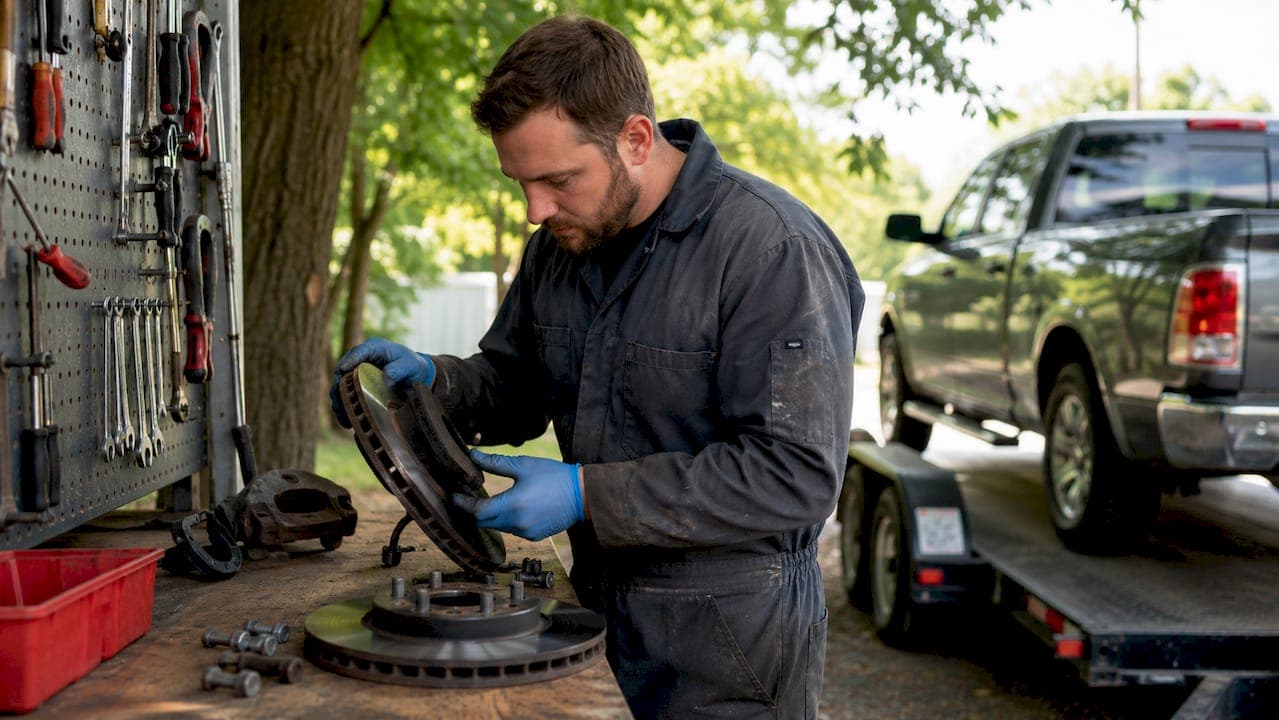
Brake components for towing performance needs are defined as the pads, rotors, lines, fluid, and supplemental systems that maintain consistent stopping power under the thermal and mechanical stress of heavy loads. Standard factory brakes are calibrated for everyday driving, not for the added weight and heat generated by towing a trailer. When towing weight climbs, stopping distances increase sharply, brake fade becomes a real risk, and the margin for error shrinks. Brands like PowerStop and Demco build products specifically for these conditions, and Canadian regulations reinforce why proper brake hardware is non-negotiable for safe towing.
1. What brake components do towing performance needs actually require?
The core towing brake system includes four categories: friction materials (pads), heat-sinking hardware (rotors), hydraulic components (lines and fluid), and supplemental braking systems for the trailer itself. Each category addresses a different failure mode under load. Pads manage friction and heat at the contact surface. Rotors absorb and dissipate that heat into the air. Lines and fluid transmit pedal force without compressing or boiling. Supplemental systems share the braking workload between the tow vehicle and the trailer.
Matching each component to the actual towing load is the most effective strategy. Bigger is not always better if the parts are not balanced with the rest of the system.
2. What are the best brake pads for towing heavy loads?
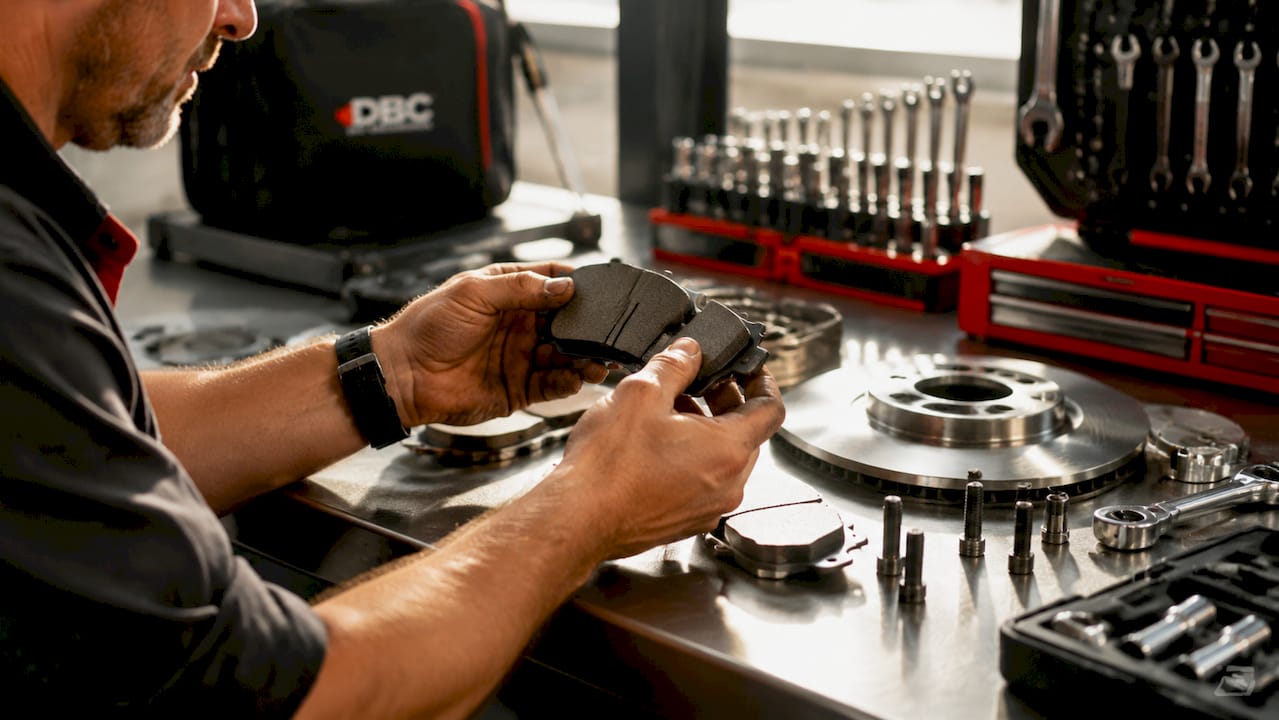
Towing-specific brake pads must withstand repeated high-temperature cycles without losing friction. Heavy-duty brake pads require a shear strength above 5,000 kPa at 300°C to prevent delamination under towing stress, exceeding standard SAE J840 requirements. That threshold matters because a pad that delaminates mid-stop is a pad that has failed entirely.
Three pad compounds dominate towing applications:
- Semimetallic pads offer the highest heat tolerance and bite, making them the standard choice for heavy-duty towing. The trade-off is increased rotor wear and more brake dust.
- Ceramic pads run quieter and cleaner but have a lower heat ceiling. They suit lighter towing loads where temperatures stay moderate.
- Severe-duty compound pads are formulated specifically for temperature cycling performance, maintaining friction consistency better than standard pads across repeated hard stops.
The noise and dust trade-off with semimetallic pads is real but manageable. For towing applications, stopping reliability outweighs cabin comfort.
Pro Tip: Always follow the bed-in procedure for new pads and rotors before your first loaded tow. Skipping this step leaves uneven deposits on the rotor surface, which causes vibration and reduces stopping power under load.
3. Which brake rotor types deliver the best towing performance?
Rotor choice directly affects how well the braking system manages heat during a long descent or a loaded highway stop. Three rotor designs are common: blank (smooth), slotted, and drilled.
Slotted rotors outperform drilled rotors for heavy towing because slots evacuate gas and debris while maintaining structural integrity. Drilled rotors, by contrast, carry a higher risk of cracking under repeated thermal stress. That cracking risk is not theoretical; it is a documented failure mode when rotors cycle through extreme heat repeatedly.
| Rotor type | Heat dissipation | Structural strength | Best use case |
|---|---|---|---|
| Blank | Moderate | Highest | Light daily driving |
| Slotted | High | High | Heavy towing, severe duty |
| Drilled | High | Lower | Street performance, light loads |
| Slotted and drilled | High | Moderate | Mixed street and light towing |
Larger rotor mass also plays a role. A heavier rotor absorbs more thermal energy before temperatures climb into the fade zone. For trucks and SUVs used for towing, upgrading to a larger diameter rotor is one of the most direct ways to extend the time before brake fade sets in.
Pro Tip: DBC Brakes engineers its cross-drilled rotors to resist warping under thermal stress. For towing applications, pair them with slotted variants or choose slotted-only designs to maximise structural durability.
4. How do supplemental braking systems enhance towing safety?
Supplemental braking systems apply the trailer's own brakes in coordination with the tow vehicle, sharing the stopping workload across all axles. Supplemental braking systems reduce stopping distances by 25–45% and are legally required across Canada and in 49 U.S. states when towed weight exceeds thresholds as low as 1,000 lbs. That legal requirement exists because the physics are unambiguous: more mass requires more braking force.
Three system types are available:
- Electronic supplemental braking systems sense deceleration in the tow vehicle and apply the trailer brakes proportionally. Demco produces well-regarded electronic systems with strong warranty coverage.
- Air braking systems are standard on commercial trailers and heavy equipment. They are reliable at scale but require air compressor infrastructure.
- Surge braking systems use hydraulic pressure from the trailer's forward momentum to activate brakes automatically. They are common on boat trailers and require no electrical connection.
Installing a breakaway switch is a critical part of supplemental brake setup and can take up to 45 minutes to complete correctly. A breakaway switch applies the trailer brakes automatically if the trailer separates from the tow vehicle. Skipping this step is both a safety failure and a legal violation in most Canadian provinces.
5. What performance brake upgrades improve towing control?
Beyond pads and rotors, three upgrades make a measurable difference in pedal feel and fade resistance under towing loads.
- Stainless steel braided brake lines. Standard rubber brake lines expand under towing stress, causing a soft, spongy pedal feel. Stainless steel braided lines eliminate that expansion, delivering firmer and more direct brake response. This upgrade is inexpensive relative to its impact on driver confidence.
- High-performance brake fluid. Upgrading from DOT 3 to DOT 4 or DOT 4+ raises the fluid's boiling point, reducing the risk of vapour lock during repeated heavy stops. Vapour lock occurs when fluid boils and compresses, causing the pedal to drop toward the floor.
- Multi-piston calipers. Larger calipers with multiple pistons apply even clamping pressure across the pad surface. Long downhill grades and stop-and-go traffic significantly increase brake heat buildup, and multi-piston calipers help manage this by distributing load more evenly across the rotor.
Pro Tip: Upgrade brake fluid at the same time as pads and rotors. Old fluid absorbs moisture over time, which lowers its boiling point and makes vapour lock more likely under towing conditions.
6. How do braking systems integrate with trailer brake controllers?
A trailer brake controller is the electronic link between the tow vehicle's brake pedal and the trailer's electric brakes. A quality trailer brake controller ensures trailer brakes engage proportionally and smoothly with the tow vehicle's brakes, improving safety and reducing brake wear on both ends. Without a controller, the trailer either brakes too late or not at all.
Two controller types are standard:
- Proportional controllers measure the tow vehicle's actual deceleration and apply the trailer brakes with matching force. This produces the smoothest, most natural braking feel and reduces wear.
- Time-delayed controllers apply a preset braking force after a fixed delay. They are simpler and less expensive but less precise under varying load conditions.
For trailers with high centres of gravity, such as tank trailers or horse trailers, Electronic Braking Systems with Roll Stability Support reduce rollover risk at lateral accelerations of 0.4G. Roll Stability Support detects lateral movement and modulates individual wheel brakes to keep the trailer tracking straight. Anti-lock Braking Systems (ABS) on the trailer prevent wheel lockup on slippery surfaces, which is particularly relevant in Canadian winter conditions.
Brake blending technology in advanced trailers optimises service and endurance braking, extending component life and maintaining consistent braking force across long hauls.
Key takeaways
The most effective towing brake setup combines severe-duty pads, slotted rotors, stainless steel braided lines, high-spec brake fluid, and a proportional supplemental braking system matched to the trailer's weight.
| Point | Details |
|---|---|
| Pad compound matters most | Severe-duty or semimetallic pads maintain friction under heat cycling that standard pads cannot handle. |
| Slotted rotors for towing | Slotted designs dissipate heat without the cracking risk that drilled rotors carry under repeated thermal stress. |
| Supplemental brakes are legal requirements | Canadian law and 49 U.S. states require supplemental braking when towed weight exceeds thresholds as low as 1,000 lbs. |
| Upgrade lines and fluid together | Stainless steel braided lines and DOT 4+ fluid eliminate soft pedal feel and vapour lock risk simultaneously. |
| Proportional controllers outperform time-delayed | Proportional brake controllers match trailer braking to actual deceleration, reducing wear and improving stability. |
Sam's take on what towing owners actually get wrong
Most towing owners upgrade their truck's engine output before they touch the brakes. That is backwards. The brakes are the only system standing between a loaded trailer and a collision, and they are routinely the last thing people spend money on.
The first upgrade I recommend is always the pad compound and rotor combination. Severe-duty pads paired with slotted rotors from a supplier like DBC Brakes address the two most common failure modes: fade from heat and rotor cracking from thermal stress. These are not exotic parts. They are direct replacements that install in an afternoon.
The second investment that gets skipped too often is a supplemental braking system. Owners assume their truck's brakes are enough. They are not, and the law agrees. A Demco electronic system or equivalent proportional controller pays for itself the first time it prevents a rear-end collision on a downhill grade.
Routine maintenance is the part nobody wants to talk about. Brake fluid absorbs moisture over time. Pads wear unevenly if rotors are not replaced at the same time. A proper bed-in procedure after every pad and rotor swap takes 20 minutes and prevents months of vibration and reduced stopping power. The cost of doing this correctly is low. The cost of skipping it is not.
— Sam
Brake upgrades for towing: what DBC Brakes offers
Towing owners in Canada looking for performance brake components have a direct option through DBC Brakes at CrossDrilledRotors.ca. DBC Brakes supplies premium brake kits, cross-drilled and slotted rotors, and severe-duty pad compounds engineered for heavy-duty use.
DBC Brakes ships across Canada with free shipping on orders over $100. Every order is backed by knowledgeable support from real staff, not automated responses. Pricing is transparent with no hidden fees. For Ford truck owners, the Ford Custom brake options page lists rotor and pad combinations matched to specific model years and towing configurations. Whether the setup is a half-ton pulling a boat trailer or a three-quarter-ton hauling livestock, DBC Brakes carries components matched to the load.
FAQ
What brake pads are best for towing heavy loads?
Severe-duty semimetallic pads are the best choice for heavy towing. They maintain friction performance under repeated high-temperature cycles better than ceramic or standard organic pads.
Are supplemental braking systems legally required in Canada?
Supplemental braking systems are legally required across Canada when towed weight exceeds the provincial threshold, which can be as low as 1,000 lbs. Specific limits vary by province.
What is the difference between proportional and time-delayed brake controllers?
Proportional controllers apply trailer brakes based on the tow vehicle's actual deceleration, producing smoother stops and less wear. Time-delayed controllers apply a preset force after a fixed delay, which is less precise under varying load conditions.
Why are slotted rotors better than drilled rotors for towing?
Slotted rotors evacuate heat, gas, and debris without the structural weakening that drilled holes create. Drilled rotors carry a higher risk of cracking under the repeated thermal stress of heavy towing.
How often should brake fluid be changed when towing regularly?
Brake fluid should be inspected at least once per year for towing applications and replaced when moisture contamination lowers its boiling point. Upgrading to DOT 4 or DOT 4+ fluid reduces vapour lock risk during heavy stops.