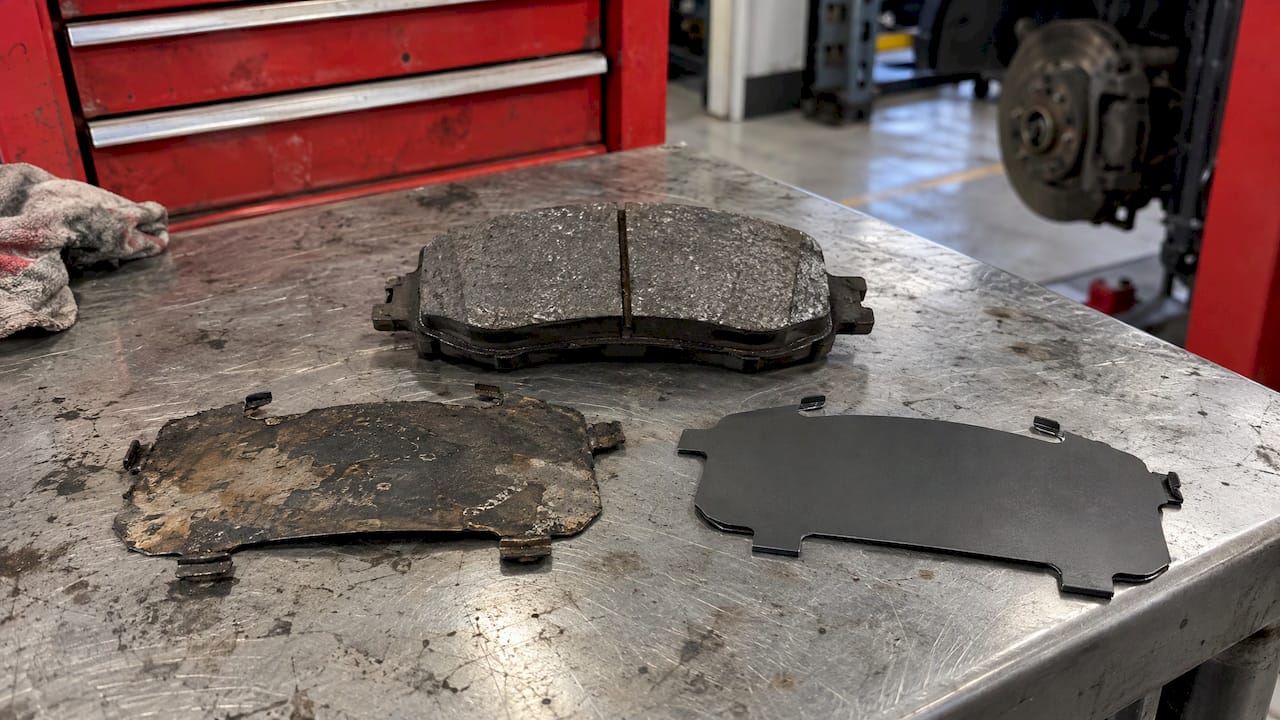
Brake shims should be replaced every time the brake pads are replaced. Reusing old shims is physically possible. It is not recommended. A shim is a layered noise-control part, and it wears out the same way the pad does. New pads fitted with a tired shim leave the noise problem in place.
This guide explains what a shim does, what the manufacturer procedures say, how to inspect a shim, and how to fit new ones. It also covers where lubricant goes and where it never goes. DBC Brakes supplies pads, rotors and brake kits for Canadian vehicles, and some pad listings are sold with a hardware kit.
TL;DR
- Replace shims whenever the pads are replaced. Nissan's service manual for the Sentra gives the same instruction.
- A shim controls noise. It does not control stopping power. A worn shim means squeal and vibration, and a new pad does not fix that.
- Reject any shim that is cracked, rusty, pitted, delaminated, bowed or greasy.
- Apply a thin coat of the specified lubricant to the shim side that faces the caliper piston or housing. Keep all grease off the pad friction surface and the rotor.
- Buy pads with the hardware included so the whole set is replaced in one job.
Table of Contents
- What a brake shim does
- Can you reuse brake shims?
- How to inspect a shim if it is already off the car
- When the question comes up in practice
- How to fit new shims
- Lubricant: where it goes and where it never goes
- Worked example: a daily driver pad change
- Performance brakes and shims
- Order the full set in one place
- FAQ
- Sources
What a brake shim does
A brake shim is a thin layered plate that sits between the back of the brake pad and the caliper piston or caliper housing. Many shims are made of steel with a rubber or plastic layer. Some are bonded to the pad at the factory.
The shim is not a spacer. It is not cosmetic either. According to Brake & Frontend, the damping material in the layered construction stops vibration at the pad and rotor from passing into the caliper and steering knuckle. The same article notes that a shim that does not make contact with the pad cannot do its job. It also notes that corrosion can make a shim fail and separate into layers.
That is why the shim matters to anyone who wants quiet brakes. Pad compound, rotor finish and caliper condition decide how the brake performs. The shim decides how much of the resulting vibration reaches the rest of the car as sound.
Can you reuse brake shims?
The short answer is no. The reasons are listed below.
What manufacturers say
The Nissan Sentra service manual tells technicians to always replace the shims and shim covers when the brake pad is replaced. UnderhoodService's Corolla brake job guide gives the same direction. Note where all four shims and clips sit before removal, then install new pads and do not reuse the old shims.
The rule is consistent. The shim and the pad are treated as one set.
Why used shims fail
Two things happen to a shim in service.
- Force. A trade article in Tech Shop Magazine reports that a shim sees over 2,000 lbs of force in an average pedal application. Over the life of a pad set, that load can distort the layered metal and rubber or plastic construction.
- Heat, moisture and road salt. Canadian winters add salt and moisture. Corrosion on the steel layer can lift the rubber bond, which is the separation described above.
A UK service centre's shim installation guide says reusing old shims is technically possible but strongly advised against. The damping material degrades or compresses with use. The same guide says a car can be driven without shims, and that the result is more noise, because shims are not critical to stopping power.
That last point deserves a plain reading. Missing or worn shims do not mean the brakes stop working. They mean the brakes are likely to squeal, chatter or groan. For a daily driver, that is a nuisance and a sign the job was not finished. For an enthusiast fitting upgraded pads and rotors, it is a reason to complete the job with every part new.
The cost argument
Shims cost little compared with pads, rotors or labour. Reusing them to save money risks a repeat visit to take the wheel off again. A brake job that has to be redone because of noise costs more than the shims did. Budget the shims into the job from the start.
How to inspect a shim if it is already off the car
Inspection is useful for one reason: it shows what the old shim looked like. A shim that looks bad confirms the replacement. A shim that looks fine is still replaced, but the check still teaches something about the brake.
Lay the shim on a flat surface and check each point below.
| Check | What a bad shim looks like |
|---|---|
| Rubber or coating layer | Cracks, tears or missing sections |
| Steel surface | Rust, pitting or rust lifting the coating |
| Layers | Separation or delamination |
| Adhesive | Loss of bond to the pad backing plate |
| Thickness | Visible thinning from wear |
| Contact spot | A shiny worn patch where the piston touched, with the damping layer gone |
| Shape | Warped or bowed instead of flat |
| Surface | Greasy or contaminated |
These reject conditions come from hardware inspection guides, including Carsparecare's pad change checklist and BoltWiki's shim failure guide. The BoltWiki guide also states that no service interval exists for shims alone. The recommendation is to replace them each time the pads are replaced.
Inspect the whole hardware set
A shim is one part of a system. Clips, pins and shims all leave a weak point when they age. A tired clip, a dry slide pin and a rusty shim can each bring back squeal, drag or uneven wear, even with new pads fitted. Replace the hardware as a group. DBC explains the clip side of this in brake pad clips: what they are and how to install them, and covers the wider set in the role of brake hardware kits.
When the question comes up in practice
The question usually arrives in one of three situations.

New pads came with new shims. Use the new ones. Discard the old ones. Some pads have the shim already bonded to the back, so there is nothing to transfer.
New pads came without shims. Fit new shims made for the vehicle. Do not move the old shims over to the new pads. Check what the pad listing includes before the order is placed. Pad sets sold with a hardware kit, such as the Rear Carbon Performance Brake Pads with hardware kit, keep the job to one order.
A shim was missing when the wheel came off. A forum thread is not a reason to drive without it. The car will still stop, as the shim guide above notes, but the noise is likely to continue. Fit a new shim.
If the old pads are being refitted after a caliper repair, the pads and shims are still a matched set. Their condition decides what happens next. Pads at the end of their life are replaced. The signs are covered in what brake pad wear tells you.
How to fit new shims
Follow the vehicle's service manual for torque values and the lubricant it specifies. The steps below are the general order.
- Record the layout. Photograph the shim, clip and pad positions before removal. Note which side each shim faces.
- Remove the old pads and shims. Take out all the old hardware that is being replaced.
- Clean the contact areas. Remove rust and dirt from the caliper bracket and the places where the hardware sits. Brake dust is a respiratory irritant, so clean it safely. A guide on removing brake dust safely covers wheel cleaning and dwell time.
- Apply lubricant where specified. Do this only on the shim type and areas the manufacturer names. See the next section.
- Fit the new shim to the new pad. Make sure it sits flat and is secured. A shim that is not in contact with the pad cannot do its job.
- Install the pad and check movement. The pad must slide freely in its clips.
- Pump the pedal and bed in the pads. The pedal must feel firm before the car moves. Follow the bedding steps for the pad. Technician-level rules are in sand or replace glazed brake pads.
For the full wheel-off sequence, see brake kit installation step by step.
Lubricant: where it goes and where it never goes
Lubricant is the second half of a quiet shim job. The correct place is set by the manufacturer. As an example, Honda's CR-V front brake procedure, as reproduced on an owner reference site, says to apply a thin coat of assembly paste to the pad side of the shims and to the back of the brake pads. It says to wipe off excess. It also says to keep grease and paste off the disc and pads, because contamination reduces stopping ability.
The safety rule is the same on every car:
- Lubricant goes on metal contact points the manual names.
- Lubricant never goes on the friction surface of the pad.
- Lubricant never goes on the rotor face.
- Excess is wiped off before the wheel goes on.
A greasy shim is also a reject condition, so a shim that picked up grease from a past job is replaced. DBC's guide to applying brake grease shows the placement point by point.
If a noise starts after a job, a checklist helps. The usual causes are in fixing new brake noise. Pad and rotor pairing is covered in matching pads and rotors. For readers who want a sense of how noise relates to pad design, there is also the brake noise and performance trade-off and pad chamfers and slots.
Worked example: a daily driver pad change
A driver has a compact sedan with worn front pads. The old shims show rust at the edges and a shiny patch where the piston pressed.
- The rust and the worn patch are two reject conditions on the table above.
- The new pad set is ordered with a hardware kit, so the clips and shims arrive together.
- The driver notes the layout, cleans the bracket, applies the specified paste to the shim side only and fits the new set.
- The result is one job with every wear part new.
The alternative is to transfer the old shims onto new pads. That puts a worn damping layer behind a new friction surface. The likely outcome is the noise the job was meant to remove.
Performance brakes and shims
Cross-drilled rotors and performance pads see more heat and harder stops than stock parts. Shims on those setups face the same force and corrosion that standard shims do. The same rule applies: new pads get new shims. A performance pad on a worn shim does not give the quiet, even feel the upgrade is for.
For trucks, work vehicles and performance cars, the pad, rotor and hardware are best chosen together. Choose a fitment by vehicle make, model and year so the parts match.
Our view on shims and brake jobs
We treat the pad, the shim, the clips and the rotor as one system. When one of them is old, the new parts around it do not get the full result.
That is why we sell DBC pads with a hardware kit on listed products, and why our brake kits are built around a matched set of rotors and pads for each vehicle. DBC is a Canadian manufacturer. Our rotors are cross-drilled and engineered to prevent warping and add durability. Our fitment is guaranteed for the vehicle chosen.
Customers get knowledgeable support, not automated replies. If a shim question comes up during an order, ask us before the job starts. Pricing is inclusive, with no hidden fees.
Sam
Order the full set in one place
DBC sells brake kits, rotors, pads and wheel bearings for cars, trucks and performance vehicles, made and supported in Canada. Pads listed with a hardware kit let the full set arrive together.
Browse brake pads, brake kits or the full collections page. Orders over $100 ship free within Canada. Expedited shipping is $29.99 per order. International shipping is $129.99 per brake kit. Details are on the shipping information page.
FAQ
Can you reuse brake shims on the same pads?
The shim and pad are replaced as a set, so the usual practice is to fit new shims with new pads. The Nissan Sentra manual states that shims and shim covers are always replaced with the pad. If the old pads are being refitted after other work, inspect the shims for cracks, rust, delamination, bowing and grease before anything else.
Is it safe to drive without brake shims?
Stopping power does not depend on the shim, according to the UK service guide. The result of a missing shim is more noise. Fitting a new shim is the correct repair. Anyone who feels a soft pedal, pulling or grinding should have the brakes checked by a qualified technician before driving.
Should brake shims be greased?
Only where the vehicle manufacturer says so, and only in a thin coat. Honda's CR-V procedure puts assembly paste on the pad side of the shims and the back of the pad, then calls for excess to be wiped off. Grease on the rotor or pad friction surface reduces stopping ability.
How often do shims need replacing?
Shims have no separate service interval. The common rule is to replace them each time the pads are replaced. The BoltWiki shim guide gives the same advice.
Sources
- Nissan Sentra Service Manual: Front disc brake removal
- Brake Shim Installation Guide, Willand Service Centre
- 10 Brake Comeback Solutions, Tech Shop Magazine
- Brake Shims: Don't Judge A Book By Its Cover, Brake & Frontend
- Tech Feature: Brake Job on 2004-2008 Toyota Corolla, UnderhoodService
- Honda CR-V Front Brake, Conventional Brake Components
- How to check brake hardware during a pad change safely, Carsparecare
- Brake Pad Shims: Failure Signs and How to Check Them, BoltWiki
- Remove Brake Dust Safely with 2 to 5 Minute Dwell