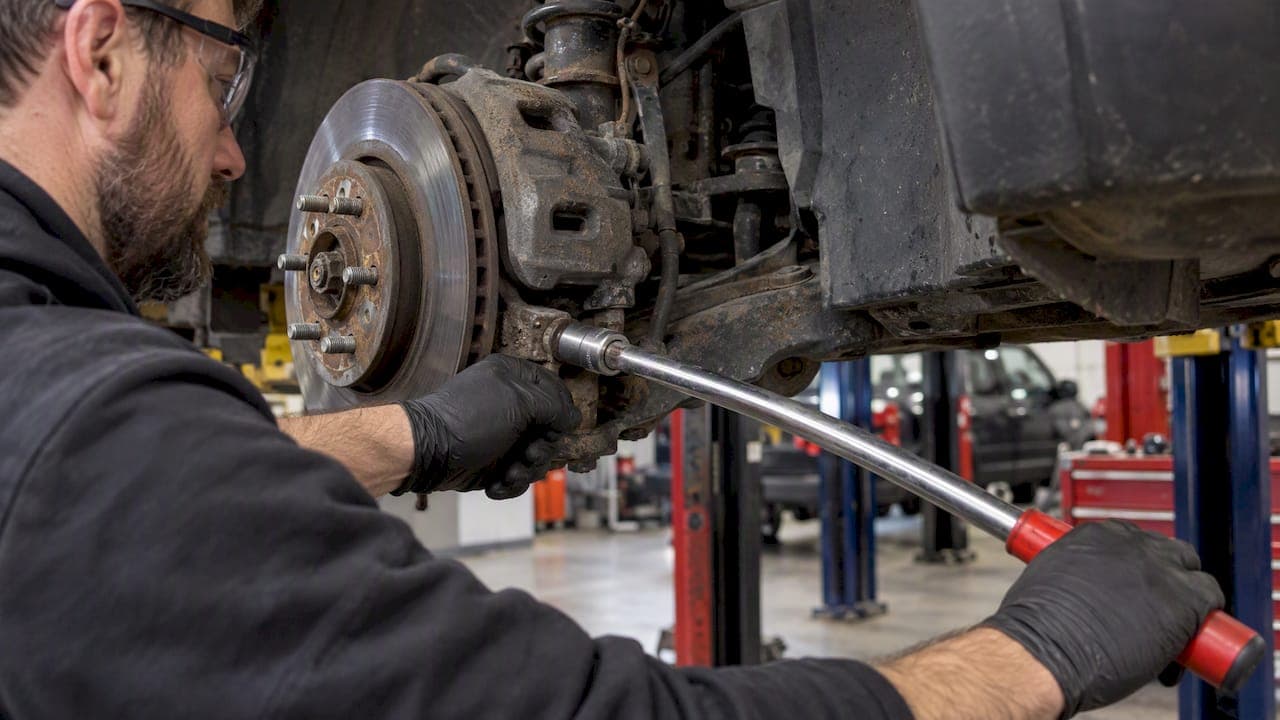
Seized caliper bolts come loose with a set order of steps: clean the threads, soak them in penetrating oil, use a 6-point socket on a long breaker bar, add shock, and use heat only as a last controlled step. Skip ahead to heat or an impact gun and the bolt head rounds or the bolt snaps. This guide covers each step, what to do if the bolt is rounded or broken, and what to check before the caliper goes back on.
TL;DR
- Identify the bolt first: slide pin bolts hold the caliper to the bracket, and bracket bolts hold the bracket to the knuckle. Each needs different handling.
- Clean, then soak with penetrating oil. Heavily rusted bolts may need an overnight soak or several days of daily applications.
- Use a 6-point socket and a long breaker bar. Apply a small tightening turn first, then loosen with steady force.
- Heat the surrounding metal, not the bolt head. Keep flame away from rubber boots and seals.
- Replace damaged bolts. Torque new ones to the vehicle's specification.
Table of Contents
- Which bolt is stuck?
- Why caliper bolts seize
- Tools and safety before starting
- Step-by-step: removing a seized caliper bolt
- Penetrating oil: is WD-40 enough?
- When the bolt is rounded, spinning or broken
- Slide pins that will not budge
- What we see at DBC
- Inspect before reassembly
- When a part needs replacing
- Replacement brake parts from DBC
- FAQ
- Sources
Which bolt is stuck?
Two sets of fasteners sit on a typical floating caliper. Misidentifying them wastes time and risks damage.
- Caliper guide (slide pin) bolts. These hold the caliper body to the bracket. They are removed to swing the caliper off the rotor during a pad change.
- Caliper bracket (carrier) bolts. These hold the bracket to the steering knuckle. They are removed to take off the bracket, usually for a rotor change. They are larger and torqued higher.
Slide pin problems often show before removal. Torn boots let in salt and water, and the symptoms are uneven pad wear, brake imbalance and a wheel rim that runs hot on one corner, according to a guide on caliper guide pins, bushings and bolts. The same source advises checking guide pins at every pad change and after winter.
If the vehicle pulls to one side or the pads wear unevenly, read uneven braking: what drivers must check and how to fix it and caliper problems: signs, causes, and fixes before starting.
Why caliper bolts seize
Common causes of a seized bracket bolt are corrosion, old thread locker, road salt, heat cycles, poor earlier service, and a tool that was not seated squarely, according to a fleet technician guide to seized bracket bolts.
Canadian conditions add to the list. Winter road salt and brine sit on the knuckle and bolt heads for months. Brake heat then bakes the corrosion in. A vehicle that has never had a wheel off in eight or ten winters is the usual case for a bolt that will not move.
Rust on the rotor and hub area is a sign the same corrosion is at work on the fasteners. See rust on brake rotors: causes, fixes, and prevention.
Tools and safety before starting
Gather these items:
- 6-point sockets in the correct size. Twelve-point sockets round off a corroded head more easily.
- A long breaker bar, ideally half-inch drive.
- Penetrating oil.
- A wire brush.
- A hammer.
- Gloves and eye protection.
- Jack stands.
- New bolts, or a hardware kit, for reassembly.
The fleet technician guide lists a six-point socket, breaker bar, penetrating oil, wire brush and eye protection as the core kit.
Safety rules:
- Work on flat ground.
- Support the vehicle on stands, never on a jack alone.
- Wear gloves and eye protection. Rust flakes, oil spray and slipped wrenches all injure eyes and knuckles.
- Never hang the caliper by its brake hose. Support it with wire or a bungee.
- Brakes are a safety system. If the job exceeds the tools or skill available, take the vehicle to a licensed mechanic.
Step-by-step: removing a seized caliper bolt
Step 1: Clean the bolt
Wire brush the head and any exposed threads. Clear dirt out of the hex so the socket seats fully. A socket that sits only partway is the main reason heads round off.
Step 2: Soak with penetrating oil
Spray the head and the exposed threads. Wait. Time does most of the work.
Soak times:
- Light rust: 15 to 30 minutes, reapplying once.
- Heavy rust: overnight.
- Very heavy rust: daily applications over several days. A Driving.ca column on seized fasteners notes that oils work best when given time and that spraying daily for several days beforehand makes removal easier.
The same rule applies to stuck rotors. See the soak method for stuck rotors.
Step 3: Seat the socket and tighten slightly
Place the 6-point socket fully on the head. Push it on by hand. Then apply a small tightening force before loosening. The Driving.ca column says a slight tightening force can sometimes break the rust bond.
Use a small movement only. Do not force the bolt tighter.
Step 4: Loosen with steady force
Place the breaker bar so that force is applied in a straight line and the socket stays square to the bolt. Pull smoothly. Jerking increases the chance of rounding the head.
Caliper bolts are normally standard right-hand thread, so counterclockwise loosens them. Check the service manual for the specific vehicle if there is any doubt.
Step 5: Add shock
If the bolt does not move, tap the head of the bolt with a hammer while keeping the socket and breaker bar in place. Shock helps the oil creep into the threads. Vibration or an impact tool is also suggested in the Driving.ca column.
An impact wrench works well on bracket bolts when the bit seats properly. It is often not an option on slide pin bolts, where access is tight.
Step 6: Use controlled heat
Heat is the last resort, not the first. Follow these rules:
- Do not heat the bolt head directly. A Hagerty article on heating fasteners warns that this can stretch a long bolt with deep engagement until it snaps.
- Heat the surrounding metal, the bracket or knuckle ear, so it expands away from the bolt.
- Keep heat away from rubber boots, brake hoses, ABS wiring, CV joint boots and the wheel bearing seal.
- Use short bursts, then try the bolt again. Repeat as needed.
- Do not heat anything near brake fluid or a leaking line.
A magnetic induction heater is a flameless option. The Driving.ca column describes it as heating a fastener while protecting nearby plastic and rubber parts.
Never heat a caliper that still holds fluid next to a rubber piston seal. If the surrounding parts are sensitive, remove the caliper first or use induction heat.
Penetrating oil: is WD-40 enough?
The answer depends on the product. WD-40's own FAQ says its Multi-Use Product may help loosen seized brake components during maintenance, but it must be kept off friction materials and components must be cleaned thoroughly afterward. The same page says WD-40 Specialist Penetrant Spray is made to loosen seized bolts. See the WD-40 FAQ.
In practice:
| Situation | Product choice |
|---|---|
| Light surface rust, short soak | General-purpose spray can help |
| Heavy rust, long-neglected bolt | A dedicated penetrating oil |
| Any spray near pads or rotors | Keep it off friction surfaces and clean the parts afterward |
Oil on pads or rotor faces reduces braking. Spray the bolt only, shield the rotor with a rag, and clean the area with brake cleaner before reassembly. Replace any pad that has been soaked in oil.
When the bolt is rounded, spinning or broken
Rounded head
Switch to a bolt-extractor socket or locking pliers. These grip a damaged head where a normal socket slips. A UK workshop guide lists both tools for rounded bolts in its stripped or seized caliper bolt guide. Hammer the extractor socket on so it bites, then turn slowly.

Spinning bolt
A bolt that turns without backing out may be stripped in the threads or may be turning together with a seized sleeve. Stop. Pushing harder can damage the knuckle. Inspect the bracket and the slide pin sleeve. A spinning bracket bolt in the knuckle is a job for a shop, since the knuckle threads may need repair.
Broken bolt
The same guide describes drilling a pilot hole and using a screw extractor, or drilling and re-tapping the hole. Drill straight and centred. An off-centre drill damages the threads and may need a repair insert or a new knuckle. If there is any doubt, a machine shop or mechanic is the safer route.
Slide pins that will not budge
A seized slide pin can lock the caliper on the bracket so it cannot float. The caliper then drags or applies unevenly. If the pin is stuck inside the bushing, soak it, tap lightly with a hammer, and twist while pulling. Replace torn boots and rusted pins. Reusing a corroded pin brings the same problem back within a season.
If the piston itself is stuck, a different procedure applies. See freeing a stuck brake caliper piston.
What we see at DBC
We sell brake rotors, pads and kits to Canadian drivers, and the same pattern comes up again and again. Most seized bolt jobs start as a simple pad or rotor swap. The bolt that will not turn then adds hours and parts.
Three points from our side of the counter:
- Time costs less than force. A bolt soaked overnight comes out more cleanly than one attacked in a rush. Most rounded heads begin with a socket that was not seated or a bar that was jerked.
- Replace the cheap parts. Bolts, slide pins, boots and clips cost little compared with a rounded knuckle or a rotor change done twice. A brake hardware kit covers the small parts that corrode first.
- Do the brake job as one job. If the caliper bolts are seized, the rotors and pads are probably tired too. Replace the whole set in one pass so the wheel only comes off once.
A simple rule applies to a bolt that cost an hour and still will not move: stop, soak again, and come back. A snapped bolt costs more than the wait.
— Sam
Inspect before reassembly
Once the bolts are out, check these parts:
- Bolt threads and head. Replace bolts with damaged threads, stretched shanks or rounded heads.
- Bracket and knuckle threads. Clean them with a wire brush or a thread chaser. Dirty threads give false torque readings.
- Slide pins and bushings. The pins should move freely and the boots should be intact.
- Pad wear pattern. Uneven wear points to a sticking caliper. See what brake pad wear tells you.
- Rotor condition. Heat marks or lips on one side suggest a dragging caliper.
Torque and thread locker
Use the torque specification for the exact vehicle, not a general figure. Specifications differ by make, model and bolt position. As one example, a Honda service document specifies that a brake caliper mounting ALOC bolt must be replaced with a new one and tightened to 30 N·m. See the Honda service information. That figure applies to that part only.
Our guide to caliper bolt torque by VIN shows how to find the right figure for a given vehicle. Where the manufacturer specifies a new bolt, a thread-locking patch or a particular thread locker, follow it.
After reassembly:
- Pump the brake pedal until it is firm before moving the vehicle.
- Check that the wheel spins freely.
- Do a low-speed test in a safe area.
- Re-check the bolt torque after the first drive.
When a part needs replacing
Replace the caliper or bracket when:
- The bolt hole threads are stripped and cannot be repaired.
- The bracket is cracked or heavily pitted.
- The piston leaks fluid or will not retract.
- The slide pin bores are corroded beyond cleaning.
For performance vehicles, caliper layout matters when upgrading. See brake caliper types for performance vehicles.
Replacement brake parts from DBC
When the bolts are out, the rotors and pads are in reach. DBC is a Canadian manufacturer of cross-drilled rotors and brake kits for cars, trucks and performance vehicles. Pricing is inclusive with no hidden fees, and orders over $100 ship free in Canada. Expedited shipping is $29.99 per order. Details are on the shipping information page.
Options:
- Brake kits for a full replacement.
- Front brake rotors and rear brake rotors.
- Brake pads.
- Wheel bearings and hubs, if the wheel was noisy before the job. See the wheel bearing versus brake noise checks.
Select the vehicle by make, model and year to confirm fitment.
FAQ
Can WD-40 be used on caliper bolts?
Yes, with limits. WD-40 says its Multi-Use Product may help loosen seized brake components, as long as it stays off friction materials and the parts are cleaned thoroughly. For heavily rusted bolts, a dedicated penetrating oil is the stronger choice. Keep all sprays off pads and rotor faces.
Are caliper bolts reverse threaded?
Caliper bolts are normally standard threads, so counterclockwise loosens them. Check the service manual for the specific vehicle. A bolt that feels like it only tightens usually means the socket is turning the wrong way or the bolt is seized, not that the thread is reversed.
How long should penetrating oil soak?
Light rust needs 15 to 30 minutes. Heavy rust is best soaked overnight, and very stubborn bolts can be sprayed daily for several days. Reapply before each attempt and clean off excess oil before using a wrench.
Is it safe to use a torch on a caliper bolt?
A torch is risky. Heat can stretch a bolt, and flame can damage rubber boots, hoses and seals nearby. Heat the metal around the bolt in short bursts, not the head. A heat gun or induction heater is safer near brake components.
What if the bolt head is rounded?
Use a bolt-extractor socket or locking pliers. If the bolt breaks, drilling a pilot hole and using a screw extractor is the usual route, and re-tapping may follow. A mechanic should handle damage to the knuckle threads.
Sources
- Seized Caliper Bracket Bolt Causes and How to Free Them
- Caliper Guide Pin, Bushing and Bolt: Faults, Repair, Care
- Corner Wrench: Fighting seized fasteners, Driving.ca
- The Fire Wrench, Hagerty Media
- WD-40 FAQ
- Stripped or Seized Caliper Bolts removal guide
- Honda service information