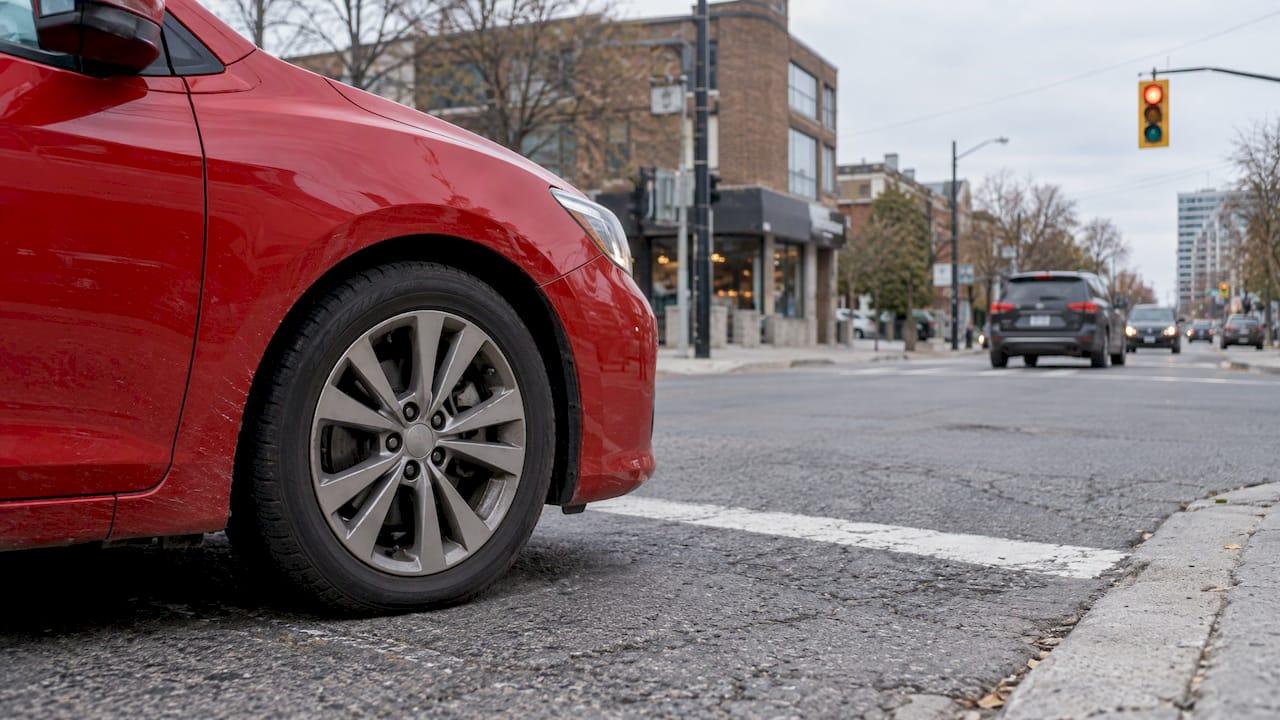
City driving wears brakes faster than highway driving. Every red light, merge and traffic jam is another pedal application, and each one turns motion into heat in the pads and rotors. Pad life in Canada varies widely with route and habits. Regular inspection, smooth braking and parts matched to the vehicle keep stopping power consistent. This guide covers why city use is hard on brakes, what wear looks like, what can be checked at home, and when an upgrade makes sense for a daily driver.
TL;DR
- Stop-and-go driving means more brake applications per kilometre, so pads and rotors wear faster than on open highway.
- Pad life depends on route and braking style more than on odometer reading alone. Ranges of 30,000 to 70,000 km are commonly quoted.
- Soft pedal, noise, vibration, pulling and warning lights call for an inspection. A full inspection needs the wheels off.
- Early braking and larger following gaps reduce wear at no cost.
- Daily drivers can upgrade to cross-drilled rotors and performance pads. Fitment, wheel clearance and the driving pattern decide the right kit.
Table of Contents
- Why city driving is hard on brakes
- How long pads and rotors last in the city
- Signs the brakes need attention
- What can be checked at home
- Driving habits that cut brake wear
- Can performance brakes suit a daily driver?
- Cross-drilled rotors for stop-and-go use
- Brake kits from a Canadian manufacturer
- A simple maintenance schedule for city drivers
- FAQ
- Sources
Why city driving is hard on brakes
A brake system slows a vehicle by pressing pads against rotors. Friction converts speed into heat. The more often that happens, the faster friction material and rotor surfaces wear.
Highway driving involves long periods of steady speed with few stops. City driving is the opposite: short distances between lights, frequent slowing and repeated full stops. The Big Insurance Group states that stop-and-go urban driving may wear pads faster than highway driving. It adds that hilly terrain and winter conditions also increase wear.

The odometer does not tell the whole story. Driving.ca reports that some drivers pass 75,000 km on a set of pads while others do not reach 40,000 km. It attributes the gap largely to route and braking frequency. A 20-km-each-way highway commute can involve very little braking. Stop-and-start urban driving involves a great deal.
What increases wear in Canadian cities
- Dense traffic and short trips. More stops per kilometre. Short trips also mean the brakes rarely reach a steady operating state.
- Hills. Long descents add heat. Cities with steep streets add load on top of the stop-and-go pattern.
- Winter. Cold, wet and salted roads are part of the wear picture in most of the country, as noted by The Big Insurance Group.
- Heavy vehicles. Trucks and SUVs carry more momentum into every stop.
- Late, hard braking. Hard stops use more of the brake's capacity than gradual ones.
How long pads and rotors last in the city
No single number fits every vehicle. Published ranges are guides only.
| Source | Pad life range | Notes |
|---|---|---|
| The Big Insurance Group | About 30,000 to 70,000 km (18,000 to 43,000 miles) | Urban driving, hills and winter may shorten life |
| Driving.ca | Under 40,000 km to over 75,000 km | Route and braking frequency explain the spread |
Rotors usually outlast pads, but they wear too. Rotors can develop rough spots, cracks, grooves or warping, and these are checked at inspection. When pads are replaced, rotor condition is the next thing to look at. The guide on replacing rotors without pads covers which measurements to ask for.
Driving.ca recommends a brake inspection at least once, and preferably twice, per year. It also recommends cleaning and lubricating the caliper slides as needed. City drivers fall at the high end of that advice.
Signs the brakes need attention
Brakes usually give notice before a failure. Ford Canada lists these signs as reasons to inspect:
- A soft or squishy brake pedal
- The brake warning light
- Steering-wheel vibration when braking
- Squealing or grinding sounds
- A burning smell
- Metallic flakes
- Deep gouges or scratches on the rotors
Mitsubishi Motors Canada adds longer pedal travel and longer stopping distance. It also says pads need replacing once they get thin, typically down to a few millimetres, even before braking feels different.
Pulling to one side under braking is another sign. Transport Canada lists pulling, a change in pedal feel and unusual squealing or grinding as the things to look for in a brake check.
Quick reference
| Symptom | Possible meaning | Next step |
|---|---|---|
| Squealing | Pads wearing thin | Book an inspection |
| Grinding | Pad material may be gone | Inspect promptly |
| Vibration in pedal or wheel | Rotor surface issue | Inspect rotors |
| Soft pedal | Hydraulic or fluid concern | Inspect promptly |
| Pulling to one side | Uneven braking | Inspect the system |
| Warning light | System fault or low pads | Inspect promptly |
A soft pedal or a warning light should be looked at by a technician rather than waited out.
What can be checked at home
A visual check is a screening step, not an inspection. ALLDATA says that a complete inspection requires removing the wheels and checking every component. A quick look is not a substitute before a long trip.
With open-spoke wheels, the rotor face and the outer pad can often be seen without touching anything. Steps:
- Park on level ground with the engine off and the brakes cool.
- Look through the wheel spokes at the rotor surface. Deep grooves, or rotors that look blue or dark gold, call for a complete inspection, per ALLDATA.
- Look at the outer pad. Friction material about as thin as the backing plate, or thinner, suggests replacement. The inner pad can wear differently, and a definitive measurement needs the wheel off and the manufacturer's specification.
- Do not touch the calipers or rotors.
Brake dust on the wheel makes the check easier. Guidance on removing brake dust from wheels explains how to clean it safely with a short dwell time, so the rotor and pad can be seen clearly.
Transport Canada recommends a licensed facility for brake checks, because newer vehicle systems may need professional checking. It also says a trained technician's inspection helps make sure important items are not missed. More on this is in the guide to why regular brake inspections matter.
Driving habits that cut brake wear
Brake life is partly a driving-habit question. These habits cost nothing:
- Look ahead. Watching signals and traffic two or three vehicles ahead allows early, gradual slowing.
- Lift off the accelerator early. Coasting scrubs speed without the pedal.
- Keep a larger following gap. A bigger gap means fewer sudden stops.
- Do not race to a red light. Arriving at a red at speed forces a hard stop.
- Remove unneeded load. Less weight means less energy to absorb.
- Keep the tyres in good condition. Brakes can only stop the vehicle as well as the tyres grip. The guide to three quick tyre checks lists what to look at.
On long descents, such as mountain routes, the pedal can feel different when the brakes overheat. The guide on brake fade causes covers downshifting, pad bedding and fluid.
Can performance brakes suit a daily driver?
Yes, when the parts are matched to the vehicle and the driving. A performance kit is not only for track use. City drivers who want firmer pedal response, consistent stopping and parts built for repeated use have good reasons to look at one.
Some considerations apply to any brake upgrade. Jalopnik reports that larger brake kits can improve heat capacity and fade resistance during prolonged braking, which helps drivers who brake for extended downhill stretches. It also notes that larger kits may need larger or differently offset wheels. The practical point is to confirm wheel clearance before ordering a big kit.
What to check before choosing a kit
- Vehicle fitment. Make, model, year and trim set the rotor and pad size. Use the vehicle selector, such as the make page, to find parts listed for the vehicle.
- Wheel size. Larger rotors and calipers need wheel clearance. Stock-diameter rotors and pads normally fit behind stock wheels.
- Driving pattern. Stop-and-go city use, hills, towing and winter each call for different priorities. Daily-use parts should perform well from the first stop of the day.
- Front, rear or both. The front axle does most of the braking, but a matched set of pads and rotors keeps the system balanced.
- Fluid and supporting parts. Pads and rotors work with fresh fluid, healthy bearings and hardware. See the brake fluid guide and the notes on common upgrade mistakes.
- Street use versus track use. Parts for the street suit cold starts and short trips. The article on why track vehicles need different street brakes explains the difference.
The article on what a brake upgrade feels like sets realistic expectations for pedal feel after an upgrade. For a view of where to spend, see the brake parts worth splurging on.
Cross-drilled rotors for stop-and-go use
Cross-drilled rotors have holes drilled through the friction surface. DBC designs its cross-drilled rotors to resist warping and to last, and offers them for cars, trucks and performance vehicles. The range includes three lines: Performance XDB, Premium Black Kote and Performance SS. Rotors, pads, kits and wheel bearings and hubs are available by category.

For a city vehicle, a matched set matters more than any one part. New pads on worn rotors, or new rotors with old pads, leave the system uneven. Kits that pair rotors with pads and a hardware kit remove that problem. Examples on the site include the front black XD rotors and a front and rear cross-drilled and slotted rotor and carbon pad kit.
Wheel bearings and hubs sit next to the rotor. When the rotor is off, bearing condition is easy to check. The wheel bearings and hubs category covers replacements.
Our view: city brakes should be built for repetition
We build brake kits for Canadian drivers, and most of them are not racing. They are commuting, school runs and errands. That pattern puts hundreds of stops on a set of brakes each week.
Our cross-drilled rotors are engineered to prevent warping and to last. Warped rotors show up as pedal vibration, and in stop-and-go driving that is felt every day. We match rotors, pads and hardware so the system works together.
We also keep the buying side plain. Pricing is inclusive with no hidden fees. Our support team answers questions with knowledge of the parts, not automated replies. We guarantee fitment, so the kit that arrives is the kit for the vehicle.
A daily driver does not need a track setup. It needs reliable, consistent brakes, installed correctly and inspected on schedule.
Sam
Brake kits from a Canadian manufacturer
DBC makes brake kits in Canada for cars, trucks and performance vehicles. Shipping within Canada is free on orders over $100. Expedited shipping is available for $29.99 per order, and international shipping is $129.99 per brake kit. Details are on the shipping information page.
Browse by category on the collections page, or go to the brake kits page to select the vehicle.
Pads are listed separately for those replacing only friction material. See brake pads for front and rear carbon performance options with hardware kits.
A simple maintenance schedule for city drivers
A routine is easier to keep than a reaction to noise.
- Every month. Look through the wheels at the rotor surface and outer pad. Listen for new noises.
- Twice a year. Have a technician remove the wheels and inspect the full system. Switching to winter tyres is a convenient time.
- At each pad change. Check rotor thickness and runout, and clean and lubricate the caliper slides.
- At the interval in the owner's manual. Replace brake fluid.
- After any warning sign. Book an inspection without waiting for the next service.
This routine suits stop-and-go use, where wear builds up faster than the odometer suggests.
FAQ
Do city brakes wear out faster than highway brakes?
In most cases, yes. Stop-and-go driving means more braking events per kilometre, and each one wears pads and rotors. Driving.ca notes that route and braking frequency explain much of the difference between drivers.
How do I know if I need new brake pads?
Squeaking, grinding, a soft pedal, longer stopping distance, vibration or a warning light are the usual signs, per Mitsubishi Motors Canada. Pads can also be worn thin before any symptom appears, so a periodic wheel-off inspection is the reliable check.
Are performance brakes suitable for a daily driver?
Yes, provided the kit is matched to the vehicle and the wheels have the clearance. Matched rotors and pads designed for repeated use suit commuting. Fitment depends on make, model, year and trim, so select the vehicle before ordering.
How often should brakes be inspected?
Driving.ca recommends at least once a year, and preferably twice. City drivers benefit from the twice-yearly schedule, ideally when tyres are changed for the season. Transport Canada advises a licensed facility for the check.
Sources
- Tips for keeping your vehicle healthy | Driving.ca
- How Long Do Brake Pads Last? | The Big Insurance Group
- When should I have my brakes inspected? | Ford Canada
- Signs You Need New Brake Pads | Mitsubishi Motors Canada
- Guide to Brake Inspection | ALLDATA DIY
- Preparing your vehicle for winter | Transport Canada
- Are Big Brake Kits Worth It For A Daily Driver? | Jalopnik
- Remove brake dust safely