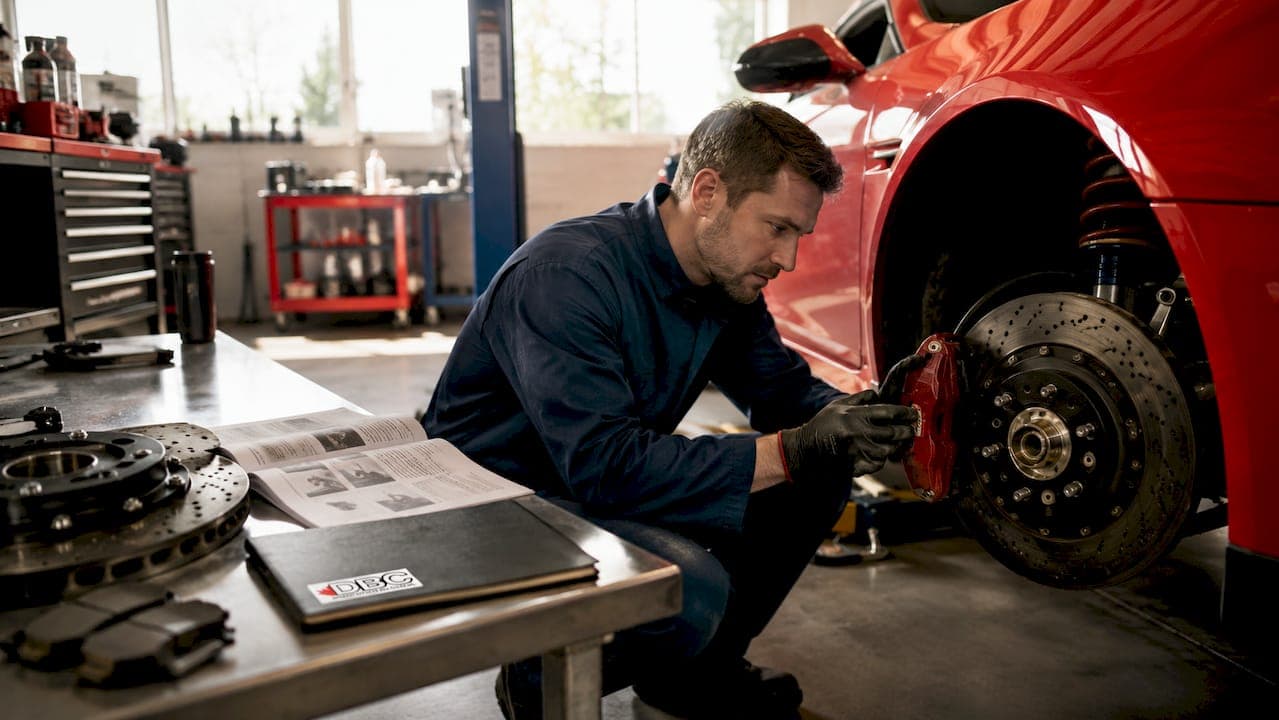
A brake kit upgrade is defined as a change to one or more braking system components, including calipers, rotors, pads, or fluid, that alters how the system generates, transfers, and manages stopping force. What does brake kit upgrade feel difference mean in practical terms? It means a change in pedal feedback, modulation quality, and thermal consistency, not a dramatic reduction in stopping distance. For most street vehicles, the tyre is the limiting factor in stopping performance. The real gains from upgrading to performance brakes show up in how the pedal communicates with the driver and how the system holds up under repeated hard stops.
How does pedal feel change with brake kit upgrades?
Pedal feel is the most immediate and noticeable change drivers report after a brake kit upgrade. The sensation comes from how force travels from your foot through the hydraulic system and into the caliper. Two caliper designs produce very different results.
Floating calipers, which are standard on most factory vehicles, use one or two pistons on a single side. The caliper body slides on pins to apply pressure from both sides of the rotor. This sliding action introduces a small amount of flex and delay. The result is a pedal that feels soft at the initial press and builds pressure gradually.
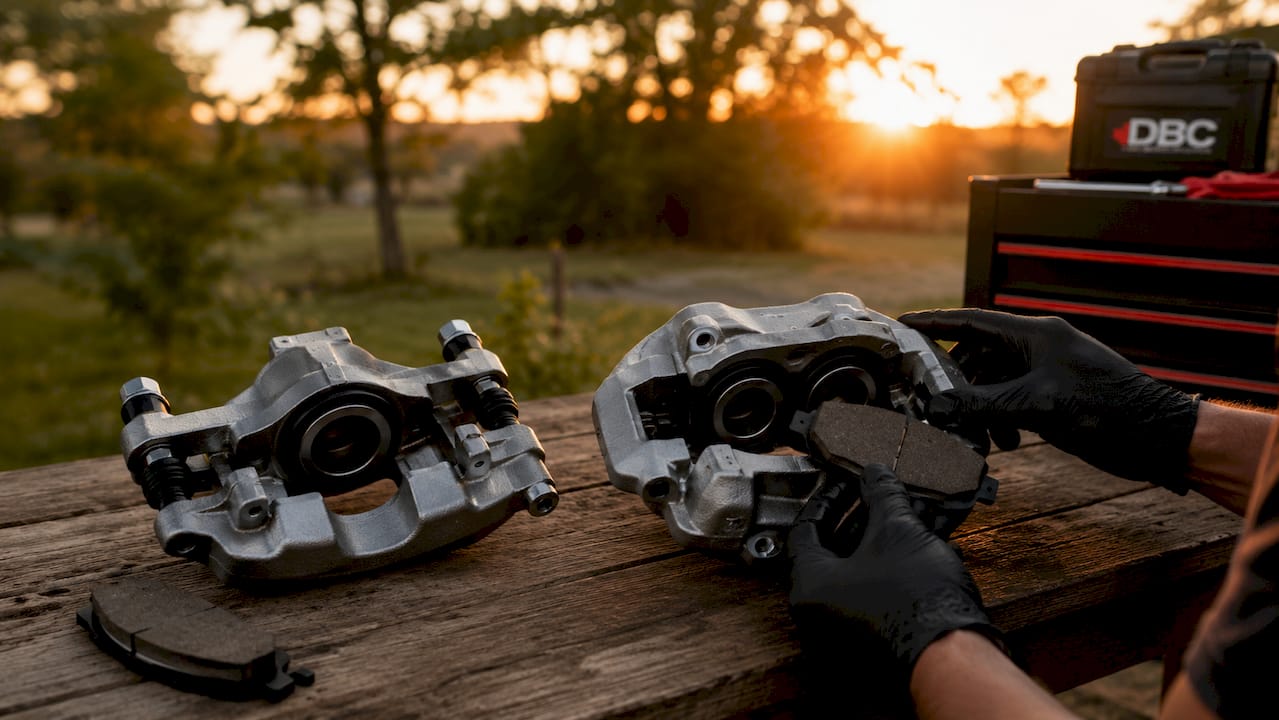
Fixed calipers mount rigidly to the upright and use pistons on both sides of the rotor simultaneously. Fixed calipers deliver immediate, linear pedal feedback and improved modulation, letting drivers sense exact tyre grip before locking up. That directness is what most drivers describe as a "firmer" or "more connected" pedal after upgrading.
Piston count also affects feel, but not in the way most drivers expect. Increasing piston count does not increase raw stopping power. Brake force depends on total piston area, not the number of pistons. More pistons distribute force more evenly across the pad face, which reduces pad taper and keeps the friction surface consistent. The practical effect is a pedal that stays firm and predictable as the pads wear, rather than developing a soft or uneven feel over time.
Key changes in pedal feel from caliper upgrades:
- Reduced pedal travel: Fixed calipers engage pads faster with less fluid movement required.
- Improved modulation: Drivers can apply partial braking force with greater accuracy.
- Consistent feel across pad life: Even force distribution prevents uneven pad wear that causes pedal variation.
- Less flex under load: Rigid caliper bodies transmit force directly without the compliance of a sliding pin design.
Pro Tip: A higher piston count adds weight and cost. If your goal is a firmer pedal on the street, upgrading brake fluid and pads often produces a more noticeable improvement than moving to a multi-piston caliper.
What role does thermal management play in brake kit upgrades?
Brakes do not fail because they lack clamping force. Brakes fail when thermal capacity is exceeded, causing hydraulic fluid to boil or pads to overheat and glaze. This is the core engineering problem that performance brake kits address.
When brake fluid boils, it produces vapour bubbles in the hydraulic line. Vapour compresses, fluid does not. The pedal goes soft and the driver loses modulation. This is brake fade, and it is the most dangerous outcome of repeated hard stops on an underspecified system.
Upgraded brake kits raise thermal capacity through three main mechanisms:
- Larger rotors: A bigger rotor has more mass to absorb heat and more surface area to radiate it. This delays the point at which temperatures become critical.
- Ventilated and cross-drilled discs: Internal vanes in ventilated rotors pull air through the disc during rotation. Cross-drilled rotors add surface area and allow gas from pad outgassing to escape, keeping the pad-to-rotor contact clean.
- Higher-grade pad compounds: Performance pads maintain their friction coefficient at higher temperatures. Standard pads can lose effectiveness after a few aggressive stops without proper bedding or quality fluid.
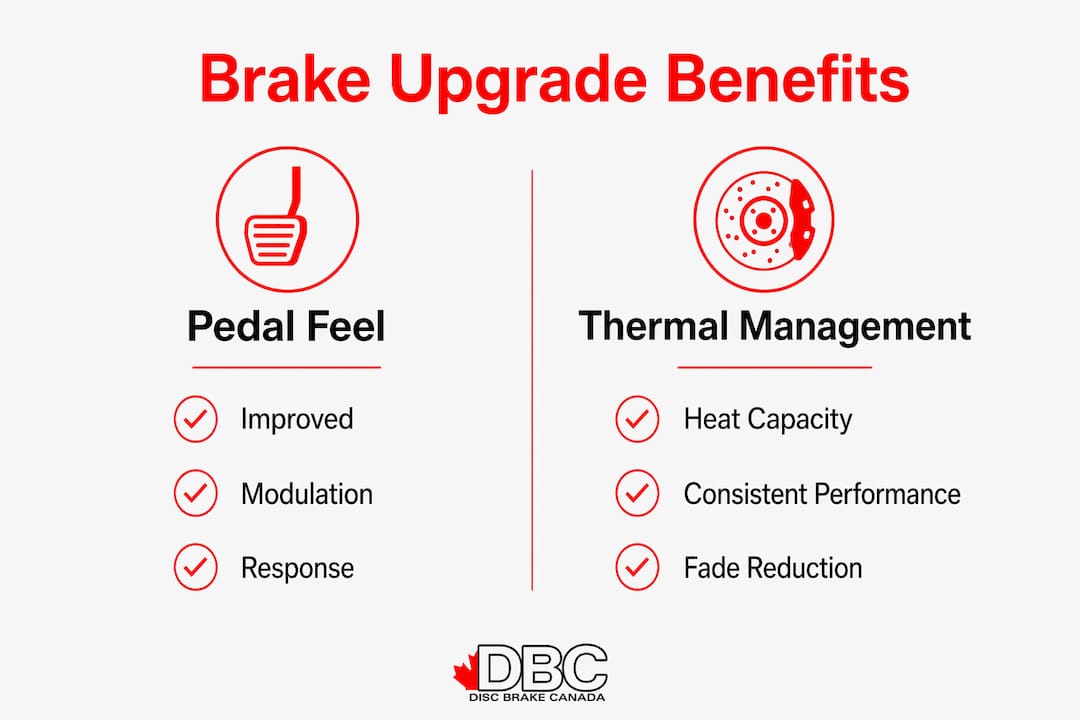
The primary performance benefit of a brake kit upgrade is enhanced thermal management, which maintains consistent pedal feel during repeated high-intensity stops. That consistency is what separates a performance system from a stock system on a mountain descent, a track day, or a loaded tow vehicle on a long grade.
| Driving scenario | Thermal risk level | Upgrade benefit |
|---|---|---|
| Daily urban commuting | Low | Minimal |
| Highway emergency stops | Moderate | Moderate |
| Mountain descents | High | Significant |
| Track or performance driving | Very high | Critical |
| Towing or heavy loads | High | Significant |
Why pads and fluid often change feel more than a full kit
Brake pad compound is the biggest factor in daily driving brake feel upgrades, often more impactful than a full kit swap. Every pad compound has a friction-temperature curve. Standard pads are engineered to work well in a narrow, low-temperature range. Performance compounds extend that range upward, maintaining bite as heat builds.
Fluid quality works the same way. Standard DOT 3 fluid has a dry boiling point that can be reached during aggressive driving. Upgrading to high-temp DOT 4 or DOT 5.1 and bleeding air from the lines improves pedal firmness substantially before any hardware changes are made. This is the single most cost-effective brake improvement available to most drivers.
Pad selection also affects daily driving trade-offs:
- Initial bite: Aggressive compounds grab hard at low pedal pressure. This feels confident but can be abrupt in traffic.
- Noise and dust: High-performance compounds often produce more brake dust and squeal than OEM pads.
- Durability: Softer, quieter compounds wear faster under repeated hard use.
- Bedding requirement: Performance pads need a proper bedding procedure to transfer a thin layer of friction material onto the rotor. Skipping this step causes uneven bite and noise.
Exploring high-performance brake compounds before committing to a full kit upgrade is a practical first step for most drivers. The cost is lower, the installation is straightforward, and the feel improvement is immediate.
Pro Tip: Flush your brake fluid every two years regardless of other upgrades. Moisture absorption lowers the boiling point of DOT fluid over time, softening the pedal even when pads and rotors are in good condition.
Do brake kit upgrades actually reduce stopping distances on street vehicles?
The answer is no, for the vast majority of drivers. For 95% of street-driven vehicles, upgrading to a full big brake kit will not reduce stopping distances compared to a well-maintained stock system with quality tyres. Stopping power on the street is limited by tyre traction, not by caliper size or rotor diameter.
The physics are straightforward. A tyre can only transfer a fixed amount of force to the road surface before it slides. Once the brake system can generate more force than the tyre can use, adding more braking hardware changes nothing about stopping distance. Modern ABS systems are already calibrated to keep braking force at the tyre's limit.
Where stopping distance does improve is in specific, high-demand scenarios:
| Factor | Street impact | Track or high-load impact |
|---|---|---|
| Tyre compound and width | High | High |
| Brake fade resistance | Low | High |
| Caliper stiffness | Low | Moderate |
| Rotor size | Low | Moderate |
| Pad compound | Low to moderate | High |
The distinction between initial bite and maximum stopping power matters here. A performance pad gives a sharper initial bite, which feels like stronger braking. The actual deceleration rate at maximum effort is still tyre-limited. Drivers often interpret the sharper initial response as shorter stopping distances, but the physics do not support that conclusion for street use.
How to choose the right brake upgrade for your vehicle
The brake upgrade sequence that delivers the best return is: tyres first, then brake fluid, then pads, and only then a full kit. Each step builds on the last. Skipping ahead to a big brake kit without addressing tyres and fluid leaves the most impactful improvements untouched.
Matching the upgrade to driving habits produces the best results:
- Daily commuting: Fresh fluid, quality OEM-replacement pads, and good all-season tyres cover every realistic need.
- Track days or autocross: Performance pad compounds, DOT 5.1 fluid, and ventilated rotors become worthwhile investments.
- Towing or hauling: Larger rotors and higher-temp fluid address the sustained heat load that stock systems struggle with.
- High-horsepower builds: A full kit with fixed calipers and matched master cylinder becomes necessary when vehicle weight and speed increase stopping demands.
One technical point that drivers often overlook is piston area matching. Brake pedal feel worsens if the piston area in the new caliper does not match the master cylinder. A mismatch produces either a mushy pedal with too much travel or an overly hard pedal with poor modulation. Checking clamping force compatibility before purchasing a kit prevents this problem.
A balanced system approach produces better results than upgrading one component in isolation. A large caliper on a stock master cylinder and stock tyres will not perform as well as a matched, moderate upgrade across all components.
Key takeaways
A brake kit upgrade primarily improves pedal feel, modulation, and thermal capacity, not stopping distance, for street-driven vehicles.
| Point | Details |
|---|---|
| Pedal feel, not stopping distance | Upgraded kits change how braking feels, not how short the car stops on the street. |
| Fixed calipers improve modulation | Fixed calipers deliver linear, immediate pedal feedback compared to floating OEM designs. |
| Thermal capacity is the real gain | Larger rotors and quality pads prevent brake fade during repeated or sustained hard stops. |
| Pads and fluid first | Upgrading brake fluid to DOT 5.1 and choosing a performance pad compound often improves feel more than a full kit swap. |
| Match the upgrade to your use | Daily drivers need less than track or tow vehicles; always match caliper piston area to the master cylinder. |
What I've learned about brake upgrades after years of watching drivers get this wrong
The most common mistake I see is drivers buying a big brake kit before they have addressed tyres and fluid. They spend considerably more money, install the kit, and then report that the car "doesn't feel that different." It doesn't, because the tyre was the limiting factor the whole time.
The second mistake is chasing piston count. A six-piston caliper sounds impressive, and it does distribute force well. But on a street car with stock tyres and standard fluid, the driver will not feel the difference compared to a quality two-piston fixed caliper. The weight and cost go up; the real-world feel improvement does not match the investment.
What actually works for most drivers is a targeted approach. Fresh DOT 5.1 fluid, a quality performance pad compound, and properly bedded rotors produce a noticeably firmer and more responsive pedal. That combination costs a fraction of a full kit and delivers most of the feel improvement that drivers are actually seeking.
For drivers who do track days or tow regularly, a full kit from a manufacturer like DBC Brakes makes genuine sense. The thermal headroom is real, and the consistency under repeated hard stops is something you feel immediately on a descent or a hot lap. The key is knowing which category you fall into before spending money.
— Sam
DBC Brakes: brake kits and components for Canadian drivers
DBC Brakes offers a full range of performance brake components, including cross-drilled rotors, performance pad compounds, and complete brake kits, built for Canadian driving conditions and backed by knowledgeable support.
Whether you are upgrading fluid and pads for a firmer street pedal or moving to a full performance kit for track or towing use, DBC Brakes carries the components to match your vehicle and driving style. Ford owners can find purpose-built options through the custom Ford brake kits page. Free shipping applies to orders over $100, and pricing is transparent with no hidden fees.
FAQ
What does a brake kit upgrade actually change?
A brake kit upgrade changes pedal feel, modulation, and thermal capacity. It does not significantly reduce stopping distances on street vehicles, where tyre traction is the limiting factor.
Does upgrading brakes add horsepower or improve acceleration?
Brake upgrades do not add horsepower or improve acceleration. The performance gain is in braking confidence, pedal response, and resistance to fade under repeated hard stops.
What is the difference between floating and fixed calipers?
Floating calipers slide on pins and apply force from one side, producing a softer pedal. Fixed calipers apply force from both sides simultaneously, delivering a firmer and more linear pedal feel.
Should I upgrade pads and fluid before buying a full brake kit?
Upgrading to a performance pad compound and high-temp DOT 4 or DOT 5.1 fluid is the recommended first step. These changes often produce more noticeable feel improvements than a full kit at a lower cost.
When does a full brake kit upgrade make sense?
A full brake kit is worthwhile for track driving, regular towing, or high-horsepower vehicles where repeated hard stops generate heat that exceeds the thermal capacity of a stock system.