
Track driving places repeated, high-energy braking loads on every component in the system, and street brakes are not built for those loads. The core reason is thermal: a street car's brake hardware is designed for infrequent, moderate heat events followed by long cool-down periods. On track, that cool-down never comes. Pads, rotors, calipers, and fluid all reach temperatures that exceed their design limits, and the result is fade, wear, or outright failure.
The primary technical drivers are:
- Heat capacity and dissipation: street rotors carry less thermal mass and fewer cooling vanes than track-spec hardware
- Friction-material temperature window: street pad compounds lose friction above roughly 400–500 °C; race compounds need that heat to work properly
- Hydraulic fluid boiling point: standard DOT 3 fluid can vapourise under sustained track loads, producing a spongy or absent pedal
- Caliper and line stiffness: rubber hoses expand under heat and pressure, softening pedal feel; floating single-piston calipers flex more than fixed multi-piston units
- Cooling and ducting: street cars have no provision for directed airflow to the rotor face; track cars often require dedicated brake ducts
Street components may survive one or two aggressive stops, but they will lose consistent performance, wear at an accelerated rate, or fail under sustained track loads. The sections below explain each failure mode and what to do about it.
Table of Contents
- How disc brakes convert speed into heat
- Why street brakes fail on track: fade, glazing, and fluid boil
- How pad compounds differ between street and track use
- Why rotor design and cooling matter on track
- Calipers, brake lines, and fluid: the hydraulic side of track braking
- Can you swap street and track pads? Pre-track prep and the 30-30-30 rule
- Signs of brake trouble on track, wear rates, and Canadian cost expectations
- How a DBC Brakes kit addresses track-day thermal demands
- Key takeaways
- The upgrade sequence most drivers get wrong
- DBC Brakes: purpose-built kits for Canadian track-day drivers
- Useful sources
How disc brakes convert speed into heat
Every time a driver presses the brake pedal, kinetic energy transfers into frictional heat at the pad-to-rotor interface. The pad's friction material clamps against the rotor face, and that contact converts vehicle momentum into thermal energy. The rotor absorbs most of that heat, acting as the system's primary thermal mass, and then dissipates it into the surrounding air.
Each component has a specific role. The pad provides the friction surface and determines the operating temperature window. The rotor stores and sheds heat; its mass, material, and venting geometry control how fast it cools. The caliper applies clamping force via hydraulic pressure, and its stiffness determines how precisely that force translates to the pad face. The brake fluid transmits pedal force through the lines; it must stay liquid under heat, because any vapour in the line compresses and kills pedal feel.
Friction materials have a temperature window within which they produce consistent, predictable friction. Below that window, cold bite is low. Above it, the material degrades. Street pads are tuned for a wide, low-to-moderate window so they work on a cold morning commute. Track pads are tuned for a narrower, high-temperature window. That difference in temperature window is the single most important reason why track vehicles need different brake hardware than street cars.
Why street brakes fail on track: fade, glazing, and fluid boil
Brake fade is the loss of stopping power under heat, and it has three distinct mechanisms. Understanding which one is occurring changes how a driver responds.
Friction fade happens when the pad compound reaches or exceeds its upper temperature limit. The binder material in the pad begins to break down, friction drops, and the pedal feels normal but the car takes longer to stop. This is the most common form of fade on track days.
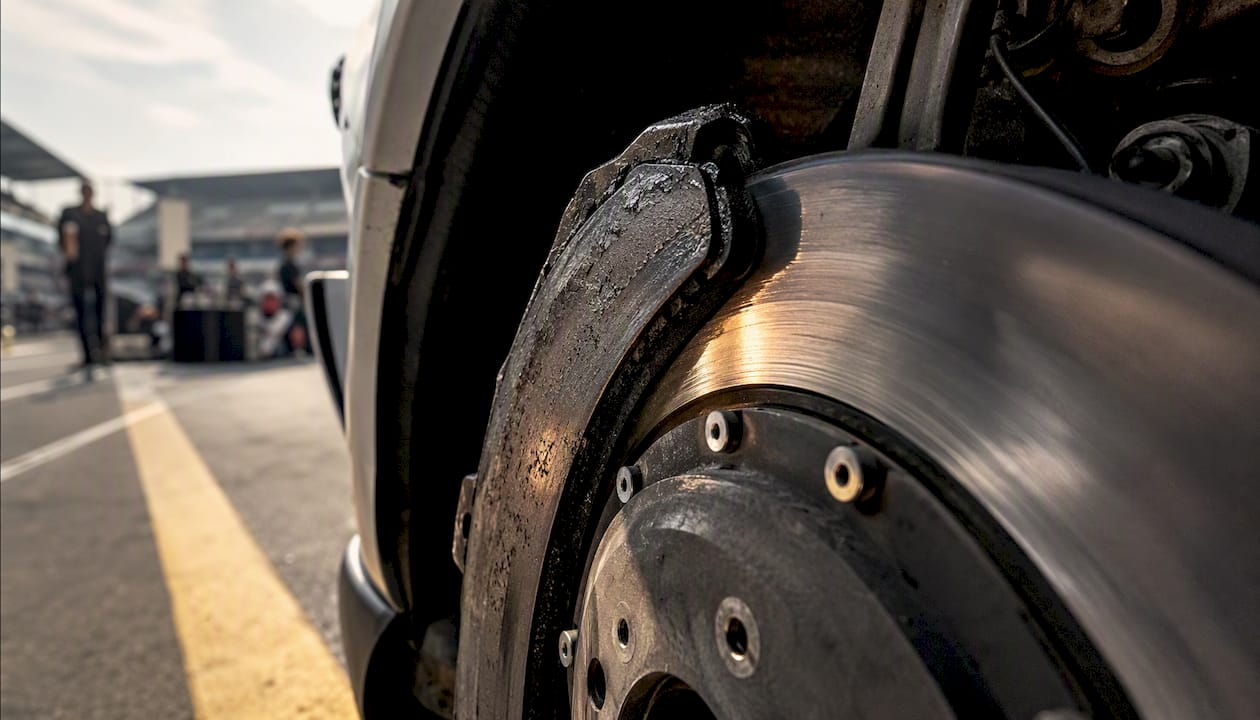
Fluid vapour fade occurs when brake fluid absorbs enough heat to boil inside the caliper or line. Vapour compresses, so the pedal travels further before pressure builds. In severe cases the pedal goes to the floor. Road & Track's track-day brake guide notes this is a direct consequence of using street-spec fluid at sustained track temperatures.
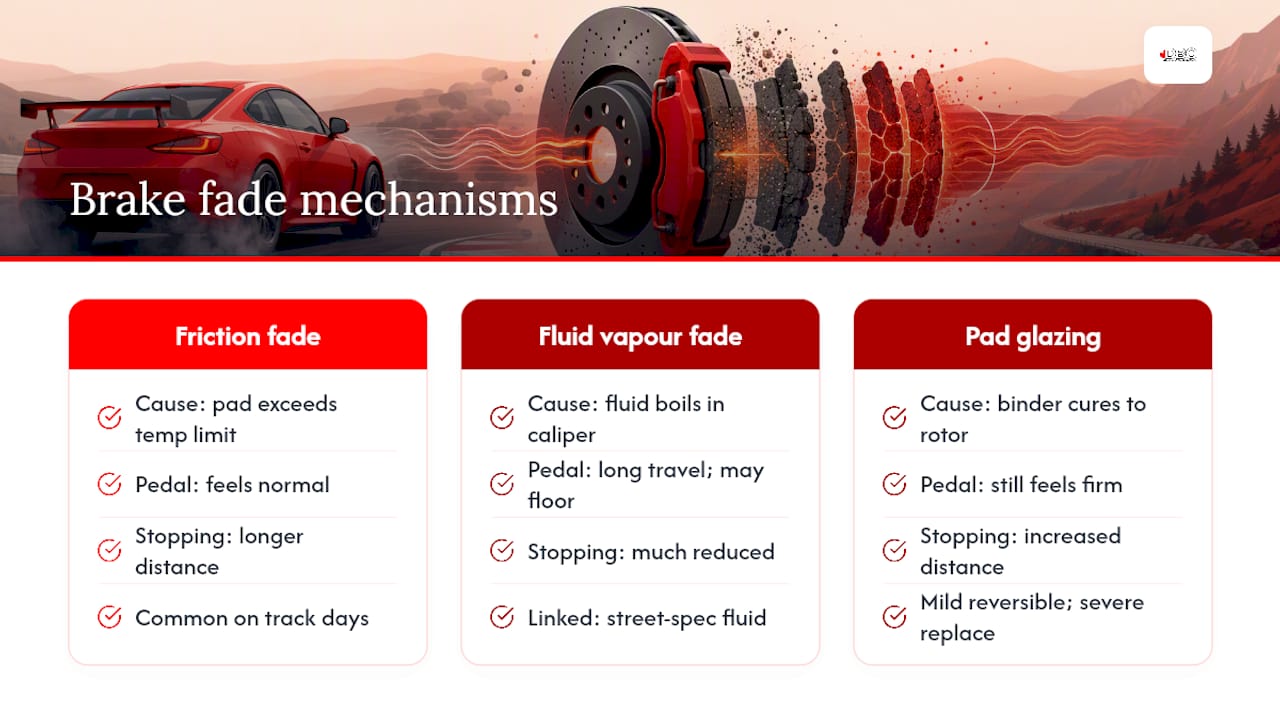
Pad glazing is a surface hardening that occurs when a pad overheats and the binder cures onto the rotor face. Glazed pads produce a glassy, low-friction surface. The pedal still feels firm, but stopping distances increase noticeably. Glazing can sometimes be reversed by a careful heat cycle, but severe glazing usually means the pads need replacement.
Outgassing is a related problem. As pad compounds heat up, they release gases at the pad-rotor interface. Those gases form a thin film that reduces friction temporarily. Slotted rotors help vent these gases away from the contact patch.
Repeated heat cycles also change rotor metallurgy. Cast iron expands and contracts with each cycle, and uneven heating creates localised hot spots. Over time, those spots harden differently from the surrounding material, producing surface variations that cause pedal pulsation and uneven pad wear. Severe cases lead to heat checking, a network of fine surface cracks that can propagate into structural cracks under continued stress.
How pad compounds differ between street and track use
Street pads and track pads are not interchangeable, and the difference goes beyond temperature rating. Road & Track explains that street pads prioritise cold bite, low dust, and quiet operation, while track pads are engineered for sustained high-temperature friction stability, with no concern for noise or dust.
The practical trade-offs break down by use case:
- Street pads: — effective from cold, low dust, quiet, wear slowly on street rotors; lose friction above roughly 400–500 °C and are not suitable for repeated hard stops
- Street/track compromise pads: acceptable cold bite for daily driving, remain stable up to several hundred degrees Celsius; Chariotz's brake pad selection guide recommends this category for drivers doing relatively few track days per year
Race engineers and manufacturers design track pad compounds without concern for noise or dust. The objective is repeatable high-temperature performance across many heat cycles. Multiple compound grades exist to match vehicle weight, brake torque requirements, and expected heat load.
Wear rates differ substantially. A set of street pads may last tens of thousands of kilometres on road use. The same car running track-only pads through a full track day can consume a significant portion of pad material in a single session, and rotor wear accelerates proportionally.
Pro Tip: Always bed new pads before a track session. The 30-30-30 procedure (three moderate stops from 30 mph, three firmer stops, three hard stops, with cool-down between each set) transfers an even layer of friction material onto the rotor face. Skipping bed-in with track compounds risks glazing the rotor on the first hard stop.
Why rotor design and cooling matter on track
Rotors do more than provide a friction surface. They are the system's primary heat sink, and their geometry determines how fast heat moves away from the contact patch.
One-piece cast rotors are standard on street cars. They are cost-effective and adequate for normal use, but their thermal mass is fixed and their cooling vane geometry is optimised for low-speed airflow. High-carbon variants improve crack resistance and heat dissipation compared to standard grey iron, making them a meaningful upgrade for drivers who track occasionally.
Two-piece rotors separate the friction ring from the aluminium hat. The hat floats on drive pins, allowing the ring to expand thermally without transmitting stress to the hub. This reduces the risk of thermal distortion and cracking under repeated high-energy stops. TEI BRAKES notes that one-piece moulded carbon-ceramic rotors take this further, offering superior fade resistance and weight savings, but they must be matched carefully to compatible pads and calipers to realise those benefits.
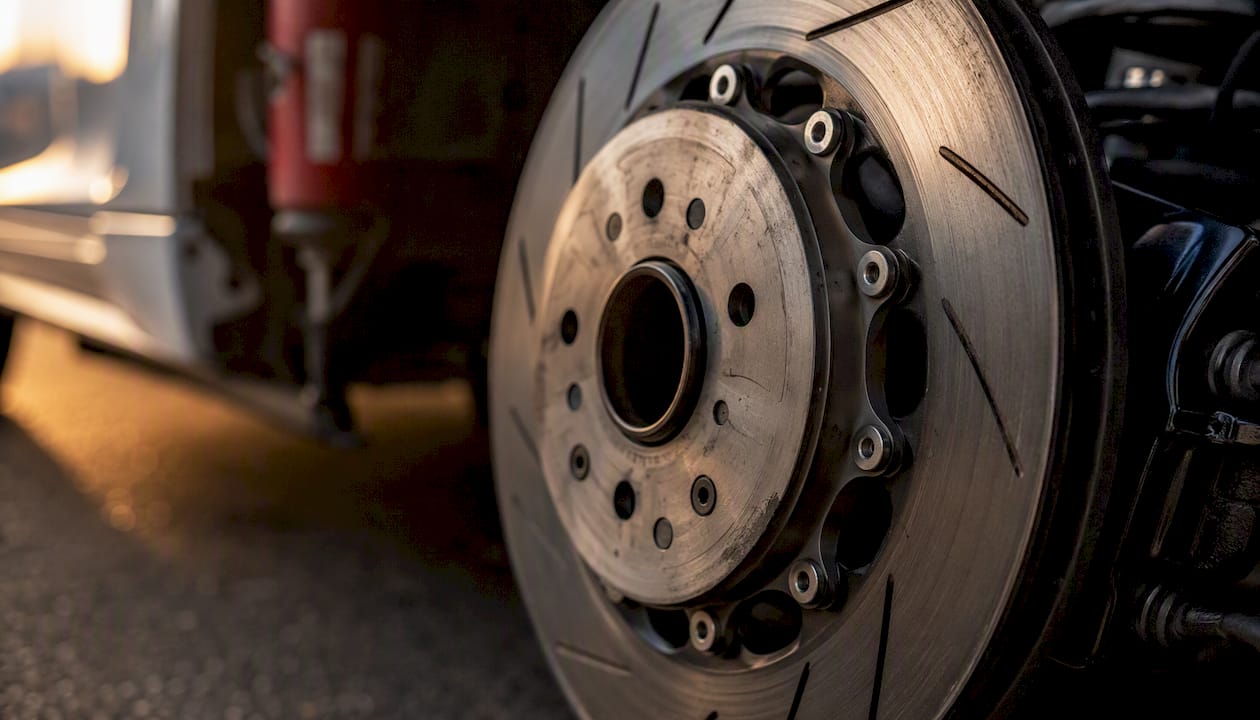
Cooling strategies matter as much as rotor material. Vented rotors with internal vanes create a centrifugal pumping effect, drawing air through the rotor body. On track, that airflow is often insufficient without directed ducting. Brake ducts channel cool air from the front bumper opening directly to the rotor face, reducing operating temperatures measurably. Many track-day cars add simple flexible duct kits for this reason.
Slotted vs. drilled rotors is a common debate. Slots clean the pad face and vent outgassing effectively without significantly weakening the rotor. Drilling reduces thermal mass and can initiate cracks at the drill holes under repeated thermal stress, particularly in standard cast iron. Cross-drilled rotors in quality materials manage gas venting while maintaining structural integrity better than simple through-drilled designs.
Warning: Underspecifying rotor construction for sustained track loads is one of the most common causes of mid-session brake failure. A rotor that survives street use may crack or warp after two or three hard track sessions if its thermal capacity and material grade are not matched to the heat load.
Calipers, brake lines, and fluid: the hydraulic side of track braking
The hydraulic system transmits pedal force to the pad, and every component in that path affects pedal feel, modulation, and resistance to heat.
Fixed vs. floating calipers: floating single-piston calipers are standard on most street cars. They are light and inexpensive but flex slightly under load, reducing pedal precision. Fixed multi-piston calipers clamp the rotor from both sides simultaneously, producing stiffer, more consistent pedal feel. Willand Service Centre's caliper comparison confirms that race calipers are designed without compromise for high-temperature performance and minimal flex. For brake caliper types suited to performance vehicles, the architecture of the caliper body directly affects how much force reaches the pad under heat.
Brake lines: standard rubber hoses expand slightly under pressure, and that expansion increases under heat. The result is a pedal that feels progressively softer as the system heats up. Braided stainless steel lines have a non-expanding inner liner, so pedal feel stays consistent regardless of temperature.
Brake fluid choices and maintenance:
- DOT 5.1: dry boiling point around 260 °C; ShiftUpGarage recommends DOT 4 or DOT 5.1 for track use, with fluid changes every 1–2 years for street/track drivers
Moisture is the critical variable. Brake fluid is hygroscopic; it absorbs water from the air over time, and water lowers the boiling point significantly. A fluid that reads 260 °C dry may boil at well under 200 °C after a year of moisture absorption.
Pro Tip: Bleed the brakes with fresh fluid before every track day. It costs under $30 in materials and takes under an hour. It is the single highest-value maintenance step for preventing mid-session pedal fade.
Can you swap street and track pads? Pre-track prep and the 30-30-30 rule
Swapping pads is a reasonable short-term approach for drivers who track occasionally. For drivers running more than roughly eight track days per year, a dedicated upgrade is the better path. Unplugged Performance's FAQ on street vs. track pads confirms that track pads are aggressive on rotors and have little cold bite, so the two-set approach (street pads for the drive to and from the circuit, track pads for sessions) is the practical standard among enthusiasts.
Pre-track inspection checklist:
- Check brake fluid condition and boiling point; replace with DOT 4 or DOT 5.1 if due
- Measure pad thickness; replace any pad below 4 mm before a session
- Inspect rotors for heat checking, scoring, or thickness below the minimum discard spec
- Check caliper slide pins and piston seals for sticking or leaking
- Inspect brake lines for cracks, swelling, or chafing
- Torque all wheel fasteners to spec after any wheel removal
- Test handbrake function and confirm it holds on a gradient
- Bleed the system if fluid has not been changed within the past year
Pad swap best practice: carry both sets in clean, sealed bags. Install track pads in a clean environment to avoid contaminating the friction surface. Torque caliper bolts to the manufacturer's specification. Bed the new pads before the first hard stop.
The 30-30-30 bed-in procedure: perform three moderate stops from approximately 50 km/h, three firmer stops from 80 km/h, and three hard stops from 100 km/h, allowing 60–90 seconds of cooling between each stop. Manufacturer procedures vary, so check the specific pad maker's instructions. The goal is an even transfer film on the rotor face before the first high-energy stop.
Pro Tip: Heat-cycle new track pads gently during the first session. Two or three warm-up laps at reduced pace before the first hard braking zone lets the compound reach operating temperature gradually, reducing the risk of uneven transfer film and early glazing.
Rear brake use on track is a common question. Most street cars have significantly less rear brake bias than front, and track driving rarely changes that. Aggressive rear brake use on a front-biased car can induce oversteer; leave the bias as-set unless you have a dedicated adjustable proportioning valve.
Signs of brake trouble on track, wear rates, and Canadian cost expectations
Stopping a session early is always the right call when any of these appear:
- Pedal travel increasing progressively through a session (fluid vapour or pad fade)
- Visible smoke from a wheel (pad or rotor overheating)
- Pulsation or vibration through the pedal (rotor hot spot or warping)
- Sudden loss of modulation or a pedal that feels inconsistent stop to stop
- Burning smell that persists after a cool-down lap
Expected wear under track use:
| Pad category | Street wear life | Track session wear | Rotor service interval |
|---|---|---|---|
| Street pads | 40,000–60,000 km | Rapid; not recommended | Per manufacturer spec |
| Street/track pads | 20,000–40,000 km | Moderate; 3–5 track days per set | Inspect after each event |
| Track-only pads | N/A for street | High; 1–2 full days per set | Inspect and measure after each event |
Canadian cost ranges for common service items (approximate, in CAD):
- Brake pad set (street/track compound): costs vary per supplier and product quality
- Rotor pair (quality aftermarket): prices vary based on brand and specifications
- Brake fluid bleed and refill (shop labour): typical costs depend on service provider
- Braided line kit: price depends on manufacturer and vehicle fitment
Warning: A rotor showing heat checking, blue discolouration across more than a quarter of its face, or thickness below the discard specification must be replaced before the next session. Continuing to use heat-damaged rotors risks cracking under load, which is a catastrophic failure mode with no warning.
How a DBC Brakes kit addresses track-day thermal demands
CrossDrilledRotors.ca (DBC Brakes) engineers its kits specifically to address the failure modes described above. The cross-drilled rotor design vents outgassing from the pad-rotor interface, reducing the gas film that causes friction fade. The drilling pattern and rotor material are selected to manage thermal expansion and reduce the risk of warping under repeated heat cycles, which is the primary failure mode for standard street rotors on track.
DBC kits are compatible with higher-temperature pad compounds and multi-piston caliper upgrades, so drivers who want to step up from a street/track pad to a dedicated track compound can do so without replacing the rotor again. The rotor geometry is designed for improved pad contact across the full face, reducing the uneven wear patterns that create hot spots.
Key details for Canadian buyers:
- Kits are available for a wide range of cars, trucks, and performance vehicles; use the vehicle selector at CrossDrilledRotors.ca to confirm fitment
- Free shipping within Canada on orders over $100
- Expert support is available by phone or email, not automated responses, for fitment and compound questions
- Brake kit reliability features are detailed on the DBC blog for drivers who want to compare specifications before ordering
DBC Brakes kits are designed and available in Canada, with inclusive pricing, no hidden fees, and direct expert support. For drivers preparing a street car for track use, the cross-drilled rotor kit provides a practical, Canada-available upgrade that addresses the thermal and mechanical demands described in this article.
Key takeaways
Track brakes fail on street hardware because repeated high-energy stops generate temperatures and mechanical stresses that exceed street-spec pads, rotors, fluid, and calipers.
| Point | Details |
|---|---|
| Fluid is the first upgrade | Replace with DOT 4 or DOT 5.1 and bleed before every track day to prevent pedal fade from vapour. |
| Match pads to track frequency | Street/track compound pads suit drivers doing relatively few track days per year; track-only pads suit dedicated sessions with a pad swap. |
| Rotors need thermal capacity | Standard cast rotors warp and heat-check under sustained track loads; cross-drilled or high-carbon variants manage heat cycles better. |
| Stop when symptoms appear | Increasing pedal travel, pulsation, smoke, or loss of modulation are signals to pit immediately, not complete the lap. |
| DBC Brakes for Canadian drivers | CrossDrilledRotors.ca kits offer cross-drilled rotors engineered for thermal stability, with free shipping over $100 and vehicle-specific fitment support. |
The upgrade sequence most drivers get wrong
The conventional advice is to buy the most aggressive pad compound available before a track day. That is the wrong starting point, and it causes more rotor damage than it prevents.
The correct sequence is: fluid first, then pads, then rotors, then calipers if the budget and commitment level justify it. Fluid is inexpensive, high-impact, and almost universally neglected. A fresh bleed with DOT 5.1 before a track day removes the moisture that causes vapour fade and costs almost nothing compared to a rotor replacement.
Pads come second because compound choice drives everything downstream. Putting an aggressive track compound on a worn or standard street rotor accelerates rotor wear dramatically and can cause uneven transfer film that creates the hot spots drivers blame on the rotor. The rotor is often the victim, not the cause.
Rotors come third. A quality cross-drilled or high-carbon rotor matched to the pad compound extends service life and reduces the warping and heat-checking that forces mid-season replacements. Calipers are last because most street calipers, properly maintained with fresh fluid and braided lines, are adequate for occasional track use. A full caliper upgrade makes sense for drivers running more than a dozen track days per year or moving to a dedicated track car.
The other thing drivers underestimate is the warm-up lap. Two or three laps at reduced pace before the first hard braking zone are not wasted time. They bring pads and rotors to operating temperature gradually, which produces a more even transfer film and more consistent friction through the session. Skipping the warm-up and going straight to a hard stop on cold track pads is the fastest way to glaze a rotor.
DBC Brakes: purpose-built kits for Canadian track-day drivers
Street brakes wear out faster on track, and replacing them piecemeal gets expensive. DBC Brakes offers a direct alternative: complete cross-drilled rotor kits engineered to handle the thermal and mechanical loads that cause standard street hardware to fail, available to Canadian drivers with no hidden fees and free shipping on orders over $100.
Each kit is designed to reduce warping, improve thermal stability, and work with the higher-temperature pad compounds that track driving demands. Fitment is vehicle-specific. Use the selector at CrossDrilledRotors.ca to find the right kit for your car, truck, or performance vehicle. If you have questions about compound compatibility or installation, DBC's support team responds directly, not through an automated system.
Before installing any new kit, run through the pre-track inspection checklist in this article, bed the new pads using the 30-30-30 procedure, and replace the brake fluid with DOT 4 or DOT 5.1. View compatible brake kits for your vehicle and order with confidence knowing the kit is built and supported in Canada.
Useful sources
The following references were used in preparing this article. Each is worth consulting for deeper technical detail on specific topics.
- Investigation of tracked vehicle braking under mu-split conditions — MDPI
- Track brake — Wikipedia
- Everything you need to know about brakes and track days — Road & Track
- Race vs. street brake calipers: a deep dive | Willand Service Centre
- Brake pad selection for street cars that see track days — Chariotz
- How to build a sensible street and track brake setup — ShiftUpGarage
- One-piece molded carbon ceramic brake systems — TEI BRAKES
- What's the difference between street and track brake pads — Unplugged Performance FAQ