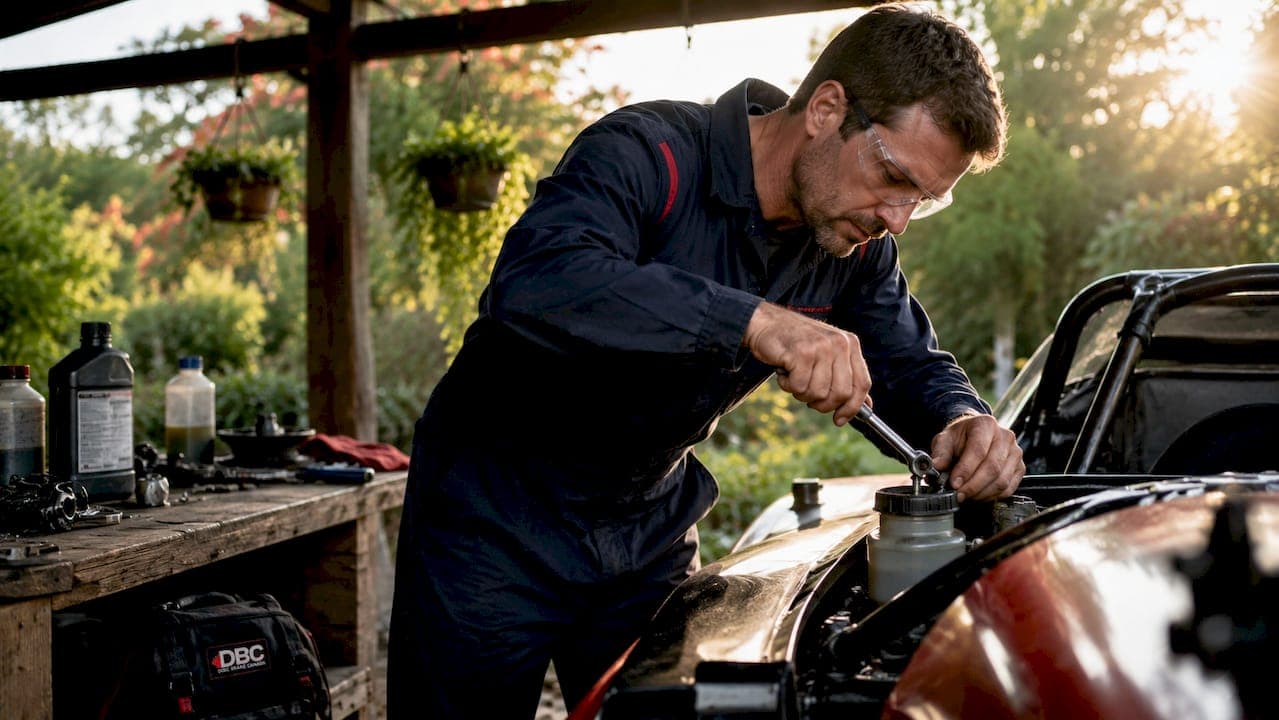
A brake fluid upgrade for performance vehicles is defined as replacing standard glycol-based fluid with a higher-specification product that raises the boiling point, improves pedal feel, and maintains hydraulic consistency under heat stress. Standard DOT 3 fluid is adequate for commuting, but it fails under the thermal load generated by hard braking on a track or mountain road. FMVSS No. 116, the U.S. Department of Transportation's minimum brake fluid standard, sets the baseline. Performance driving demands more than that baseline. DBC Brakes, a Canadian brake specialist, treats fluid selection as the first step in any staged brake system upgrade, because the fluid is what transfers every input from your foot to the caliper.
What is performance brake fluid and how does it differ from standard fluid?
Performance brake fluid is defined by its boiling point, chemical base, and viscosity. These three factors determine whether the fluid holds up under the heat generated by aggressive braking.
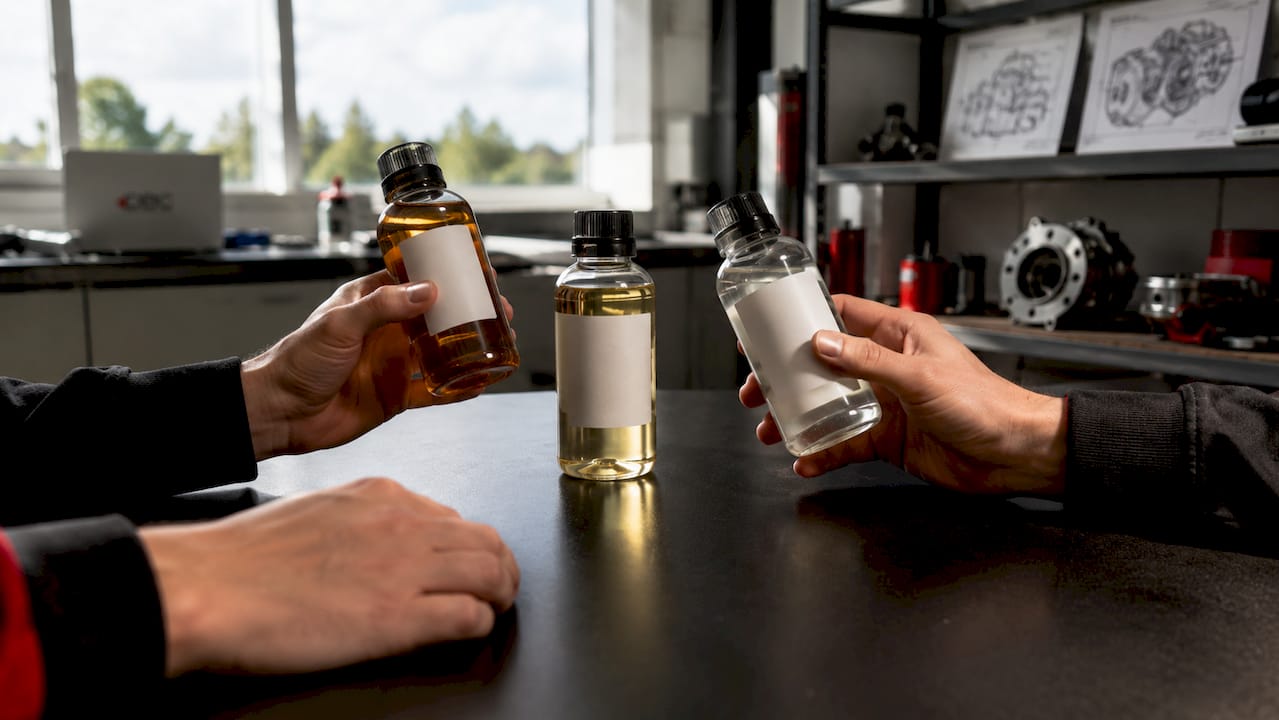
Brake fluid types at a glance
| Type | Chemical base | Dry boiling point | Wet boiling point | Best use |
|---|---|---|---|---|
| DOT 3 | Glycol ether | 401°F (205°C) | 284°F (140°C) | Daily commuting |
| DOT 4 | Glycol ether/borate ester | 446°F (230°C) | 311°F (155°C) | Spirited street driving |
| DOT 4 LV | Glycol ether/borate ester | 446°F (230°C) | 311°F (155°C) | Modern ABS/ESC vehicles |
| DOT 5.1 | Glycol ether | 500°F (260°C) | 356°F (180°C) | Track and high-demand use |
| DOT 5 | Silicone | 500°F (260°C) | 356°F (180°C) | Military/vintage only |
DOT 3, DOT 4, and DOT 5.1 are all glycol-based. That matters because glycol-based fluids are compatible and can be mixed without causing system failure. DOT 5 is silicone-based and chemically incompatible with all glycol fluids. Mixing DOT 5 into a glycol system causes braking failure.
One of the most persistent myths in performance brake fluid is that a higher DOT number always means better performance. DOT number alone does not determine performance. A premium DOT 4 fluid from a reputable manufacturer can outperform a budget DOT 5.1 product because the real measure is the actual dry and wet boiling point, not the classification number.
Pro Tip: When comparing fluids, look for the published dry and wet boiling point figures on the bottle, not just the DOT rating. A fluid labelled "Super DOT 4" or "DOT 4 Plus" often exceeds standard DOT 5.1 boiling points.
Why do performance vehicles need premium brake fluid with high boiling points?
Heat is the core problem in performance braking. Every hard stop converts kinetic energy into heat, and that heat travels from the pads and rotors directly into the caliper and fluid.
When brake fluid reaches its boiling point, it vaporises inside the caliper. Vapour compresses, liquid does not. The result is a soft, spongy pedal that travels further before generating braking force. This is brake fade caused by vapour lock, and it is dangerous at speed.
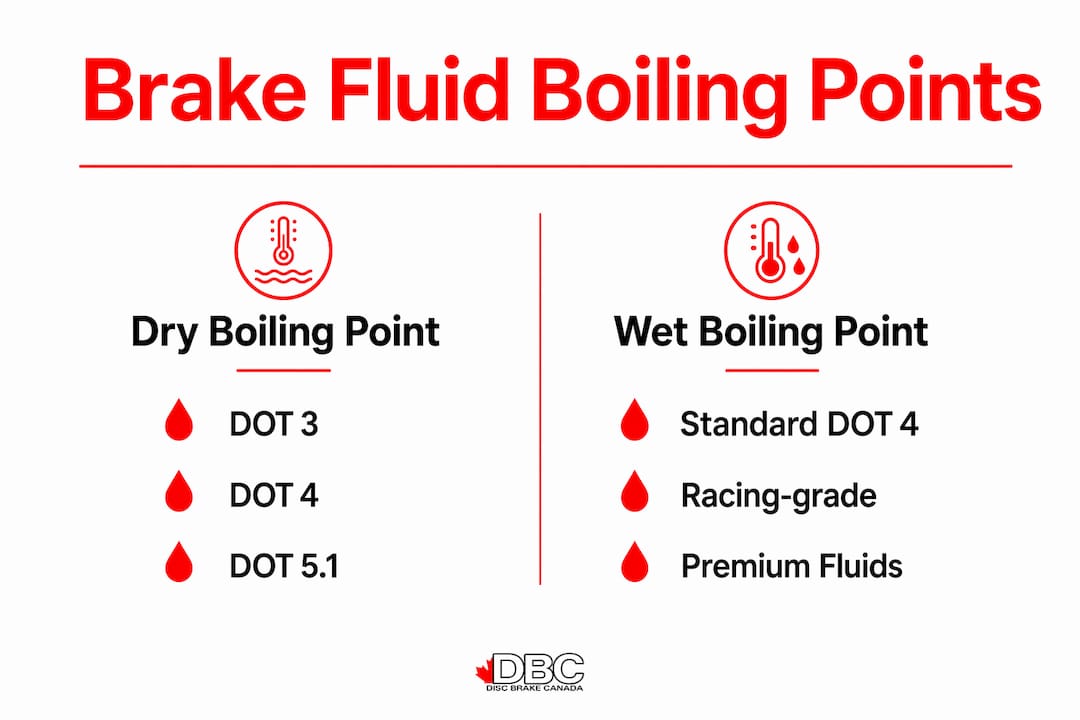
Standard DOT 4 fluid has a dry boiling point of 446°F (230°C) and a wet boiling point of 311°F (155°C). Racing-grade fluids reach dry boiling points up to 644°F (340°C) and wet boiling points up to 392°F (176°C). That gap represents the difference between consistent braking lap after lap and a pedal that goes soft on the third corner.
The wet boiling point matters as much as the dry figure. Brake fluid is hygroscopic, meaning it absorbs moisture from the air over time. Moisture lowers the boiling point significantly. High-performance fluids absorb moisture faster than standard fluids due to greater hygroscopicity. That trade-off is acceptable for track use, but it requires more frequent fluid changes to keep the wet boiling point from dropping to dangerous levels.
Key thresholds to understand:
- Dry boiling point: the boiling point of fresh, uncontaminated fluid
- Wet boiling point: the boiling point after the fluid has absorbed 3.7% water by volume
- DOT 4 wet minimum: 311°F (155°C) per FMVSS No. 116
- Racing fluid wet target: 356°F (180°C) or higher
How to select the right brake fluid for your vehicle and driving style
Matching fluid to vehicle and use case is a practical decision, not a marketing one. The wrong fluid can degrade your ABS and electronic stability control (ESC) systems.
Modern vehicles with ABS, ESC, and advanced driver assistance systems (ADAS) require low-viscosity fluid. High-viscosity racing fluids slow ABS and ESC corrections, increasing stopping distances and risking electronic system faults. Experts recommend low-viscosity fluids for modern braking systems such as DOT 4 LV or Super DOT 4 to maintain quick hydraulic response. Always check your owner's manual for the OEM viscosity specification before selecting a fluid.
Matching fluid to driving style:
- Daily driving: Standard DOT 4 meets all requirements. No upgrade needed unless the vehicle is also used for track days.
- Spirited street driving: A Super DOT 4 or DOT 4 Plus product raises the boiling point without changing viscosity. This is the most practical upgrade for enthusiasts who drive hard on public roads.
- Track days and autocross: DOT 5.1 or a high-specification DOT 4 racing fluid is the right choice. Verify that the fluid's viscosity is compatible with your ABS system before committing.
- Towing and mountain driving: DOT 4 is the minimum. The sustained heat from long descents with a loaded trailer demands a fluid with a wet boiling point above 311°F (155°C).
- Dedicated race vehicles: Full racing fluid with a dry boiling point above 572°F (300°C) is appropriate. These vehicles typically lack ABS, so viscosity compatibility is less of a concern.
For high-performance sports cars, the brake system upgrade considerations extend beyond fluid to caliper capacity and rotor size. Fluid selection should align with the full system specification.
Pro Tip: Never use DOT 5 silicone fluid in a vehicle that originally used glycol fluid. Even a small residual amount of glycol fluid will cause the two to separate and form gel-like deposits that block caliper passages.
Step-by-step guide to upgrading your brake fluid safely
A brake fluid upgrade is a full system flush, not a top-up. Topping up with a higher-specification fluid does not remove the old, moisture-contaminated fluid already in the system.
What you need:
- New brake fluid matching your vehicle's OEM viscosity specification
- A brake bleeder kit (vacuum or pressure type)
- Clear tubing and a collection bottle
- Nitrile gloves (brake fluid strips paint and irritates skin)
- A torque wrench for bleeder screws
The flush process:
- Check the current fluid condition using a brake fluid test strip or a refractometer. Discoloured or contaminated fluid confirms the need for a full flush.
- Remove the old fluid from the reservoir using a turkey baster or fluid transfer pump. Refill with fresh fluid before bleeding to avoid introducing air.
- Bleed each caliper in sequence, starting with the caliper furthest from the master cylinder. The standard sequence for most vehicles is rear right, rear left, front right, front left.
- Continue bleeding until the fluid running through the clear tubing is clean, bubble-free, and matches the colour of fresh fluid.
- Top up the reservoir to the MAX line and replace the cap securely.
- Pump the brake pedal firmly several times before moving the vehicle. Confirm pedal feel is firm before driving.
Brake fluid should be flushed every two years under normal conditions. Track and mountain driving require more frequent changes, often every season or after every event. The role of brake fluid in safety extends directly to how consistently you maintain it.
Pro Tip: Label the date of your fluid change on a piece of tape inside the engine bay. It takes 30 seconds and removes all guesswork at your next service interval.
Troubleshooting common brake fluid upgrade problems
A fluid upgrade does not fix every brake problem. Knowing the difference between a fluid issue and a mechanical issue saves time and money.
Symptoms and their likely causes:
- Spongy pedal after bleeding: Usually indicates air still in the system or a mechanical issue such as caliper flex. Spongy pedals after bleeding point to hardware problems, not vapour lock.
- Brake fade despite new fluid: Check pad compound and rotor condition first. Brake pads and calipers often limit performance before fluid boiling point becomes the constraint.
- ABS activating at lower speeds than expected: Verify fluid viscosity. Incorrect viscosity harms ABS and ESC performance and increases stopping distances.
- Pedal knockback on track: This is a mechanical issue caused by rotor runout pushing the caliper pistons back. Fluid cannot correct it.
Fluid upgrade alone will not fix a spongy pedal caused by caliper flex, worn brake hoses, or pad knockback. Address mechanical issues first, then upgrade the fluid as the final step in a staged brake improvement plan.
When brake fade persists after a fluid upgrade, the next logical step is upgrading to braided stainless steel brake lines, which resist expansion under pressure. After that, consider high-performance brake compounds matched to your driving conditions. The brake kit upgrade difference becomes most noticeable when fluid, lines, pads, and rotors are upgraded together as a system.
Key takeaways
A brake fluid upgrade for performance vehicles delivers real gains only when the fluid's boiling point, viscosity, and chemical compatibility all match the vehicle's braking system and driving demands.
| Point | Details |
|---|---|
| Boiling point is the key metric | Dry and wet boiling points determine fade resistance, not the DOT number alone. |
| Viscosity affects ABS and ESC | Low-viscosity fluid is required for modern electronic braking systems to function correctly. |
| DOT 5 is not a performance upgrade | Silicone-based DOT 5 is incompatible with glycol systems and causes braking failure if mixed. |
| Flush every two years minimum | Moisture absorption lowers the wet boiling point over time, reducing safety margins. |
| Fluid is the last upgrade, not the first | Fix mechanical issues such as caliper flex and worn pads before changing fluid. |
Why I treat brake fluid as the final piece, not the first
Most enthusiasts reach for a fluid upgrade first because it is the cheapest and easiest change on the list. I understand the logic. It is also, in my experience, the wrong sequence.
Brake fluid matters enormously, but it operates within a system. If your pads are glazed, your rotors are warped, or your rubber brake hoses are ballooning under pressure, a higher-specification fluid will not save you. The fluid transfers force. It cannot create force that the rest of the system is losing.
The sequence I follow is: pads first, then lines, then fluid, then rotors or a full kit if the budget allows. Each step reveals whether the next one is actually needed. I have seen enthusiasts spend money on racing fluid and then discover the spongy pedal they were chasing was caused by a cracked rubber hose that cost less than the fluid did.
The other thing I push back on is the assumption that the highest-specification fluid is always correct. A Super DOT 4 product with a dry boiling point of 500°F (260°C) is more than adequate for 95% of track day drivers. Full racing fluid with extreme boiling points is hygroscopic enough to require changes after every event. That is fine for a dedicated race car. For a street-driven sports car that sees four track days a year, it is unnecessary maintenance overhead.
Choose the fluid that matches your actual use case, not the most aggressive option on the shelf.
— Sam
DBC Brakes and CrossDrilledRotors.ca: brake system upgrades for Canadian enthusiasts
DBC Brakes supports performance vehicle owners with a full range of brake system components, from premium brake fluids to engineered cross-drilled rotors designed to resist warping under heat. Every product is selected for compatibility with the vehicles Canadian enthusiasts actually drive.
CrossDrilledRotors.ca carries brake fluids matched to DOT 4, DOT 4 LV, and DOT 5.1 specifications, alongside complete brake upgrade kits for a wide range of makes and models. Orders over $100 ship free across Canada, and every purchase is backed by knowledgeable support from real people, not automated responses. If you are ready to upgrade your brake system beyond fluid alone, the full product catalogue is available at CrossDrilledRotors.ca.
FAQ
What is the best brake fluid for track day use?
DOT 5.1 or a high-specification Super DOT 4 fluid with a dry boiling point above 500°F (260°C) is the standard recommendation for track use. Verify viscosity compatibility with your vehicle's ABS system before selecting a racing-grade product.
How often should performance brake fluid be changed?
Brake fluid should be flushed every two years under normal conditions. Vehicles used on track or in mountain driving require changes more frequently, often after every season or event.
Can I mix DOT 4 and DOT 5.1 brake fluid?
Yes. DOT 3, DOT 4, and DOT 5.1 are all glycol-based and are chemically compatible. DOT 5 silicone fluid is not compatible with any glycol fluid and must never be mixed into a standard braking system.
Does a higher DOT number mean better performance?
Not automatically. Real performance depends on boiling points and compatibility, not the DOT classification number. A premium DOT 4 product can outperform a budget DOT 5.1 fluid in real-world conditions.
Why is my brake pedal still spongy after a fluid upgrade?
A spongy pedal after a fluid change usually indicates a mechanical issue such as caliper flex, a worn rubber brake hose, or pad knockback. Fluid alone cannot correct hardware problems, and those issues should be diagnosed and resolved before the fluid upgrade is evaluated.