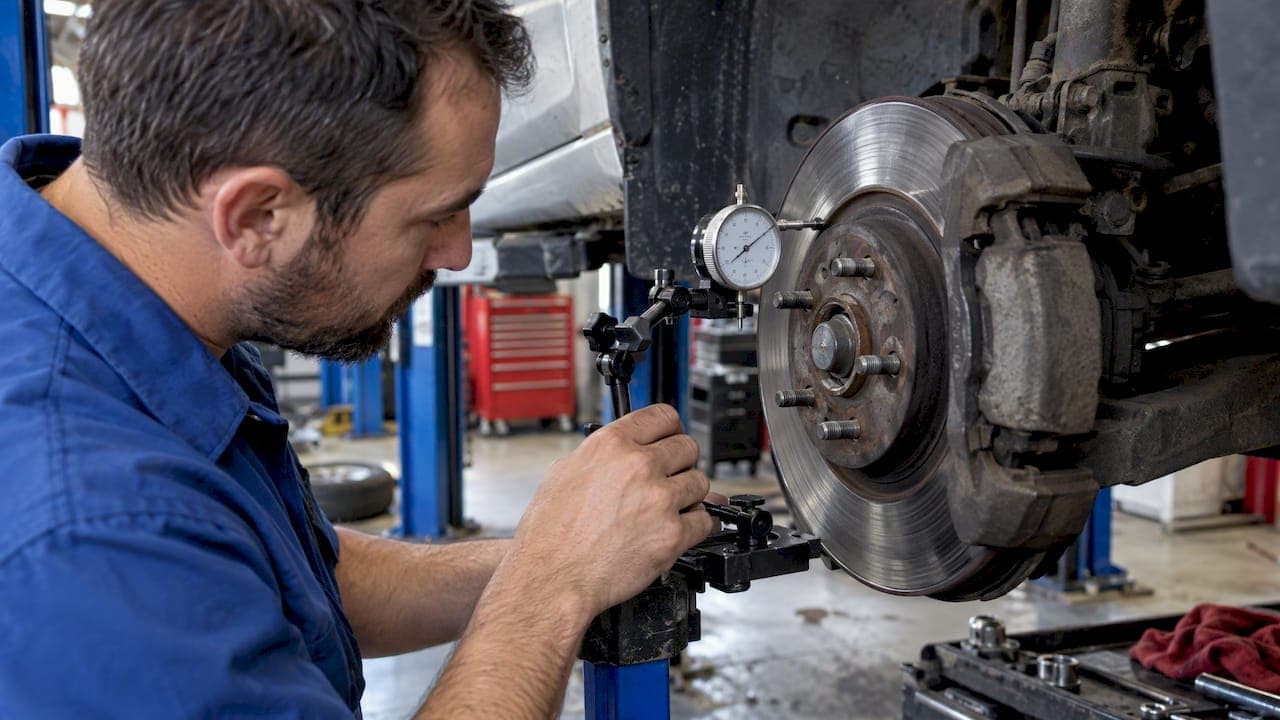
You can replace rotors without replacing pads only if the rotors pass three checks: thickness above the manufacturer's minimum, no deep scoring, pitting or hot spots, and no runout or pedal pulsing. Pads are the part that wears out first, so used pads on new rotors are a compromise. Ask the shop for written measurements, not a visual opinion.
TL;DR:
- Measure each axle separately with a micrometer and dial indicator, since front and rear rotors wear differently and thickness variation or runout can cause pulsing.
- An OEM bulletin recommends resurfacing only above minimum thickness plus 0.5 mm; replace rotors at or below the minimum because machining removes metal.
- In the Greater Toronto Area, pads alone cost $200–$400 per axle, versus $350–$700 at independent shops and $500–$1,000+ at dealers for pads and rotors.
- Clean the hub, service slide pins, match the pad compound, and bed the brakes with repeated partial stops; avoid holding the pedal while rotors remain hot.
Table of Contents
- When you can safely replace rotors without replacing pads
- How to inspect and measure rotors: a step-by-step workflow
- Resurfacing versus replacing rotors: rules, limits and practical implications
- Installing new pads on existing rotors: cleaning, matching and bedding
- Cost and value: when pads-only saves money and when it is false economy
- Our recommendation: measure first, then match
- Matched rotors, pads and brake kits from us
- FAQ
- Sources
When you can safely replace rotors without replacing pads
The cleanest case for keeping your existing pads is when you have new pads on old rotors that still measure well. Replacing rotors while keeping pads is a narrower call, because worn pads rarely have much life left. Both decisions rest on the same objective criteria.
Start with the minimum thickness stamped on the rotor hat or edge. That number is a discard limit, not a target. Measure per axle and treat anything close to the stamp as a replacement, because a rotor at the limit has no material left to absorb heat. Our technician guide on verifying minimum thickness with a four-point micrometer walks through the reading in detail.
A rotor can pass on thickness and still fail on surface. These conditions disqualify reuse:
- Deep grooves you can catch with a fingernail
- Hot spots or blue and brown discoloration from overheating
- Pitting or heavy corrosion on the friction face
- Pad material transferred unevenly across the surface
- Pedal pulsing or steering wheel shake under braking
BMW service information says to replace discs in pairs per axle, to install new pads whenever discs are replaced, and to replace discs when thickness or runout readings exceed the specified limits. It also warns that discolouration and hard spots point to overheating. You can read it in the BMW service bulletin.
Replacement is mandatory when rotors fall below minimum thickness, show deep grooves, warp, corrode heavily or develop hot spots. That is the standard a working mechanic applies, as Gregg Automotive lays out. Resurfacing is only an option when enough thickness remains.
Never assume the front and rear axles wear the same. Front rotors do most of the stopping, so they usually reach the limit first. Measure each axle on its own and make a separate decision for each.
How to inspect and measure rotors: a step-by-step workflow
Eyes alone will not tell you whether a rotor is safe. A rotor can look clean and still be under its limit, so bring the right tools.
A four-point micrometer measures thickness. A dial indicator on a magnetic base measures lateral runout. A flashlight and a straightedge show scoring and cupping. Your foot on the pedal, on a test drive, tells you whether pulsing is present.
- Clean the friction face with brake cleaner so grease and dust do not hide damage.
- Find the stamped minimum thickness and write it down.
- Measure thickness at several points around the rotor, in from the outer edge. Record each number.
- Compare the readings. A spread between them points to thickness variation, which causes pulsing.
- Mount the dial indicator and rotate the rotor by hand to read runout. Our guide to matching pads and rotors and checking runout explains the check.
- Run a flashlight across the face at a shallow angle and drag a straightedge over it to spot scoring and hot spots.
- Repeat on the other side of the same axle, then on the second axle.
Pro Tip: Write every reading on the repair order before the wheel goes back on, so you and the shop are arguing about numbers rather than impressions.
Report these red flags to your shop: a reading at or near the stamp, a visible spread between the four points, any runout above the vehicle's specification, or discolouration on the face. Then ask two questions. Can I see the micrometer readings? And is resurfacing possible, given what is left? A shop that measures will answer both without hesitation. As Cars With Fares puts it, a shop should measure rotors and show the caliper readings rather than quote new rotors automatically.
Resurfacing versus replacing rotors: rules, limits and practical implications
Resurfacing shaves a thin layer off the friction face on a lathe so the surface is flat and parallel again. It does not add material back. Every pass takes metal you cannot recover, and the rotor must still sit above its stamped minimum when the cut is done.

One OEM service bulletin ties the decision directly to measured thickness. Measure each axle. If the rotors are above the minimum specification plus 0.5 mm, an on-car brake lathe resurfacing is recommended, and if they are at or below the minimum, replace them. The full text is in the brake disc resurfacing guidelines.
Why do many shops now prefer replacement? Rotors cost less than they used to, labour is the larger part of the bill, and a thin resurfaced rotor runs hotter and wears faster. Still, resurfacing is a safe and cost-effective choice in the right case:
- Thickness is comfortably above the minimum after the planned cut
- The damage is light, such as mild grooving or a glazed face
- Runout and thickness variation are within specification
- The machine is accurate and the operator measures before and after
Resurfacing is not advisable, or simply not available, in these cases:
- Deep scoring that the cut cannot clear without dropping below the limit
- Hot spots or heat checking, which can return after machining
- Corrosion that has pitted the face
- A rotor already near the stamped minimum
When in doubt, replace the rotors and pair them with fresh pads. You lose a little money up front and avoid repeat visits for judder.
Installing new pads on existing rotors: cleaning, matching and bedding
If your rotors pass every check, new pads on old rotors will work well, provided the installation is done properly. Skipping prep is how a good rotor ends up with vibration.
Start by cleaning. Remove rust from the hub face and the rotor edge, and scrub pad transfer off the friction face with brake cleaner. Service the caliper slide pins, and replace worn clips and shims. If wheels are caked in brake dust, Diamondbrite's guide to removing brake dust safely covers cleaning without harming the finish.
Match the pad compound to the rotor condition. A very aggressive compound on a lightly worn, smooth rotor can bite unevenly. Our guide on sanding or replacing glazed pads covers surface prep on the pad side.
Then bed the system in with this routine:
- Drive to an empty road and make a few gentle stops to warm the brakes.
- Accelerate and brake firmly without stopping fully.
- Repeat for several stops, then let the brakes cool by driving without braking.
- Run another set of partial stops, then cool again.
- Park without holding the pedal down on hot rotors.
Pro Tip: Never hold the brake pedal at a standstill right after hard bedding stops, because hot pads can imprint material onto the rotor and cause judder.
Our brake bedding procedure gives the full sequence. Afterward, test drive and listen for squeal or feel for shake. If either persists, return to the shop for rework.
Cost and value: when pads-only saves money and when it is false economy
Pads-only per axle is the cheaper job, but not always the cheaper outcome. In the Greater Toronto Area, Cars With Fares lists pads only per axle at typically $200–$400, and pads plus rotors per axle at $350–$700 at an independent shop and $500–$1,000+ at a dealer.
Pads plus rotors per axle: $350–$700 at an independent shop, $500–$1,000+ at a dealer. Cars With Fares reports these as typical GTA ranges, and dealer labour usually drives the higher end.
Regional pricing varies, and Master Mechanic notes that road salt and moisture speed up rotor corrosion in Ontario. Seized calipers or extra parts add to the bill too.
Pads-only is a good saving when the rotors measure well and the surface is clean. It becomes false economy when you skip rotors that are marginal, then pay for the same labour again in a few months. Buying rotors with pads gives matched wear and consistent stopping power, and you pay for one wheel-off visit instead of two.
To get an honest quote, ask for the thickness measurements and a written diagnosis before you approve any work.

Our recommendation: measure first, then match
Our position is plain. If you want consistent braking, replace rotors and pads together. If you want to save money, keep the rotors only when they pass every measurement and surface check, not because they look fine.
Most of the damage we hear about comes from skipped steps, not from the choice itself. Insist on measurements, follow the manufacturer's minimum-thickness rule, and treat the stamped number as a hard stop. The received wisdom that rotors must always be swapped with pads is overstated, and the opposite habit of never checking is worse. A rotor in specification with clean pads and a careful bedding routine can serve you well.
If you decide replacement is the right call, we offer matched rotor and pad kits so you are not guessing at compatibility. Choose by the numbers on your vehicle, not by price alone.
— Sam
Matched rotors, pads and brake kits from us
If your measurements say replace, we make that decision simple. Our engineered cross-drilled rotors resist warping and are built for durability, and we offer them across our Performance XDB, Premium Black Kote and Performance SS lines. You can also buy pads and complete brake kits that are matched to the rotor, so the compound and the surface work together from the first stop.
Our pricing is inclusive, with no hidden fees. Check the shipping terms when placing an order. Expedited shipping is available for $29.99 per order. Our support team answers questions directly, with no automated replies, so you can confirm fitment for your vehicle before you order.
Start with our brake kits collection to see matched rotor and pad sets, or browse brake rotors if you only need the discs. Check fitment for your vehicle, or contact us and we will help you pick the right combination.
FAQ
Can you resurface rotors without replacing pads?
Yes, if the rotors stay above their stamped minimum thickness after the cut. One OEM bulletin recommends on-car resurfacing only when thickness is above the minimum specification plus 0.5 mm, as the resurfacing guidelines describe. Used pads often carry the old wear pattern, so new pads are the better pairing.
Can rotors last a very long time?
They can, but it depends on driving habits, pad choice and climate. Road salt and moisture speed up corrosion, so rotors in wet or salted regions wear out sooner. Measure thickness at every pad change and replace when you reach the limit.
How do you change brakes on a car?
Lift and support the vehicle, remove the wheel, unbolt the caliper and remove the old pads. Inspect and measure the rotor, install new rotors if needed, then fit new pads and clean the hardware. Bed in the brakes with a series of partial stops before normal driving.
How much does it cost to replace both brake pads and rotors?
Costs depend on the vehicle and shop. In the GTA, pads and rotors per axle typically run $350–$700 at an independent shop and $500–$1,000+ at a dealer, according to Cars With Fares. Ask for a written quote with thickness measurements.
Sources
- BRAKE PAD MAINTENANCE SERVICES: BRAKE DISC RESURFACING GUIDELINES
- Brake Pads & Rotors Replacement Cost (GTA 2026) | Cars With Fares
- Should You Replace Brake Pads and Rotors at the Same Time?
- SI B34 06 13
- How Much Does Brake Repair Cost in Ontario? | Master Mechanic