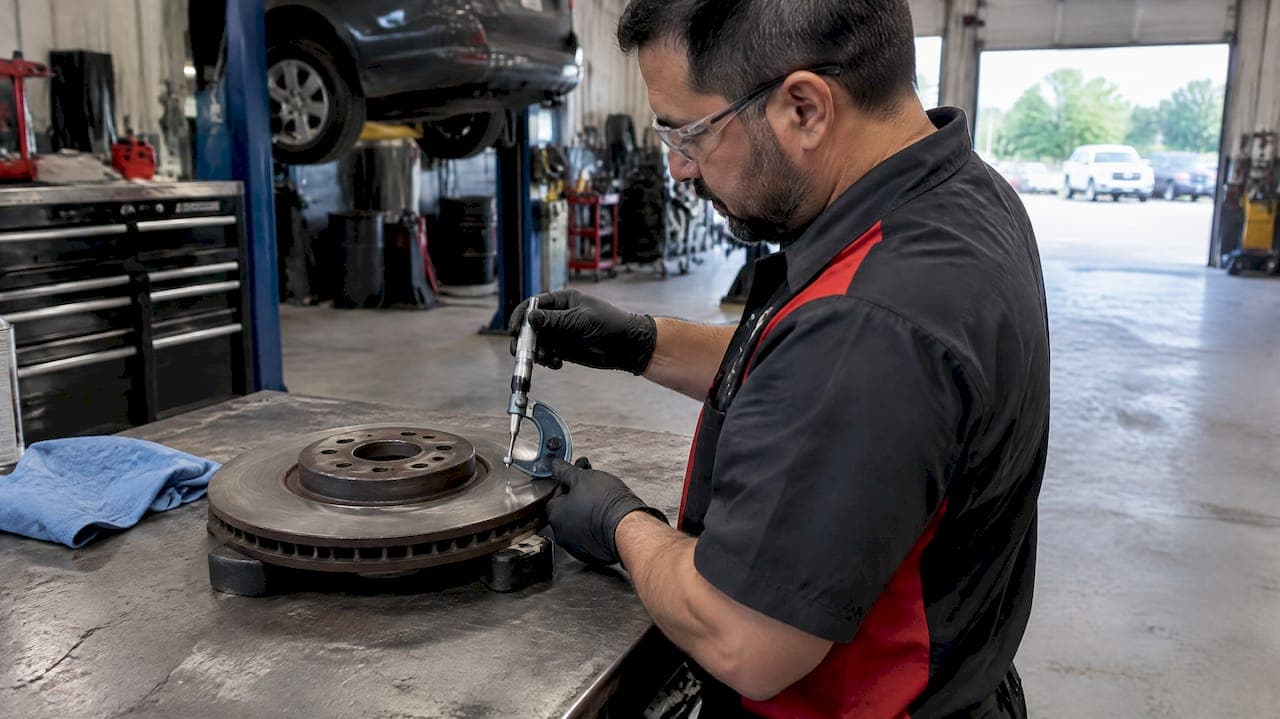
If your lowest measured rotor thickness is at or below the rotor's stamped MIN TH or the vehicle manufacturer's wear limit, replace the rotor. Measure with a calibrated micrometer at four or more points around the braking track, then use the lowest reading, not an average. Inspection rules in jurisdictions such as Ontario follow this same stamped or manufacturer wear-limit approach.
TL;DR:
- Rotors should be replaced if their lowest measured thickness is at or below the stamped MIN TH or the vehicle's wear limit, with four or more measurements needed for accuracy.
- Thinner rotors cannot safely dissipate heat and are more prone to cracking, warping, and disc thickness variation, which causes vibrations and uneven pedal feel.
- Use a calibrated disc micrometer to measure at least four evenly spaced points, avoiding grooves or rust, and record the lowest value for decision-making.
- When considering resurfacing, ensure the post-turn thickness remains well above MIN TH, as machining close to the limit risks compromising rotor safety.
- Symptoms like pedal pulsation, steering wheel vibration, or noise often indicate disc thickness variation, which can often be corrected through measurement and turning if within safe margins.
Table of Contents
- What minimum rotor thickness means and why it matters
- Where to find the minimum thickness: rotor stamp, service manual and parts data
- How to measure rotor thickness: tools and step-by-step method
- Where exactly to measure and how many points (measurement grid)
- When to replace: thresholds, conservative margins and inspection notes
- Resurfacing versus replacement: machining limits and practical trade-offs
- Disc thickness variation (DTV) and other signs to measure or repair
- Technician best practices: calibration, recordkeeping and quality control
- Author perspective: balancing technician judgement and conservative safety practice
- Ready to replace a worn rotor
- Sources
- FAQ
What minimum rotor thickness means and why it matters
A new rotor has a nominal thickness. Over time, pad contact wears that surface down. The minimum thickness, often stamped as MIN TH, is the discard point set below the nominal figure.
Thinner rotors hold less heat and flex more under braking force. That raises the risk of cracking, warping, or heat-related failure during hard stops. A worn rotor is also more prone to disc thickness variation, known as DTV, where thickness differs around the rotor's circumference. DTV changes pedal feel and can cause vibration through the steering wheel or brake pedal.
Where to find the minimum thickness: rotor stamp, service manual and parts data
Most rotors carry a stamped minimum thickness on the hub, the outer edge, or the hat area. Common labels include "MIN TH" or "DISC MIN." Road grime and corrosion can obscure the stamp, so a clean surface and good light help.
When no stamp is visible or legible, check the vehicle service manual or OEM technical data. Rotor minimum thickness is often listed directly in the rotor section of professional service specification databases alongside measuring diagrams. Cross-check any online parts listing against the physical stamp before relying on it.
How to measure rotor thickness: tools and step-by-step method
A disc micrometer built for brake rotors gives the most reliable reading. A calibrated digital micrometer also works. A vernier caliper is a poor substitute here, since the tolerance between usable and discard thickness is often under a millimetre, and a caliper's jaws can't match a micrometer's precision on a curved braking surface.
- Clean the braking surface with a rag to remove dust, rust, and brake deposits.
- Choose a measuring band on the braking track, avoiding grooves, lips, or the hat area.
- Take at least four equally spaced measurements around the rotor.
- Record each reading along with the wheel position.
- Identify the lowest value across all four points.
Pro Tip: Zero the micrometer before each session, skip any spot with visible grooves or rust pitting, and measure the same radial band on both sides of the rotor to catch disc thickness variation.
Where exactly to measure and how many points (measurement grid)
Measure at least four points spaced evenly around the braking track, staying clear of the chamfered edge and the hat. A tight spread between readings usually points to even wear. A wide spread, even a few tenths of a millimetre, often signals DTV rather than uniform thinning.
- Avoid placing the micrometer over deep grooves or scoring, since this gives a false low reading.
- Clean the surface first, since brake dust and light corrosion add false thickness.
- Measure the same circumferential band on each side to compare true radial variation.
When to replace: thresholds, conservative margins and inspection notes
The rule is direct: if the lowest measured thickness is at or below the stamped MIN TH or the vehicle manufacturer's wear limit, the rotor should be replaced. There's no safe case for running thinner.
Many shops build in a margin beyond the bare minimum. A common practice is to replace rather than machine once remaining thickness sits within about 0.5 millimetres of the discard figure, since a rotor that thin has little life left after resurfacing.
This approach lines up with formal inspection standards. Ontario's vehicle safety inspection regulation requires a disc to be no thinner than its stamped dimension or, where no stamp exists, the manufacturer's wear limit. The bonded lining pad limit is set separately at 1.5 millimetres. Our guide to disc inspection triggers covers how these thresholds apply during routine checks.

Resurfacing versus replacement: machining limits and practical trade-offs
Turning a rotor removes material to correct runout or DTV. It should never bring the rotor to or below MIN TH. If the post-turn thickness would land close to that line, replacement is the safer call.
Machining still has a place when:
- Remaining thickness leaves enough margin after the cut.
- The DTV found is within a range that turning can correct.
- The cost of machining compares favourably against a full replacement.
Pro Tip: Ask a shop for the actual DTV figure before approving a resurface. Our post on the rotor warping myth outlines the DTV threshold technicians commonly use to decide between turning and replacing.
Disc thickness variation (DTV) and other signs to measure or repair
Pedal pulsation, steering wheel vibration under braking, uneven pad wear, and a grinding or scraping noise all point toward a rotor that needs measuring. These symptoms often trace back to DTV rather than overall thinning.
A technical paper on fault detection in brake rotors found that DTV as small as 0.01 inch, roughly 0.25 millimetres, can produce vibration that's noticeable to the driver and detectable through vehicle signals. That's why a four-point measurement grid matters: a single reading can miss a variation that small. For a deeper look at symptoms and fixes, see our brake vibration diagnosis guide.

When DTV is within a correctable range, machining often resolves it. When thickness after correction would approach MIN TH, replacement is the better option.
Technician best practices: calibration, recordkeeping and quality control
Repeatable results start with consistent habits.
- Zero or verify the micrometer before each measurement session.
- Clean the braking surface fully before taking any reading.
- Use the same measuring positions and the same tool for both sides of an axle.
- Record the vehicle, axle position, each individual reading, the tool used, and technician initials.
- File the measurements with the service record for future reference.
Pro Tip: Mark the margin between measured thickness and MIN TH on the work order, and decline to resurface a rotor sitting close to that line. A short-life part costs the customer more in the long run. Heavy brake dust or corrosion can throw off a reading, so a safe cleaning method before measuring helps avoid a false result. Our drilled rotor noise guide covers related surface issues that can affect both noise and measurement accuracy.
Author perspective: balancing technician judgement and conservative safety practice
Manufacturers set MIN TH for a reason, and the margin between a worn rotor and a dangerous one is often thinner than people expect. When a measurement lands close to that line, I favour replacement over a judgement call that saves a customer a small amount today.
Keep the readings. Explain the numbers plainly. A documented decision protects the technician and the driver, and it costs nothing compared to a brake failure.
— Sam
Ready to replace a worn rotor
A rotor at or below its minimum thickness isn't a part to patch, it's a part to swap. There are sellers offering engineered, Canadian-made brake kits with cross-drilled rotors designed to resist warping over repeated heat cycles. Pricing is typically transparent, and shipping policies vary.
Browse brake rotors by application to find a replacement matched to your vehicle, or check the Performance XDB, Premium Black Kote, and Performance SS lines if you're replacing rotors and pads together as a kit. If you need your order faster, expedited shipping is available at checkout. Knowledgeable support is available if you're unsure which rotor fits your vehicle, no automated runaround required.
Sources
For jurisdictional discard limits, Ontario's safety inspection regulation sets the legal baseline. For measurement procedure and OEM specification lookups, Mitchell1's rotor specification data is a standard professional reference. For DTV detection research, the PHM Society's fault detection paper covers the underlying technical basis.
- R.R.O. 1990, Reg. 611: Safety inspections
- Rotor Specifications - Mitchell1
- Fault detection and isolation for brake rotor thickness variation
FAQ
Is 4mm too low for brake pads?
Pad wear limits vary by manufacturer, but many pads list a minimum friction thickness well below 4 millimetres, so 4 millimetres alone doesn't confirm a problem. Check your pad's specific wear indicator or manufacturer spec rather than relying on a single number across all vehicles.
How do I know if my rotors are too thin?
Measure the braking track at four or more points with a micrometer and compare the lowest reading to the rotor's stamped MIN TH or the manufacturer's wear limit. If that lowest reading is at or below the stamped figure, the rotor is due for replacement.
What thickness should you replace rotors with?
There's no single universal replacement thickness, since each rotor has its own nominal and minimum figures set by the manufacturer. Check the stamped specification on the rotor hub or the OEM service data for your specific vehicle before buying a replacement.
Is 2mm bad for brakes?
A reading that low almost always sits at or below the discard limit on nearly every rotor design, since most minimum thickness specifications are measured in whole millimetres above that point. Treat a 2 millimetre reading as a clear sign to replace the rotor rather than attempt any further use or machining.