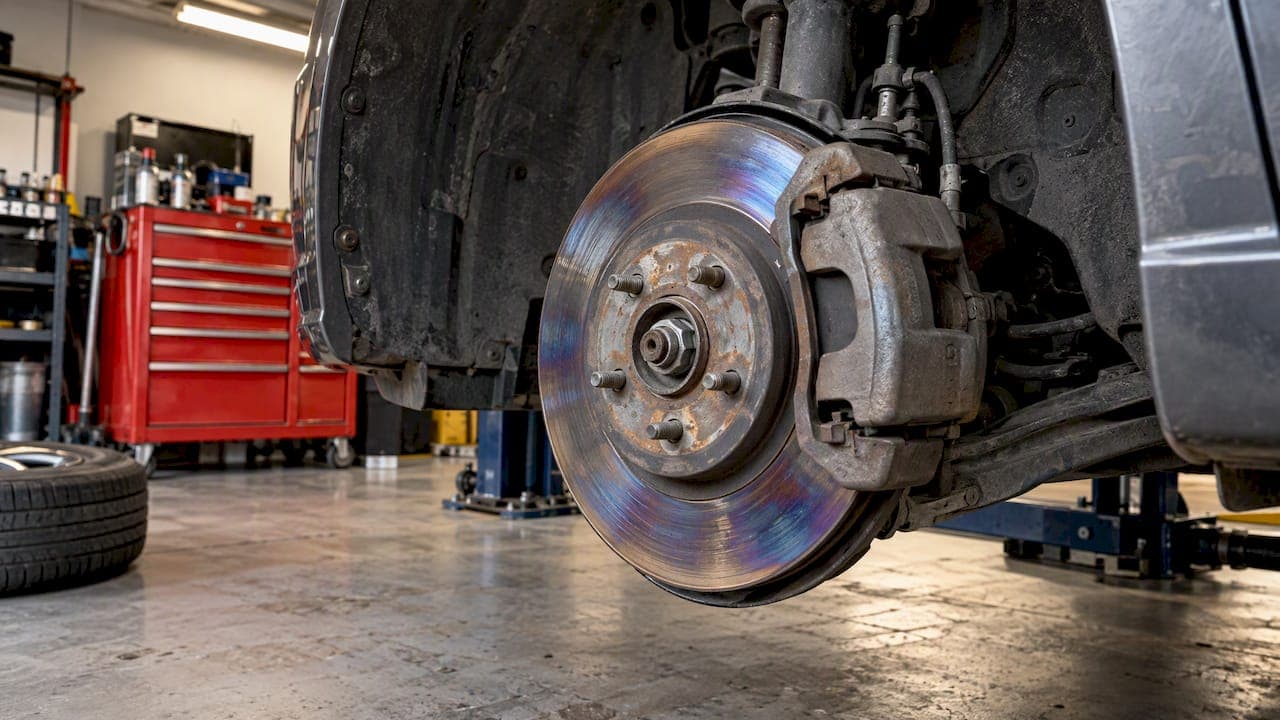
Blue, violet or gold colour on a new rotor means the metal has been overheated. Technical guidance on thermal damage treats this colouring after installation as evidence that the friction surfaces got too hot. A faint tint on the edge of a rotor is one case. Deep blue across the friction face, raised hard spots, cracks, pulling to one side or a burning smell is another. The first case needs watching. The second needs a brake inspection before further driving.
This guide covers what causes bluing on new rotors, how to judge how serious it is, what to do next and how to bed in new brakes so heat stays under control.
TL;DR
- Blue or violet colour on new rotors is a heat mark. It is not a cosmetic finding.
- Common causes: a sticking caliper, poor bedding-in, incorrect pad or caliper assembly, excess hub run-out, and aggressive use too soon.
- Severe bluing, raised hard spots or cracks mean the rotor must be replaced, not machined.
- Grinding, smoke, a burning smell or a pull to one side: stop driving and arrange an inspection.
- Clean new rotors as the maker directs, then bed in the pads and rotors with gentle, repeated stops.
Table of Contents
- What blue colouring on a rotor means
- Why new rotors turn blue
- Harmless tint or real damage?
- What to do when a new rotor turns blue
- Pulsing, squealing and noise after install
- Cleaning and bedding in new rotors
- Preventing blue rotors on the next set
- Our view on blue rotors
- Replacement brakes for Canadian vehicles
- FAQ
- Sources
What blue colouring on a rotor means
Rotors are cast iron. Heat changes the surface of cast iron in steps, and colour shows how far the change went. Light straw or gold tones point to moderate heat. Blue and violet point to much higher temperatures. The colour is a record of a heat event that already happened.
The ALLDATA Canada brake inspection guide states that blue or dark-gold rotors indicate overheated brakes and need a complete inspection. It also warns against touching calipers or rotors, since they may be very hot.
YourMechanic explains that blue heat spots are overheated, tempered metal. Such metal may wear unevenly, form a bulge and produce grinding. Its advice is to replace rotors that show heat spots.
Two points follow from this:
- Blue colour is a symptom. The cause is something that made the brakes run hotter than they should.
- If the cause is not found and fixed, a replacement rotor can turn blue again.
Why new rotors turn blue
The TecAlliance technical guide lists the usual causes of blue, violet or golden colouring after installation: poor bedding-in, excessive hub run-out, incorrect caliper or pad assembly, and overloading or aggressive use. Each is covered below.
A sticking or frozen caliper
A caliper that does not release keeps the pad pressed on the rotor. The brake drags on every kilometre driven. Brake & Frontend notes that a sticking or frozen caliper can keep pads dragging, which causes uneven wear, steering pull and increased heat. A piston may stick so that the brake fails to release.
Signs of a dragging brake:
- One wheel is much hotter than the others after a short drive.
- The vehicle pulls to one side when braking, or drifts when not braking.
- A burning smell comes from one wheel.
- The car feels slow to roll or fuel use rises.
On one corner only, the bluing is a strong clue that the caliper, slide pins or brake hose on that side needs attention. Old calipers can seize at the slide pins or the piston. Fitting new rotors and pads on a tired caliper is a common route to a blue rotor within days.
Poor bedding-in
New pads and rotors need a controlled break-in so that a thin, even layer of pad material transfers to the rotor. Skipping this and going straight to hard braking, such as a steep descent or a highway stop from high speed, can overheat unbedded surfaces. TecAlliance warns that improperly bedded friction surfaces can overheat, change metallurgically and lead to reduced efficiency, vibration and worsening wear. The bed-in steps are set out further down.
Incorrect pad or caliper assembly
Assembly faults hold the pad against the rotor or let it contact unevenly. Examples:
- Pads installed in the wrong position or the wrong way round.
- Slide pins left dry, dirty or corroded, so the caliper cannot float.
- Hardware clips missing or reused when worn.
- A pad that is slightly too thick or the wrong shape for the caliper bracket.
- Pads and rotors that do not match in type or design. The pad and rotor matching guide explains why the pairing matters.
A rotor that shows a blue band in one narrow strip often points to a pad that is not making full contact across the face.
Hub run-out and rust on the hub face
If the hub face has rust, dirt or damage, the rotor does not sit flat. It wobbles slightly as it turns, and the pads touch it on every revolution. That constant light contact creates heat, uneven wear and pulsing. TecAlliance lists excessive hub run-out among the causes. The rotor runout symptoms guide describes how to spot and confirm it. Clean the hub face and check run-out with a dial indicator before fitting the rotor. A worn wheel bearing adds to the problem, so a bearing with play should be replaced at the same visit. The wheel bearings and hubs collection lists matching parts.

Aggressive use or heavy loads too soon
Towing, a loaded vehicle, mountain roads and track-style driving all put extra heat into the brakes. Doing this on fresh, unbedded pads can push surface temperatures past what the parts can handle. The heat dissipation guide covers how rotors shed heat and why the 300°C range matters.
Brake fluid, hoses and parking brake
Other faults can leave a brake partly applied: a collapsed rubber brake hose, a rear parking brake cable that does not release, or a master cylinder issue. These show up the same way as a sticking caliper, with heat at one or more wheels. A technician can check each in a short inspection.
Harmless tint or real damage?
Not every colour change is a failure. New rotors often carry a protective coating, and normal pad contact leaves a polished band. A slight surface variation during the first drives is expected. The TecAlliance guide separates this from harmful discolouration. Use the table below as a first check, not a final verdict.
| What is seen | Likely meaning | Action |
|---|---|---|
| Even, polished grey band where the pads touch | Normal pad contact | None |
| Light straw or gold tint at the rotor edge, no symptoms | Moderate heat, possibly from early use | Check bedding-in, monitor, re-inspect after a week |
| Blue or violet patches on one rotor only | Dragging brake or uneven pad contact | Inspect caliper, slide pins, hose and pads before more driving |
| Deep blue across the friction face | Severe overheating | Replace rotor and find the cause |
| Dark spots that feel raised or hard | Heat-induced hard spots | Replace rotor, no resurfacing |
| Visible cracks | Structural damage | Stop driving, replace rotor |
| Pulling, smoke, burning smell or grinding | Active fault | Stop driving, arrange an inspection |
A Volkswagen technical bulletin filed with the U.S. regulator says rotors with severe bluing, high-heat raised hard spots or visible cracks are not serviceable and must be replaced. The bulletin is a U.S. document for specific vehicles, but the principle is a conservative one that applies broadly.
Resurfacing is not a cure for hard spots. Brake & Frontend says hard spots extend beneath the visible surface, so machining may leave the underlying problem in place. The existing guide on hot spots on rotors goes through further checks.
What to do when a new rotor turns blue
Follow these steps in order.
- Stop hard driving. Avoid towing, steep descents and sudden high-speed stops until the cause is known.
- Let the brakes cool fully. Do not touch the rotor or caliper after driving. ALLDATA warns that they may be very hot.
- Clean the wheel and look. Brake dust hides marks and hot spots. A short guide on how to remove brake dust safely helps get a clear view of the rotor face once everything has cooled.
- Compare the sides. Blue on one corner only points at that caliper. Blue on all four points at bedding, pad type or driving use.
- Check the caliper. Slide pins should move freely. The piston should retract. The pad should move in its bracket by hand.
- Check the hub face and run-out. Look for rust or debris behind the rotor and measure run-out.
- Replace what is damaged. Rotors with severe bluing, hard spots or cracks are replaced. Pads that have overheated are usually replaced with them, since overheated pads can glaze.
- Fix the cause before refitting. A seized caliper, collapsed hose or bent hub needs repair first.
- Bed in the new parts correctly using the steps below.
When to stop driving
A Canadian repair shop explains that a light squeak during the first few hundred kilometres can occur while new pads and rotors bed in. Persistent squeal after that period, pulsing, longer stops, pulling, smoke or a burning smell warrants inspection. Grinding or smoke calls for stopping driving and arranging an inspection.
In plain terms:
- Keep driving gently and watch: a faint tint, no noise, no pull, normal pedal, and a short bed-in period still running.
- Stop and get an inspection: grinding, smoke, strong burning smell, pedal that goes soft or long, one wheel far hotter than the others, or a car that pulls hard.
If the vehicle can still be driven safely, a short, slow trip to a shop is reasonable. If smoke is rising from a wheel, park and arrange a tow.
Pulsing, squealing and noise after install
Blue rotors can come with pulsing, squeal or a slow-to-fade noise. Pulsing at the pedal is a common sign of uneven rotor wear or run-out. Heat spots make it worse, because hard areas wear differently from soft ones. The new brake noise checklist lists what a technician looks at after the first 200 to 300 miles, about 320 to 480 km.
New brakes can also smell for a short time. The new brakes smell article explains that a few days of faint odour is normal, while one wheel smoking is not.
Rust is a separate matter. A rust film on a rotor face is common after wet or salted roads and often wears off. The rotor rust guide explains how to tell surface film from damage. Canadian winters bring road salt, so rotors that sit unused for a week may look orange before they look blue.
Cleaning and bedding in new rotors
Most bluing on new parts traces back to a bad start. Two steps matter: preparation and bed-in.
Preparing the rotor
Many new rotors ship with an anti-corrosion coating. Whether to remove it depends on the maker's instructions, so follow the sheet in the box. The guide on how to clean new rotors before installation gives the general method. Keep fingerprints and grease off the friction face. Use brake cleaner only on the friction surface, never on the hat area where it could run into bearings or paint.
Bedding in
Bedding in means a series of gentle stops that warm the pads and rotors gradually and lay down an even transfer layer. Many technicians use a routine known as the 30/30/30 rule: roughly 30 moderate stops from about 30 mph (50 km/h), with about 30 seconds of cooling between stops. Pad makers publish their own procedures, and some differ. Use the one packed with the pads.
General principles hold across most procedures:
- Do not bring the vehicle to a complete stop with the pedal held down once the brakes are hot. That can imprint pad material on one spot of the rotor.
- Keep cooling time between stops. Do not make repeated hard stops back to back.
- Avoid towing, heavy loads and hard braking during the break-in period.
- After bed-in, drive a few minutes with light braking so the brakes cool before parking.
Preventing blue rotors on the next set
Small habits lower the chance of heat marks:
- Replace or service worn calipers, slide pins and hardware at the same time as rotors.
- Clean the hub face and check run-out.
- Match the pad compound to the rotor and to how the vehicle is used.
- Torque wheel nuts in a star pattern to the specified value. Uneven torque can distort a rotor.
- Bed in new parts before hard use.
- Downshift on long descents and let the engine share the load.
The article on habits that prevent rotor warping covers these in more detail. If rotors are replaced without pads, the page on replacing rotors without pads explains why thickness and run-out are worth checking.
Our view on blue rotors
We see the same pattern often. A driver fits new rotors, drives hard in the first week and sees blue marks. The rotor is blamed, though the cause was usually in the rest of the system: a tired caliper, a dry slide pin, a dirty hub face or skipped bed-in.
Our rotors are engineered to resist warping and to last, and our kits are built so that rotors, pads and hardware are chosen to work together. That is the point of a kit. Fewer mismatched parts means fewer surprises after install. Fitment is guaranteed, and a person answers questions, with no automated replies.
If a rotor on any vehicle shows severe bluing, hard spots or cracks, replace it and fix the cause first. Then bed the new parts in with care. Send the make, model and a photo to our support team and a technician will help check what is going on.
Sam
Replacement brakes for Canadian vehicles
When rotors are past saving, replace them as a set with matched pads. DBC sells cross-drilled rotors and brake kits for cars, trucks and performance vehicles. Pricing is inclusive, with no hidden fees, and shipping within Canada is free on orders over $100. Expedited shipping is $29.99 per order. Browse the brake kits collection, brake rotors or brake pads. Details are on the shipping information page.
Enter the vehicle make, model and year on the site to see parts that fit. Replace both rotors on an axle at the same time. Inspect calipers, hoses and slide pins before the new parts go on.
FAQ
Are blue rotors after install normal?
A faint tint or a polished band is common. Strong blue or violet colour is not normal on new rotors, because it records overheating. Check for a sticking caliper, incorrect assembly and skipped bed-in. Severe bluing, raised hard spots or cracks mean replacement.
Can I drive with blue rotors?
It depends on the symptoms. With a faint tint, normal pedal feel and no pull, gentle driving while the parts bed in is reasonable. With grinding, smoke, a burning smell, pulling or a pedal that feels wrong, stop driving and arrange an inspection.
Can blue rotors be resurfaced?
Heat spots can extend below the visible surface, so machining may not remove the problem. Service guidance cited above says rotors with severe bluing, hard spots or cracks must be replaced. A technician can measure thickness and judge.
What is the 30/30/30 rule for brakes?
It is a bed-in routine: about 30 moderate stops from roughly 30 mph (50 km/h) with about 30 seconds of cooling between stops. It applies to new pads and rotors. Pad makers may publish a different procedure, and the one in the box takes priority.
How long do new brakes take to stop making noise?
A light squeak in the first few hundred kilometres can be part of bedding in. Noise that continues beyond that, or comes with pulsing, pulling or a burning smell, needs an inspection.
Sources
- INCORRECT ASSEMBLY MISUSE/THERMAL DAMAGE, TecAlliance
- Brake Rotors & Calipers, Brake & Frontend
- Guide to Brake Inspection, ALLDATA DIY Canada
- How to Install New Rotors, YourMechanic
- Brake Rotor Vibration / Pulsation bulletin 46-19-02, NHTSA
- Why Are My Brakes Squeaking? West Yale Auto
- Remove Brake Dust Safely, Diamondbrite