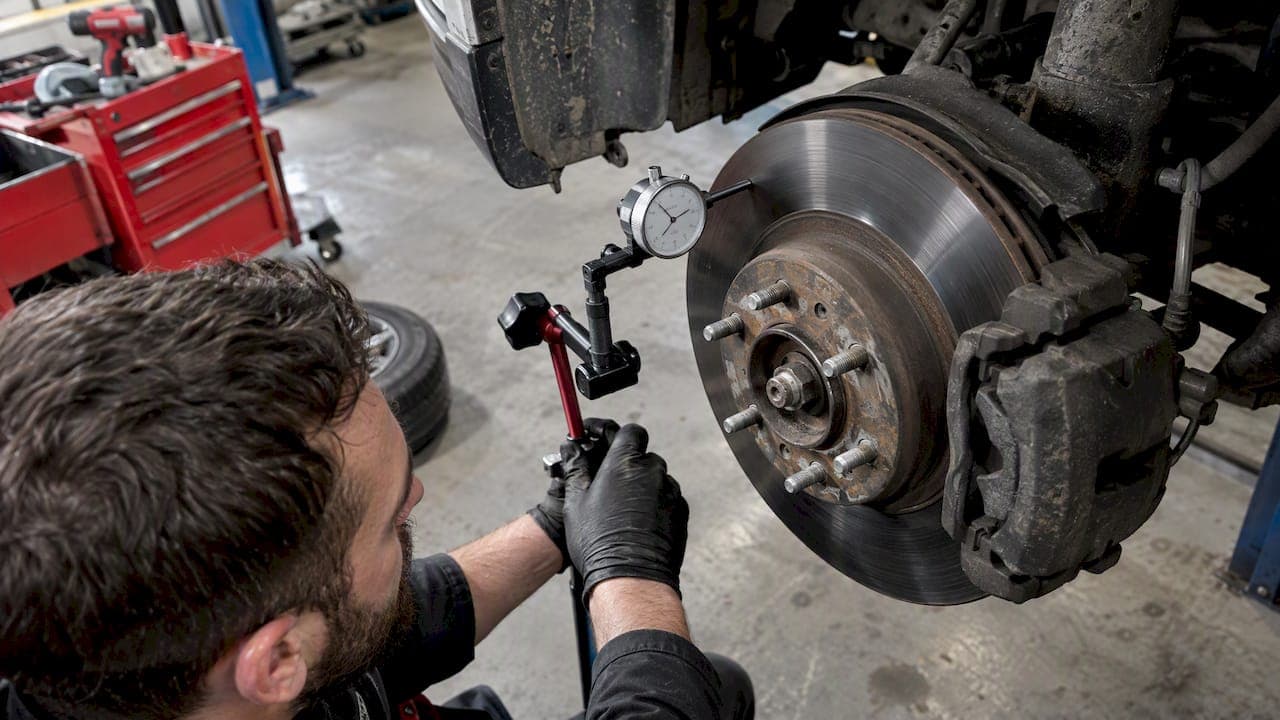
Rotor runout shows up as a pulsing brake pedal, vibration in the steering wheel or seat during braking, and uneven pad and rotor wear. Runout is the side-to-side wobble of a rotor as it spins. A dial indicator confirms it. Cleaning the hub, re-torquing the wheel and checking the bearing fix most cases.
This guide lists each symptom, explains what causes it and shows how a shop or a careful DIYer confirms it. It also covers what to do when the numbers are out of range.
TL;DR
- Main symptoms: brake pedal pulsation, steering wheel or seat vibration under braking, and uneven pad wear.
- Runout is a measurement of wobble. Most pulsation comes from thickness variation that excess runout creates over time.
- Confirm it with a dial indicator, with the rotor clamped to the hub as it is when mounted.
- Clean the hub face and check the wheel bearing before replacing rotors. Otherwise new rotors can repeat the problem.
- Runout beyond spec means indexing, machining or replacement, depending on the numbers.
Table of Contents
- What rotor runout is
- Rotor runout symptoms
- Symptom checklist
- Causes of excess runout
- How to confirm runout
- What the numbers mean
- What to do when runout is out of range
- Is it safe to keep driving?
- Our view on runout
- Rotors, pads and bearings from DBC
- Prevention after installation
- FAQ
- Sources
What rotor runout is
A brake rotor should spin flat against its hub. Lateral runout is how far the friction surface moves side to side during one turn of the wheel. The movement is small, measured in hundredths of a millimetre or thousandths of an inch.
Two terms matter:
- Lateral runout (LRO): side-to-side movement of the rotor face.
- Disc thickness variation (DTV): differences in thickness around the rotor, measured with a micrometer.
The two are linked. SAE J3111 is the recommended practice that covers both thickness variation and lateral runout measurement for vehicles under 4,540 kg gross weight. Shops and manufacturers treat them as a pair for a reason.
Why "warped rotor" is usually the wrong label
Most drivers say a rotor is warped when the pedal pulses. In most cases the rotor did not bend from heat. Technicians interviewed by Autosphere point to uneven pad contact, and to rust or dirt on the hub surface, as common causes of braking vibration. The rotor then wears unevenly and develops thickness variation.
The chain looks like this:
- The rotor does not sit perfectly flat on the hub.
- The pads touch one part of the rotor harder on each turn.
- That spot heats and wears differently.
- Thickness variation builds up.
- The variation is felt as pulsation.
For a deeper look at this point, see the article on the rotor warping myth.
Rotor runout symptoms
Symptoms rarely appear on day one. Mitchell service information notes that pedal pulsation typically develops some 4,800 to 11,300 km (3,000 to 7,000 mi) after runout exceeds specification. A rotor can feel fine after installation and start to pulse months later.
1. Brake pedal pulsation
This is the most common sign. The pedal pushes back against the foot in a rhythm that follows wheel speed. It is usually light under gentle braking and stronger as speed rises. Pulsation that only appears under hard braking from highway speed often points to early thickness variation.
2. Steering wheel shake
Front rotors send vibration through the steering. The wheel shimmies side to side during braking, mostly from highway speed. The shaking stops when the brake is released. Shaking at constant speed with no braking points elsewhere: tire balance, bent wheels or worn suspension parts.
3. Seat or floor vibration
Rear rotors with runout produce vibration in the seat or floor rather than the steering wheel. The steering stays steady while the body of the vehicle shudders.
4. Uneven pad and rotor wear
Pads wear more on one side or show polished and dull patches. The rotor face shows bands or shiny spots. Technicians check for hot spots on the rotor and for even pad wear during a brake inspection.

5. Light drag or rubbing noise
A rotor that wobbles can brush the pad lightly even with the pedal released. The result is a faint rhythmic rub, extra heat at one wheel and reduced pad life.
6. Clicking or looseness from the wheel
Roughness, looseness or noise from the wheel bearing is a sign of bearing damage. A worn bearing allows the hub to wobble, and the rotor wobbles with it. Check the bearing before blaming the rotor.
Symptom checklist
| Symptom | Where it is felt | Likely link to runout |
|---|---|---|
| Pulsing pedal | Brake pedal | High: runout or thickness variation |
| Steering shimmy when braking | Steering wheel | High on front axle |
| Seat or floor shudder when braking | Body | High on rear axle |
| Vibration with no braking | Whole vehicle | Low: check tires, wheels, suspension |
| Uneven pad wear | Visible at inspection | Medium to high |
| Rhythmic rubbing | Heard near one wheel | Medium: runout, bearing or caliper drag |
Causes of excess runout
Runout rarely comes from the rotor alone. The usual sources are:
- Rust or debris on the hub face. Cleaning the hub surface of rust and debris before installation prevents "fake" runout from uneven seating, according to Mitchell service data. This step is often skipped.
- Uneven wheel nut torque. Tightening nuts in the wrong order or with an impact wrench can pull the rotor hat out of plane.
- Worn wheel bearing or hub. Play in the bearing moves the rotor face.
- Poor rotor quality. Rotors machined out of tolerance start with runout built in.
- Mismatched parts. Pads and rotors that do not work together can wear unevenly. See the guide to matching pads and rotors.
Bearings are part of the same system. DBC lists wheel bearings and hubs for vehicles where the hub is the source of the wobble.
How to confirm runout
Symptoms suggest a problem. Numbers confirm it. The method matters, because a poor measurement gives a wrong answer.
Tools
- Dial indicator with a magnetic or fixed base
- Micrometer for thickness variation
- Wheel nuts with spacers, or a clamping plate
- Torque wrench
- Wire brush and brake cleaner
Steps
- Check thickness variation first. Mitchell notes that thickness variation must be checked before assembled lateral runout, since excess variation alone can cause pulsation.
- Lift the vehicle and remove the wheel. Support it on stands.
- Clean the hub face. Remove all rust and debris.
- Secure the rotor. Use wheel nuts with spacers or a clamping plate. Tesla's service procedure uses a clamping plate at 100 Nm (73.7 lb-ft) to simulate a mounted wheel.
- Set up the indicator. Place the tip 10 to 15 mm from the outer edge of the friction surface, as in the same procedure.
- Rotate the rotor slowly. Read the total swing from low to high. Mark the high and low spots.
- Check the bearing and hub separately. A rotor bolted to a bad hub gives a false rotor reading. Hub face runout needs its own measurement.
A longer walk-through is in the article on accurate rotor runout measurement.
Why a bare rotor reading misleads
A rotor measured loose on a hub ignores the clamping force of the wheel. Technicians measure assembled lateral runout (ALRO) for this reason. GM's GMW14933 standard addresses assessment of assembled lateral runout and thickness variation on the vehicle.
What the numbers mean
There is no single limit. Each manufacturer sets its own, and some inspection programs set a hard reject point.
| Source | Figure | Note |
|---|---|---|
| SGI Saskatchewan light vehicle inspection | 0.3 mm (0.012 in) | Reject limit for lateral runout |
| Tesla Model Y service manual | 0.050 mm total | 2025 procedure |
| BMW bulletin SI B34 01 14 | 0.030 mm | Maximum thickness difference |
The three figures measure different things. The Saskatchewan figure is a roadworthiness limit, the Tesla figure a service specification, and the BMW figure a thickness limit. They cannot be compared directly. The correct value for a given vehicle is in its own service manual.
BMW's bulletin also states that runout is not an acceptable measurement for diagnosing brake vibration under warranty. A thickness variation check is required instead. Some makers therefore treat thickness variation as the primary measure.
What to do when runout is out of range
The fix depends on the reading and on the cause.
- Reclean and re-torque. Remove the rotor, clean the hub and rotor mating faces, refit, and torque the wheel nuts in a star pattern to spec. Measure again.
- Index the rotor. Technicians use an indexing method when runout is slightly out of spec, in the 0.025 to 0.127 mm range. Remove the rotor, turn it by one or more studs, and measure again. The aim is the lowest combined runout.
- Machine on the vehicle. An on-vehicle lathe cuts the rotor face true to the hub. Tesla's procedure lists this as an option where possible.
- Replace the rotor. If thickness variation is high or the rotor is near minimum thickness, replace it. Replace pads at the same time in most cases. See replacing rotors without pads.
- Replace the bearing or hub. If the hub face or bearing has play, fix it first. Otherwise a new rotor will wobble the same way.
Technicians say that swapping "warped" rotors without cleaning the hub or checking runout leads to the same vibration soon after. The Autosphere report makes the same point.
Is it safe to keep driving?
Mild pulsation is not an immediate failure. It is a sign that the brakes need attention. Several situations call for a shop visit soon:
- The pedal pulses hard enough to feel like a loss of control.
- The steering shakes hard enough that the vehicle pulls during braking.
- The vehicle pulls to one side when braking.
- A burning smell or heat at one wheel appears.
- Braking distances feel longer.
A licensed technician should inspect any of these. Provincial inspections treat rotor condition as a safety item. Saskatchewan sets a 0.3 mm reject limit for lateral runout, and Quebec's mechanical inspection guide lists brake components in its inspection. Rules differ by province.
For related issues, read the brake vibration causes and repair guide.
Our view on runout
We make brake kits in Canada, and we see the same pattern in questions from drivers. A person installs new rotors, the pedal pulses a few months later, and the rotor gets the blame. In many of these cases the rotor was not the starting point. The hub face had rust, the nuts were tightened unevenly, or the bearing had play.
Our advice is plain:
- Treat the hub face as part of the brake job. Clean it every time.
- Torque wheel nuts with a torque wrench, in a star pattern.
- Measure runout when the symptoms appear, and measure thickness variation too.
- Match pads to rotors. The wrong pairing wears the rotor unevenly.
- Choose rotors that come with guaranteed fitment for the vehicle, so the first fitment is not a variable.
Cross-drilled rotors are engineered at DBC to resist warping and improve durability. Good rotors do not replace good installation. Prep work and measurement decide the result.
— Sam
Rotors, pads and bearings from DBC
When measurement shows a rotor needs replacing, DBC sells brake rotors, brake pads and brake kits for cars, trucks and performance vehicles. Pricing is inclusive, with no hidden fees. Orders over $100 ship free within Canada. Expedited shipping is 29.99 $ per order. Details are on the shipping information page. Customer support is staffed by people, not automated replies.
For wider background, see the Canadian driver's guide to brakes and rotors and the overview of brake upgrades that work.
Prevention after installation
Runout problems are easier to prevent than to repair. A short routine helps:
- Clean the hub face and rotor mounting surface with a wire brush.
- Fit the rotor flat, with no rust or grease between it and the hub.
- Torque wheel nuts to the manufacturer value, in a star pattern, by hand-operated torque wrench.
- Measure assembled runout on any rotor that will be used on a vehicle with a history of vibration.
- Bed in the new pads as the pad maker directs.
- Re-check torque after the first drive.
Drivers who tow, carry heavy loads or drive in mountain terrain generate more heat. Heat does not bend the rotor in most cases, but it exposes weak spots: uneven pad contact turns into hot spots faster under heavy use.
FAQ
How do I tell if a rotor is warped?
The usual sign is a pulsing pedal or a shaking steering wheel when braking. A dial indicator on the clamped rotor confirms lateral runout, and a micrometer confirms thickness variation. Most such rotors are not bent. They have wear patterns from uneven pad contact.
What is the typical rotor runout specification?
It depends on the vehicle. Tesla lists 0.050 mm total for the Model Y. Saskatchewan inspections reject at 0.3 mm. Use the service manual figure for the specific vehicle.
How is rotor thickness variation measured?
A micrometer measures the rotor thickness at several points around the friction surface, in the same band and at the same distance from the edge. The spread between the highest and lowest reading is the variation. SAE J3111 describes the recommended practice.
Is it okay to drive with warped rotors?
Mild pulsation allows short trips to a shop. Strong shaking, pulling to one side, heat or a burning smell need a technician's inspection before further driving. Braking performance is a safety item.
Sources
- SAE J3111: Brake Rotor Thickness Variation and Lateral Run-Out Measurements
- SGI Light Vehicle Safety Inspection Methods and Standards
- Vibration When Braking: Diagnosing and Repairing (BMW service bulletin)
- Tesla Model Y service manual: Measure Runout
- Mitchell service document 5044074
- Autosphere: Brake Inspections, Systematic Safety
- GMW14933: Assessment of Disc Brake Rotor Assembled Lateral Runout and Thickness Variation
- SAAQ Road vehicle mechanical inspection guide