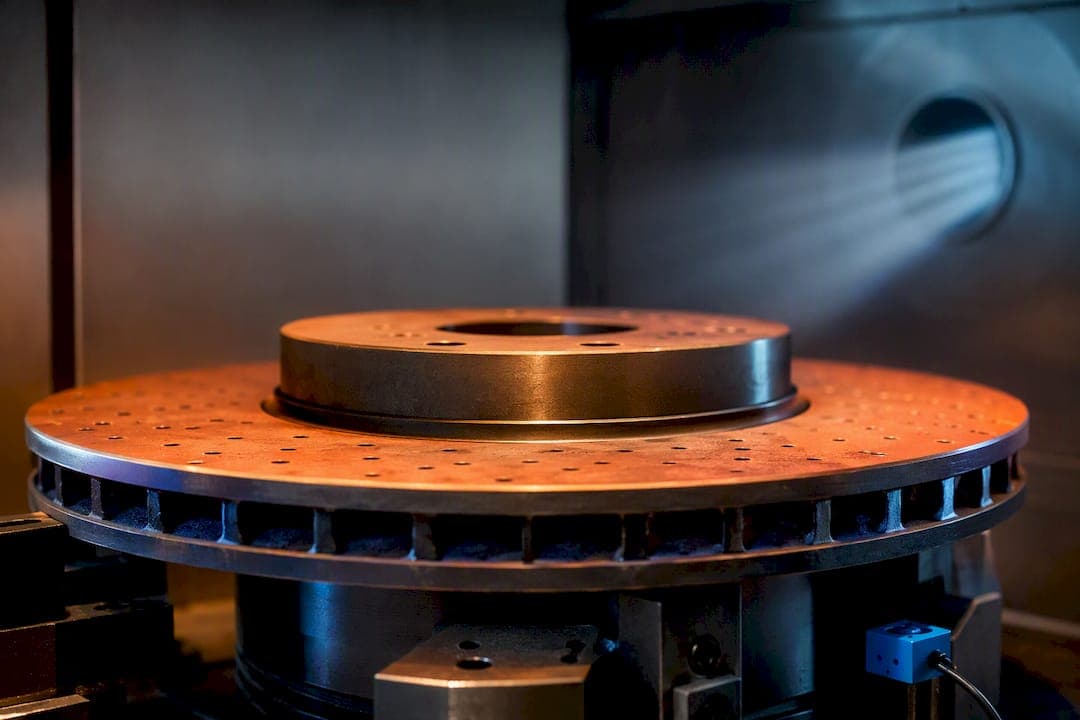
Rotors shed heat through conduction into the hub, convection into passing air, and radiation at extreme temperatures. Material, geometry, and airflow are the three levers that decide how fast that happens. For daily driving, a stock vented rotor with matched pads handles the load. Towing, track days, or long mountain descents demand more surface area, better alloy choices, and sustained airflow to avoid fade.
TL;DR:
- Cross-drilled and hybrid rotors offer improved cooling by increasing surface area and airflow, especially under repeated heavy braking or long descents.
- Proper maintenance, including regular inspection for hairline cracks and correct torque, is essential to prevent heat-related rotor damage and ensure durability.
- Material choices like multilayer and ventilated designs help manage sustained heat cycles, but they come with higher costs and complexity.
- Rotor temperature thresholds for fade, glazing, and fluid boiling are around 260 to 300°C, with real-world interface temperatures ranging from 82°C to 296°C.
- Upgrading to rotors engineered for higher heat dissipation, such as cross-drilled models, is effective when their design accounts for stress concentrations and proper fitment.
Table of Contents
- The physics of rotor heat dissipation
- Which rotor materials handle heat best?
- How rotor geometry improves cooling
- Does vehicle speed affect brake cooling?
- How hot is too hot for rotors?
- How to prevent rotor heat damage
- The manufacturing case for cross-drilled rotors
- Weighing cooling gains against cost and durability
- Upgrade to rotors built for the heat your driving actually generates
- Sources
- FAQ
The physics of rotor heat dissipation
Every stop starts at the pad-rotor interface, where kinetic energy converts to heat almost instantly. That contact ring, usually a narrow band on the rotor face, is where temperatures spike first and hardest. Conduction carries that heat inward through the rotor's iron or steel structure toward the hub and hat. Convection carries it outward into the air moving across the rotor surface and through any internal vanes.
Which path dominates depends on the event. A single hard stop from highway speed relies mostly on conduction and thermal mass, since there isn't time for airflow to matter much. Sustained braking, like a long grade or repeated lapping, shifts the burden onto convection. Radiation only becomes meaningful above roughly 500°C, which is rare outside racing or heavy commercial use.
For a technician estimating peak temperature, the inputs that matter are vehicle mass, speed at brake application, rotor mass, and the surface area exposed to airflow. Engineers modelling this transient behaviour use finite element tools that account for how boundary conditions like airflow and contact pressure change heat flux over time, since a static calculation badly underestimates real-world peaks.
Which rotor materials handle heat best?
Cast iron remains the standard because it balances cost, machinability, and thermal capacity. It retains 84% of its strength at 500°C, which explains why it survives repeated hard stops without warping under normal driving loads. Stainless steel resists corrosion better but conducts heat less efficiently, so it tends to run hotter at the surface for the same energy input.
Aluminium-core sandwich designs cut rotational mass significantly, a real advantage for handling and unsprung weight. The trade-off is thermal conductivity that can outpace the alloy's strength retention under sustained heat, which is why these builds show up more in weight-sensitive or short-duration applications than in endurance use.
Where multilayer construction earns its keep is in applications with constant heat cycling and no cooldown window:
- Endurance braking on long descents, where a single rotor mass never gets to fully dissipate between applications.
- Bicycle disc brakes, where Shimano's ICE Technologies uses a stainless-aluminium-stainless clad rotor to pull heat away from the pad contact area faster than a solid steel disc could manage.
- Any setup pairing a multilayer rotor with finned pad backplates, which further limits how much heat soaks into brake fluid and hydraulics.
The limit is cost and complexity. Multilayer rotors are harder to manufacture and typically show up only where the thermal problem justifies the price.
How rotor geometry improves cooling
Vane geometry inside a ventilated rotor works like a centrifugal pump. As the rotor spins, air gets drawn in near the hub and flung outward through the vanes, pulling heat out of the annulus with it. More vane surface area and better-shaped channels move more air per rotation, which is why plain solid rotors fade faster under repeated braking than vented ones of similar mass.

Drilled and slotted patterns add surface area and vent gases and dust from the pad-rotor interface, but they also introduce stress concentrations around each hole or slot edge. Cross-drilling and slotting increase airflow turbulence and effectively reduce peak rotor temperatures compared with plain vented rotors, and numerical studies comparing solid, drilled, slotted and hybrid patterns consistently find hybrid ventilated designs deliver the lowest peak surface temperatures under comparable loads.
Match the design to the job:
- Daily driving: standard vented rotors handle typical stops without extra maintenance concerns.
- Towing or mountain routes: cross-drilled or hybrid patterns move more heat without the aggressive stress risk of deep slots.
- Track duty: slotted or hybrid designs prioritized for peak cooling, accepting shorter service intervals in exchange.
Pro Tip: Inspect drilled rotor edges for hairline cracking every few thousand kilometres if you tow regularly or drive mountain routes often. Early cracks radiate from the hole edge, not the surface, so a quick visual check catches problems before they spread.
Does vehicle speed affect brake cooling?
Airflow across the rotor face scales with vehicle speed, which is why cooling performance at 80 to 100 km/h looks nothing like a parking lot stop. At highway speed, enough air moves through a ventilated rotor to carry heat away almost as fast as it's generated during normal braking. Repeated hard stops from a track or a loaded trailer on a grade need sustained airflow well beyond what casual driving provides, which is where vane design and rotor mass start to matter more than material alone.
Bicycle rotors face a different problem entirely: low mass concentrated at the pad contact area means temperatures spike fast on long descents, even though the total heat energy is small compared to a car. That's the exact scenario multilayer clad rotors were built for.
Electric vehicles add another wrinkle. Higher curb weight increases stored kinetic energy per stop, but regenerative braking handles much of the everyday deceleration, so the rotors see less frequent but sometimes higher-intensity thermal events during hard stops.

How hot is too hot for rotors?
Transient thermal testing on real braking events shows interface temperatures commonly ranging from roughly 82°C to 296°C, with validated numerical models tracking within 5% of rig measurements. Beyond that range, three practical thresholds start to matter:
- Pad fade, typically starting above 260 to 300°C depending on compound, where friction coefficient drops noticeably.
- Glazing, where excessive heat hardens the pad surface and reduces bite even after cooling.
- Brake fluid boiling, which introduces air into the lines and causes a soft or failing pedal, a separate but related failure mode from rotor overheating.
Measurement matters here. Infrared guns read surface temperature only, missing the higher core temperature at the pad contact zone, and transient readings during active braking differ meaningfully from steady-state readings taken after a stop.
How to prevent rotor heat damage
Consistent maintenance limits how much heat becomes a durability problem. Check disc thickness variation (DTV) regularly; a spec around 0.0006 inches keeps pedal pulsation and uneven heat buildup in check. Confirm proper torque and even clamping load across lug nuts, since uneven clamping concentrates heat unevenly across the rotor face.
Pad selection matters as much as rotor choice. Finned backplates reduce heat soak into the caliper and fluid, which protects pedal feel on long descents.
- Follow a proper bedding procedure on new rotors and pads before subjecting them to hard use.
- Swap front and rear pads after initial bedding cycles to help equalize material transfer, a habit several pad manufacturers recommend.
- On long descents, stage your braking and use lower gears rather than dragging the pedal continuously.
- Flush brake fluid on schedule to keep its boiling point where it needs to be.
Pro Tip: If you're descending a long grade, brake in short, firm applications rather than one long drag. Continuous light braking generates more cumulative heat than a few hard, controlled stops with cooling gaps between them.
The manufacturing case for cross-drilled rotors
The geometry and material principles above explain why DBC Brakes engineers cross-drilled rotors specifically to manage hot spotting and resist warping under repeated heat cycling. The same 0.0006 inch DTV tolerance and installation habits referenced above are the standard DBC Brakes recommends to technicians working on its kits.
Weighing cooling gains against cost and durability
Chasing maximum cooling isn't free. Cross-drilled and hybrid-vented rotors cost more to manufacture, and aggressive geometry can shorten pad life if it's mismatched to how the vehicle is actually driven. A track-tuned rotor on a daily commuter wears pads faster without a meaningful benefit, since the extra cooling capacity never gets used.
Most drivers do better with a ventilated or cross-drilled rotor matched to a pad compound suited for their actual driving. That combination covers the thermal range most people encounter, without the cracking risk that comes from overbuilding a rotor for duty cycles it will never see.
— Sam
Upgrade to rotors built for the heat your driving actually generates
Cross-drilled geometry only pays off when the manufacturing behind it accounts for the stress concentrations it creates. Rotors are engineered specifically to add that airflow and surface area without the cracking risk that plagues poorly designed drilled patterns, often backed with guaranteed fitment and transparent pricing without hidden fees.

Start by checking fitment against your vehicle in the brake rotor collection, or go straight to a matched performance brake kit if you already know your setup. Orders over $100 ship free within Canada, and expedited shipping is available for $29.99 per order if you need parts sooner. For surface care between services, safe brake dust removal with a short dwell time helps protect your rotor finish long after installation.
Sources
- Design and analysis of a disc brake rotor for optimal performance
- Transient thermal behaviour in brake linings and rotors: a mathematical and experimental study
- Step-by-step guide for modeling heat generation in a disc brake (COMSOL)
FAQ
How hot is too hot for rotors?
Fade and glazing risk usually starts above 260 to 300°C depending on pad compound, though rotors themselves can handle higher transient spikes without damage. Documented braking events show interface temperatures ranging from about 82°C to 296°C during real testing, so sustained readings near the top of that range deserve attention to pad choice and cooling.
What is the 30/30/30 rule for brakes?
Definitions vary across the industry, and no single standardized version appears in engineering literature. Generally, drivers use it as a rough bedding guideline involving a series of controlled stops from moderate speed with cooling intervals between them, rather than a fixed engineering specification.
How do I calculate heat dissipation?
Estimating peak rotor temperature starts with vehicle mass, speed at brake application, and rotor mass and surface area exposed to airflow. Engineers refine these estimates using transient thermal models that account for changing boundary conditions like airflow and pad contact pressure, since a simple energy calculation misses how heat actually moves through the rotor over time.
How do I deglaze rotors?
Light glazing often improves with a proper bedding cycle using firm, controlled stops that let the pad transfer material evenly onto the rotor surface. Severe glazing usually requires resurfacing or replacement, since a hardened pad surface layer won't fully recover with driving alone. Checking disc thickness variation at the same time catches uneven wear before it causes pulsation.
Does DBC Brakes sell rotors designed for better heat dissipation?
Yes, DBC Brakes engineers cross-drilled rotors specifically to manage heat and resist warping under repeated braking cycles. Current pricing for kits and rotor lines is available directly on the DBC Brakes site.