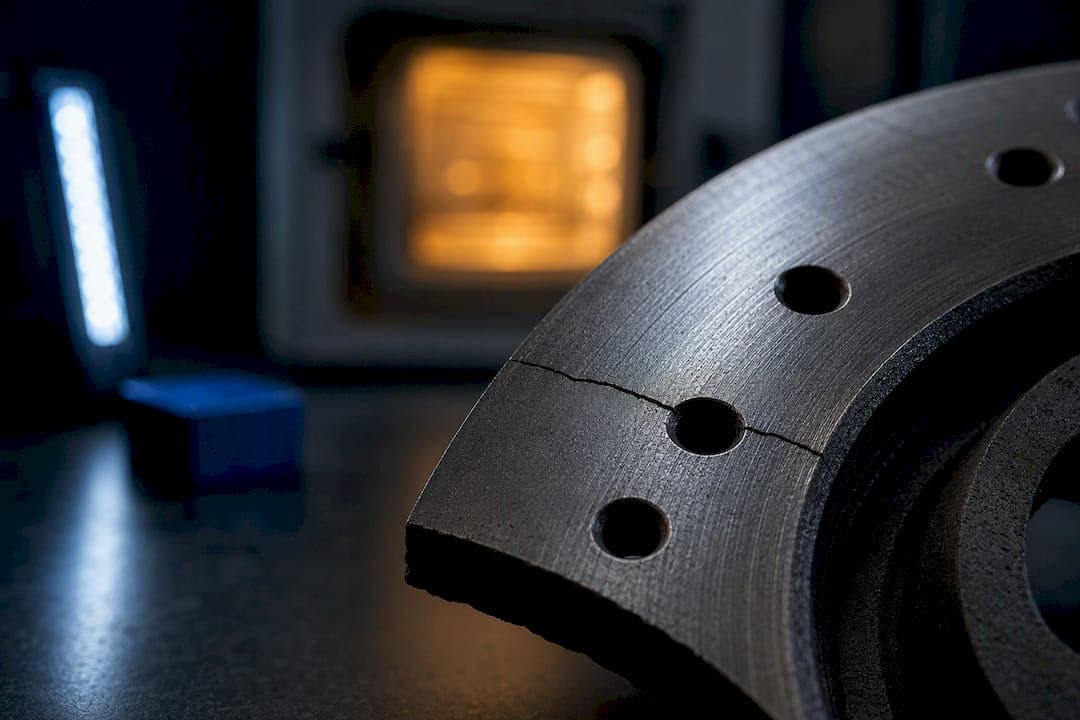
Yes, drilled rotors can and do crack, especially under repeated high heat. The holes act as stress risers, and manufacturers test for this exact failure mode using SAE J2928's 150 heat-cycle procedure. If a crack runs through the full thickness of the rotor or connects two holes, stop driving and replace it. For heavy track use, a slotted or blank rotor is the safer long-term choice.
TL;DR:
- Drilled rotors are more prone to cracking due to stress concentrations around unfinished hole edges and repeated thermal cycles.
- High-heat use, sharp hole patterns, poor metal quality, and aggressive pads significantly increase the risk of crack propagation.
- Visual inspection for full-thickness cracks, discoloration, and thickness below specifications is critical for safety.
- Manufacturing features like chamfered holes and heat treatments can halve crack growth risk in drilled rotors.
- For heavy track or high-performance use, slotted or blank rotors outperform drilled ones in durability.
Table of Contents
- Top causes of drilled-rotor cracking
- How cracks start and propagate around drilled holes
- How to inspect drilled rotors and when to replace them
- Risk factors that increase cracking risk
- Prevention and mitigation: what manufacturers and owners can do
- If you find cracks: practical next steps and timeline
- How DBC Brakes engineers cross-drilled rotors to reduce cracking
- Why the track-versus-street debate matters more than the crack itself
- Sources
Top causes of drilled-rotor cracking
Thermal shock is the main driver behind drilled rotors cracking. Every hard stop heats the rotor surface fast, then the surrounding metal cools at a different rate. Repeat that cycle a few hundred times and you get low-cycle thermo-mechanical fatigue, the same failure mechanism engineers study in thermal cracking analyses of disc brakes.
Holes make this worse by design. Each drilled opening removes material and concentrates stress around its edge, giving heat cycles a weak point to attack. If the drilling process leaves jagged, unfinished edges, you don't need hundreds of cycles. According to practical guidance on drilled rotor manufacturing, those micro-fractures can start propagating almost immediately.
Three factors combine to determine how fast that happens:
- Thermal cycling frequency — repeated hard braking without cooldown time accelerates fatigue.
- Hole finishing quality — chamfered, radiused edges resist cracking far better than raw drilled holes.
- Metal composition — inconsistent iron quality or poor casting creates weak spots pad friction and heat to exploit.
Pad chemistry plays a supporting role too. Aggressive track compounds generate more heat at the rotor face than street pads, feeding the same thermal cycle that starts the crack in the first place.
How cracks start and propagate around drilled holes
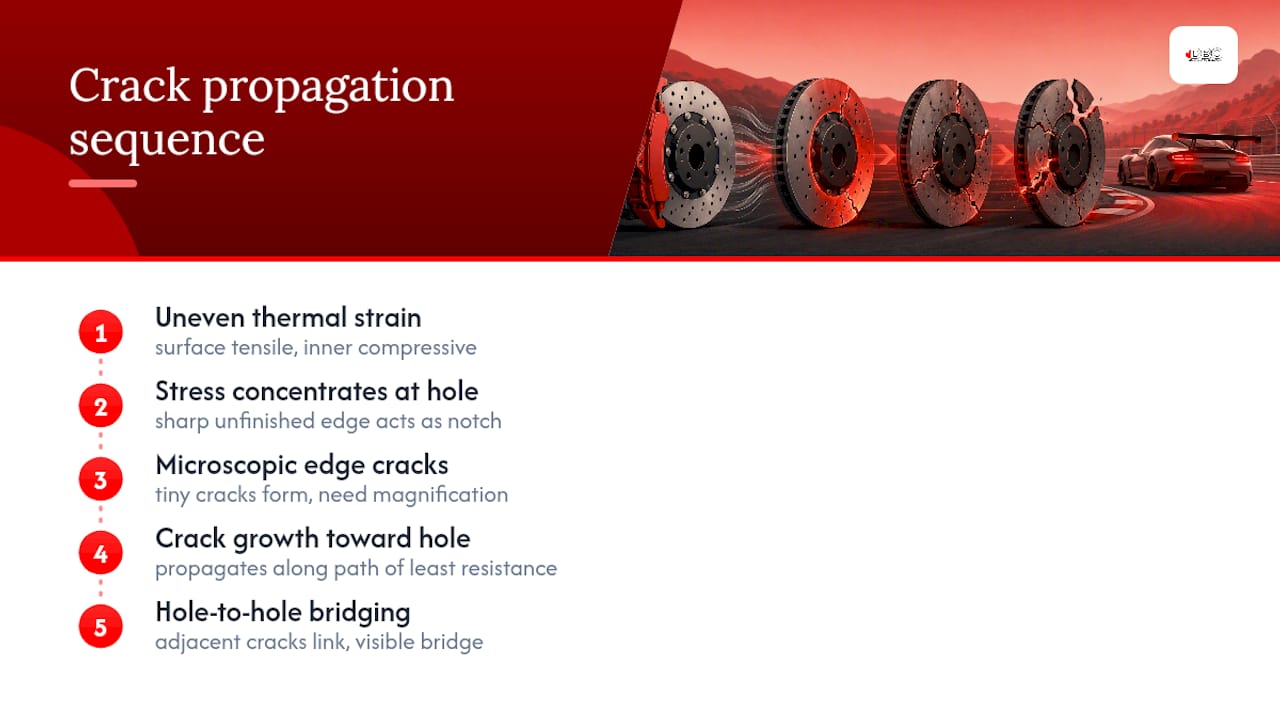
Picture the rotor surface heating unevenly every time you brake. The friction ring expands where the pad grips it, while the hat and inner sections stay cooler and resist that expansion. That mismatch creates tensile stress on the surface and compressive stress underneath, a cycle that repeats with every stop.
Drilled holes give that stress somewhere specific to concentrate. A hole with a sharp, unfinished edge acts like a notch in a piece of sheet metal: bend it enough times and it fails exactly at the notch. Microscopic cracks form at these edges first, often invisible without magnification. As the thermal cycles continue, the crack lengthens along the path of least resistance, frequently reaching toward the nearest hole.
Once two adjacent cracks link up, you get the bridging pattern experienced mechanics recognize instantly, a visible crack running hole to hole across the rotor face. Finite-element modelling of braking heat flux backs this progression, showing predictable crack paths tied directly to where thermal strain concentrates around the drilled pattern.
How to inspect drilled rotors and when to replace them
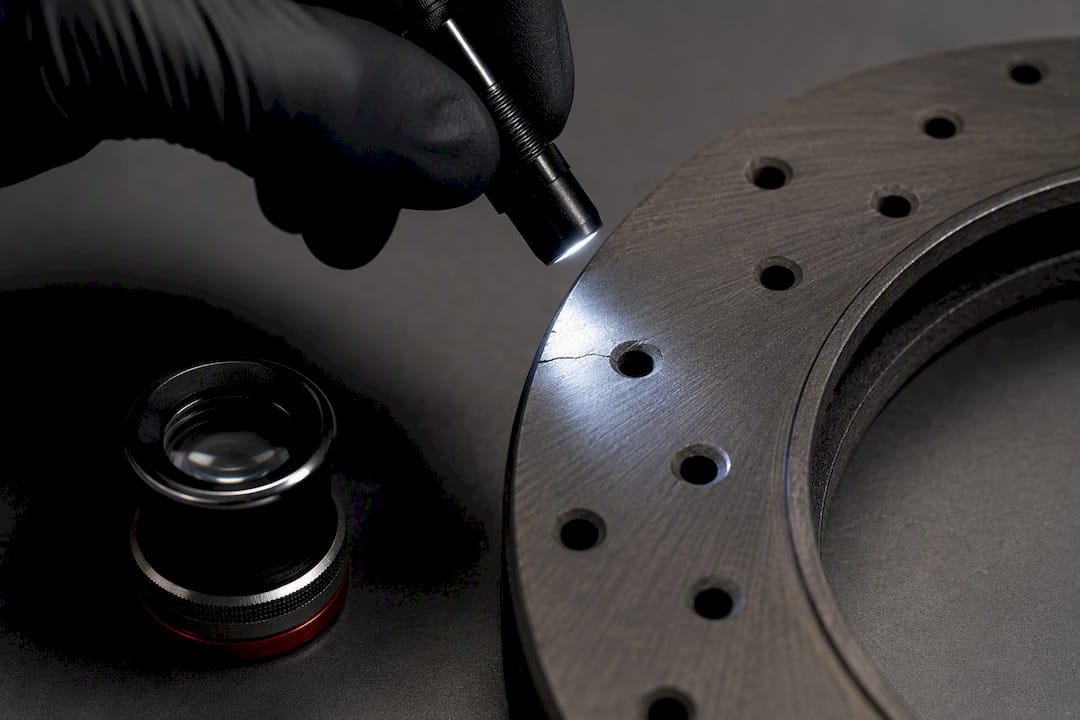
Checking your rotors doesn't require a lift or special tools, just good light and a few minutes.
- Clean the rotor face with brake cleaner so dust doesn't hide hairline cracks.
- Inspect under strong, angled light, rotating the wheel slowly to catch every hole edge.
- Look for bluing or discoloured spots, which signal areas that ran hotter than the rest of the rotor.
- Check thickness against the minimum spec stamped on the rotor hat or listed in your service manual.
- Measure runout if you have a dial indicator, since warped rotors often crack sooner.
Replace the rotor immediately if a crack runs through the full thickness, if two cracks connect between holes, or if any crack sits near the hat mounting area. A rotor below minimum thickness spec should also come off the car regardless of crack appearance.
Pro Tip: A short surface crack that stops at one hole and doesn't grow over a few thousand kilometres is usually a heat check, not a structural failure, but keep re-checking it at every oil change.
Risk factors that increase cracking risk
Not every driver faces the same odds. Track days, autocross, and mountain descents with sustained braking put far more thermal load on a rotor than commuting ever will. Cross-drilled rotors trade thermal mass for cooling and water evacuation, a fine trade for street driving but a real limitation once heat builds up lap after lap.
Several factors stack the odds against you:
- Repeated heavy braking or towing generates more heat cycles per drive than typical daily use.
- Inline hole patterns with sharp edges concentrate stress worse than staggered, chamfered layouts.
- Aggressive or mismatched pad compounds raise rotor temperature beyond what the design was built to handle.
- Caliper imbalance, where one side grips harder than the other, creates uneven heat and accelerates wear on one rotor.
- Rotors machined below minimum thickness lose the mass needed to absorb heat without cracking.
Prevention and mitigation: what manufacturers and owners can do
Manufacturing quality decides most of a drilled rotor's crack resistance before it ever reaches your car. Chamfering and radiusing hole edges removes the sharp notch where cracks start, and staggering the hole pattern instead of drilling straight lines spreads stress across the rotor face rather than concentrating it along one path.
Heat treatment is the countermeasure with the clearest data behind it. A dynamometer study on cross-drilled rotors found that stress-relieving and ferritic nitrocarburizing treatments cut crack propagation by about 51% compared with untreated rotors. That's a substantial reduction from a manufacturing step most buyers never think to ask about.
For owners, prevention comes down to matching the rotor to the job:
- Choose slotted or blank rotors for heavy track workloads where thermal cycling is constant.
- Reserve drilled rotors for street use, where cooling and wet-weather performance matter more than repeated high-heat sessions.
- Bed new pads and rotors correctly before driving hard.
- Avoid letting calipers drag, since a dragging caliper keeps one rotor hotter than the other.
- Pair rotors with pad compounds suited to your driving style rather than the most aggressive option available.
Pro Tip: Keeping your wheels clean reduces brake dust buildup around the caliper and hub, which helps you spot new cracks faster during routine washes. A quick brake dust removal routine makes those inspections easier.
If you find cracks: practical next steps and timeline
A visible crack doesn't always mean an emergency, but it does mean action.
- Stop driving immediately if the crack runs through the rotor's full thickness or links two holes.
- Book a shop inspection that measures thickness, checks runout, and documents the crack's length and location against SAE J2928-style classification.
- Ask whether resurfacing is possible. Drilled rotors have limited material to machine away, and resurfacing near a hole often removes too much thickness to stay within spec.
- Replace rather than repair once a shop confirms the rotor is below minimum thickness or the crack pattern is progressing.
- Replace rotors in pairs on the same axle to keep braking balanced.
How DBC Brakes engineers cross-drilled rotors to reduce cracking
Some manufacturers design cross-drilled rotors to address common failure points using chamfered hole edges, controlled manufacturing tolerances, and heat-treatment processes aimed at extending service life under repeated braking.
Before buying any drilled rotor, ask the supplier three questions: has the rotor passed heat-cycle testing, are the holes chamfered or radiused, and what warranty backs the product. Verifiable answers to those three questions separate a durable rotor from a liability. Explore DBC Brakes' cross-drilled rotor lineup to compare specifications directly.
Why the track-versus-street debate matters more than the crack itself
Most arguments about drilled rotors focus on whether they crack, when the real question is whether they crack under your conditions. A commuter doing city stop-and-go generates a fraction of the thermal cycling a track day produces in twenty minutes. Judging drilled rotors by track-day failure rates and applying that verdict to daily driving is where a lot of advice goes wrong.
What gets underestimated is manufacturing control. Two drilled rotors can look identical and perform completely differently based on whether the holes were chamfered and whether the metal was heat-treated. It's the difference between a rotor that survives years of street use and one that develops heat checks within a season.
If you're deciding between drilled, slotted, or blank rotors, prioritize matching the rotor to your actual driving, not the most aggressive-looking option. Ask about testing and finishing before you ask about price.
— Sam
Sources
The technical claims above draw on SAE J2928's 150-cycle dynamometer standard, peer-reviewed heat-treatment crack propagation research, and finite-element thermal fatigue modelling. Practical manufacturing detail comes from hole-pattern and chamfering guidance widely used across the aftermarket brake industry.
- Effect of Heat Treatment on Crack Propagation and Performance of Disk Brake with Cross Drilled Holes | International Journal of Automotive Technology
- How to minimize cross-drilled brake rotor crack formation | Hot Rod
- Thermal cracking in disc brakes (finite-element and thermo-mechanical fatigue analysis)