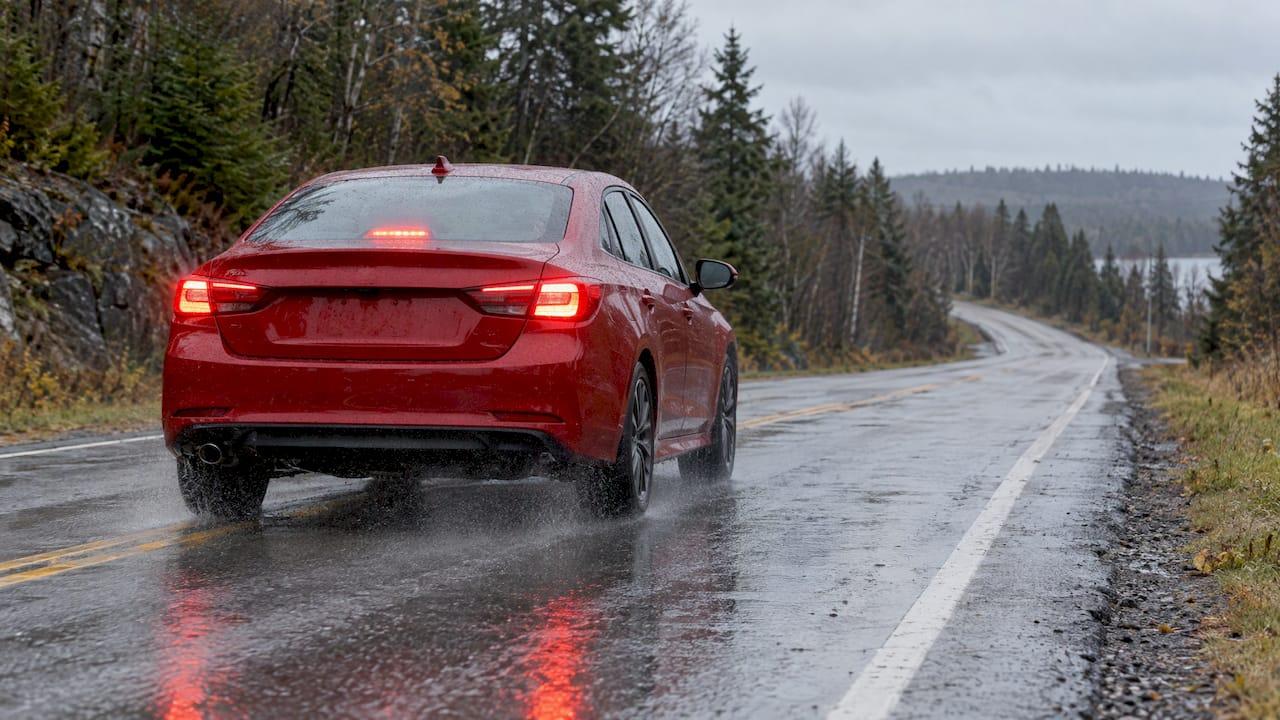
Wet roads lengthen stopping distances. Water cuts the grip between tires and pavement, so the same brakes need more road to do the same job. Canadian road safety bodies put the increase at roughly 40 to 50% in rain, and more with worn tires. The fixes are mostly simple: lower speed, a bigger gap, good tires and brakes in sound condition.
This guide covers what rain does to stopping, how to brake in it, what wet-brake noise means, and where brake parts fit in.
TL;DR
- Rain can increase stopping distance by 40 to 50% compared with dry pavement, per AIRB.
- Leave at least 4 seconds behind the vehicle ahead in poor weather, not the usual 2.
- Tires set the limit of wet grip. Check tread depth before changing any brake part.
- Light grab or squeal in the first stops after rain is common. Grinding, a spongy pedal or a warning light needs an inspection.
- Rotors, pads and hardware in good condition keep brakes consistent in rain. Fitment must match the vehicle.
Table of Contents
- How rain changes stopping distance
- Stopping distance at common speeds
- How to brake in the rain
- Tires set the limit
- Wet brakes: what is normal
- Maintenance that helps in rain
- Our view on wet-weather brake parts
- Brake kits for wet-weather driving
- Wet-weather checklist
- FAQ
- Sources
How rain changes stopping distance
Brakes do not stop a vehicle by themselves. They slow the wheels, and the tires turn that into deceleration through grip on the road. Water between tire and road reduces that grip.
The figures from Canadian sources:
- AIRB states that rain can increase stopping distance by 40 to 50% compared with dry pavement. A car that stops in 100 feet on a dry road may need 140 to 150 feet or more on a wet one. With worn tires at highway speed the gap can more than double.
- The Road Safety at Work Alliance gives figures for a passenger vehicle on all-season tires. At 50 km/h it needs 40 m or more on a wet road, against 35 m dry. At 80 km/h it needs 200 m or more, against 87 m dry.
- Michelin Canada states that wet pavement stopping distances can be twice as long as on dry roads.
The sources differ because conditions differ: tire wear, speed, road surface and how much water is present. The direction is the same in all of them. Wet roads take more distance, and speed makes it worse.
Why water reduces grip
Research gives a physical reason. A peer-reviewed study in Physical Review B found that rubber friction on wet rough surfaces at low speeds is typically 20 to 30% lower than on the same dry surfaces. Water smooths the road texture, so the rubber grips less.
A study in Tribology Letters found that even 1 to 3 mm of water noticeably affects how braking force passes from tire to road. No full hydroplaning is needed for this, and the effect is most visible above 80 km/h.

The first minutes of rain
The first rain on a dry road is often the worst. The Canadian Association of Road Safety Professionals explains that on roads dry for a long time, light rain can cause viscous aquaplaning, where oil and dust mix with water into a thin slick film. Michelin Canada notes that the first 15 to 30 minutes of rainfall are often the most dangerous for the same reason.
Hydroplaning
With too much water or too much speed, tires lift off the pavement and float. The Ontario Ministry of Transportation notes that hydroplaning makes control very difficult. The Alberta Driver's Guide gives the response: do not brake, release the accelerator and steer where the vehicle should go. Braking comes back once the tires grip again.
Stopping distance at common speeds
The table uses the Road Safety at Work Alliance figures for a passenger vehicle on all-season tires.
| Speed | Dry road | Wet road |
|---|---|---|
| 50 km/h | 35 m | 40 m or more |
| 80 km/h | 87 m | 200 m or more |
The wet figures are minimums. Worn tires, a heavy load or standing water add to them.
How to brake in the rain
The habits are the same across Canadian driver handbooks.
- Slow down before the corner or stop. The Ontario handbook says to drive slowly enough to stop within the distance that can be seen.
- Be smooth. Gentle steering, braking and acceleration reduce the chance of a skid.
- Add following distance. The Ontario handbook gives at least two seconds in ideal conditions and more in bad weather. Road Safety at Work advises at least 4 seconds in poor weather.
- Start braking early and lightly. Early pressure lets weight shift gradually and keeps the wheels from locking.
- Skip cruise control. The BC Knowledge Test Prep advises never using it on wet or slippery roads.
- Use low beams. The Alberta guide advises low beam headlights in rain.
Threshold braking without ABS
Vehicles with ABS handle lock-up control electronically: press firmly and steer. For vehicles without ABS, the Ontario handbook describes threshold braking. Brake as hard as possible until a wheel begins to lock, release pressure slightly, then press again with as much force as possible without a skid. The handbook says not to pump the brakes.
Counting the gap
Pick a fixed object, such as a sign or overpass. When the vehicle ahead passes it, count seconds until the front of the vehicle reaches the same point. In rain the count should be four or more. Add more behind motorcycles and large trucks, or with a heavy load, which the Ontario handbook flags as needing extra space.
More on technique: safe braking in wet road conditions.
Tires set the limit
Brakes can only use the grip the tires provide. Michelin Canada states that wet grip depends on tread depth, and that at 4/32" or below, wet braking performance drops sharply.
Three checks before any brake work:
- Tread depth on all four tires.
- Tire pressure, checked cold.
- Matching tires on each axle.
Season matters as well. Transport Canada notes that below 7°C all-season and summer tires begin to lose elasticity and traction, while winter tires keep grip at much lower temperatures. CAA-Quebec points out that winter-rated all-season tires have a harder compound, which can reduce grip on wet roads in fall and spring. Cold-season behaviour is covered in the Canadian cold weather brake guide. A short tire check list is at start with tyres.
Wet brakes: what is normal
Water reaches rotors and pads in rain, puddles and car washes. Common effects in the first stops:
- A slight delay before the brakes bite.
- Light grabbing as a thin water film and surface rust clear from the rotor face.
- A brief squeal.
Driving.ca lists wet brakes among normal causes of squeaking, along with brake pad type, improperly lubricated parts, rusty rotors, and cold or brand new brakes. Squeaking can indicate a problem, but it does not always.
Drying brakes after deep water
Road Safety at Work advises slowing down through deeper water and applying the brakes gently to help them dry out. Then confirm the brakes pull evenly on all wheels before speeding up.
The Ontario handbook gives a test after a flooded stretch: when it is safe and the road is clear, stop quickly and firmly from 50 km/h. The vehicle should stop in a straight line, and the pedal should feel firm, not spongy.
When to book an inspection
The Ontario handbook lists squeaking or grinding when braking and dashboard warning lights as signs of potential brake problems. In addition:
- Noise that continues after the first 5 stops in dry conditions.
- Pulling to one side under braking.
- A soft or spongy pedal.
- Vibration through the pedal or steering wheel.
A guide to what the first stops reveal: brake noise in rain.
Lubricant sprays
A spray lubricant is not a brake fix. Brakes depend on friction between pad and rotor, and oil on either surface reduces it. Noise in rain is better handled by cleaning, checking hardware and replacing worn parts. A technician should inspect any noise that does not clear.
Maintenance that helps in rain
Brake maintenance keeps wet performance predictable. Brake maintenance guidance from a fleet repair provider explains how worn components affect stopping and why regular checks matter.
A basic schedule:
- Pads: check thickness at every tire rotation. Replace at the manufacturer's minimum.
- Rotors: check for deep grooves, heavy rust on the friction surface, cracks and uneven wear.
- Brake fluid: replace on the manufacturer's interval. Fluid absorbs moisture over time.
- Hardware: clips, shims and slides need to move freely.
- Wheel bearings and hubs: play at the wheel affects pad contact. Replace worn units.
More on the order of fixes: maintenance that improves stopping distance.
Heat and repeated braking
The Ontario Air Brake Handbook states that brakes convert the energy of a moving vehicle into heat, and that repeated or severe use can raise temperatures high enough to damage components. Anticipating conditions and keeping distance reduces harsh braking. On long descents, see engine braking vs. brakes and brake fade causes.
Our view on wet-weather brake parts
We build DBC brake kits for Canadian roads, and Canadian roads mean rain, slush and salt.
Tires come first, then fresh pads and rotors in good condition. When parts wear, the brakes lose consistency, and rain exposes it.
Our cross-drilled rotors are engineered to prevent warping and to add durability. Cross-drilled rotors, pads and hardware are sold as matched sets, so the parts work together and fitment is guaranteed for the vehicle.
Support is handled by people who know brakes. There are no automated replies. Pricing is inclusive, with no hidden fees.
Sam
Brake kits for wet-weather driving
DBC sells brake kits, rotors, pads and wheel bearings and hubs, made for cars, trucks and performance vehicles. Rotor finishes include Performance XDB, Premium Black Kote and Performance SS.
Order steps:
- Select the vehicle make, model and year on the make selector.
- Choose a brake kit, or order brake rotors and brake pads separately.
- Add wheel bearings and hubs if the wheel end needs them.
- Check out.
Shipping within Canada is free on orders over $100. Expedited shipping is $29.99 per order. International shipping is $129.99 per brake kit. Details are on the shipping information page. The full range is on the DBC Brakes home page.
For how kit features relate to long-term reliability, see brake kit features for reliability. A note on rotor size: why bigger rotors rarely shorten a single cold stop.
Wet-weather checklist
Before the rainy season:
- Measure tire tread and set pressure.
- Check pad thickness and rotor surfaces.
- Replace brake fluid if it is due.
- Test the brakes in a safe, empty area.
In the rain:
- Lower speed. Brake early and lightly.
- Keep 4 seconds or more behind the vehicle ahead.
- Use low beams.
- Do not use cruise control.
- Dry the brakes with gentle pressure after deep water.
After the rain:
- Note any noise, pulling or soft pedal.
- Book an inspection if the symptom continues.
FAQ
What do you do when brakes are wet?
Slow down and apply the brakes gently to help them dry out. Road Safety at Work advises this after deeper water. Then confirm the vehicle brakes evenly before returning to speed.
What is the braking distance in the rain?
AIRB puts the increase at 40 to 50% over dry pavement. A car stopping in 100 feet when dry may need 140 to 150 feet or more. At 80 km/h, the Road Safety at Work Alliance gives 200 m or more on a wet road against 87 m dry.
What makes braking distance increase?
Speed, wet or slick pavement, worn tires and a heavy load all add distance. Water lowers grip between tire and road. Worn tread cannot clear the water, so wet braking drops sharply at 4/32" or below.
Can WD-40 be sprayed on brakes to stop squeaking?
No. Brakes work through friction, and a lubricant on pads or rotors reduces it. Find the cause instead: moisture, rust, dust, worn pads or dry hardware. Have a technician inspect noise that continues.
Do winter tires help in wet conditions?
Yes, in cold temperatures. Michelin's technical communications director says winter tires are designed to improve traction on wet roads and in heavy rainfall. Transport Canada notes that other tire types lose elasticity below 7°C.
Sources
- Driving at night and in bad weather, Ontario MTO Driver's Handbook
- Driving along, Ontario MTO Driver's Handbook
- Maintaining your vehicle, Ontario MTO Driver's Handbook
- The Official Air Brake Handbook, Ontario
- Driving in Rain, AIRB
- Impact of Weather Conditions, CARSP
- Vehicles Take Longer to Stop in Poor Conditions, Road Safety at Work Alliance
- Driving for the Conditions, Road Safety at Work
- Driving safely on wet roads, Michelin Canada
- Rubber friction on wet and dry road surfaces, Physical Review B
- Physical Model of Tire-Road Contact Under Wet Conditions, Tribology Letters
- Safe driving and emergencies, BC Knowledge Test Prep
- Emergency Situations and Challenging Conditions, Alberta Driver's Guide
- Using winter tires, Transport Canada
- Winter-rated all-season tires, CAA-Quebec
- Is it normal for my brakes to do that?, Driving.ca
- Common questions about winter tires, Driving.ca
- Why brake maintenance prevents accidents