
Brake early and smoothly, keep both hands on the wheel, and give yourself at least double the normal stopping distance. That single adjustment prevents most wet-road incidents.
- Reduce speed before entering a curve or hazard zone, not during it.
- Avoid abrupt steering or brake inputs.
- Leave at least double the dry stopping distance between you and the vehicle ahead, per ICBC guidance.
- If your vehicle has ABS, keep steady pressure on the pedal and steer around obstacles.
- If it does not have ABS, keep the wheels rolling with threshold braking.
Panic responses — slamming the brakes, jerking the wheel — are the primary cause of wet-road loss of control.
Key takeaways
Safe braking in wet road conditions depends on braking earlier, doubling the following distance, and keeping tyres and brake components in serviceable condition.
| Point | Details |
|---|---|
| Brake early and smoothly | Apply pressure earlier than in dry conditions; avoid abrupt inputs that cause wheel lock. |
| Double the following distance | Stopping distances increase by roughly 50–60% in wet conditions; at least double the dry gap. |
| Maintain tyre tread above 4/32" | Wet braking performance drops sharply below 4/32" (3 mm); replace tyres before that threshold. |
| Service brake fluid every 2 years | Moisture-contaminated fluid reduces braking consistency; follow manufacturer service intervals. |
| DBC Brakes cross-drilled rotors | Engineered to channel water and heat, helping maintain consistent stopping performance in wet conditions. |
Table of Contents
- Why wet roads increase stopping distances and hydroplaning risk
- Step-by-step braking technique for wet roads
- How to reduce the chance of hydroplaning
- Vehicle checks that make wet-road braking safer
- How to regain control if the vehicle starts to skid
- How to perform an emergency stop on a wet road
- When you should not drive in wet conditions
- How brake quality and maintenance affect wet-road stopping
- One habit that improves wet-road safety immediately
- Better wet-road stopping starts with better brake components
- Sources
Why wet roads increase stopping distances and hydroplaning risk
Water between a tyre and the road surface reduces the friction a tyre needs to grip. The tyre's contact patch, which is roughly the size of a hand, must displace that water fast enough to maintain contact with the pavement. When it cannot, the tyre floats.
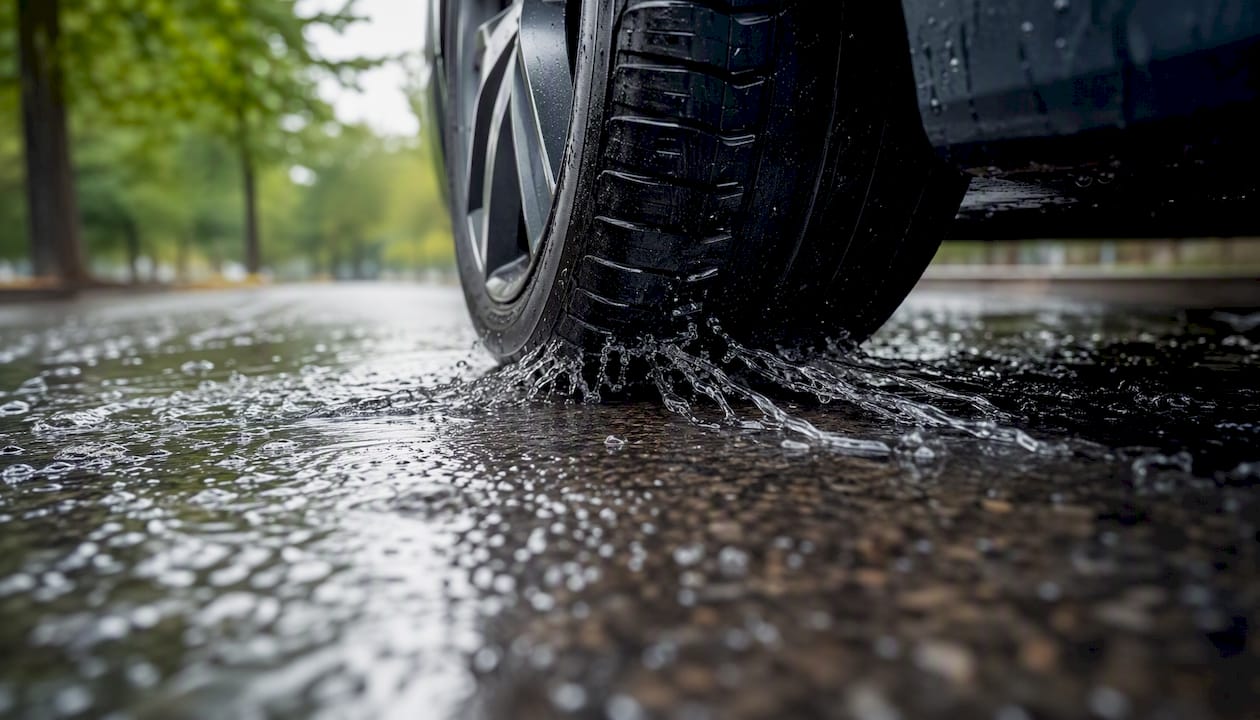
According to the AAA roadway safety guide, stopping distances can increase significantly in wet conditions at typical driving speeds. That figure alone justifies the doubled following distance.
Pro Tip: The first 10–30 minutes of rainfall are often the most hazardous. Oil and road film that have built up on dry pavement mix with the initial rain to create a slippery surface before the water washes it away.
Road surface type also matters. Concrete tends to drain better than smooth asphalt, and asphalt that has been polished by traffic offers less grip than freshly laid pavement. Electronic Stability Control (ESC) and Traction Control help manage wheel spin and lateral slip, but they cannot override the physics of reduced traction. Adjusting speed and technique remains the driver's responsibility.
Step-by-step braking technique for wet roads
Brake earlier than you think you need to. On a wet road, the margin for error is smaller, and the time to correct a mistake is shorter.
ABS-equipped vehicles
Federal Way Automotive's braking guide confirms the correct ABS technique: press the pedal firmly and hold it. Do not pump the pedal. The system pulses automatically to prevent wheel lock. While ABS is active, the wheel remains steerable, so direct the vehicle toward the intended path.
- Press the brake pedal firmly and hold steady pressure.
- Keep both hands on the wheel and steer around any obstacle.
- Maintain pedal pressure until the vehicle stops or the hazard is cleared.
- Expect pedal vibration — that is normal ABS operation.
Non-ABS vehicles
Threshold braking keeps the tyre at the edge of lock-up without crossing it. Place the heel of your foot on the floor and use the ball of your foot to modulate pressure.
- Apply firm pressure until you feel the tyre begin to resist.
- Ease off slightly to keep the wheel rolling.
- Reapply. Repeat as needed.
- Steer while the wheels are rolling, not while locked.
Pro Tip: Practise threshold braking in a safe, empty car park during light rain to build the muscle memory before you need it on a live road.
Dos and don'ts:
- Do brake in a straight line before entering a corner.
- Do keep cruise control off in wet conditions. Road Safety at Work notes that cruise control can maintain inappropriate speeds and delay your reaction to sudden hazards.
- Do not brake while the steering wheel is turned.
- Do not slam the pedal from full speed.
How to reduce the chance of hydroplaning
Hydroplaning happens when tyres cannot displace water fast enough. Speed is the primary factor. The faster you travel over standing water, the less time the tyre has to channel water away through its tread grooves.
Prevention:
- Reduce speed in heavy rain and on roads with visible standing water.
- Drive in the tyre tracks of the vehicle ahead, where water has already been displaced.
- Maintain correct tyre pressure. Under-inflated tyres deform and lose their ability to channel water efficiently.
- Keep tread depth above the commonly recommended minimum depth for wet traction. Michelin Canada confirms that wet braking performance drops sharply below this threshold.
- Turn off cruise control before entering wet sections of road.
If hydroplaning begins:
As noted by DriveSchoolPro, the correct response is to ease off the accelerator, keep the wheel straight, and wait for grip to return rather than braking hard or steering abruptly.
- Ease off the accelerator gradually.
- Hold the wheel straight and steady.
- Do not brake hard until you feel the tyres reconnect with the road.
- Once grip returns, apply gentle, steady braking if needed.
- Steer back to your intended path calmly.
Vehicle checks that make wet-road braking safer
A vehicle that is mechanically sound stops shorter and more predictably. These checks take under 30 minutes and are worth doing before any wet-season driving.
Tyres:
- Check tread depth with a tread-depth gauge or the coin test. Replace tyres before they reach 4/32" (3 mm).
- Inflate to the manufacturer's specification, found on the door jamb sticker.
- Consider tyres rated for wet traction if you drive frequently in rain. Refer to tyre replacement timing guidance before your next wet season.
Brake system:
- Check pad thickness. Most pads should be replaced at or before 3 mm of remaining material.
- Inspect rotors for deep grooves, scoring, or visible rust that does not clear after a few stops.
- Check brake fluid. Moisture-contaminated fluid lowers the boiling point and can cause fade under repeated wet-road braking. The role of brake fluid in stopping performance is often underestimated.
- Confirm the ABS warning light is off. An active ABS fault means the system will not function in an emergency.
Visibility:
- Replace wiper blades that streak or skip. A blade that leaves a film is worse than no blade.
- Top up screenwash with a solution rated for the temperature range.
- Clean headlights and taillights. Dirty lenses reduce output significantly.
- Use demisters front and rear to keep glass clear. The Alberta Motor Association recommends keeping lights clean and wipers in good condition as a baseline wet-weather preparation.
Pro Tip: After driving through a deep puddle, apply light brake pressure for a few seconds to dry the pads and restore friction. Pirelli's rain driving guide confirms this practice helps recover braking effectiveness quickly.
How to regain control if the vehicle starts to skid
Look where you want to go. That single instruction is the foundation of skid recovery, because the hands follow the eyes.
Rear-wheel skid (oversteer)
- Look at the intended path, not at the hazard.
- Steer gently in the direction the rear is sliding (into the skid).
- Do not brake. Keep the throttle neutral.
- Wait for the rear to grip.
- Straighten the wheel as the vehicle realigns.
Front-wheel skid (understeer)
- Ease off the accelerator.
- Do not add more steering input — the front wheels need to roll to regain grip.
- Hold the wheel steady until the tyres reconnect.
- Once grip returns, steer to the intended path.
Do not:
- Oversteer past the skid direction.
- Panic-brake during a skid.
- Counter-steer violently after the vehicle begins to recover.
How to perform an emergency stop on a wet road
The best emergency stop starts before the emergency. Scanning the road ahead and maintaining a gap gives you the time to brake progressively rather than at maximum force.
Scenario: You are approaching a rain-soaked suburban intersection and a pedestrian steps into the road 40 metres ahead.
ABS vehicle sequence
- Press the brake pedal firmly and hold it down.
- Keep both hands on the wheel and steer to avoid the hazard if the gap allows.
- Maintain pedal pressure. Let ABS modulate the braking force.
- Steer to a safe stop position.
Non-ABS vehicle sequence
- Apply firm threshold pressure — heel on the floor, ball of the foot controlling force.
- Ease off if a wheel locks, then reapply.
- Steer while the wheels are rolling.
- Bring the vehicle to a controlled stop.
Before the emergency:
- Scan at least 12 seconds ahead in rain.
- Increase the gap to the vehicle ahead to at least double the dry-road distance.
- Reduce speed on approach to intersections, school zones, and pedestrian crossings.
- Test brakes gently after passing through standing water to confirm pad contact.
When you should not drive in wet conditions
Some conditions make driving unsafe regardless of skill or vehicle condition. Recognising them early is the correct response.
Clear indicators to stop or avoid driving:
- Standing water that covers road markings or hides the road surface depth.
- Underpasses or dips where water accumulates and current may be present.
- Visibility so poor that you cannot see the road markings or the vehicle ahead.
- Whiteout conditions from heavy rain combined with spray from large vehicles.
Practical rules:
- If you cannot judge the depth of standing water, do not enter it. Water as shallow as 15 cm can affect steering and braking.
- Choose an alternate route or wait for conditions to improve.
- Never assume a flooded road is passable because another vehicle crossed it — conditions change within minutes.
Floodwater carries specific risks beyond wet braking. Water entering the engine air intake causes hydrolock, which destroys the engine. Hidden potholes and debris beneath the surface can puncture tyres or damage suspension. Moving water exerts significant force on a vehicle's body and can shift or float a car at depths that appear manageable. If the road is flooded, turn around.
How brake quality and maintenance affect wet-road stopping
Brake components wear differently in wet conditions, and that wear shows up faster than on dry roads. Federal Way Automotive notes that moisture and standing water reveal sticky calipers, contaminated fluid, and uneven pad wear faster than dry-road driving does.
Key maintenance points:
- Brake fluid absorbs moisture over time, lowering its boiling point. Most manufacturers recommend replacement every two years or per the vehicle's service schedule. A detailed brake fluid guide covers service intervals and contamination signs.
- Pad material affects wet friction. Worn or glazed pads take longer to bite in wet conditions.
- Rotor surface condition matters. Warped or deeply grooved rotors reduce the pad's contact area and extend stopping distances. Clamping force and rotor contact explains how surface area and caliper pressure interact.
- After driving through deep water, apply light brake pressure to dry the pads, as confirmed by Pirelli's rain driving guidance.
Cross-drilled rotors are designed to channel water and heat away from the pad surface. That venting effect helps maintain consistent friction during repeated wet stops, reducing the fade that smooth rotors can experience under sustained load.
| Maintenance item | Threshold / action |
|---|---|
| Tyre tread depth | Replace at or before 4/32" (3 mm) for wet performance |
| Brake pad thickness | Inspect at 3 mm; replace before material is exhausted |
| Brake fluid | Replace every 2 years or per manufacturer schedule |
| Rotor condition | Replace if grooved beyond manufacturer spec or visibly warped |
Regular brake inspections catch issues that wet conditions expose quickly. Spongy pedals, uneven wear, and rusty or warped rotors all lengthen stopping distances when roads are wet, per DriveBC road safety information.
One habit that improves wet-road safety immediately
Count the gap. When rain begins, say "four seconds" aloud and actively count the time between when the vehicle ahead passes a fixed point and when you reach the same point. Most drivers underestimate their following distance by a significant margin in wet conditions, and the act of counting forces a conscious recalibration.
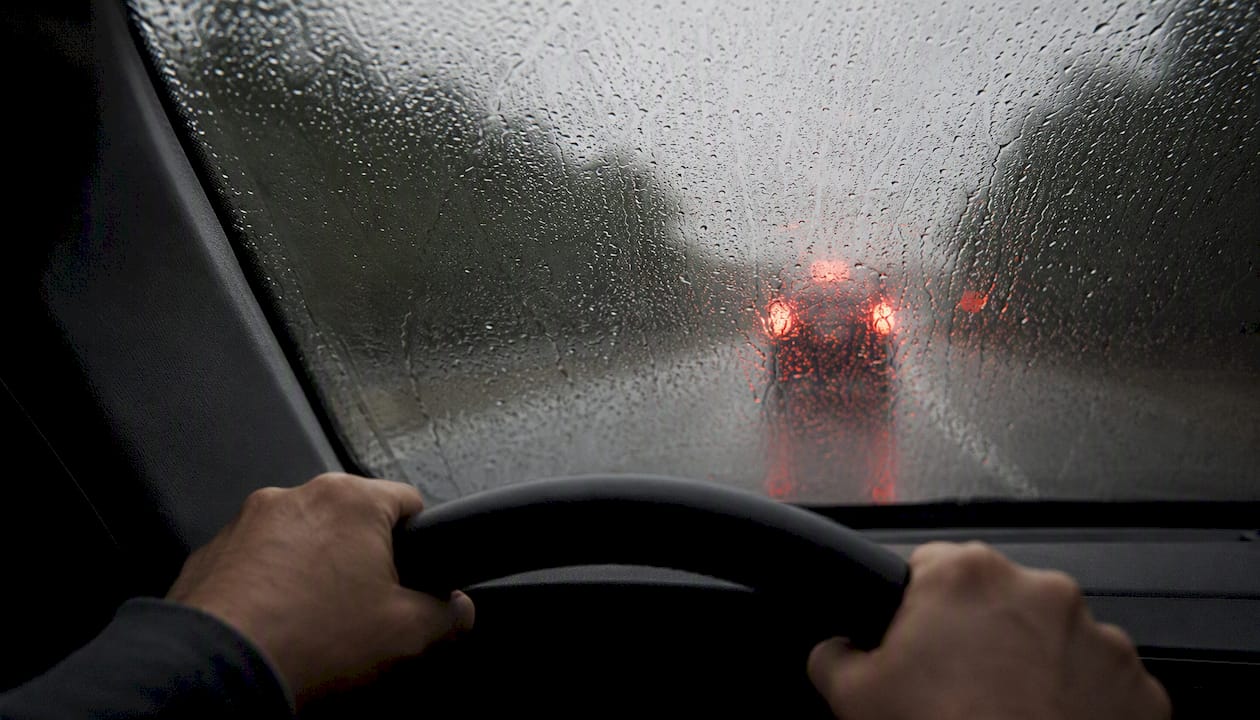
This habit works because it converts an abstract instruction — "increase your distance" — into a measurable, repeatable action. DriveSchoolPro's rain driving guidance supports structured practice in varied rain conditions as the most reliable way to build the instinct for increased following distance. Counting the gap is the simplest version of that practice available on any commute.
Start with four seconds in light rain. Move to five or six in heavy rain or on roads with standing water. The habit costs nothing and requires no special conditions to practise.
Better wet-road stopping starts with better brake components
Technique and maintenance cover most of the gap between a safe stop and a close call. The brake components themselves cover the rest. DBC Brakes performance brake kits feature cross-drilled rotors engineered to reduce warping and dissipate heat, which helps maintain consistent friction across repeated wet stops. Kits are priced with no hidden fees, and orders over $100 ship free within Canada. Check fitment for your vehicle directly on the DBC brake kit collections page and confirm compatibility with a real person on the support team before ordering.
Sources
The guidance in this article draws on government and insurer road-safety pages, tyre manufacturer technical content, and automotive maintenance resources. Primary sources include ICBC's wet-weather driving guidance, the AAA Get a Grip roadway safety guide, Michelin Canada's wet-road driving tips, Pirelli's rain driving safety guide, DriveSchoolPro's rain driving summary, and Federal Way Automotive's braking technique guide. Government and insurer sources were prioritised for safety thresholds; tyre and brake manufacturer sources were selected for technical accuracy on component performance.
- Get a Grip (AAA roadway safety guide)
- Driving in poor conditions (ICBC)
- Driving safely on wet roads (Michelin Canada)
- Braking techniques for safer driving on wet roads (Federal Way Automotive)
- Driving in rain (DriveSchoolPro summary of DVSA Skill 25)
- Safety first: tips for driving in the rain (Pirelli)