
The emergency brake system is defined as a secondary, mechanical braking mechanism that operates independently from a vehicle's primary hydraulic brakes. Every driver benefits from understanding its dual role: keeping a parked vehicle stationary and providing a backup if the main brakes fail. The role of emergency brake system function goes well beyond the parking lot. Knowing how it works, when to use it, and how to maintain it can be the difference between a controlled stop and a serious accident.
What is the role of emergency brake system in vehicle safety?
The emergency brake system serves two distinct purposes. First, it holds a vehicle in place when parked. Second, it acts as a mechanical fail-safe if the primary hydraulic braking system loses pressure. These two functions make it one of the most underappreciated safety components on any vehicle.
The system operates independently from the hydraulic circuit that powers the service brakes. That independence is what gives it value. If a brake line ruptures or fluid pressure drops, the emergency brake still works because it relies on cables or electric motors rather than fluid. The Machinery Directive 2006/42/EC and similar safety frameworks recognise secondary braking as a mandatory design requirement precisely because hydraulic systems can and do fail.
Drivers who treat the emergency brake as a parking-only feature are missing half its purpose. Understanding its full function is the first step toward using it correctly.
How does the emergency brake work compared to service brakes?
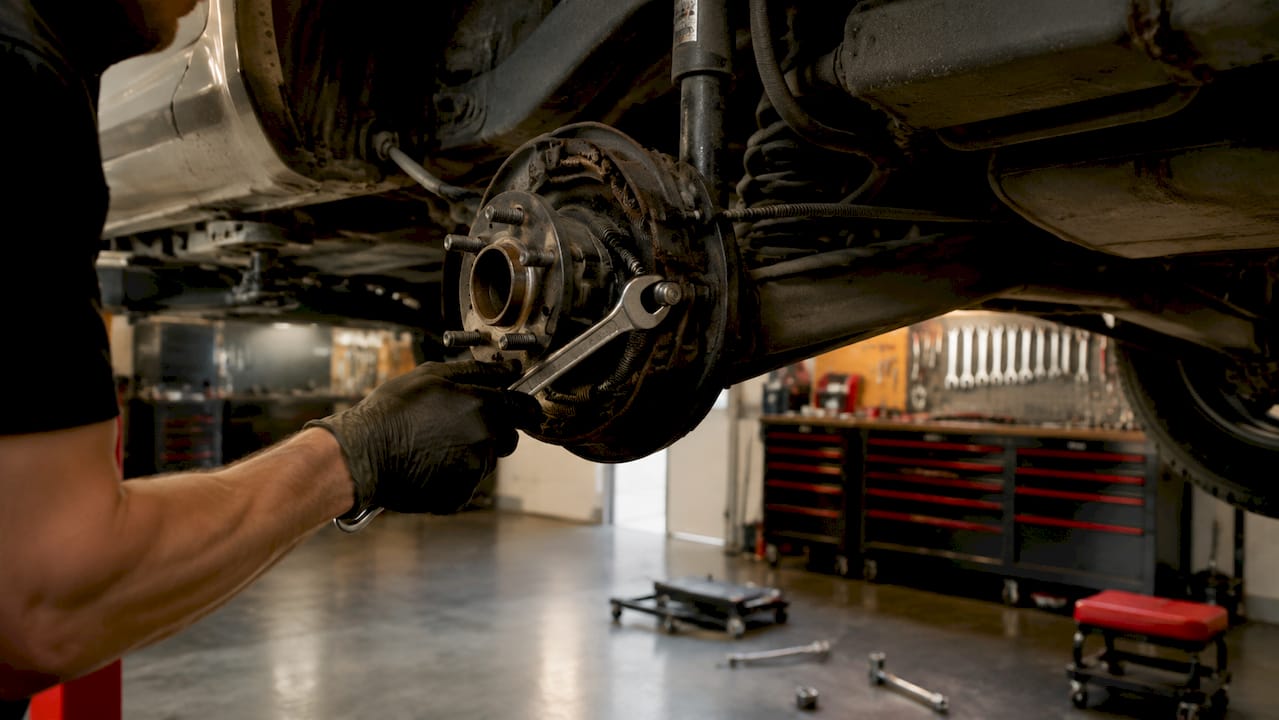
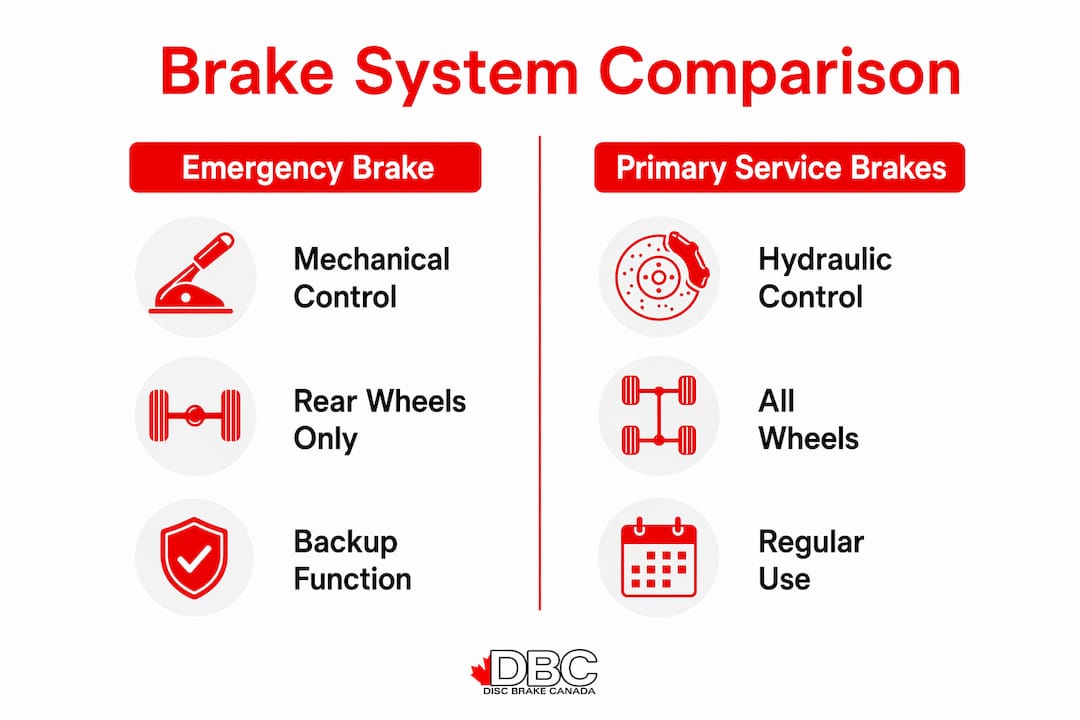
The emergency brake engages rear wheels mechanically via cables or electric motors, independent of the hydraulic system. Service brakes, by contrast, apply force to all four wheels through pressurised brake fluid. That difference in design determines what each system is built to do.
Service brakes are designed for repeated, high-force stops during normal driving. The emergency brake is designed for gradual deceleration and stationary holding. Applying it at speed does not replicate the stopping power of service brakes. It slows the vehicle progressively, which is useful in a brake failure scenario but not a substitute for full hydraulic braking.
| Feature | Emergency brake | Primary service brakes |
|---|---|---|
| Control method | Cable or electric motor | Hydraulic fluid pressure |
| Wheels engaged | Rear wheels only | All four wheels |
| Typical use case | Parking, brake failure backup | Normal driving stops |
| Stopping power | Gradual deceleration | Full, high-force stopping |
| Power dependency | Mechanical or electric | Hydraulic system required |
The rear-wheel-only design is deliberate. Engaging the front wheels mechanically at speed would cause immediate front-wheel lockup and loss of steering. By limiting engagement to the rear, the system allows the driver to retain some directional control. That said, even rear-wheel engagement at high speed carries skid risk without proper technique.
Pro Tip: Practise applying the emergency brake gently in an empty car park at low speed. This builds the muscle memory needed to apply it gradually rather than yanking it in a real emergency.
Why are emergency brakes important for parking and brake failure?
The emergency brake adds a layer of security that the transmission's "Park" setting alone cannot provide. The Park pawl in an automatic transmission is a small metal pin. On a steep incline, the full weight of the vehicle rests on that pin. Engaging the emergency brake distributes that load to the rear brake cables or pads, reducing stress on the transmission and preventing rollback.
In a brake failure scenario, the emergency brake becomes the primary means of slowing the vehicle. Engine braking combined with incremental emergency brake application slows the vehicle more safely than sudden activation. Shifting to neutral removes engine braking and should be avoided during a failure event.
Situations where applying the emergency brake is the right call:
- Parking on any incline, regardless of transmission type
- Primary brake failure during driving, applied gradually alongside engine braking
- Holding the vehicle stationary during a hill start
- Preventing rollback when stopped in traffic on a slope
- As a last resort to slow the vehicle if all other braking is lost
Fail-safe brake systems with proactive maintenance reduce unplanned downtime by 15% compared to reactive approaches. That figure applies directly to vehicle safety: a well-maintained emergency brake is far more likely to function correctly when it is actually needed.
How should drivers use the emergency brake correctly?
Correct emergency brake use requires gradual, modulated application. Yanking the emergency brake at high speed causes rear-wheel skid and loss of directional control. Few drivers receive formal training on this, but the technique is straightforward: apply steady, increasing pressure rather than a single sharp pull or press.
Common mistakes drivers make with the emergency brake:
- Applying it suddenly at highway speed, causing rear-wheel lockup
- Leaving it fully engaged while driving, which overheats rear brake components
- Relying on it as a substitute for service brakes during normal stops
- Ignoring it entirely and never testing whether it holds the vehicle
Electronic parking brakes (EPB) introduce additional considerations. EPBs must not be used at speed except in genuine emergencies, and manufacturers warn that doing so can cause vehicle instability and require post-use inspection. EPBs also rely on electrical power to disengage. If the vehicle loses battery power, releasing the brake requires a manual override, which is often a hidden mechanism described only in the owner's manual.
Understanding the difference between a traditional cable-operated handbrake and an EPB matters for knowing what to do in a power loss situation. The manual override for EPB systems is essential knowledge that driver education programmes rarely cover.
Pro Tip: Locate the manual EPB release procedure in your owner's manual before you ever need it. Knowing where it is takes two minutes. Finding it during a dead-battery situation takes much longer.
What maintenance and technology advances apply to emergency brakes?
Proactive maintenance keeps the emergency brake reliable. Cable-operated systems need regular inspection for fraying, corrosion, and cable stretch. Rear brake pads or shoes that the emergency brake engages also wear over time. Checking brake kit reliability factors as part of routine servicing prevents the emergency brake from becoming a system that looks functional but fails under load.
Automated Emergency Braking Systems (AEBS) are now mandatory in many new vehicles to prevent rear-end collisions. AEBS proactively applies the brakes before the driver intervenes, using sensors to detect imminent collisions. This is a fundamentally different technology from the traditional emergency or parking brake. Drivers should not conflate the two. AEBS handles collision avoidance; the parking brake handles stationary holding and brake failure backup.
Emergency Brake Assist (EBA) systems detect emergency braking and automatically apply maximum brake force, compensating for a driver's delayed or insufficient pedal input. Studies indicate EBA can reduce accidents by up to 20%. That reduction reflects how often drivers under-apply the brakes in genuine emergencies.
| System | Type | Key advantage | Limitation |
|---|---|---|---|
| Manual parking brake | Mechanical cable | No power dependency | Requires driver skill |
| Electronic parking brake (EPB) | Electric motor | Auto-hold, hill assist | Fails without power |
| Emergency Brake Assist (EBA) | Hydraulic assist | Maximises stopping force | Requires hydraulic system |
| Automated Emergency Braking (AEBS) | Sensor-activated | Pre-emptive collision avoidance | Not a parking solution |
Cold weather adds another maintenance variable. Brake performance in Canadian winters is affected by cable contraction, frozen components, and reduced pad friction. Drivers in colder climates should release the emergency brake before overnight parking in freezing conditions to prevent the rear pads from bonding to the rotors.
Key takeaways
The emergency brake system is a mechanical backup that holds vehicles stationary and provides a fail-safe when hydraulic brakes fail, requiring correct technique, regular maintenance, and clear understanding of electronic variants to function reliably.
| Point | Details |
|---|---|
| Dual function | The emergency brake parks the vehicle and backs up the hydraulic system during failure. |
| Rear-wheel engagement | It acts on rear wheels only, preserving steering control during gradual deceleration. |
| Gradual application | Sudden activation at speed causes skid; steady, increasing pressure is the correct technique. |
| EPB power dependency | Electronic parking brakes require power to disengage; know your manual override location. |
| Proactive maintenance | Regular cable and pad inspection keeps the emergency brake functional when it matters most. |
Why drivers underestimate the emergency brake
Most drivers I speak with treat the emergency brake as a parking formality. They pull it up, forget it exists, and release it the next morning. That habit works fine until it does not.
What I have found is that the real gap is not knowledge of what the emergency brake does. Most drivers know it holds the car in place. The gap is knowing what to do with it when the service brakes stop working. That scenario is rare, but it is not theoretical. Brake fluid leaks, hose failures, and caliper seizures happen. When they do, the emergency brake is the only mechanical tool left.
The other thing I have noticed is that drivers with newer vehicles assume their EPB is smarter than it is. It is not a substitute for the hydraulic system. EPBs are not designed to mimic primary brake stopping, and using them improperly causes instability and component damage. Technology adds convenience, but it does not remove the need for driver understanding.
My honest recommendation: spend ten minutes reading the emergency brake section of your owner's manual. Then find an empty car park and practise a low-speed emergency brake application. That combination of knowledge and muscle memory is worth more than any upgrade.
— Sam
Reliable brake components from a Canadian specialist
Keeping your emergency brake in working order starts with quality components and regular servicing. DBC Brakes, operating through CrossDrilledRotors.ca, is a Canadian brake specialist offering premium brake kits, cross-drilled rotors, and expert guidance for a wide range of vehicles.
DBC Brakes provides transparent pricing with no hidden fees and free shipping on orders over $100. Whether you drive a daily commuter or a performance vehicle, their team offers knowledgeable support without automated responses. Browse the full brake product selection to find components matched to your vehicle's specific needs and keep every part of your braking system, including the emergency brake, ready when it counts.
FAQ
What is the emergency brake system?
The emergency brake system is a secondary, mechanical braking mechanism that operates independently from the primary hydraulic brakes. It holds the vehicle stationary when parked and provides a backup braking option if the main system fails.
Can you stop a car with only the emergency brake?
The emergency brake can slow a vehicle gradually but is not designed for full emergency stops at speed. Correct technique involves applying it incrementally alongside engine braking, not pulling it sharply.
What happens if you pull the emergency brake at high speed?
Yanking the emergency brake at speed causes rear-wheel lockup and loss of directional control. Gradual, modulated application is the only safe technique at any significant speed.
How does an electronic parking brake differ from a manual handbrake?
An electronic parking brake uses an electric motor instead of a cable and can apply automatically. Its key limitation is that it requires electrical power to disengage, making manual override knowledge necessary for power-loss situations.
How often should the emergency brake be inspected?
The emergency brake cables, rear pads, and adjustment should be inspected at every major service interval. In Canadian climates, additional checks before winter are advisable to catch corrosion and cable stiffness early.