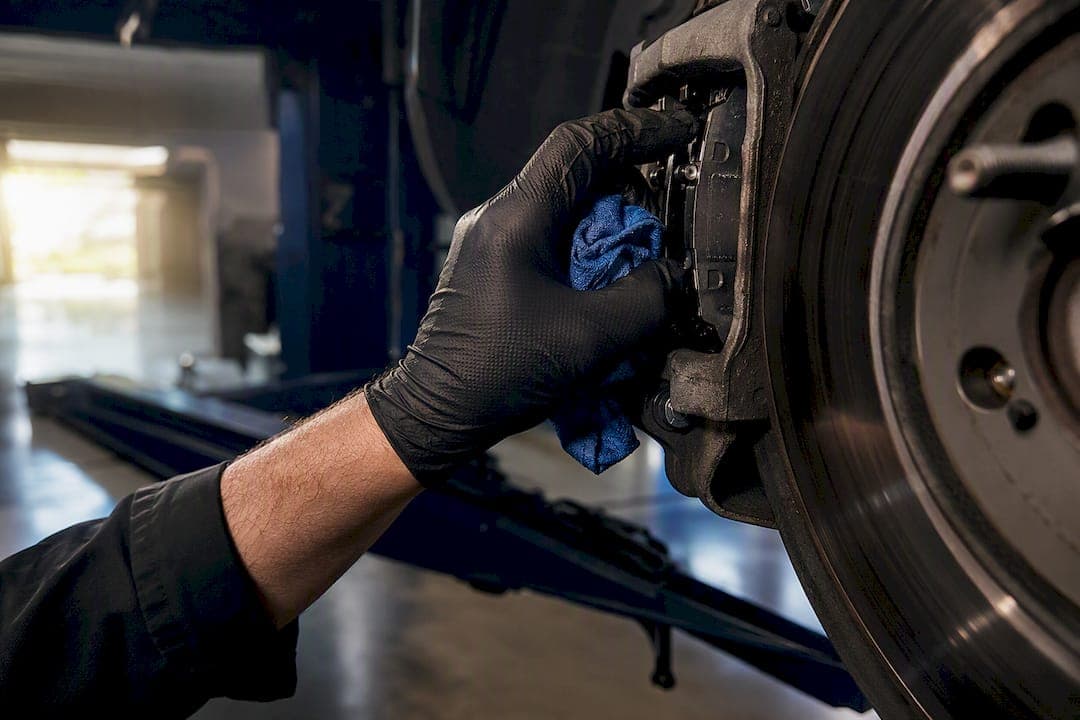
Cutting your car's stopping distance starts with speed, not equipment. A small reduction in speed lowers braking distance more than almost any part you can buy, because the relationship is exponential, not linear. After that, keep tyres at the correct pressure and tread depth, and keep pads, rotors, and fluid on a service schedule. Targeted upgrades, like premium tyres or high-friction pads, close the remaining gap.
TL;DR:
- Reducing your speed has the greatest impact, as braking distance increases exponentially with speed; halving speed can cut stopping distance by up to four times.
- Maintaining proper tyre pressure and tread depth is crucial, as underinflated or worn tyres significantly compromise grip and increase braking distance.
- Regular inspection and replacement of brake pads, rotors, and fluid are essential to keep braking performance optimal and prevent soft pedals or warped components.
- Upgrades like premium tyres or high-friction brake pads improve stopping distance only after basic maintenance and correct tyre pressure are addressed.
- Road conditions such as wet, snowy, or icy surfaces can quadruple or even tenfold increase stopping distance, requiring drivers to slow down substantially.
Table of Contents
- What determines how far your car takes to stop?
- Maintenance checklist: the high-impact upkeep tasks that shorten stopping distance
- Upgrades that actually reduce braking distance (what helps and what doesn't)
- How speed and road conditions change stopping distance
- Quick checks and habits to use every drive
- Author perspective and EEAT: practical notes from a brake kit manufacturer
- How DBC products can help reduce stopping distance
- Sources
- FAQ
What determines how far your car takes to stop?
Total stopping distance is thinking distance plus braking distance. Thinking distance covers the moment you spot a hazard to the moment your foot hits the pedal. Braking distance is what happens after that, once the vehicle's physics take over.
Speed dominates the second half of that equation. Research on braking physics confirms braking distance rises with the square of speed: double your speed and braking distance quadruples, not doubles. Triple it, and braking distance increases ninefold.
The math that matters: A car braking from 50 km/h might need roughly 15 metres to stop. At 100 km/h, that same car needs closer to 60 metres, not 30. The extra speed doesn't cost you double the distance. It costs you four times the distance.
Several factors compound or ease that base physics:
- Tyres — tread depth and inflation pressure control how much rubber actually grips the road.
- Brakes — pad thickness, rotor condition, and fluid quality decide how consistently force reaches the wheels.
- Vehicle weight — a fully loaded car or truck carries more momentum and needs more distance to shed it.
- Road surface — asphalt, gravel, and painted lane markings all offer different friction.
- Slope — downhill grades add momentum; uphill grades assist braking.
- Driver reaction time — fatigue, distraction, and age all extend the thinking-distance portion of the total.
Maintenance checklist: the high-impact upkeep tasks that shorten stopping distance
Most stopping-distance problems trace back to skipped maintenance, not bad luck. Work through these in order of impact:
- Check tyre pressure monthly. Use the pressure printed on your driver's door pillar, not the number moulded into the tyre sidewall. Both under and overinflated tyres reduce the contact patch that transfers braking force to the road.
- Inspect tread depth regularly. Wet-weather grip drops noticeably well before tyres hit the legal minimum, often starting around 3 to 4 millimetres of remaining tread. Waiting until the legal limit means driving on already-compromised rubber.
- Inspect brake pads and rotors. Replace pads before they thin past the manufacturer's minimum, and watch for deep grooves or warping on rotor surfaces.
- Flush brake fluid on schedule. Fluid that's gone dark or cloudy has absorbed moisture, which lowers its boiling point and can lead to a soft pedal under hard braking.
- Check alignment and wheel balance. Misalignment causes uneven pad wear and pulls the car off-centre during hard stops, extending the distance needed to stop straight.
Pro Tip: Book a pressure and tread check every time you get fuel, not just once a season. It takes under two minutes and catches problems before they become expensive ones.
A basic pad and rotor inspection at a shop typically runs 20 to 30 minutes and costs little beyond labour if no parts need replacing. See a professional immediately if you feel pulsing through the pedal or hear grinding.
Upgrades that actually reduce braking distance (what helps and what doesn't)
Not every upgrade delivers the same return. Some change how a car feels under braking without meaningfully shortening the distance it takes to stop.
- Tyres first. Tyre grip is often the single biggest lever on stopping distance, and premium compounds can stop several metres shorter than budget tyres at highway speeds in comparative testing. If your tyres are worn or the wrong compound for the season, upgrade this before anything else.
- Brake pad compounds matter for fit, not just friction. A high-friction pad built for track driving can feel grabby and noisy in daily commuting, while a pad tuned for smooth street use may fade under repeated hard stops. Match the compound to how you actually drive.
- Rotor design affects heat management, not raw stopping distance. Cross-drilled and slotted rotors help clear heat and debris during repeated hard braking, which matters most for towing, mountain driving, or track use. Coated rotors resist corrosion in salty winter climates, keeping response consistent over years of driving.
- ABS improves control, not always distance. Anti-lock systems help you steer while braking hard, but on loose gravel or deep snow, ABS can sometimes extend stopping distance slightly compared to a skilled driver modulating the pedal manually. Grip still comes from the tyre, not the electronics.
Prioritize tyres and basic brake service first. Save rotor and pad upgrades for after that foundation is solid.
How speed and road conditions change stopping distance
The speed-squared relationship isn't a rounding trick. Going from 60 km/h to 120 km/h doesn't double your braking distance, it quadruples it, because kinetic energy scales with velocity squared.
Wet roads increase braking distance by roughly 1.5 to 2 times compared to dry pavement. Packed snow pushes that multiplier to 3 or 4 times, and ice can stretch it to 5 to 10 times normal distance.
A practical rule: cut your speed by roughly a third on wet roads, and much more on snow or ice. Reaction time also varies more than most drivers assume. Fatigue and distraction routinely push real-world reaction times beyond textbook minimums, which is exactly why following distances need extra margin in poor conditions, not less.
Quick checks and habits to use every drive
Build these into your routine rather than treating them as occasional chores:
- Before you start the car, glance at tyre pressure warnings, check for visible tyre damage, and clear frost or condensation from every window.
- Test the brake pedal for firmness before pulling out. A soft or sinking pedal means stop and get it checked, not drive carefully and hope.
- On the road, keep a longer following distance than feels necessary, especially in rain or reduced visibility.
- After driving through standing water, tap the brake pedal lightly a few times at low speed to clear moisture from the pads before you need full stopping power.
If the pedal ever feels wrong mid-drive, spongy, grinding, or pulling to one side, treat it as a reason to stop driving, not a reason to drive gently until you get home.
Author perspective and EEAT: practical notes from a brake kit manufacturer
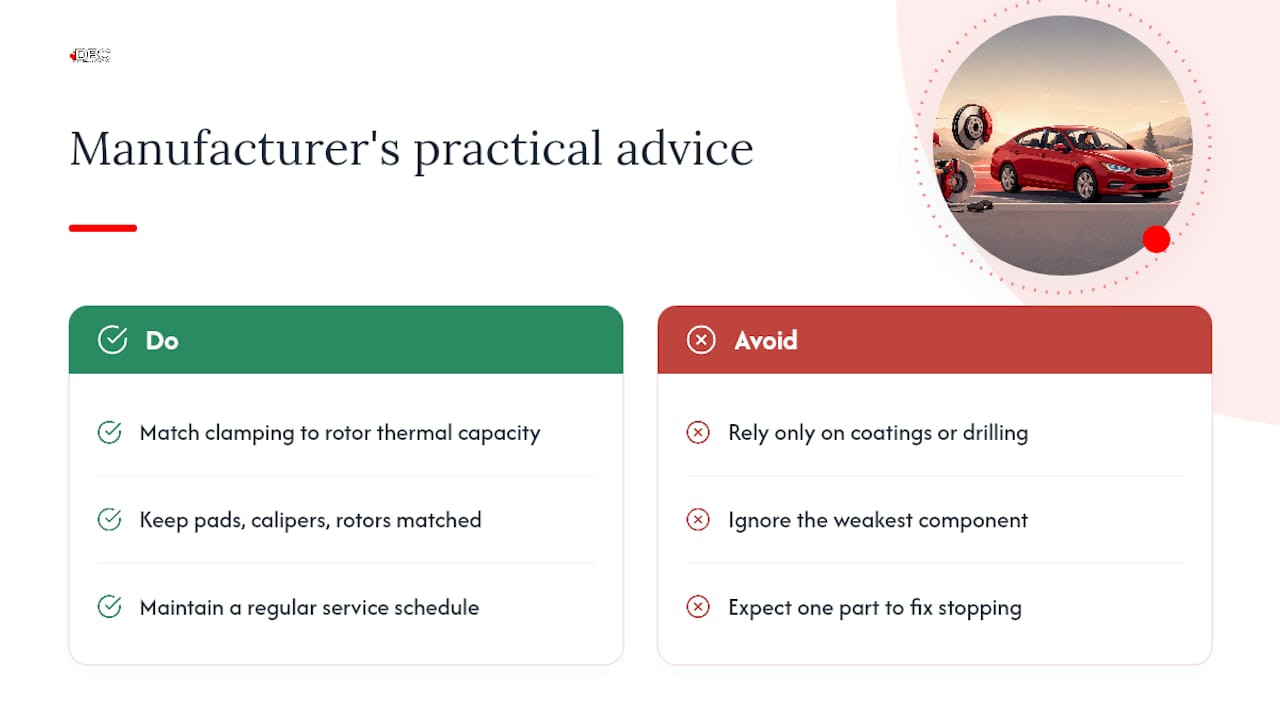
Working with rotor and pad design day to day teaches you one thing fast: components only perform as well as the weakest link in the system. Clamping force and rotor thermal capacity have to be matched, pads, calipers, and rotors together, or an upgrade underdelivers no matter how good any single part is on paper.
Rotor coatings and drilling patterns help with corrosion and heat, but they don't replace a maintenance schedule...
— Sam
How DBC products can help reduce stopping distance
There are direct options for drivers who've done the maintenance basics and want a measurable upgrade beyond stock parts. The cross-drilled rotors address heat buildup and warping under repeated hard stops, while compatible pad and rotor kits are built to work as a matched system rather than mismatched parts bought separately.
Pricing is shown in full at checkout with no hidden add-ons, and orders over $100 ship free within Canada. Professional installation is recommended for any brake component swap, since torque specs and bedding-in procedures affect how the parts perform in the first few hundred kilometres. Start with the premium brake kits if you're ready to move past basic maintenance, or browse the full brake kit collection to compare options for your vehicle.
Sources
For the physics behind braking distance, government winter-driving guidance, and hands-on maintenance detail, see the linked sources throughout this article, including Transport Canada's tyre inflation guidance and the PIARC technical braking-distance guidance.
- PMC article on braking physics
- Transport Canada — driving safely in winter
- Brake — stopping distances and driver reaction research
FAQ
How can I increase my stopping distance?
Speed is the biggest factor: higher speed, worn tyres, low tread, worn brake pads, a heavier load, and wet or icy roads all extend stopping distance significantly.
What is the 30/30/30 rule for brakes?
There's no universally recognized "30/30/30 rule" in braking standards; definitions vary by source, so treat any specific numeric rule you encounter with caution and rely on manufacturer guidance instead.
How far should I brake at 60 km/h?
There's no single fixed number since it depends on tyres, road surface, and reaction time, but braking distance rises sharply with speed, so a car needing roughly 15 metres from 50 km/h will need meaningfully more from 60 km/h, and far more again at highway speeds.
What are 5 factors that affect stopping distance?
Tyre condition, brake system health, vehicle weight, road surface and slope, and driver reaction time are the five core factors, with speed acting as a multiplier across all of them.
Do brake upgrades like DBC's cross-drilled rotors actually shorten stopping distance?
Upgraded rotors mainly improve heat management and consistency under repeated hard stops rather than single-stop distance on their own; pairing them with good tyres and matched pads gives the most reliable overall improvement.