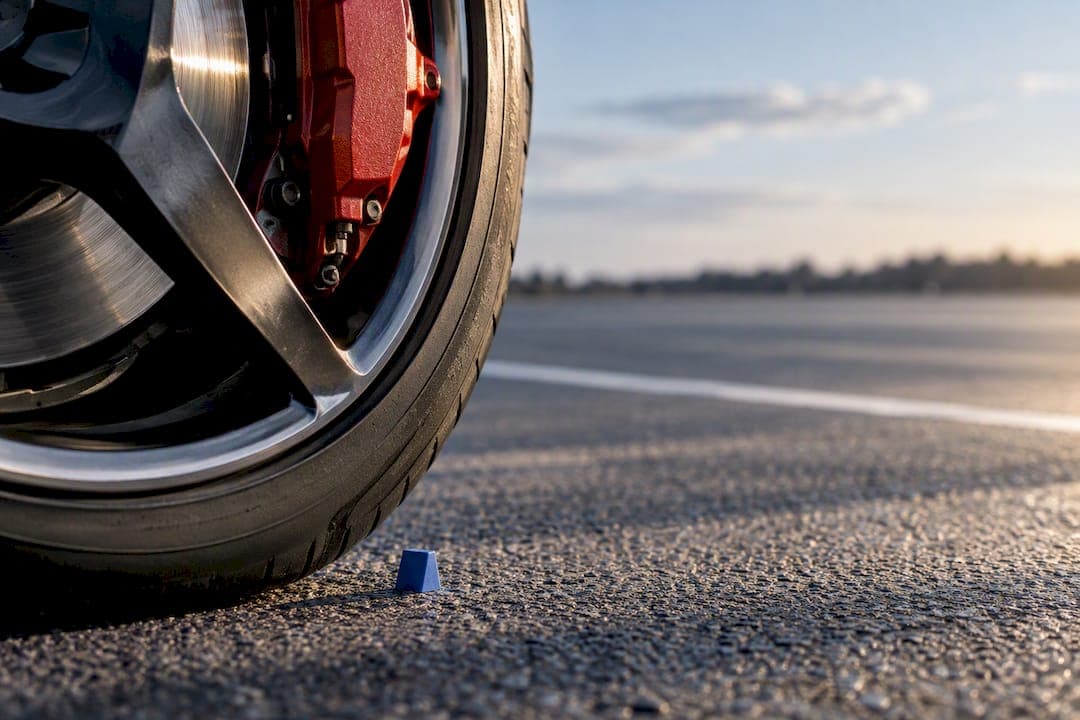
Larger rotors rarely shorten a single cold stopping distance. Their main benefit shows up during repeated or heavy braking, where added surface area and mass slow the heat buildup that causes brake fade. Tyres remain the primary limit on how fast a vehicle stops. This explainer draws on SAE thermal research and DBC Brakes' technical background to separate rotor myths from measurable effects.
TL;DR:
- Larger rotors increase leverage and pad contact area but do not significantly shorten single-stop distances because tyre grip and ABS limit stopping capability.
- The effectiveness of bigger rotors mainly appears during repeated or heavy braking, where better heat dissipation reduces brake fade.
- Rotor design, especially vented or hybrid, impacts heat management more than diameter and is crucial for sustained braking performance.
- Upgrading tyres and pads usually offers a greater impact on stopping distances than increasing rotor size for everyday driving.
- Proper fitment, matching rotor design with intended use, and considering vehicle weight and caliper compatibility are essential before upgrading rotor size.
Table of Contents
- How rotor size changes brake mechanics: torque, leverage and contact area
- Why tyres and ABS usually determine stopping distance
- Heat, fade and repeated braking: the practical scenario where larger rotors help
- Why rotor design often matters more than diameter alone
- Practical trade-offs and upgrade checklist: fitment, weight, pads, calipers and costs
- Publisher perspective: when we recommend a rotor-size upgrade and when another change is better
- How DBC's engineered cross-drilled rotor kits map to the real benefits described
- Sources
- FAQ
How rotor size changes brake mechanics: torque, leverage and contact area
Brake torque comes from two factors: clamping force applied by the caliper and pad, and the effective radius where that force acts. A larger rotor increases the effective radius. That raises leverage, but only if clamp force and pad friction coefficient stay the same. Rotor diameter alone changes nothing about how hard the caliper squeezes or how grippy the pad compound is.
This is why swapping to bigger rotors without changing calipers or pads often produces a modest torque increase rather than a dramatic one. The direct mechanical effects are:
- Leverage: a larger radius multiplies the same clamp force into more torque at the wheel.
- Pad contact area: bigger rotors can accommodate larger pads, spreading force over more surface.
- Cooling surface: more rotor mass and surface area absorb and shed heat more slowly building up.
None of these effects matter if the tyre cannot transmit the extra torque to the road.
Why tyres and ABS usually determine stopping distance
A tyre's coefficient of friction against the road sets a ceiling on how much braking force can reach the pavement, regardless of how much torque the rotor and caliper produce. Once that ceiling is reached, any torque beyond it just tries to lock the wheel.
ABS exists precisely for this reason. It releases brake pressure the instant it detects wheel slip, keeping the tyre near its peak grip rather than a full lock. That means extra brake torque from a larger rotor often has nowhere to go: the system was already limited by tyre grip before rotor size became relevant.

One consistent theme across enthusiast and engineering discussions is that tyre grip, not rotor size, decides how short a single stop can be. For everyday street driving, upgrading tyres typically has a bigger effect on stopping distance than upgrading rotors alone.
Heat, fade and repeated braking: the practical scenario where larger rotors help
Brake fade happens when rotor temperature climbs high enough that the pad's friction coefficient drops, reducing braking power even though the driver presses just as hard. A single stop from highway speed rarely generates enough heat to cause this. A mountain descent, a track session or a loaded tow vehicle repeatedly stopping does.
Numerical studies show hybrid ventilated rotor designs, combining cross-drilling with slots and side grooves, dissipate heat more effectively than solid or simple vented rotors, reducing surface temperature rise under repeated braking.
That finding comes from SAE research on ventilation cut patterns. A separate SAE dynamometer study measured how directing airflow to the rotor reduced average disc temperature by modest single-digit percentages at tested speeds. Situations where this matters most:
- Track days: consecutive hard braking zones raise rotor temperature lap after lap.
- Mountain descents: sustained braking on long grades builds heat with little cooling time in between.
- Towing or hauling: added vehicle mass increases the energy each stop must absorb.
- Commercial fleets: frequent stop-and-go cycles compound heat faster than a private daily driver ever will.
Drivers preparing for a descent can also review maintenance steps that reduce fade risk before relying on rotor size alone.
Why rotor design often matters more than diameter alone
Diameter is one variable. How a rotor handles heat is often a bigger one. Solid rotors are simplest but retain heat longest. Vented rotors add internal channels that let air move through the disc, carrying heat away faster than a solid design. Cross-drilled and slotted designs add surface features that help clear gas and debris from the pad face, and hybrid designs combine these approaches for more consistent temperatures over repeated stops.
- Solid rotors: lowest cost, least heat dissipation, suited to light-duty use.
- Vented rotors: internal vanes move air through the rotor, cutting temperature rise.
- Cross-drilled or slotted rotors: additional surface features assist heat and gas management, and DBC's cross-drilled rotor line is built around this approach.
- Hybrid designs: combine multiple features for more even temperature control across repeated stops.
Pro Tip: Match rotor type to pad compound and driving use. A high-temperature pad paired with a poorly vented rotor still overheats; a well-vented rotor with a low-temperature street pad wastes the rotor's advantage.
Practical trade-offs and upgrade checklist: fitment, weight, pads, calipers and costs
Bigger rotors add rotational mass. That mass sits at the wheel, farther from the vehicle's centre, so it takes more energy to spin up and slow down than the same mass located elsewhere. The effect on acceleration is usually small, but it is not zero, and it is one reason a rotor upgrade should be sized to the actual need rather than chosen by instinct.
Before ordering parts, work through this checklist:
- Confirm wheel clearance: a larger rotor may not fit inside the existing wheel.
- Check hub and bolt pattern: rotor diameter changes sometimes require different hub or bracket hardware.
- Verify caliper clearance: calipers must be able to sit properly over the new rotor diameter and thickness.
- Match pad compound to the rotor: a heat-focused rotor upgrade needs a pad rated for the temperatures involved.
- Bed in new components: follow a proper bed-in procedure and check brake fluid condition before heavy use.
Readers running stock calipers should review what changes when pairing larger rotors with original calipers before assuming a straightforward swap.
Publisher perspective: when we recommend a rotor-size upgrade and when another change is better
For daily commuting, tyres and pads are the first upgrade to consider, not rotor size. For towing, repeated heavy braking or track use, larger or engineered rotors paired with matching pads and cooling become worth the cost. We weigh performance gain against fitment and price before recommending a rotor change over a simpler fix.
— Sam
How DBC's engineered cross-drilled rotor kits map to the real benefits described
For drivers whose braking load actually involves repeated heat cycles, towing, mountain routes or frequent stop-and-go work, an engineered rotor makes practical sense. DBC Brakes builds its Performance XDB, Premium Black Kote and Performance SS lines around cross-drilled construction designed to manage heat and resist warping over repeated hard use, with guaranteed fitment and no hidden fees on pricing.
Before ordering, check the following on each product page:
- Fitment details: confirm rotor diameter, hub dimensions and bolt pattern match the vehicle.
- Recommended pad pairing: pick a pad compound suited to the expected heat load.
- Kit versus single rotor: a full brake kit bundles rotors and pads matched for the same use case.
Orders over $100 ship free, and expedited shipping is available for $29.99 per order when timing matters. Use the fitment guide on the product page, or contact support directly with questions before placing an order.
Sources
- Numerical Investigations on Thermo-Structural Behavior of Various Cut Patterns for Ventilation on Automobile Brake Discs (SAE, 2020)
- Why bigger brake rotors are almost always better (The Pro's Closet blog)
FAQ
Do bigger brake rotors stop better?
Bigger rotors mainly improve resistance to brake fade during repeated or heavy braking rather than shortening a single cold stop. Tyre grip and ABS intervention usually set the limit on stopping distance, as described by enthusiast and engineering sources. Larger rotors help most when heat management, not raw torque, is the limiting factor.
What is the 30/30/30 rule for brakes?
This is not a term covered by the sources reviewed for this article, and definitions vary across sources that use it. Rather than repeat an unverified rule, focus on proper bed-in procedure and pad-to-rotor temperature matching, both covered above.
What is the typical braking distance at 70 mph?
Stopping distance at any speed depends on tyres, road surface, brake condition and vehicle weight, so there is no single figure that applies universally. The factors that matter most, tyre grip and ABS function, are covered in the tyres and ABS section above.
Can rotors last 150,000 miles?
Rotor lifespan depends heavily on driving style, pad compound and maintenance rather than a fixed mileage figure, so no universal number applies. Rotors exposed to frequent heavy braking or repeated fade cycles wear faster than those used mainly for light daily driving.