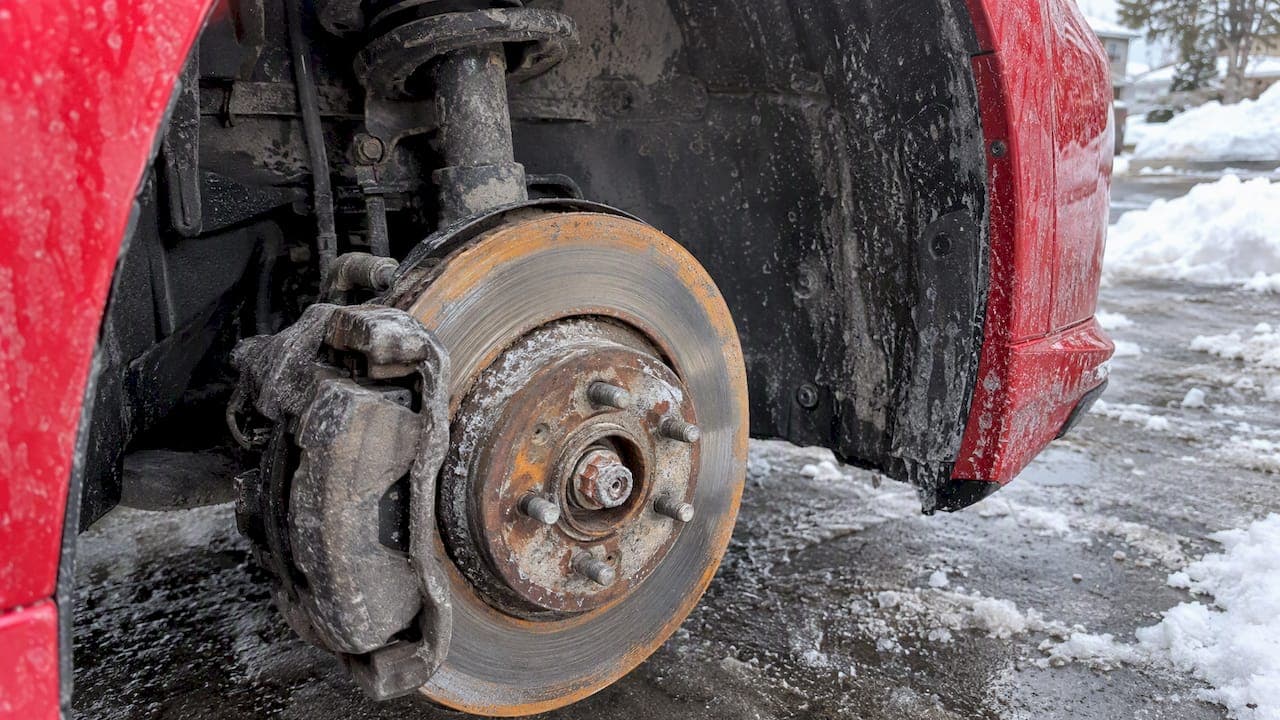
Salt on brake rotors causes surface rust within hours of wet exposure. Light rust usually wears off after a few gentle stops. Deep pitting, grinding, pulling or a changed pedal feel is a repair issue, not a cleaning job. Washing the underbody in salt season, driving the brakes regularly and choosing coated rotors reduce the damage.
This guide covers what salt does to rotors, how to tell harmless film from real damage, how to clean salt off safely, and how to prevent it in a Canadian winter.
TL;DR
- Road salt and moisture put orange surface rust on cast iron rotors quickly. A thin film is common and usually clears with normal braking.
- Pitting, scaling, cracks, a pulsing pedal, pulling, squealing or grinding need a professional inspection.
- Wash salt from the wheels, brakes and underbody during salt season, then make several firm stops to dry the rotors.
- Do not spray lubricants on friction surfaces. Use brake cleaner made for the job.
- Coated rotors, clean slide pins and regular brake use protect the system through winter.
Table of Contents
- Why road salt attacks brake rotors
- Surface film or real damage?
- How to remove salt and light rust safely
- When salt damage is not a cleaning job
- Preventing salt damage through a Canadian winter
- Our perspective on salt and rotors
- Replacement kits for salt-affected brakes
- FAQ
- Sources
Why road salt attacks brake rotors
Brake rotors are cast iron. Iron oxidizes when it meets water and oxygen, and chloride from road salt speeds this up. Research on highway environments finds that chloride ions combined with acidic deposition make conditions much more corrosive, with southern Canada among the regions affected.
Canadian roads add a second factor. Modern de-icing products often include additives such as beet juice. A Canadian trade magazine notes that these additives make the product stick to vehicle surfaces. That raises the risk of fast corrosion on the undercarriage and brake components.
The rotor face is the most exposed part. It is open to spray from the tires, it is hot after braking, and it cools while wet. Salty slush that lands on a warm rotor dries into a crust. The next overnight stop gives the surface moisture and salt to work with.

How fast does it happen?
Surface rust can show after a single wet night. A car parked after a salty commute often has orange rotors by morning. This is normal for bare cast iron.
Storage makes it worse. A manufacturer service bulletin notes that extended parking in humid conditions increases the chance of rotor corrosion. If the braking surface corrodes unevenly, the driver can feel pulsation. The same bulletin says brake systems tend to self-clean in use.
Surface film or real damage?
The first step is to tell the two apart. The table below gives a quick read.
| Sign | Likely meaning | Action |
|---|---|---|
| Even orange film on the rotor face after parking | Light surface rust | Drive gently, then check again |
| Film gone after a few stops, bright swept track | Normal self-cleaning | No action |
| Rust ring on the outer edge, bright track in the middle | Common on parked or low-use vehicles | Monitor, drive normally |
| Deep pits, flaking, scale on the friction face | Corrosion damage | Professional inspection |
| Cracks, especially near the cooling vanes | Structural damage | Stop driving, replace |
| Pulsing pedal after storage | Uneven corrosion or thickness variation | Burnish, then inspect if it persists |
| Pulling, squeal, grinding, soft pedal | Brake problem, not just rust | Repair now |
Official guidance supports this split. Ontario's passenger vehicle inspection standard treats deep corrosion, pitting or scaling as a safety concern when it reduces braking performance. That includes uneven contact, thickness below specification and cracks. Inspectors in Ontario and Saskatchewan are told to reject vehicles with severe rusting, cracks that reach the cooling vents, or wear and pitting that take thickness below the OEM or industry standard.
For a closer look at the difference, see our guide on surface film versus damage on rotors and our overview of rust on brake rotors: causes, fixes and prevention.
How to remove salt and light rust safely
These steps apply to light surface rust and salt crust. They do not apply to deep pitting.
- Rinse first. Use low-pressure water on the wheel wells, wheels, calipers and rotors. Salt dissolves in water, so rinsing removes it before it dries again.
- Clean the caliper bracket. Salt deposits on the bracket can be cleaned with brake cleaner and a brass brush, according to a Canadian owner guide. The same guide advises cleaning and lubricating the slide pins.
- Keep lubricant off the friction surface. Slide pins take grease. Rotor faces and pad surfaces do not.
- Dry the brakes by driving. After washing, make a short, cautious drive with several firm brake applications. One EV maker's service note for road salt says to wash salt and mud from the wheel, brake, suspension and underbody areas and then verify braking performance with a short drive.
- Burnish if the pedal pulses. A manufacturer bulletin describes 10 to 15 moderate stops from 56 to 64 km/h, with cooling time between stops, to clear corrosion-related pulsation. Choose a quiet road with no traffic behind.
- Re-check. The rotor face should look uniform and grey. If rust returns in patches or the pulse stays, book an inspection.
Five or six gentle stops are often enough to wipe light oxidation off the face. Do not use this as a test for a damaged rotor. A rotor that looks pitted after cleaning is pitted.
Cleaning products
Brake cleaner is made to leave no residue on friction surfaces. Water-based (aqueous) cleaners are generally preferred over solvent types for safety and environmental reasons. A hazardous-waste regulator notes that aerosol solvents can contain hazardous chemicals. Wear gloves and eye protection, and work in a ventilated space.
New rotors need a different step. They ship with a protective coating that has to come off before installation. See how to clean new rotors before installation.
What not to use
Penetrating oil and general lubricants do not belong on a rotor face. Transport Canada's Light Vehicle Brake Systems standard, published on May 1, 2026 with mandatory compliance from November 1, 2026, prohibits visible brake fluid or lubricant on the brake friction surface. The standard applies to vehicle makers, but the principle is the same for owners. Any oil on a friction surface cuts braking force.
When salt damage is not a cleaning job
Transport Canada's winter driving guidance says pulling, a change in pedal feel, squealing or grinding may mean the brakes need repair. These symptoms are not fixed by rinsing.
A professional inspection should include:
- measuring rotor thickness against the minimum specification
- checking that the pads move freely
- inspecting the caliper slide pins
- examining brake lines for leaks or corrosion
That list follows the Ontario inspection standard, which also names rust-jacking as a rejectable defect. Rust-jacking is rust buildup that lifts or separates the friction material from the backing plate.
Seized pads and stuck rotors
Salt can lock a pad in its bracket or a rotor on its hub. Signs include one wheel running hot, a burning smell, pulling to one side, or a rotor that will not come off the hub. A stuck pad needs a technician to check the caliper, slide pins and bracket before the car is driven further. For rotors fixed to the hub with corrosion, see our walkthrough on freeing stuck rotors safely.
Preventing salt damage through a Canadian winter
Prevention costs less than replacement. These habits cover most of the risk.
Wash the underbody
A Canadian owner guide suggests washing the undercarriage every two to three weeks during salt season. Wash more often after storms and after driving on freshly treated roads. Pick a wash with an underbody spray, and wash in above-freezing weather when possible so water does not freeze in the calipers.

Use the brakes
Brakes clean themselves when they work. Light, regular braking wipes the film off. Short trips with little braking leave salt on the rotor face.
This matters most for EVs and hybrids. A Canadian garage explains that regenerative braking means friction brakes get used less, so rotors are not wiped clean as often. Its advice is to use the friction brakes on purpose from time to time.
Service the slide pins each fall
Caliper slide pins that bind cause uneven pad wear and drag. Greasing them every fall is part of the routine in the Canadian owner guide above. Use high-temperature brake grease on pins only.
Book a pre-winter inspection
Transport Canada advises owners to follow the manufacturer's maintenance schedule, including a professional brake inspection, particularly before winter. Check pad thickness, rotor thickness, and the condition of lines and hardware before the first salt.
Store seasonal vehicles correctly
A car parked for winter faces the worst combination: salt residue, humidity and no braking. Wash the undercarriage before storage and park in a dry space. Our guide on winter brake storage covers rotors and calipers in detail.
Choose coated rotors
Bare cast iron rusts on every unprotected surface. A coating on the hat and non-friction areas slows corrosion where the pads never touch. A Canadian owner guide lists choosing coated rotors among its preventative measures, alongside frequent washing and oil-based undercarriage coatings.
When fitting new parts, a few other points affect rotor life. Ask for thickness and runout checks when replacing rotors without pads. Follow technician-vetted habits to prevent warping. Plan an upgrade with local conditions in mind using our brake upgrade guide for Canadian road conditions.
Our perspective on salt and rotors
We build brake kits for Canadian roads, so salt is the first condition we design around. A rotor that looks fine in July has to survive months of brine, slush and cold starts.
Our rotors are cross-drilled and engineered to resist warping and to hold up over time. The Premium Black Kote line carries a coating, which is the kind of protection that matters most where road salt sits. We do not claim a coating makes a rotor immune to rust. Bare friction faces will still show a film after a wet night, and that is normal for any iron rotor.
Our advice is simple. Wash the underbody, drive the brakes, grease the slide pins, and have the system inspected before winter. When a rotor is pitted, cracked or below minimum thickness, replace it rather than clean it.
Fitment matters as much as material. We guarantee fitment and answer questions with people, not automated replies, so owners can confirm the right kit for the vehicle before ordering. Pricing is inclusive, with no hidden fees.
Sam
Replacement kits for salt-affected brakes
If the rotors are pitted or past minimum thickness, a full set is often the cleaner fix than replacing one part at a time. DBC offers brake kits with cross-drilled rotors in three lines: Performance XDB, Premium Black Kote and Performance SS. Individual brake rotors, brake pads and wheel bearings and hubs are also available.
To find the right parts, select the vehicle make and choose a kit that fits. Orders over $100 ship free in Canada. Expedited shipping costs $29.99 per order. Current shipping terms are on the shipping information page.
FAQ
Is it okay if my rotors are rusted?
Light surface rust is normal on cast iron and usually wears off with a few gentle stops. Deep corrosion, pitting, scaling or cracks are a safety concern, particularly when they reduce thickness below specification. Ontario and Saskatchewan inspectors reject vehicles for severe rusting on the rotor friction surface, per the Ontario standard. Have a technician measure the rotor if there is any doubt.
Can I use WD-40 to clean my brake rotors?
No. Lubricants on a friction surface reduce braking force, and Transport Canada's 2026 brake systems standard prohibits visible lubricant on the brake friction surface of new vehicles. Use a brake cleaner made for rotors and pads. Water-based cleaners are generally preferred over solvent types.
What should I do if a brake pad is seized to the rotor?
Do not keep driving on it. Signs are a hot wheel, a burning smell or pulling to one side. A technician should check pad movement, the slide pins and the caliper, as the inspection standard describes. Repeated seizing usually points to corroded hardware that needs replacement.
How often should I wash salt off my brakes?
A Canadian owner guide suggests every two to three weeks during salt season. Wash sooner after storms or heavy salting. Finish with a short drive and several firm stops so the pads and rotors dry.
Sources
- Passenger / Light-Duty Vehicle Inspection Standard (Ontario)
- Brake rotor corrosion and pulsation service bulletin (NHTSA)
- Rust busters (CAA Magazine)
- Highway environment corrosivity (Transportation Research Board)
- How to remove road salt from brake components
- Preparing your vehicle for winter (Transport Canada)
- Light Vehicle Brake Systems standard (Transport Canada)
- Aqueous brake washers (California DTSC)
- Tech Note: road salt and brake calipers (Tesla Service)
- Why does my EV have rust on the brakes all the time?