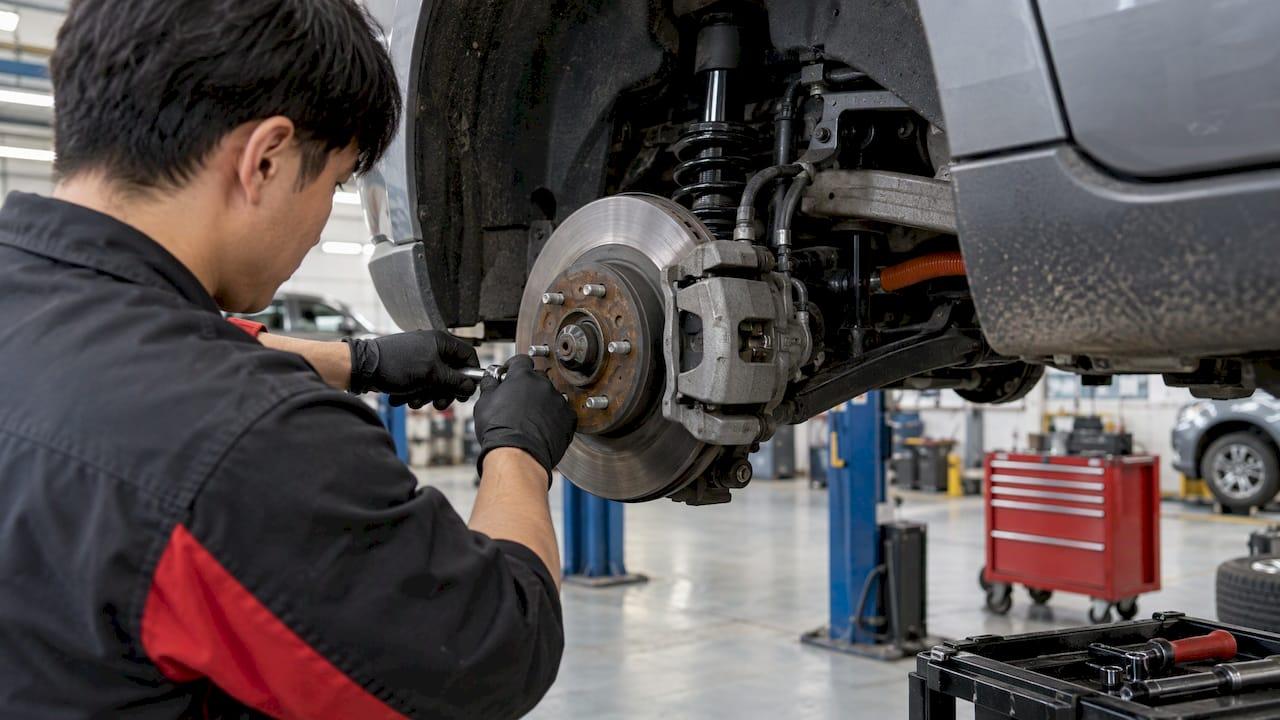
Regenerative braking reduces how often the friction brakes do the work, so pads and rotors usually wear more slowly on hybrids and EVs. It does not remove brake wear. Less use also brings a different problem: corrosion, especially where roads are salted. This guide covers how regen affects wear, what fails first in Canadian conditions, and what to inspect.
TL;DR
- Regen braking slows the vehicle with the electric motor. Friction brakes do less work, so pad wear drops.
- A peer-reviewed study found regen uses the friction brakes more efficiently and reduces pad wear.
- Less use means more rust. Road salt, brine and moisture attack rotors, calipers and slide pins.
- Seized calipers cause uneven pad wear and rotor problems, even on low-mileage brakes.
- Inspect brakes on a regular schedule and press the brake pedal firmly now and then to keep surfaces clean.
Table of Contents
- Regen braking and friction braking: the basic difference
- How regen reduces pad and rotor wear
- The trade-off: less use, more corrosion
- Uneven pad wear on hybrids and EVs
- How to inspect and maintain brakes on a regen vehicle
- When regen braking feels different or stops working
- Our perspective on regen and rotors
- Replacement parts for Canadian conditions
- FAQ
- Sources
Regen braking and friction braking: the basic difference
A conventional brake turns motion into heat. Pads press on a rotor, friction slows the wheel, and the energy is lost as heat. Mazda explains that regenerative braking works differently. An all-electric or hybrid powertrain captures energy as the vehicle slows or goes downhill, then uses it to recharge the battery.
The motor works as a generator during regen. The drag that generator creates slows the vehicle. That drag does the work that pads and rotors would otherwise do.
The two systems work together. They are not substitutes. Mazda notes that no form of regenerative braking currently handles the force needed for emergency braking at higher speeds. Hard stops, full stops and high-speed stops still depend on friction brakes.
| Feature | Friction braking | Regenerative braking |
|---|---|---|
| Slows the vehicle by | Pads pressing on rotors | Motor acting as a generator |
| Energy result | Lost as heat | Partly returned to the battery |
| Wears pads and rotors | Yes | No |
| Emergency stops | Primary system | Supports, not enough alone |
| Rust risk from disuse | Low on regular vehicles | Higher on EVs and hybrids |
How regen reduces pad and rotor wear
Every stop that regen handles is a stop the pads do not handle. A peer-reviewed study in the Proceedings of the Institution of Mechanical Engineers found that driving an EV with a regenerative braking system uses the friction brakes more efficiently and reduces brake pad wear. The same study reported an 11 to 22% gain in driving range, depending on regen settings and the drive cycle.
Brake dust follows the same logic. The BRAKE Report cites a case study in which a regen system with 70 percent energy efficiency cut brake wear emissions by 70 percent. It adds that a more realistic figure, once driving behaviour, road conditions and the mechanical brake type are considered, is 50 percent.
That last point matters. The saving varies. Three factors drive the difference:
- Driving style. Smooth, anticipatory driving lets regen do most of the slowing. Late, hard braking calls on the friction brakes.
- Terrain. Long downhill stretches let regen work for a long time. Stop-and-go city driving gives frequent regen events at low speed, where regen is weakest.
- Regen setting. Many vehicles offer stronger or weaker regen. A stronger setting means less pad use.
Why regen fades at low speed
Regen force drops as speed falls. At the end of a stop, the friction brakes finish the job. This is why even gentle city driving still wears pads a little, and why pad thickness should be measured rather than assumed.
The trade-off: less use, more corrosion
Pads that rarely touch the rotor do not wear out, but they do rust. The BRAKE Report notes that on EVs the mechanical pads may be used sparingly or not at all. That reduces dust, but the pads can corrode easily, which can raise safety concerns.
In Canada, salt is the main driver. John Niemiera of PowerStop told Autosphere that in the northern U.S. and much of Canada, municipalities use salt, brine and sand to melt snow. These act as oxidizers that corrode bare metal. Corrosion on a caliper can cause drag and uneven wear on pads and rotors, leading to disc thickness variation (DTV). DTV is often felt as a pulsing pedal or a vibrating steering wheel.

The same source says that on hybrids and EVs the friction brakes are used less often because so much kinetic energy goes to the battery. Pads and rotors may last longer, but corrosion tends to build up from the lack of use, so it belongs on the brake inspection report.
Jobber Nation quotes NRS making the same point from the parts side: brake pads sit close to the road and see water, mud, dirt and road salt every time the vehicle is driven, which makes a good environment for corrosion. Continental, quoted in the same article, says rust can form on calipers, pad backing plates and slide pins in salted regions, and any of it can affect braking performance.
For a deeper look at how salt reaches the rotor surface and how to clean it, see the DBC guides on salt on brake rotors and rust on brake rotors.
Uneven pad wear on hybrids and EVs
One of the common reader questions is why one pad wears more than the other. On regen vehicles the cause is often a sticking caliper rather than heavy braking.
Vehicle Service Pros describes a hybrid where the right inner pad was worn to the backing plate and the outer pad was worn unevenly. It calls this common on hybrids because the brakes are not exercised much and the calipers eventually bind. A bound caliper does not release, so the pad keeps rubbing. Rusted slide pins make the caliper slide unevenly and cause irregular pad wear.
Signs of a sticking caliper:
- One wheel is noticeably hotter than the others after a drive.
- The vehicle pulls to one side when braking.
- Inner and outer pads on the same wheel show different thickness.
- A burning smell comes from one wheel.
- One rotor shows blueing or heavy scoring.
Any of these calls for an inspection by a qualified technician before the next long drive.
How to inspect and maintain brakes on a regen vehicle
A regen vehicle needs the same brake checks as any other, with more attention to corrosion. Pad thickness alone does not show the condition of the system.
Inspection interval
Toyota Canada's Electrified Service Experts recommend a service every 6 months or 8,000 km for electrified vehicles, the same as for gas vehicles. The technician removes the wheels and inspects pads, calipers, rotors, brake lines and hoses. Toyota adds that pads and rotors tend to last longer than on a gas vehicle because of regen. Check the owner's manual for the interval set by the manufacturer of your vehicle.
What to check
- Pad thickness on all four wheels, inner and outer pads.
- Rotor surface for rust scale, grooves, a lip at the edge and uneven wear.
- Caliper slide pins for free movement and lubrication.
- Brake hoses and lines for cracks or corrosion.
- Brake fluid age and condition.
Brake fluid
Continental, quoted by Jobber Nation, states that the standard service life of brake fluid in any vehicle is two to three years. Regen does not change that interval. Fluid absorbs moisture over time, and old fluid affects pedal feel and braking performance. For background on brake fluid maintenance and moisture, see that guide on brake care.
Keep the friction brakes active
For winter use in salted regions, Tesla's Model Y maintenance guidance is a useful example of the manufacturer approach: clean and lubricate the calipers on a set schedule where roads are salted, and apply the friction brakes regularly. Other makers publish their own advice. Follow the owner's manual for the specific vehicle.
A practical routine for winter:
- Apply the brake pedal firmly a few times at the end of a drive on a safe, clear road. This helps clear moisture and light surface rust from the pads and rotors.
- Rinse wheel wells and brake components after salted drives where the vehicle's care guide allows it.
- Book a caliper clean and lube before winter and again in spring.
- Replace rotors showing deep corrosion, rather than waiting for the pads to wear out.
DBC covers cold-weather braking in more detail in its cold weather brake performance guide, and road-condition upgrades in the Canadian road conditions brake upgrade guide.
When regen braking feels different or stops working
Regen strength is not constant. Drivers may notice the vehicle slowing less when lifting off the accelerator, or the pedal feeling different as the system blends regen with friction braking. Regen output depends on conditions the vehicle manages itself, such as battery state and temperature, and the owner's manual for the vehicle lists them.
What to do:
- Treat the friction brakes as the primary system. Regen assists but does not replace them, so leave a larger following gap whenever the vehicle slows less than expected.
- Check the dashboard. A brake or powertrain warning light means a stop and a call to the dealer or a qualified technician.
- Do not ignore a hard pedal, a long pedal or grinding. These point to the hydraulic and friction side, which needs inspection immediately.
- Report persistent loss of regen to the service department with the conditions in which it happens.
With regen reduced or unavailable, all stopping falls on the friction brakes. Pads, rotors and calipers in good condition matter most at that moment.
Our perspective on regen and rotors
Regen braking changes how brakes wear. It does not change what the friction brakes must do when it counts: stop the vehicle in an emergency, in any weather, on salted roads.
We build DBC cross-drilled rotors for Canadian drivers. Our rotors are engineered to resist warping and to last, and our kits are made with guaranteed fitment. For regen vehicles that spend long periods without hard braking, we see the same pattern drivers report: surface rust builds up between uses. When the friction brakes are called on, they need to be clean and in good condition.
Our advice is to inspect rather than guess. Check pad thickness and caliper movement, and replace rotors that are heavily corroded. Choose parts matched to the exact vehicle. Our support team answers questions directly, with no automated replies.
Sam
Replacement parts for Canadian conditions
When inspection shows corroded rotors or worn pads, DBC supplies brake kits, rotors, pads, and wheel bearings and hubs. Kits are matched to the vehicle by make and model. Pricing is inclusive with no hidden fees, and shipping within Canada is free on orders over $100.
Browse brake kits and rotors for your vehicle or use the make selector to find the correct fit.
For an overview of how parts fit together, the guides to Canadian brakes and rotors and car brake parts cover the basics.
FAQ
Does regenerative braking eliminate brake wear?
No. Regen takes over much of the routine slowing, so pads and rotors wear more slowly. Friction brakes still handle hard stops, low-speed stops and the final part of every stop. Corrosion can also age pads and rotors without any mileage.
Is it normal for one brake pad to wear more than the other?
Some difference can be normal, but a large gap is a warning. On hybrids and EVs, rusted slide pins or a sticking caliper are common causes. Have the caliper and slide pins inspected, and replace pads as a set per axle.
What is the difference between regular braking and regenerative braking?
Regular braking presses pads on rotors and turns motion into heat. Regenerative braking uses the electric motor as a generator, slows the vehicle and sends part of the energy to the battery. Both systems work together on electrified vehicles.
Why is my regen braking not working?
Regen can be limited by conditions the vehicle manages, and the owner's manual explains them for each model. If regen disappears persistently or a warning light appears, have the vehicle checked. Until then, rely on the friction brakes and leave extra stopping distance.
Sources
- Mazda USA: What Is Regenerative Braking and How Does it Work?
- Performance evaluation of regenerative braking systems (Proceedings of the Institution of Mechanical Engineers)
- The BRAKE Report: Brake Wear Enviro Impact, Trends to Combat Them (Part Two)
- Autosphere: Brake Inspections, Systematic Safety
- Jobber Nation: Regenerative Braking Systems, A Whole New Ball Game
- Vehicle Service Pros: Maintaining and Repairing Hybrid and Electric Vehicle Braking Systems
- Toyota Canada: What It's Like to Maintain an Electrified Vehicle