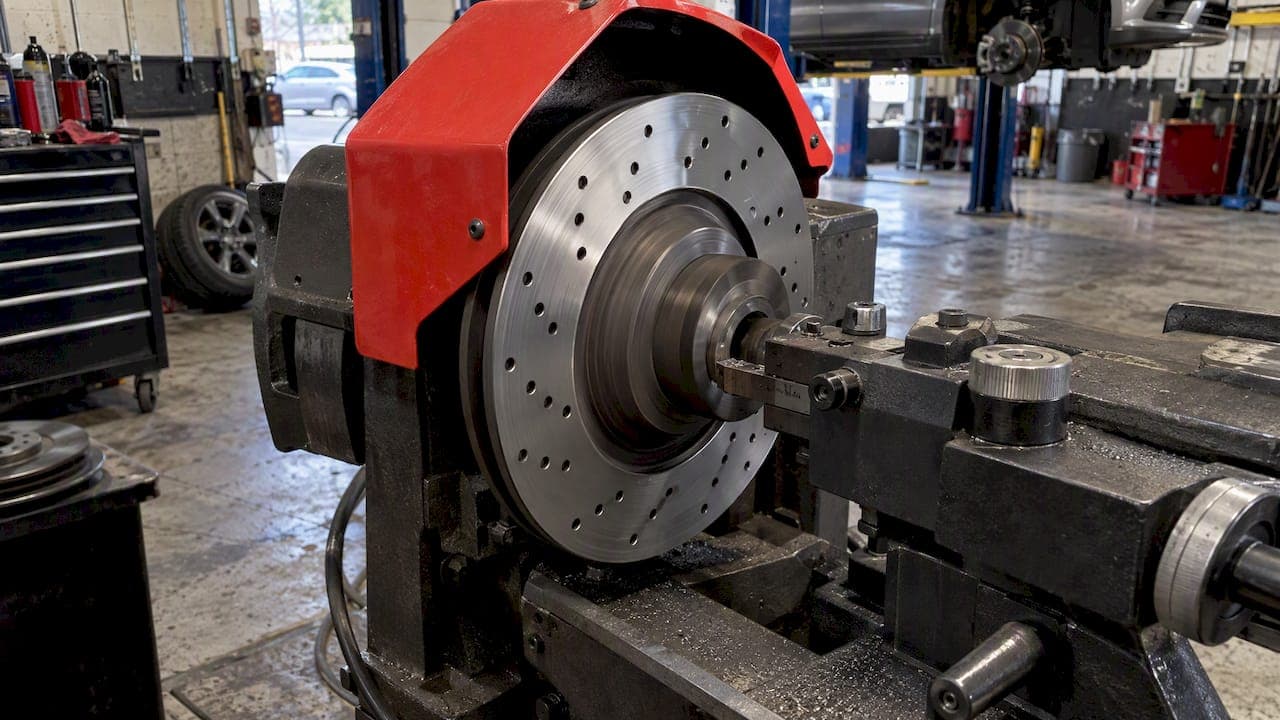
Drilled rotors can sometimes be machined, but it is rarely worth it. The holes interrupt the cut, which is hard on the lathe bit. Modern rotors also have little spare thickness. A shop that agrees to the job has to use very light passes and confirm the rotor stays above its minimum thickness. In most cases, replacing the rotors is the cleaner result.
This guide covers what machining involves, how to check whether a rotor qualifies, what it costs against replacement, and whether drilled rotors suit daily driving.
TL;DR
- Drilled rotors can be turned only with light cuts. Interrupted cuts through the holes damage tooling, so many shops decline the job.
- A rotor must stay above the minimum thickness stamped on it after machining. If it cannot, it is replaced.
- Machining fees of about $60 to $80 per rotor are close to the price of new rotors, so replacement is often the better value.
- Drilled rotors suit spirited and performance driving. For plain commuting, a quality coated rotor is often enough.
- Replace drilled rotors when they are below minimum thickness, cracked beyond the holes' edges, badly grooved or pulsating.
Table of Contents
- Can drilled rotors be turned or resurfaced?
- Machining methods: on-car lathe or bench lathe
- Check thickness before any cut
- Cost: machining against new rotors
- What improper machining causes
- When to replace drilled rotors
- Are drilled rotors good for daily driving?
- Are drilled rotors safe?
- Perspective: our view on turning drilled rotors
- Replacing drilled rotors with DBC
- Quick decision guide
- FAQ
- Sources
Can drilled rotors be turned or resurfaced?
Yes, in some cases. The practical answer depends on the shop, the rotor and the thickness left.
Turning a rotor means removing a thin layer from both friction faces. The goal is a flat, parallel surface. That works well on a solid rotor. On a drilled rotor, the cutting bit repeatedly leaves and re-enters the metal at each hole. That interrupted cut chips and dulls the bit.
Online technician discussions describe drilled rotors being turned in two or three thin passes, because a heavy cut risks damaging the bit as it crosses the holes. Training guidance for rotor machining is similar: drilled and slotted rotors get lighter cuts than plain ones. Treat these as workshop practice, not a guarantee. Many shops simply refuse drilled rotors, and that is their right.
Two more points matter:
- Hole edges are chamfered on a quality drilled rotor. Machining can remove or round that finish, which changes how the holes handle heat.
- Grinding is a different process from turning. It is sometimes suggested for interrupted surfaces, but it is not a standard service at most Canadian brake shops.
Machining methods: on-car lathe or bench lathe
Two types of machine do the work.
| Method | How it works | Notes for drilled rotors |
|---|---|---|
| Bench lathe | Rotor is removed and mounted on a bench machine | Most common. Needs light passes and a sharp bit. |
| On-car lathe | Machine attaches to the hub and cuts the rotor in place | Matches the rotor to the vehicle's own hub, which can reduce runout. Same interrupted-cut limit applies. |
Whichever machine is used, the aim is a flat, parallel surface within thickness limits. The machine does not change the thickness rule. If material removal would take the rotor under its limit, the job stops.
Check thickness before any cut
Every rotor has a minimum thickness (MIN TH) stamped on the hat or edge. It is the manufacturer's limit for safe use, not a target.
A technician decides if machining is appropriate by comparing the current thickness with how much metal must come off to restore a flat surface. If the rotor cannot meet specification after the cut, it has to be replaced.
A basic check:
- Clean the rotor faces and look for the stamped MIN TH value.
- Measure thickness with a micrometer at several points around the rotor, away from the hole edges.
- Note the lowest reading. Compare it with MIN TH.
- Subtract the metal a cleanup cut would remove from both faces.
- If the result is at or under MIN TH, replace the rotor.
Technicians can follow our four-point micrometer workflow for verifying minimum thickness. Measuring at several points also shows thickness variation, which causes pedal pulsation.
Current rotors leave little to work with. One Canadian automotive columnist notes that modern rotors are made lean, and that losing mass or thickness makes them more prone to warping at operating temperatures. A drilled rotor has already lost some mass to its holes, so the margin is smaller again.
Cost: machining against new rotors
The same columnist reports that machining fees can run about $60 to $80 per rotor, with new replacements costing little more. That article is from 2019, so check current local rates.
The comparison for a drilled rotor:
- Machining a pair: two rotors at the shop's rate, plus the risk that the shop finds the rotors too thin or declines the job.
- Replacing a pair: a full-thickness rotor with a fresh friction surface and a new service life.
When the price gap is small, replacement removes the thickness question completely.
What improper machining causes
Machining done badly can bring problems back. A US technical service bulletin states that improperly machined rotors may cause brake pulsation or vibration after several months and that the servicing facility is responsible for that failure. The usual causes are excess lateral runout, uneven thickness, or a rotor machined too thin.
Ask the shop to confirm three things before any cut: measured thickness, the MIN TH value, and how runout will be controlled on the hub.

When to replace drilled rotors
No single mileage figure applies. Driving style, pad material, vehicle weight and road conditions change how fast rotors wear. Replace drilled rotors when any of these apply:
- Thickness is at or below MIN TH. Replacement is the only option.
- Cracks spread past the hole edges. Small hairline cracks around holes can appear on drilled rotors in hard use. Cracks that extend across the friction face or toward the rotor edge are a reason to replace. Canada's brake standard requires braking system components to perform without detachment or fracture, except minor cracks that do not impair attachment of the friction facings (Transport Canada, effective 1 May 2026). Have a technician judge any crack.
- Deep grooves or a pronounced lip. The surface is no longer flat, and the pads cannot seat properly.
- Pulsation that returns after pads and hardware are in good order. Uneven thickness or runout are the likely causes.
- Blue heat marks or visible heat damage. The rotor has seen temperatures beyond its design.
A standard brake job includes cleaning, inspecting and lubricating hardware, and in most cases machining drums and rotors. Ask for the thickness readings on the invoice either way. If you are fitting rotors without new pads, see why to ask for thickness and runout figures.
Are drilled rotors good for daily driving?
They can be used daily, with trade-offs. Drilled rotors give gas, water and debris a path off the friction face. That helps in hard braking, wet conditions and track use. For ordinary commuting at legal speeds, the benefit is smaller.
What to weigh:
- Heat and fade: the holes help the pad face stay clean under repeated hard stops. Most commuters rarely reach that level.
- Cracking: holes concentrate stress. The risk rises with hard, repeated heat cycles. Hairline marks at the hole edges need monitoring.
- Noise: drilled and slotted rotors can whistle or hum with some pads. Our guide to diagnosing drilled rotor noise covers the checks.
- Rust: an Alberta repair shop notes that road salt can cause rust to form in non-wiped areas of drilled and slotted rotors. Canadian winters make a protective coating worth considering. See coated rotor benefits for daily drivers and causes and prevention of rust on brake rotors.
The same shop's view is that drilled and slotted rotors are rarely beneficial on a regular daily-driven vehicle. That is one opinion, and it fits a plain commuter car. It fits less well a heavy truck, a tow vehicle, a hilly route or a performance car driven hard.
Wheel dust is another daily-use point. Drilled rotors and performance pads can leave more brake dust on wheels. Cleaning it correctly protects the finish: here is how to remove brake dust safely using a short dwell time.
Are drilled rotors safe?
A quality drilled rotor, correctly made and fitted, is safe for road use. The risk lies in poor manufacturing, worn rotors kept in service, or hard track use without inspection.
Safe use comes down to habits:
- Buy rotors made for the vehicle, with chamfered holes and a listed fitment.
- Bed in new pads and rotors as the pad maker instructs.
- Inspect rotor faces at every tire rotation.
- Replace at MIN TH, and at any sign of spreading cracks.
- Do not machine a rotor you cannot measure.
A brake that pulls, pulses or feels soft should be seen by a licensed technician before it is driven further.
Perspective: our view on turning drilled rotors
We manufacture cross-drilled rotors, so we hear this question often. Our advice is plain. A drilled rotor is built to be replaced, not rebuilt. The holes are placed and chamfered for a specific job, and cutting the face changes the part. With machining fees close to the price of a new rotor, turning rarely saves money.
We also tell buyers not to choose drilled rotors on looks alone. If the vehicle is a daily driver on salted roads, we point to coated rotors. If the vehicle is a truck, a tow rig or a performance car, drilled and slotted designs make sense. Our support team answers fitment questions directly, without automated replies, because the right rotor depends on the vehicle.
When a customer asks us whether to turn or replace, we ask for one number first: the measured thickness against MIN TH. If it is close, replace.
— Sam
Replacing drilled rotors with DBC
If your rotors are near their limit, DBC sells cross-drilled and slotted rotors as well as complete brake kits and brake pads. Our lines are Performance XDB, Premium Black Kote and Performance SS. Pricing is inclusive, with no hidden fees. Shipping within Canada is free on orders over $100. Expedited shipping costs $29.99 per order. Start from the DBC home page and select your vehicle to confirm fitment.
Quick decision guide
| Situation | Suggested action |
|---|---|
| Thickness well above MIN TH, light pulsation | Ask whether a shop will do a light cut. Replace if they decline. |
| Thickness near MIN TH | Replace. |
| Cracks past hole edges | Replace. |
| Daily driver, salted roads | Consider a coated rotor. |
| Truck, tow, track or spirited use | Drilled and slotted rotors suit the job. |
FAQ
Can drilled and slotted rotors be machined?
Sometimes. The interrupted cut through the holes damages cutting bits, so shops use very light passes or decline. The rotor must stay above its MIN TH afterward. Many owners replace them instead.
Can you resurface drilled rotors at home?
Not in a practical way. Resurfacing needs a lathe and a thickness measurement. Light sanding of a pad surface does not correct runout or thickness variation. Use a shop or replace the rotors.
Are drilled rotors good for daily driving?
They work, but the benefit is small for normal commuting. Heat control matters more for towing, hills and hard driving. In salted regions, a coated rotor helps limit rust.
Are drilled rotors safe?
A well-made drilled rotor is safe when fitted correctly and inspected. Replace it at minimum thickness or if cracks spread beyond the hole edges. See a licensed technician for any pulsation or pulling.
Sources
- Your Corner Wrench: Don't bother with machining your brake rotors (Driving.ca)
- Technical Service Bulletin 2015173/34 (NHTSA)
- Transport Canada brake standard, effective 1 May 2026
- Rotor Turning Cost: How to Save Money (Spend On Auto)
- Brake Rotor Machining, St. Albert
- What You Should Know About a Brake Job (Dean's Automotive)
- Repairs that you don't need: Drilled & Slotted Brake Rotors