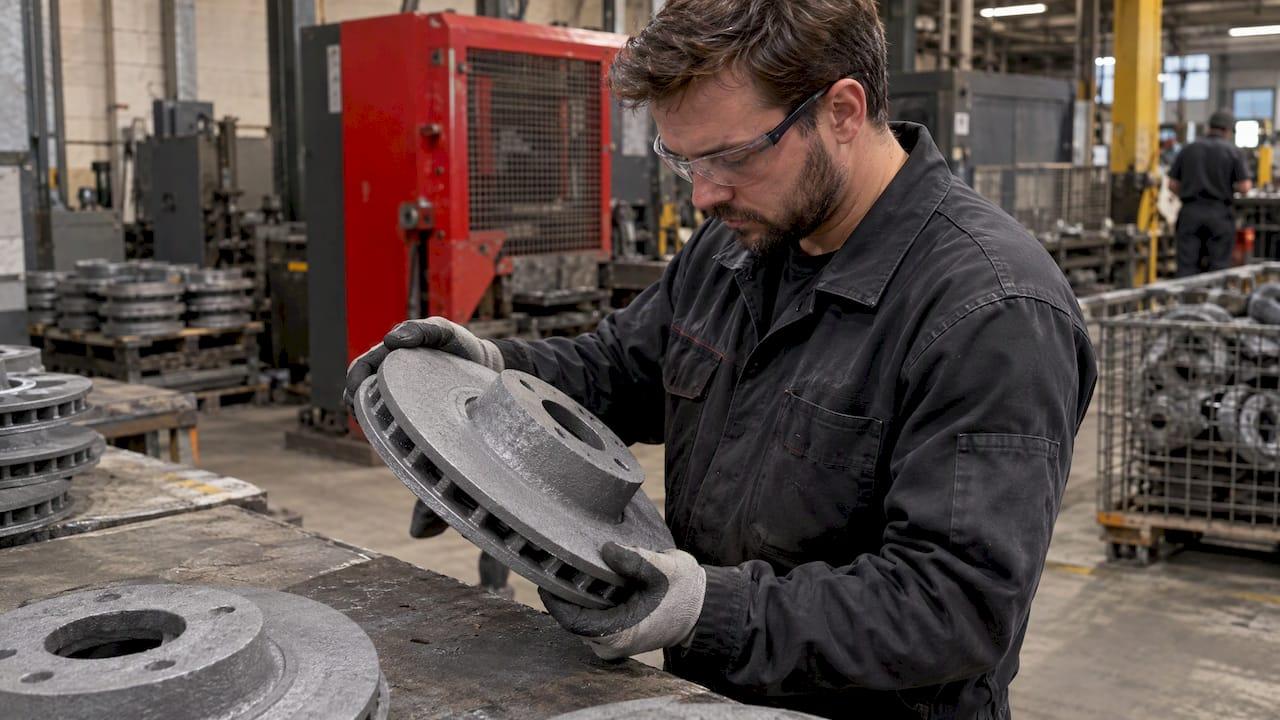
Rotor casting quality is how sound, consistent and defect-free a rotor is after it is cast. For a brake rotor, that means even metal density, no hidden voids or inclusions, and a clean surface to machine. Poor casting shows up as uneven wear, vibration and cracking. Good casting shows up as steady braking over many stops.
The phrase also covers electric motor rotors, which are a different part. Most search results for it are about motors. This article covers brake rotors first, then explains the motor side so the two are not confused.
TL;DR
- Casting quality is about the metal inside the rotor: density, graphite structure, voids and inclusions. Machining and coating come after it.
- Hidden defects such as inclusions and porosity can stay undetected until the part is in service (IntechOpen case study).
- Hard spots in a casting can cause uneven wear (Tire Review).
- Checks that a buyer can do: fitment match, visible finish, balanced weight, clean machined faces, and a supplier that states its quality process.
- Electric motor rotors have their own casting defects and tests. They are covered in a separate section below.
Table of Contents
- What rotor casting quality means for brake rotors
- Casting defects that matter on a brake rotor
- How casting quality shows up on the road
- How to judge a brake rotor before buying
- Quality control in brake manufacturing
- Material and coating choices
- Perspective
- The other meaning: electric motor rotors
- Choosing brake rotors in Canada
- DBC brake kits and rotors
- FAQ
- Sources
What rotor casting quality means for brake rotors
A brake rotor starts as molten iron poured into a mould. The result is a rough casting. It is then machined to final thickness, finished, and in some cases drilled, slotted or coated. Each later step depends on the first one. A machined face cannot fix a weak or uneven casting under the surface.
Casting quality covers four things:
- Material consistency. The same iron composition and graphite structure from one rotor to the next.
- Soundness. No gas pockets, shrinkage voids or trapped debris in the friction ring.
- Dimensional accuracy. Wall thickness and hat geometry close to the drawing, so machining removes only a small, even amount.
- Repeatability. A batch of rotors that behave alike, so a left and right side wear at the same rate.
Most passenger-vehicle rotors are grey cast iron. The graphite flakes in it help move heat out of the friction ring. Research on automotive-grade SAE G3000 grey iron measured how flake shape and composition change its thermal diffusivity (study on graphite flake morphology). In short, the structure of the iron affects how a rotor handles heat. That structure is set during casting and cooling.
Casting defects that matter on a brake rotor
Inclusions
Inclusions are non-metallic particles trapped in the metal. A failure analysis of a cast brake rotor describes them as subsurface defects that may be found during machining, or may stay undetected until the part fails in service (IntechOpen). The same source notes that the most severe defects can act as stress raisers or crack starters.
Gas porosity and shrinkage voids
Gas pockets form when gas is trapped as the iron solidifies. Shrinkage voids form when metal contracts as it cools and the mould is not fed with enough liquid iron. Both leave small empty spaces. In a friction ring that sees repeated heating and cooling, those spaces are weak points.
Hard spots and uneven structure
Hard spots are local areas of harder iron. A brake service reference notes that hard spots in a rotor casting can cause uneven wear, and that the quality of original rotors can range from excellent to questionable (Tire Review). A rotor with hard spots wears in bands. The driver feels this as pedal pulsation, often blamed on warping.
Thermal cracking
Grey cast iron discs under repeated thermal shock develop surface cracks over time. A study of a used grey iron brake disc reports thermal cracking, spalling wear and tribo-oxidation as failure mechanisms (Springer, Microstructure evolution of cast iron brake discs). Some cracking is part of normal ageing. A casting with voids or inclusions near the surface gives cracks an earlier start.
How casting quality shows up on the road
A driver does not see the casting. The driver feels the results:
- Pedal pulsation or steering wheel shake under braking. Uneven wear and thickness variation are common causes.
- Noise from uneven friction surfaces.
- Short pad or rotor life, where one rotor wears faster than its pair.
- Visible cracks around holes, slots or the edge of the friction ring.
Installation matters as well. The Tire Review guide above notes that dirt on the hub face or the inside face of the rotor hat can cause runout. Cleaning those faces before fitting removes one common cause that has nothing to do with casting. Rule out the install first, then look at the rotor.
How to judge a brake rotor before buying
A buyer cannot X-ray a rotor. These practical checks narrow the field.
| Check | What to look for | Why it matters |
|---|---|---|
| Fitment | Match to year, make, model and trim | A wrong hat or diameter cannot be fixed by machining |
| Surface finish | Even, clean friction faces with no pits or flaking | Pits can point to surface defects or poor handling |
| Edges and holes | Clean, chamfered edges on drilled or slotted rotors | Sharp edges are where cracks tend to start |
| Protection | Coating on the hat and non-friction areas | Limits rust on the shelf and in service |
| Supplier process | A stated quality control process and real customer support | Shows who answers if a part has a problem |
| Total cost | Price with shipping and taxes stated up front | Avoids paying more at checkout |
On drilled rotors, hole finish counts. See our notes on why drilled rotors crack on track for how chamfers and heat treatment affect crack resistance.
Quality control in brake manufacturing
A supplier controls casting quality through process steps, not through one final look. Typical steps in rotor production include checking incoming material, controlling pour and cooling, inspecting castings, machining to tolerance, balancing, and checking finished parts. Vision systems are now used in some plants to find casting porosity, sand inclusions and machining errors on every disc (iFactory overview of brake rotor inspection).

DBC explains its own approach in the role of quality control in brake manufacturing. For a wider view of how design choices change braking, see understanding brake rotor design and performance.
Material and coating choices
Casting quality is one part of the picture. Material grade and coating change how a rotor lasts.
- Rotor material. Cast iron keeps its strength at high temperature better than many alternatives. Our rotor material comparison sets out the figures.
- High carbon iron. Added carbon helps with heat for towing and hard driving. See when high carbon rotors pay off.
- Coating. A coated hat and edge resists rust on daily drivers. Our guide to coated rotor benefits covers stuck rotors and corrosion.
Wheel care also affects how rotors look and last. Brake dust and road salt collect on wheels and rotors alike. A guide to protecting alloy wheels with ceramic coatings covers the wheel side of that work. For rotor surface rust, see surface film or damage.
Perspective
Rotor casting quality is the part of a brake that a buyer never sees. We build our approach around that fact.
Our brake kits use cross-drilled rotors engineered to resist warping and to last. We state the fitment and we guarantee it. Pricing is inclusive, with no hidden fees. Shipping is free in Canada on orders over $100.
We are a Canadian manufacturer. Customers speak to people who know brakes, not to automated replies. A buyer who asks about casting, coating or fitment gets a direct answer.
For most drivers, the right rotor is the one that fits the vehicle, suits how it is driven, and comes from a supplier that stands behind the part.
Sam
The other meaning: electric motor rotors
The search results for this phrase mostly describe electric motor rotors, such as aluminum or copper die-cast squirrel cage rotors. These are not brake parts. The ideas overlap with brake rotors, because both are castings and both fail from hidden voids. The details differ.
What goes wrong in motor rotor castings
In aluminum motor rotors, porosity and discontinuities from casting can cause eccentricity, losses, unwanted sounds and false fault readings. Large amounts of air and shrinkage porosity are the most common defects (Kozma and Zsoldos, MDPI, 2024). Shrink holes and cold shuts are the main internal defects in die-cast aluminum rotors. A cold shut is a weak seam where two flows of molten metal meet and do not fuse (Electricalapparatus.net).
Why it matters for a motor
Porosity is introduced during the die-cast process and can degrade motor performance. In extreme cases it can force an outage and cause irreversible damage (Jeong et al., IEEE). About 10% of failures in industrial induction machines relate to rotor defects (Nau, Schmitz and Pires, IEEE, 2015).
How motor rotors are inspected
Motor rotor quality is checked with imperfection tests on rotor bars and end rings, motor current signature analysis and ultrasound. These can run on the production line or in the field (IEEE, 2015). Bar-by-bar electromagnetic testing can find broken bars, porosity and blowholes before the motor is assembled (SM SYSTEM). Visual checks on a removed rotor can reveal a cracked end ring or a die-cast end ring separated from the laminations (Electricalapparatus.net).
CT scanning gives numbers. In one study, a well-cast aluminum end ring had about 120 porosities, each under 1.5 mm³, evenly spread. A poorly cast part had 360 porosities, with volumes of 3 to 4.5 mm³, unevenly spread (Kozma and Zsoldos, MDPI).

Standards for motors in Canada
Motors sold in Canada fall under CSA standards, not under brake rules. CSA C22.2 No. 100 covers motors in general, and No. 77 covers motors for classified locations (IEEE PCIC 2022 paper). CSA Group is accredited by Natural Resources Canada to test three-phase induction motor efficiency against CAN/CSA C390-10 and C747-09 (CSA Group). These standards do not apply to brake rotors.
Choosing brake rotors in Canada
A short process keeps the choice simple.
- Identify the vehicle. Year, make, model, trim and brake package. Use the make selector to match parts to the vehicle.
- Match the use. Daily commuting, towing, and track use call for different rotor and pad combinations.
- Pick rotors and pads together. A rotor and pad pair designed to work together wears more evenly.
- Check the total price. Confirm shipping, taxes and fees before checkout.
- Fit with care. Clean the hub face, torque the wheel to specification, and bed in the pads as the pad maker directs.
If the vehicle needs a larger package, big brake kits are listed separately. Single rotors are under front brake rotors, including the Front G3000 rotor G-FVP-12007014-D.
DBC brake kits and rotors
DBC makes brake kits with cross-drilled rotors for cars, trucks and performance vehicles. Product lines include Performance XDB, Premium Black Kote and Performance SS. Pricing is inclusive, with no hidden fees. Shipping within Canada is free on orders over $100. Expedited shipping is $29.99 per order. International shipping is $129.99 per brake kit; details are on the shipping information page.
Browse brake kits or brake rotors, or start from the DBC home page. Support staff can confirm fitment before an order.
FAQ
Can a bad casting cause rotor warping?
Uneven structure, such as hard spots, can cause uneven wear, which a driver feels as pulsation (Tire Review). Dirt between the hub and rotor can cause runout too. Clean mating faces at install and use a rotor made to be consistent.
Can casting defects be seen with the eye?
Some cannot. Subsurface inclusions can stay hidden until machining or service (IntechOpen). Visible signs include pitting, cracks and uneven finish. Buying from a supplier with a stated quality process lowers the chance of defects reaching the vehicle.
Is rotor casting quality the same for brake rotors and motor rotors?
The causes overlap, since both are castings that can contain porosity. The parts, materials and tests differ. Motor rotors are usually aluminum or copper and are tested electrically. Brake rotors are usually grey cast iron and are judged on wear, heat handling and fit.
Does a coating improve casting quality?
No. A coating protects against rust on the hat and non-friction areas. It does not change the metal inside. Casting quality and coating work together: a sound casting with a good coating gives a rotor that looks clean and wears evenly.
Sources
- Root Cause Failure Analysis of Castings: A Case Study of a Brake Rotor (IntechOpen)
- Brake Rotors: When To Resurface And When To Replace (Tire Review)
- The effect of graphite flake morphology on the thermal diffusivity of gray cast irons
- Microstructure evolution and tribo-oxidation of cast iron brake discs (Springer)
- AI Vision Brake Rotor Inspection for Casting and Machining (iFactory)
- CT-Based Defect Analysis in Aluminium Rotor End Rings (MDPI)
- Squirrel Cage Electric Motor: Aluminum vs Copper Rotor (Electricalapparatus.net)
- Quality assurance testing, Jeong et al. (IEEE)
- Methods to evaluate the quality of stator and rotor (IEEE, 2015)
- Squirrel Cage Rotor Testing (SM SYSTEM)
- Squirrel Cage Rotor Testing (Electricalapparatus.net)
- How to Specify a Motor with the Smorgasbord of Standards (IEEE PCIC 2022)
- Motor and Turbine Testing and Certification (CSA Group)