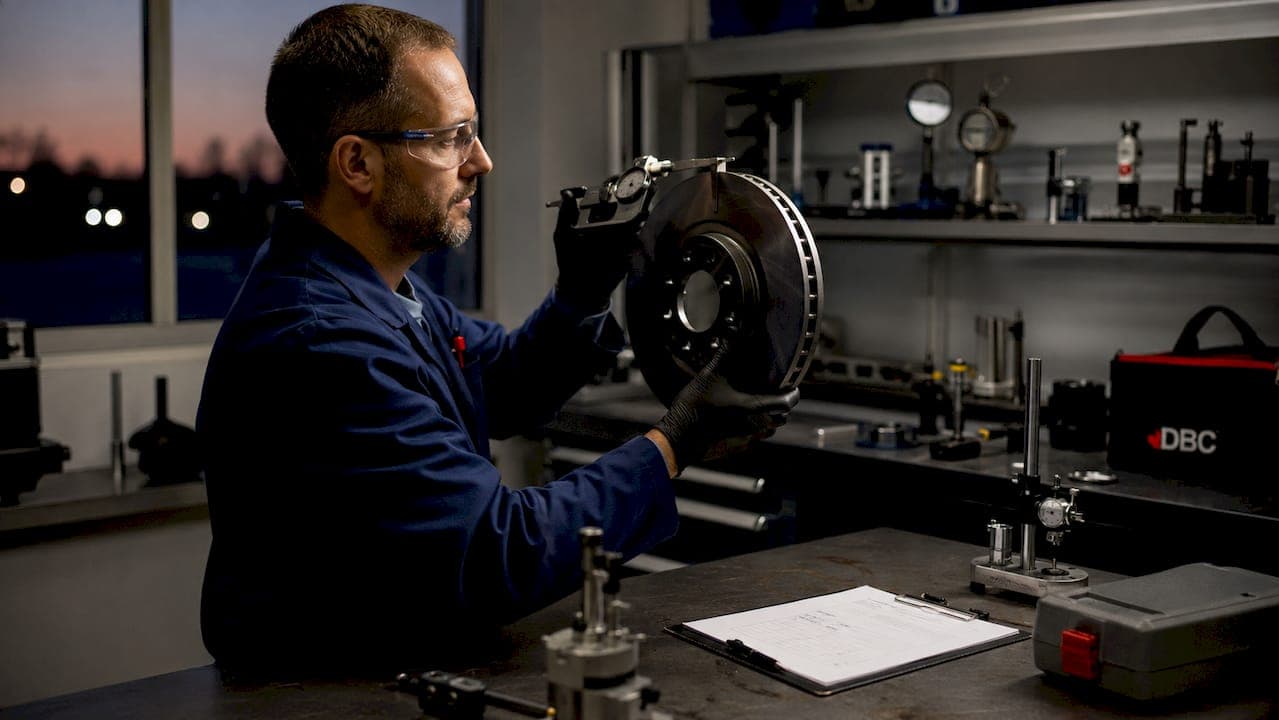
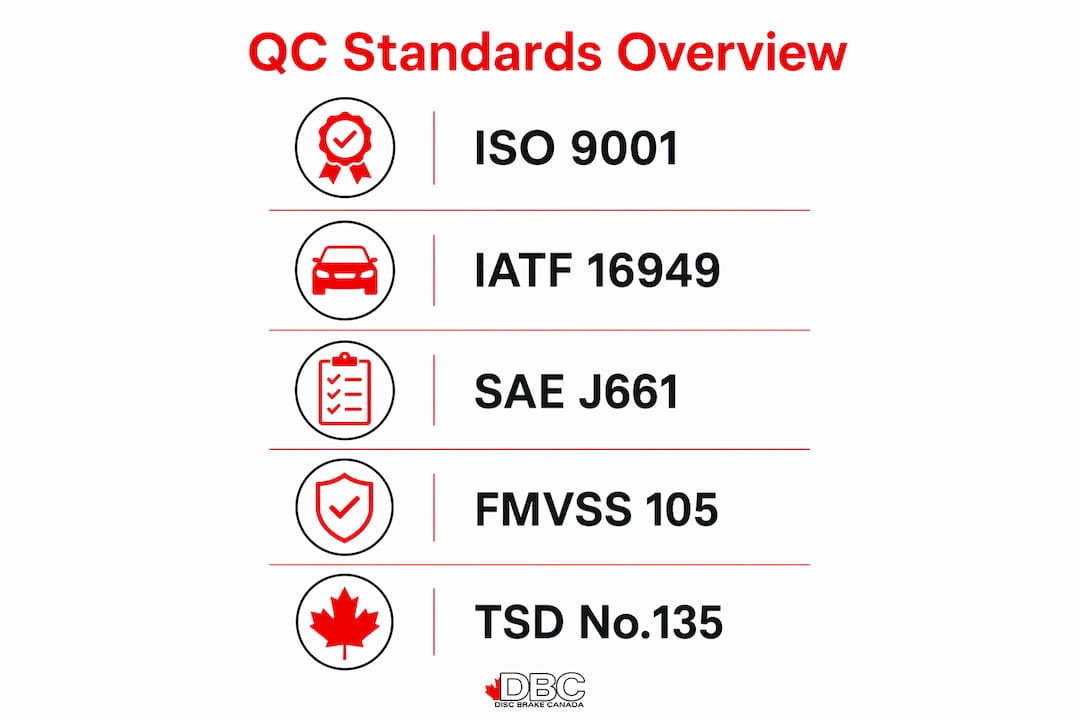
Quality control in brake manufacturing is the systematic process of preventing defects and verifying that every component meets defined safety and performance standards before it reaches a vehicle. Brakes are safety-critical parts. A single defect, whether casting porosity in a caliper or dimensional variation in a rotor, can cause brake fade, fluid leakage, or complete stopping failure. The role of quality control in brake manufacturing spans the entire production chain, from raw material selection through final assembly validation. Standards such as ISO 9001, IATF 16949, SAE J661, and FMVSS 105 define the minimum requirements every manufacturer must meet.
What are the core quality control processes in brake manufacturing?
Brake caliper quality control involves checkpoints at every production stage, from material controls and nondestructive tests to functional and thermal validation. Each checkpoint targets a specific failure mode. Missing one stage does not just risk a single part. It risks every unit produced under the same process conditions.
The main QC process stages in brake component production are:
- Material controls and casting inspection: Incoming raw materials are verified against chemical and mechanical specifications. Castings are inspected for surface defects, dimensional accuracy, and internal integrity before machining begins.
- Machining tolerances and SPC application: Statistical Process Control (SPC) monitors critical dimensions such as rotor thickness, runout, and parallelism in real time. Drift in a machining centre is caught before it produces a batch of non-conforming parts.
- Nondestructive testing (NDT): Ultrasonic testing (UT), magnetic particle inspection (MPI), and computed tomography (CT) detect subsurface defects without destroying the part. These methods are the primary defence against casting porosity reaching the finished product.
- Functional and hydraulic validation: Calipers and master cylinders undergo pressure cycling and leak tests to confirm they hold rated hydraulic pressure. Thermal validation confirms performance after heat exposure.
- Final assembly checks: Torque verification, clearance measurement, and visual inspection confirm correct assembly before packaging.
Pro Tip: Run Gage Repeatability and Reproducibility (Gage R&R) studies on every measurement instrument in your control plan before relying on SPC data. Measurement reliability is a prerequisite for trusting process capability results on critical dimensions like rotor thickness and runout.
Which standards and regulations shape brake manufacturing QC?
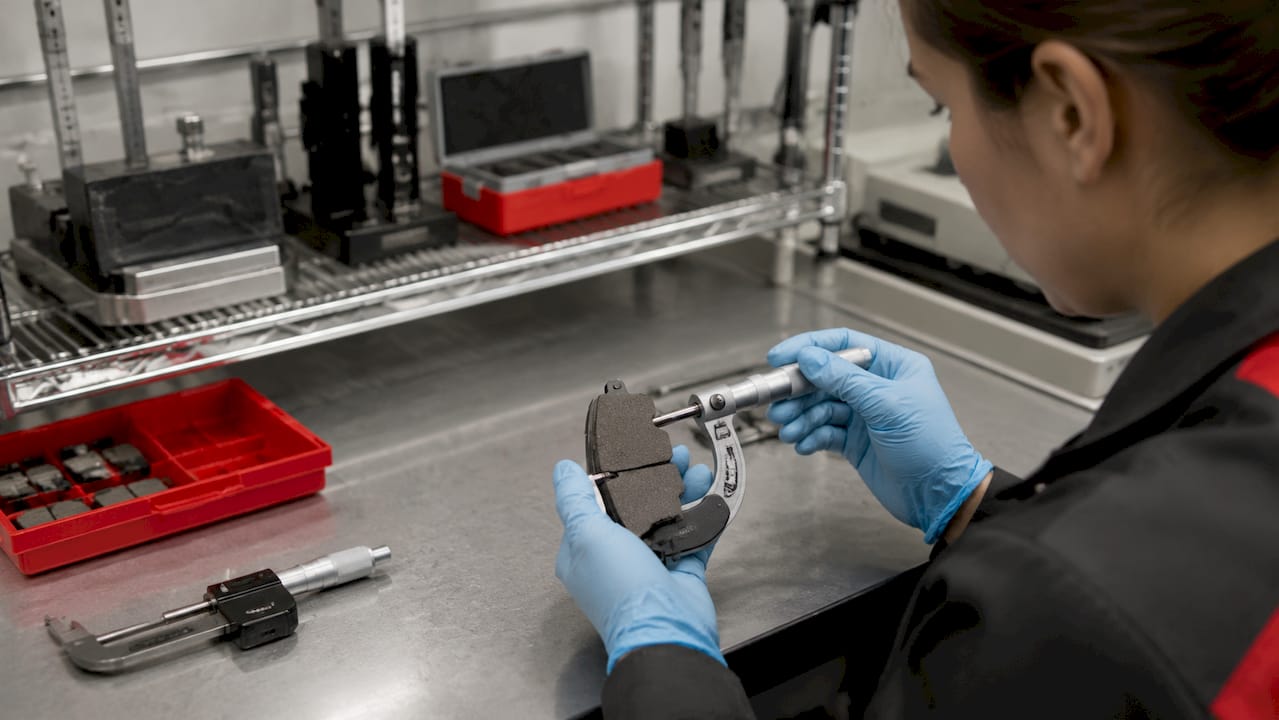
Brake manufacturing quality assurance operates within a layered framework of international, national, and industry-specific standards. Each layer adds requirements that QC teams must document, validate, and maintain.
| Standard / Regulation | Scope | Key QC Requirement |
|---|---|---|
| ISO 9001:2015 | Quality management system | Identification, traceability, and record control |
| IATF 16949 | Automotive QMS | APQP, PPAP, FMEA, SPC, and MSA mandatory |
| SAE J661 | Brake lining testing | Standardised friction and wear test procedure |
| FMVSS 105 | Hydraulic brake performance | Multi-round stopping distance and water recovery tests |
| Canada TSD No. 135 | Canadian service brakes | Performance and verification criteria for service and parking brakes |
SAE J661 defines the accepted brake lining quality test procedure used for both in-process and acceptance testing. It gives QC teams a repeatable, standardised method for measuring friction coefficient and wear under controlled conditions.
FMVSS 105 governs vehicle-level hydraulic braking performance, including stopping-distance tests across multiple rounds and a water recovery test. This means QC cannot stop at dimensional conformance. Manufacturers must validate that components deliver actual stopping power after thermal and environmental stress.
Canada's Technical Standards Document No. 135 specifies service brake and parking brake system requirements for the Canadian market. Canadian manufacturers and suppliers must align their QC documentation and verification methods with this document to achieve regulatory compliance.
IATF 16949 builds on ISO 9001 by mandating core automotive quality tools including Advanced Product Quality Planning (APQP), Production Part Approval Process (PPAP), FMEA, SPC, and Measurement System Analysis (MSA). These are not optional enhancements for Tier 1 brake suppliers. They are entry requirements for OEM business.
Pro Tip: Map every QC checkpoint in your control plan directly to the relevant clause in IATF 16949 or TSD No. 135. Auditors and OEM customers expect traceability between your process controls and the regulatory requirement they satisfy.
How do quality control tools and techniques improve brake manufacturing outcomes?
The most effective QC strategies prioritise frequent failure modes through FMEA-based rule systems and apply targeted control actions at specific production stations. This approach eliminates root causes rather than managing scrap after the fact.
FMEA and rule-based decision systems
Failure Mode and Effects Analysis (FMEA) identifies which failure modes carry the highest risk based on severity, occurrence, and detectability. A 2026 expert-system concept translates FMEA outputs into station-level QC rules, enabling automated decisions about which inspections to run and how to rank defect severity for brake disc production. The targeted failure modes include disc thickness variation (DTV), runout, and parallelism. These are the same dimensions that directly affect pedal feel and rotor wear rates in service.
Design FMEA (DFMEA) and Process FMEA (PFMEA) serve different functions. DFMEA addresses design-level risks before tooling is cut. PFMEA targets production process risks at each manufacturing station. Both feed the control plan that QC teams execute on the shop floor.
SPC, MSA, and measurement reliability
SPC charts monitor process output in real time and signal when a process drifts toward its control limits. The data SPC uses is only as good as the instruments producing it. Gage R&R studies validate that gauges and coordinate measuring machines (CMMs) produce consistent, accurate readings before QC teams rely on them for process decisions.
A measurement system with excessive variation will produce false alarms or, worse, miss real defects. In brake manufacturing, where tolerances on rotor thickness and caliper bore diameter are tight, unvalidated measurement systems are a direct quality risk.
Traceability as a chain of evidence
ISO 9001 supports traceability by requiring controlled identification and records throughout production. Traceability in brake manufacturing functions as an operational chain of evidence. It links each raw material lot through process parameters and inspection results to the finished product. When a field failure occurs, traceability answers which batch was affected, what process conditions applied, and which inspection records cover that production run.
ISO 9001 provides the governance framework. It does not automatically deliver genealogical detail. Manufacturers must build traceability systems that capture batch numbers, machine IDs, operator records, and inspection data at each station.
What impact does quality control have on brake performance and safety?
Rigorous quality assurance in brake production directly determines whether a vehicle stops reliably under real-world conditions. Defects that escape QC do not stay hidden. They show up as performance failures.
- Casting porosity in a caliper body creates leak paths under hydraulic pressure. The result is brake fluid loss and a loss of pedal pressure, which reduces stopping force at the moment it is needed most.
- Dimensional variation in rotor thickness or runout causes disc thickness variation (DTV) in service. DTV produces brake judder and uneven pad wear, which reduces friction contact area and extends stopping distances.
- Friction material inconsistency in brake linings causes variation in the friction coefficient across a set of pads. Uneven braking force across an axle affects vehicle stability during hard stops.
"Because defects like casting porosity cause performance loss or leakage, QC must combine systematic process control with nondestructive and functional tests." — ICOOH, Quality control in brake caliper production
FMVSS 105 multi-step tests require manufacturers to validate stopping distances across multiple rounds and confirm brake recovery after water exposure. These tests force QC to go beyond dimensional conformance and verify actual braking performance under stress. A component that passes dimensional inspection but fails a water recovery test reveals a gap in the QC programme that only functional validation can close.
Strong QC also reduces warranty costs and protects brand reputation. A brake component that fails in service generates warranty claims, potential recalls, and liability exposure. Each of those outcomes costs far more than the investment in a thorough QC programme at the production stage. The role of the brake caliper in converting hydraulic pressure to clamping force means that caliper defects have a direct and immediate effect on stopping distance.
Key takeaways
Quality control in brake manufacturing requires end-to-end process controls, validated measurement systems, and regulatory compliance to produce components that perform reliably under real-world stopping conditions.
| Point | Details |
|---|---|
| QC spans the full production chain | Controls must cover material selection, machining, NDT, functional testing, and final assembly. |
| Standards define minimum requirements | SAE J661, FMVSS 105, IATF 16949, and Canada TSD No. 135 set the compliance floor for brake QC. |
| FMEA drives targeted defect prevention | DFMEA and PFMEA outputs feed station-level control rules that address root causes, not just scrap. |
| Measurement reliability is non-negotiable | Gage R&R validation must precede SPC deployment on critical brake dimensions. |
| Traceability enables accountability | A documented chain of evidence from raw material to finished part supports both compliance and field failure investigation. |
What I've learned about QC that most brake manufacturers overlook
The biggest gap I see in brake manufacturing QC programmes is not a missing test. It is the assumption that end-of-line inspection is a substitute for in-process control. Teams invest in final inspection equipment and then wonder why scrap rates stay high. The defect was created three stations earlier. Inspection found it late.
The shift that changes outcomes is moving control upstream. FMEA is the tool for that. When PFMEA outputs are translated into specific, station-level control rules, as the rule-based disc QC research demonstrates, QC stops being reactive. It becomes a production management function.
The second thing most teams underestimate is measurement system quality. I have seen SPC charts that looked stable until a Gage R&R study revealed the gauge was contributing more variation than the process. Every decision made from that data was unreliable. Validate your instruments before you trust your charts.
Finally, Canadian manufacturers have a specific compliance obligation under TSD No. 135 that does not always get the same attention as FMVSS 105. Both matter. Treat them as parallel requirements, not sequential ones.
— Sam
DBC Brakes and quality-built brake components for Canadian drivers
Quality control in brake production only delivers value when the finished components meet the standards that QC was designed to enforce. DBC Brakes sources and supplies brake kits built to the performance and dimensional standards that quality-focused manufacturers and drivers rely on.
DBC Brakes is a Canadian specialist offering cross-drilled rotors engineered to resist warping and maintain consistent friction contact. Every kit ships with transparent, all-inclusive pricing and free shipping on orders over $100. For professionals and enthusiasts who understand what rigorous brake manufacturing standards require, DBC Brakes brake components are a direct match for that standard. Browse the full catalogue to find components verified for your vehicle make and model.
FAQ
What is the role of quality control in brake manufacturing?
Quality control in brake manufacturing is the systematic process of preventing defects and verifying that every component meets defined safety and performance standards. It covers material selection, machining, nondestructive testing, functional validation, and final assembly inspection.
Which standards apply to brake manufacturing quality assurance?
The primary standards are ISO 9001, IATF 16949, SAE J661, FMVSS 105, and Canada's Technical Standards Document No. 135. Each standard addresses a different layer of the QC requirement, from quality management systems to vehicle-level braking performance.
What is FMEA and how does it improve brake QC?
Failure Mode and Effects Analysis (FMEA) identifies and ranks potential failure modes by severity, occurrence, and detectability. In brake manufacturing, FMEA outputs feed station-level control rules that target defects like disc thickness variation and casting porosity before they reach final inspection.
Why is traceability critical in brake component production?
Traceability links each raw material lot through process parameters and inspection records to the finished product. When a field failure occurs, traceability identifies which production batch is affected and what process conditions applied, supporting both regulatory compliance and corrective action.
What does FMVSS 105 require from brake manufacturers?
FMVSS 105 requires multi-round stopping-distance tests and a water recovery test to confirm hydraulic brake performance under real-world conditions. Manufacturers must validate that components deliver reliable stopping power after thermal and environmental stress, not just dimensional conformance.