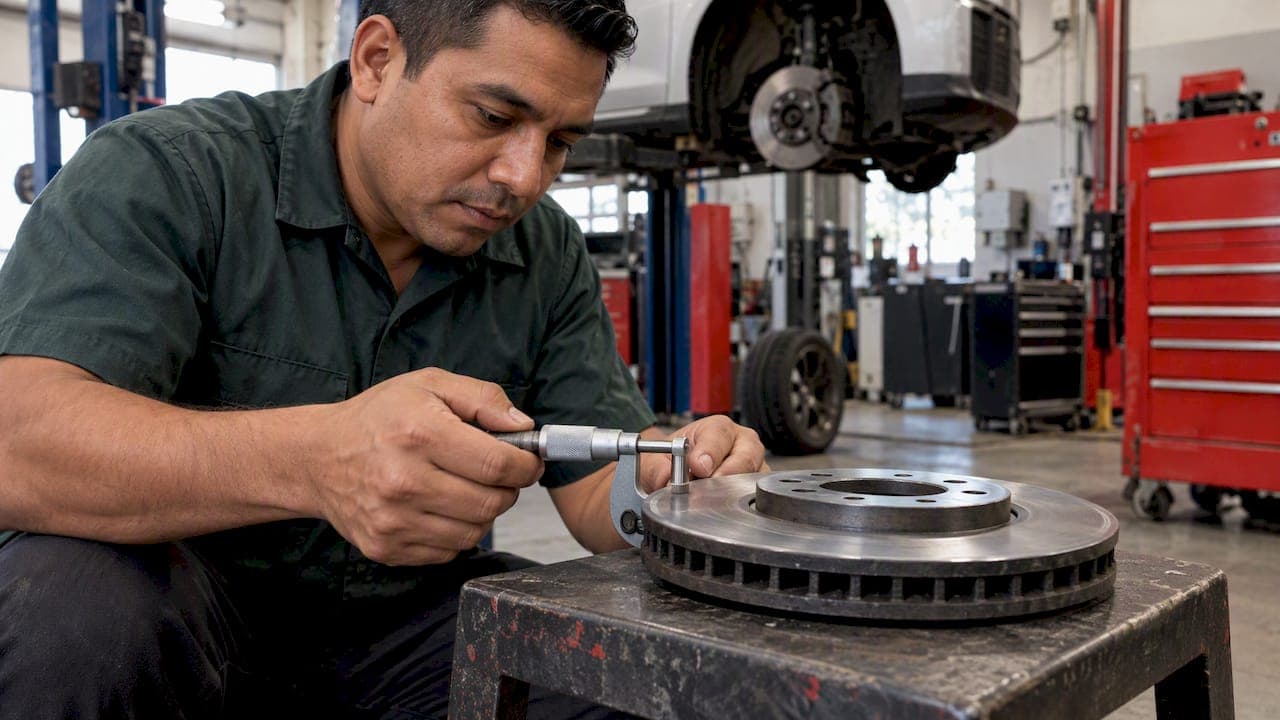
Brake rotors do not need balancing the way tires do. A rotor lacks the mass and diameter to cause a significant balance problem on a road vehicle, according to Brake & Front End. A vibration blamed on "rotor balance" is almost always one of three things: wheel and tire imbalance, rotor runout, or rotor thickness variation. Each has a different test and a different fix.
TL;DR
- Automotive brake rotors are not balanced in the field. Tires and wheels are.
- Vibration at speed, with or without braking, points to the tire or wheel. Vibration only during braking points to the rotor.
- Rotor problems are measured as runout and thickness, with a dial indicator and a micrometer.
- Rust on the hub face, worn parts or uneven pad deposits can mimic a "bad" rotor.
- Severe vibration, pulling or unusual noise calls for an inspection before further driving.
Table of Contents
- Why rotors are not balanced like tires
- Wheel imbalance or rotor problem: how symptoms differ
- Step 1: the road test
- Step 2: measure runout and thickness
- Causes of runout that are not the rotor
- Correct the rotor or replace it
- What happens if the problem is left alone
- When to inspect the brakes
- Our view on rotor balancing
- Brake kits matched to the vehicle
- FAQ
- Sources
Why rotors are not balanced like tires
Balancing corrects uneven mass distribution in a spinning part. Industrial rotors such as turbines, fans and motor armatures are balanced on machines because uneven mass loads bearings and shortens machine life. That is the subject of most pages returned for the phrase "rotor balancing".
An automotive brake rotor is a different case. It is a relatively light, small-diameter casting that turns at wheel speed. Its mass is too low to produce a significant balance problem in the field, per the Brake & Front End discussion of the topic. The part that does get balanced is the wheel and tire assembly, which is heavier, larger in diameter and mounted farther from the axle.
When a driver reports a shake, the word "balance" usually belongs to the tire. The brake rotor is judged by other measures: how flat it runs, how even its thickness is and whether it is above its minimum thickness.
Wheel imbalance or rotor problem: how symptoms differ
The first diagnostic question is when the vibration happens. MasterTechPrep separates the two groups this way: vibration only when braking points to rotor thickness variation or runout, and vibration at speed, whether braking or not, points to a tire or wheel problem.
A certified mechanic quoted by J.D. Power says the same: an unbalanced wheel or bad alignment typically causes vibration all the time, while vibration only when braking points first to the brakes.
| Symptom | Most likely cause | First check |
|---|---|---|
| Steering wheel shakes at highway speed, with or without braking | Tire or wheel imbalance | Spin balance, or road force balance |
| Brake pedal pulses during braking | Rotor thickness variation, often linked to runout | Runout and thickness measurement |
| Shake only when brakes are applied | Rotor or pad surface problem | Road test, then rotor inspection |
| Vibration that stays after a standard balance | Tire uniformity or another component | Road force balancing |
| Grinding or sudden loss of braking performance | Worn pads or rotors, or damage | Immediate inspection |
Brake pedal pulsation is commonly caused by rotor thickness variation, and runout can create that variation, as Brake & Front End explains in its rotor servicing guide.
For vibrations that survive a standard balance, shops use road force balancing. It measures tire uniformity alongside spin balance, per The Motor Guy.
Step 1: the road test
The road test comes before any part is removed. The Motor Guy describes vibrations as rhythmic and frequency dependent. Different components produce different patterns, so a speed-sensitive shake and a brake-sensitive shake point to different systems.
A simple sequence:
- Drive at the speed where the vibration appears, without touching the brake. Note whether the steering wheel, seat or floor carries it.
- Repeat the same speed and apply light braking. Note whether the vibration changes or the pedal pulses.
- Brake gently from a lower speed. A pulse that appears only here points to the rotors or pads.
- Record the speed range, the location of the feel and the conditions. A technician can use this record.
This step prevents the most expensive error. MasterTechPrep identifies replacing or machining rotors to cure a wheel-imbalance symptom as a common and costly diagnostic mistake. It describes vibration diagnosis as a methodical process of elimination.
Step 2: measure runout and thickness
If the road test points to the brakes, measurement follows. Technicians use a dial indicator to measure rotor runout and a micrometer for thickness. This follows the approach described by Brake & Front End and the Ministry of Transportation of Ontario inspection standard.
Runout
Runout is the side-to-side wobble of the rotor face as it turns. A dial indicator measures lateral variation. Brake & Front End advises indexing the rotor position on the hub to learn whether the fault lies in the rotor itself or in the wheel hub. If the high spot stays with the rotor when it is moved a stud position, the rotor is the cause. If the high spot stays with the hub, the hub face is the cause.

Acceptable runout for new discs is generally no more than 0.070 mm, based on the Ministry of Transportation of Ontario standard and Hella guidance cited in the research. Always compare against the vehicle manufacturer's figure, which can differ.
Thickness
In Ontario, rotors must be measured for thickness. They are rejected if they fall below the OEM or industry-standard wear limit, per the inspection standard and Regulation 611. Safety also requires that components be free of significant cracks or mechanical damage. The minimum thickness is normally stamped on the rotor. For a measurement routine, see the workflow for verifying minimum thickness with a four point micrometer.
The thickness check covers more than the minimum. Thickness variation, measured at several points around the friction surface, is what the driver feels as pedal pulsation.
Causes of runout that are not the rotor
A rotor that measures out of spec is not always a bad rotor. Several causes sit around it:
- Rust on the hub face. Rust around the wheel studs or slight runout at the wheel hub can cause rotor runout, and cleaning rust from the hub may help, per Brake & Front End. The guide on surface film versus damage on rotors covers what rust is cosmetic and what is not.
- Uneven wheel nut torque. Tightening wheel nuts out of sequence or unevenly can distort the mounting. A torque wrench and a star pattern remove this variable.
- Worn hub bearings. Play in the bearing shows up as lateral variation at the rotor face. Bearings belong in the same inspection.
- Pad deposits. Uneven pad material on the rotor face can feel like a warped rotor. A 10 minute check on pad deposits versus warped rotors separates the two.
- Mismatched pads and rotors. Friction material that does not suit the rotor can leave uneven transfer. The pad and rotor matching guide explains how to match them.
Only after these are eliminated does the rotor itself become the suspect.
Correct the rotor or replace it
The decision follows from the measurements. If rotor thickness is above the minimum wear limit, and the runout can be corrected by cleaning the hub or by minor machining, the rotor may be kept. Otherwise it must be replaced. That rule appears in the Brake & Front End guide and the Mag & Turbo guidance summarized in the research.
Mag & Turbo notes that resurfacing can sometimes solve the problem, but the thickness limit is paramount. Once machining would take the rotor below that limit, replacement is the only option.
Signs that point to replacement:
- Thickness at or below the stamped minimum.
- Deep grooves and discolouration. ALLDATA advises planning on replacing both pads and rotors in this case.
- Cracks or mechanical damage.
- Runout that remains after the hub has been cleaned and the rotor re-indexed.
Replacing rotors alone is not always the best approach. The article on replacing rotors without pads explains why thickness and runout should be checked and why new pads usually go with new rotors.
What happens if the problem is left alone
Persistent vibration accelerates wear on other vehicle components, including brake rotors, per Michelin Canada. A minor shake that is ignored can become a larger repair bill.
Some symptoms call for action sooner. Motor1 advises stopping driving and seeking inspection with severe vibration, pulling, unusual noises or unpredictable steering. These can indicate critical failures. In braking terms, a grinding noise or a sudden change in braking performance means the vehicle should be inspected right away, not at the next service.
When to inspect the brakes
Inspect immediately when any of the following occur:
- Pulsation in the brake pedal.
- Grinding noises.
- A sudden change in braking performance.
Periodic checks of rotor thickness and condition are part of standard maintenance and safety inspections. Many Canadian jurisdictions require them, as the Ontario standard and R.R.O. 1990, Reg. 611 show. The same applies after new rotors are installed: a post-installation check of runout confirms that the hub face was clean and the installation is sound.
Prevention helps. The three technician-vetted habits to prevent rotor warping cover bedding in, torque and cooling. For a wider view of causes and repairs, see the brake vibration guide.
Our view on rotor balancing
We make brake rotors and kits, and the question about rotor balancing reaches us often. Our answer is short: the rotor is not what gets balanced, so the diagnosis has to start somewhere else.
Most shake complaints we hear about turn out to be tires, hub faces or installation. A rotor gets replaced when measurements show it should be, not on a guess. We recommend measuring runout and thickness before and after any rotor installation. We recommend cleaning the hub face every time. We recommend pads that suit the rotor.

For Canadian drivers, the road conditions add a factor. Salt and moisture cause rust on hub faces. A hub that was not cleaned at the last service is a common reason for new rotors showing runout. A wire brush and a few minutes prevent it.
Our rotors are engineered for performance and durability, and we sell them as complete kits so the parts are matched. We price inclusively, with no hidden fees, and our support is staffed by people who know brakes, not automated replies. If a measurement or a fitment question comes up, ask us before the part goes on the car.
— Sam
Brake kits matched to the vehicle
When measurements show that rotors need replacing, a matched kit removes the pad and rotor compatibility question. DBC Brakes is a Canadian manufacturer. Its kits use cross-drilled rotors engineered to resist warping and wear, and fitment is guaranteed. Pricing is inclusive, and shipping is free in Canada on orders over $100. Expedited shipping is available for $29.99 per order.
Browse the brake kits collection or the brake rotors collection. Wheel bearings and hubs are listed on the collections page. Shipping terms are on the shipping information page.
FAQ
Do new brake rotors need to be balanced?
No. Brake rotors are not balanced in the field, because their mass and diameter are too small to cause a significant balance problem. The wheel and tire assembly is what gets balanced after new brakes are fitted. If vibration appears after a brake job, check hub cleanliness, wheel nut torque and runout first.
Why does the steering wheel shake only when braking?
Vibration only when braking points to rotor thickness variation or runout. Pad deposits can also cause it. A technician measures runout with a dial indicator and thickness with a micrometer to confirm the cause. If the shake is present at speed without braking, the tires and wheels are the more likely source.
What runout is acceptable on a rotor?
For new discs, runout is generally no more than 0.070 mm. The vehicle manufacturer's specification takes priority when it differs. The measurement is taken with a dial indicator, and the rotor can be re-indexed on the hub to see whether the rotor or the hub causes the variation.
Can a warped rotor be machined instead of replaced?
Sometimes. A rotor may be kept if thickness is above the minimum wear limit and the runout can be corrected by cleaning the hub or minor machining. If machining would take the rotor below the limit, or if it has cracks, deep grooves or discolouration, it must be replaced.
When should a vibrating car stop being driven?
Severe vibration, pulling, unusual noises or unpredictable steering mean the vehicle should be inspected before further driving. Grinding or a sudden change in braking performance also calls for an immediate brake inspection by a qualified technician.
Sources
- Can A Rotor Become Out Of Balance Like A Tire? (Brake & Front End)
- Diagnostic Solutions: Servicing Brake Rotors (Brake & Front End)
- Distinguish between brake component vibration and wheel imbalance (MasterTechPrep)
- Why Does My Car Shake When It Brakes? (J.D. Power)
- Steering Wheel Vibrates At Highway Speed (The Motor Guy)
- Passenger / Light-Duty Vehicle Inspection Standard (Ministry of Transportation of Ontario)
- Why Does My Steering Wheel Shake? (Mag & Turbo)
- Use Your Senses: Sense of Touch (ALLDATA)
- Handling Problems: Symptom Vibration (Michelin Canada)
- Why Your Steering Wheel Might Shake At Highway Speeds (Motor1)