
Braided brake lines (a PTFE inner tube wrapped in stainless-steel braid) prevent the inner hose from expanding under hydraulic load. That single function preserves master cylinder travel, raises system pressure faster, and delivers a firmer, more linear pedal. They do not change pad friction, rotor bite, or tyre grip — the improvement is in control and feel, not raw stopping physics.
Key facts up front:
- SAE J1401 and NHTSA FMVSS 106 set the minimum performance standards for all flexible brake hoses sold in North America, including volumetric expansion, burst pressure, and whip-test durability.
- Goodridge's internal testing found that standard OE rubber hose expanded by 0.136 cc/ft at 1,000 psi, while its PTFE braided stainless hose expanded by only 0.0002932 cc/ft at 4,000 psi — a difference of several orders of magnitude.
- The primary benefit drivers notice is the removal of a mushy or spongy pedal; braided lines improve linearity and modulation, not outright stopping force.
DBC Brakes supplies premium brake kits for Canadian drivers, and understanding what braided lines actually do helps you decide whether the upgrade fits your vehicle and driving style.
Table of Contents
- What are braided brake lines made of?
- How do braided brake lines change braking performance?
- What do braided lines actually improve over OEM rubber hoses?
- What are the downsides and common myths?
- Installation, inspection, and Canadian certification guidance
- When are braided brake lines worth fitting?
- Research-backed data and engineer insights
- Key takeaways
- A practical note on braided lines in Canadian conditions
- Useful sources and further reading
What are braided brake lines made of?
A braided brake line has three functional layers, and each one earns its place.
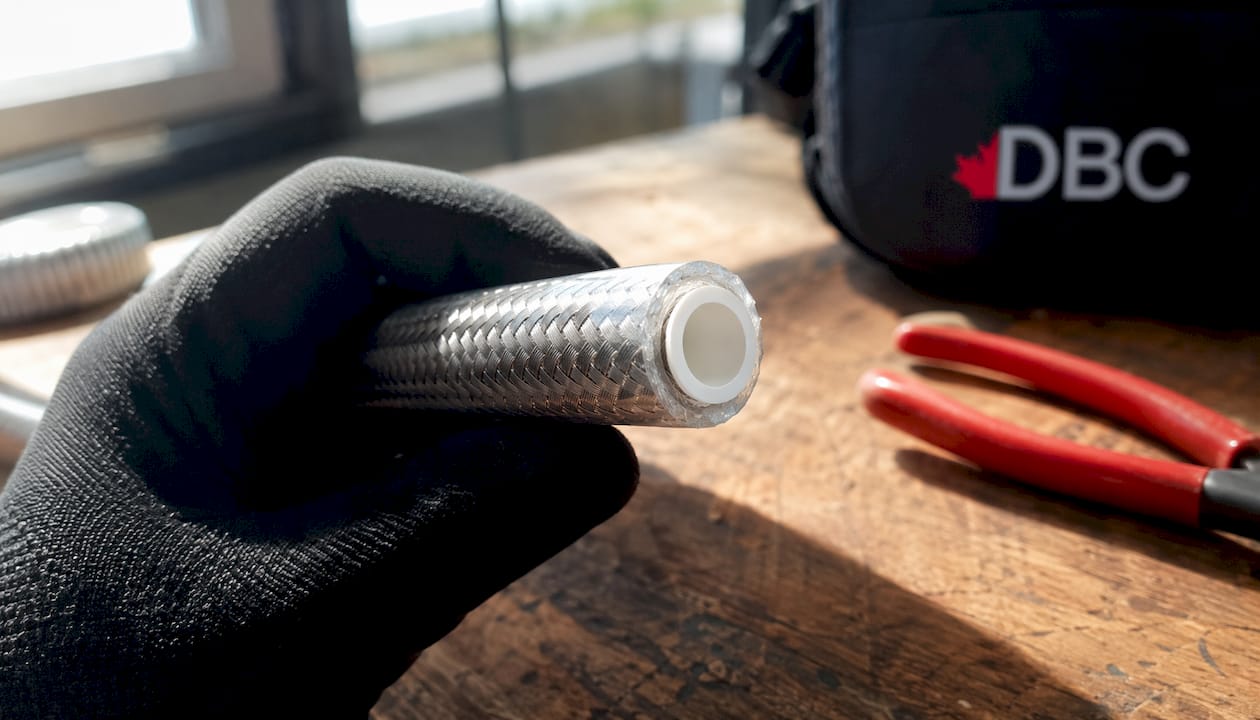
PTFE inner core. The innermost tube is made from polytetrafluoroethylene (PTFE), the same material as Teflon. PTFE is chemically inert — it does not degrade when exposed to heated DOT brake fluid or extreme temperatures, unlike EPDM rubber, which softens and swells under thermal cycling. That stability matters because a liner that absorbs fluid or deforms under heat changes the hydraulic volume of the circuit.
Stainless-steel braid. Over the PTFE core sits a woven braid of stainless-steel wire, typically 304 or 316 grade. The braid's job is mechanical: it resists radial (outward) expansion when hydraulic pressure builds inside the hose. This is the hoop-stress containment function. Rubber overmoulding cannot do this because rubber is also a flexible material; stainless wire is not.
Outer jacket and fittings. Most street-legal braided lines add a PVC or polyester outer coating over the braid. This protects the wire from road salt, gravel, and abrasion, and it protects the vehicle's paint and brake lines from the braid itself. End fittings are either swaged (factory-crimped, non-reusable) or reusable compression fittings. Swaged fittings are the preferred choice for street use because they are dimensionally consistent and less dependent on installer technique.
Pro Tip: When comparing kits, look for swaged or crimped end fittings rather than reusable types. Swaged ends are more consistent and are less likely to leak if the hose is ever flexed hard during suspension travel.
The layered construction means the hose can flex freely with suspension movement while keeping the hydraulic fluid path dimensionally stable under pressure. That combination — flexibility plus volume stability — is exactly what a brake hose needs to do.
How do braided brake lines change braking performance?
The mechanism is straightforward: every millimetre of master cylinder travel is supposed to move fluid into the caliper and push the piston against the pad. If the hose expands radially as pressure builds, some of that fluid volume goes into inflating the hose rather than moving the caliper piston. The pedal travels further before meaningful clamping force is generated.

Braided lines reduce volumetric expansion to near zero. The stainless braid constrains radial growth so that virtually all master cylinder displacement becomes caliper piston movement. The result is a faster pressure rise at any given pedal input and a shorter pedal travel before the brakes engage firmly.
The real-world effects drivers notice:
- Firmer pedal feel — the pedal stops feeling spongy and responds more directly to foot pressure.
- Faster transient response — the time between pressing the pedal and generating deceleration decreases, which matters during threshold braking and trail braking at the limit.
- Better modulation — because the pressure-volume relationship is more linear, small changes in pedal force produce predictable changes in braking force, making it easier to brake at the edge of traction without locking a wheel.
- Consistency under heat — PTFE does not soften or swell as brake fluid temperature rises, so pedal feel stays consistent during repeated hard stops.
Changing only the flexible lines (while keeping fluid quality constant) still shows measurable stiffness gains at high pressure, especially above 1,000 psi. This confirms the lines themselves contribute to reduced compliance, not just a simultaneous fluid change. For a deeper look at how pedal feel translates to driver perception, the guide on brake pedal feel covers the full picture.
What do braided lines actually improve over OEM rubber hoses?
The practical advantages are real, but they need to be framed correctly. Braided lines improve the hydraulic efficiency of the system; they do not change the coefficient of friction at the tyre-rotor interface. Stopping distance is ultimately determined by pad compound, rotor condition, and tyre grip. What braided lines change is how precisely and consistently you can access that stopping force.
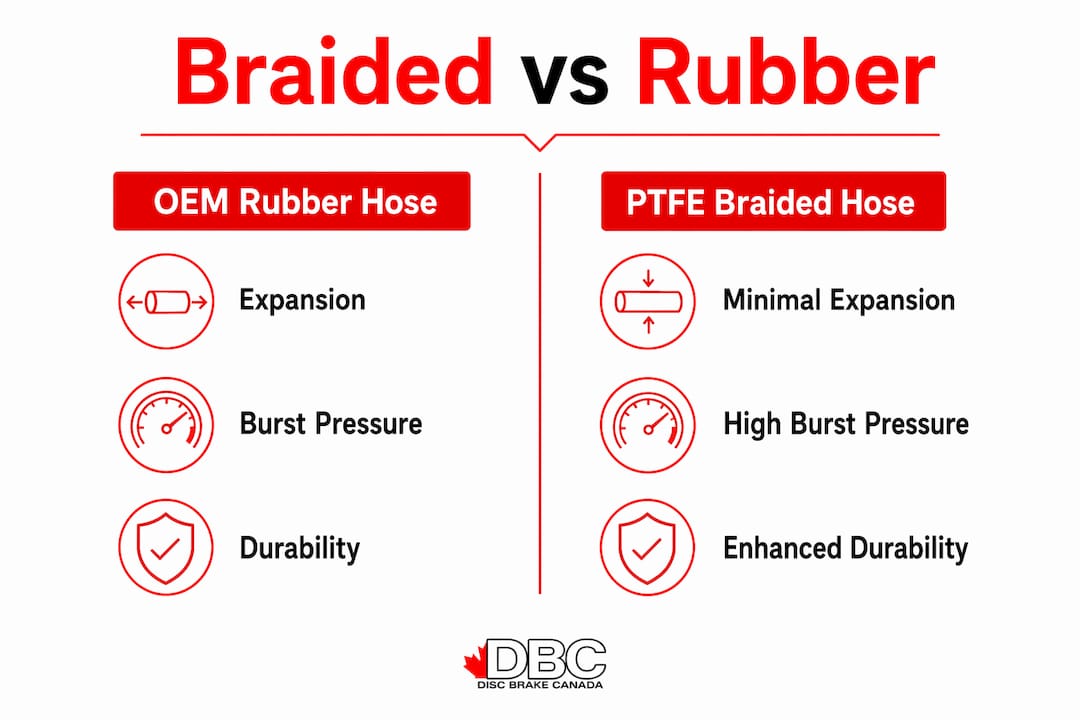
| Feature | OEM rubber hose | PTFE stainless braided hose |
|---|---|---|
| Volumetric expansion at 1,000 psi | 0.136 cc/ft (Goodridge test data) | Near zero |
| Burst pressure (Goodridge testing) | 8,000–9,000 psi | 12,750–13,500 psi |
| Whip test result (Goodridge testing) | 15–27 hours (below 35-hr standard in some samples) | — |
| Typical OEM warranty/lifespan | Approximately a few years | Longer, with some manufacturers offering extended mileage guarantees. |
| Abrasion resistance | Rubber outer sheath | Stainless braid + PVC coating |
| Pedal feel | Can feel spongy under load | Firm and linear |
The burst pressure and whip-test data above come from Goodridge's internal testing data represent a meaningful safety margin difference, with PTFE braided hoses bursting at substantially higher pressures compared to rubber hoses, yielding higher safety factors.
For daily commuting on flat roads, the difference in pedal feel is noticeable but not dramatic. The upgrade delivers the most value under sustained high-heat or high-demand use — track days, mountain descents, towing, or repeated hard stops in traffic. Understanding how this fits into a broader brake upgrade is covered in the brake kit upgrade feel difference guide.
What are the downsides and common myths?
Braided lines are a well-proven upgrade, but there are genuine trade-offs and a few misconceptions worth addressing directly.
Actual downsides:
- Cost. Braided kits cost more than OEM rubber replacements. For a vehicle used only for light daily driving, the performance gain may not justify the price difference.
- Hidden inner damage. The stainless braid conceals the PTFE liner, so abrasion or internal damage is less visible than on a rubber hose. Inspection requires closer attention to fittings, kinks, and braid fraying.
- Fitting stress. The stiffer construction places more stress on end fittings during suspension articulation if the hose is routed incorrectly or cut too short.
- Maintenance attention. Braided lines do not eliminate the need for regular inspection; they change what you look for.
Common myths:
"Braided lines make you stop shorter." Partially true, but the mechanism is indirect. Braided lines reduce system compliance and latency, which allows a skilled driver to access threshold braking more predictably. That can shorten real-world stopping distances through better modulation — but the lines themselves do not increase friction. Pads, rotors, and tyres still determine the physics.
"Braided lines are illegal on the street." Not accurate, provided the lines carry DOT approval and meet SAE J1401 requirements. Lines that pass these standards are legal for highway use in Canada. Lines that do not carry DOT approval should not be used on public roads.
"Any braided kit is better than OEM." Quality varies. Low-quality kits that use thin braid, poor-grade fittings, or no outer coating may not pass whip-test requirements. Always verify DOT compliance before fitting.
Installation, inspection, and Canadian certification guidance
Installation checklist
Correct installation is as important as product quality. Over-torqued banjo bolts and poor routing are the primary failure modes for braided kits.
- Use the torque specifications in the vehicle's service manual for banjo bolts and fitting threads. Over-tightening deforms fittings and causes leaks.
- Do not twist the hose during installation. Braided lines are stiffer than rubber and will hold a twist, which stresses the braid and fittings.
- Route hoses with enough slack for full suspension travel and steering lock without contact with moving parts or sharp edges.
- Use new copper or aluminium crush washers on banjo fittings — never reuse old ones.
- Bleed the system thoroughly after installation. Air in the circuit will negate the pedal feel improvement entirely.
For a full bleeding sequence and overhaul steps, the brake system overhaul guide covers the process in detail.
Inspection intervals and what to look for
Visually inspect braided lines at every tyre rotation or oil change. In Canada, road salt, gravel, and freeze-thaw cycles accelerate wear at fittings and outer coatings. Look for:
- Fraying or broken strands in the stainless braid
- Kinks or sharp bends, especially near fittings
- Discolouration or corrosion at the end fittings
- Any sign of fluid weeping at banjo connections
Because the braid hides the inner liner, any deformation of the outer jacket or fitting area warrants replacement, not just monitoring.
Statistic callout: Goodridge's whip testing found that OE rubber hoses from five different manufacturers failed in 15–27 hours, below the 35-hour minimum required by FMVSS 106; PTFE braided hoses ran for significantly longer durations before rupturing, well above the required minimum hours for the whip test.
Canadian certification context
All flexible brake hoses used on Canadian roads must meet CMVSS (Canadian Motor Vehicle Safety Standards), which aligns closely with NHTSA FMVSS 106 and SAE J1401. These standards cover volumetric expansion limits, burst pressure, and the whip test. DOT-approved lines that pass the whip test are the minimum acceptable standard for highway use. Swaged fittings are strongly preferred for street applications because they meet dimensional consistency requirements more reliably than field-assembled reusable fittings.
If you are not confident in torque specs, bleeding procedures, or correct routing for your specific vehicle, use a certified shop. Installation errors on brake lines are safety-critical, not just performance issues.
When are braided brake lines worth fitting?
Who benefits most
Braided lines deliver the clearest value in these situations:
- Track days or performance driving — repeated hard stops heat the system and expose compliance in rubber hoses. Braided lines maintain consistent pedal feel across a full session.
- Towing or heavy loads — sustained braking on grades generates heat and high system pressures. The higher burst pressure and volume stability of braided lines provide a real safety margin. See the guide on brake components for towing for the full picture.
- Lifted or modified suspension — suspension lifts change hose routing geometry and can stress OEM rubber lines beyond their designed range of motion. A correctly measured braided kit handles the new geometry without stress concentration.
- Older vehicles with aged rubber hoses — rubber hoses are generally warranted for about three years or 60,000 miles. A vehicle with original hoses beyond that interval is a candidate for replacement, and upgrading to braided at that point is logical.
- Repeated high-heat use — mountain driving, spirited canyon runs, or any driving pattern that involves repeated hard stops.
What to look for in a kit
When evaluating a braided brake line kit, check for:
- DOT approval and SAE J1401 compliance marked on the hose or packaging.
- PTFE (not rubber) inner core — confirm this in the product specifications.
- 304 or 316 stainless-steel braid — 316 offers better corrosion resistance in salt environments.
- Swaged or factory-crimped end fittings, not field-assembled reusable types for street use.
- Outer PVC or polyester coating for abrasion and corrosion protection.
- Vehicle-specific lengths and fittings — avoid universal kits that require routing workarounds.
- Warranty terms — reputable manufacturers back their lines with a mileage guarantee.
For a broader view of where braided lines fit relative to pads, rotors, and fluid in a brake upgrade budget, the brake parts worth splurging on guide ranks the components by impact.
Research-backed data and engineer insights
The engineering case for braided lines rests on measured hydraulic behaviour, not marketing claims.
Volumetric expansion is the core metric. Goodridge's controlled testing showed OE rubber hose expanding at 0.136 cc/ft at 1,000 psi, rising to 0.290 cc/ft at 2,900 psi. Its PTFE braided hose measured 0.0002932 cc/ft at 4,000 psi. That near-zero expansion is what produces the firmer pedal.
Burst pressure data from the same testing: PTFE braided hoses burst at 12,750–13,500 psi, triple the SAE J1401 minimum of 4,250 psi for this hose type. OE rubber hoses in the same test burst at 8,000–9,000 psi, with a recommended safe working pressure of 3,600 psi.
| Test metric | OE rubber hose | PTFE braided hose | SAE J1401 minimum |
|---|---|---|---|
| Expansion at 1,000 psi (cc/ft) | 0.136 | 0.0002932 | Specified limit |
| Burst pressure (psi) | 8,000–9,000 | 12,750–13,500 | 4,250 |
| Whip test duration (hours) | 15–27 | — | 35 |
PTFE's chemical inertness under heat is a separate advantage. Unlike EPDM rubber, PTFE does not absorb brake fluid or soften under thermal cycling. This means the liner's internal diameter stays consistent as the system heats up, preserving the pressure-volume relationship that produces linear pedal feel. Engineers describe this as volume stability under thermal load, and it is why the improvement is most noticeable during sustained hard use rather than a single stop from low speed.
The modulation benefit is the most practically significant for performance driving. Braided lines do not increase the coefficient of friction at the pad-rotor interface. What they do is reduce system compliance so that threshold braking — holding the brakes at the edge of lockup — becomes more predictable and repeatable. That is the difference between a driver who can consistently brake late into a corner and one who cannot.
Key takeaways
Braided brake lines improve pedal feel and hydraulic efficiency by eliminating inner hose expansion, with the greatest benefit under high-heat or high-demand driving conditions.
| Point | Details |
|---|---|
| Core function | PTFE/stainless construction reduces volumetric expansion to near zero, converting more master cylinder travel into caliper movement. |
| Performance gain | Firmer pedal, faster pressure rise, and better modulation — not a direct increase in raw stopping force. |
| Best use cases | Track days, towing, lifted vehicles, and aged rubber hoses beyond three years or 60,000 miles. |
| Safety and compliance | Choose DOT-approved, SAE J1401-compliant kits with swaged fittings; inspect regularly for fraying braid and fitting corrosion. |
| Installation quality | Correct torque, no hose twist, proper routing, and a full bleed are as critical as the product itself. |
A practical note on braided lines in Canadian conditions
The engineering data makes a clear case for braided lines in high-demand applications. What gets less attention is the inspection side, and in Canada that matters more than in most markets. Road salt, freeze-thaw cycles, and gravel roads accelerate corrosion at fittings and wear through outer coatings faster than in milder climates. A braided line that looks fine from a distance can have compromised fittings or a kinked inner liner that only shows up on close inspection.
The upgrade is worth doing for the right vehicle and use case. For a daily driver that never sees a track or a mountain grade, the pedal feel improvement is real but modest. For a vehicle that tows regularly, runs track days, or has suspension modifications, the hydraulic stability and higher safety margin are genuinely useful. The one caution that applies to every installation: do not let the stainless braid's tidy appearance substitute for a proper inspection routine. Check fittings, look for fraying, and replace any line that shows deformation near the end fittings — regardless of how new it looks.
For cautious DIYers, a certified shop for installation and a self-inspection checklist for ongoing maintenance is the right combination. For those comfortable with brake work, the brake upgrade mistakes guide covers the most common errors worth avoiding before you start.
Useful sources and further reading
- Braided stainless steel brake lines — Wikipedia: foundational overview of construction and hydraulic function.
- Brake Lines Upgrade — MotorTrend: Goodridge test data on volumetric expansion, burst pressure, and whip-test results; SAE J1401 and FMVSS 106 context.
- Stainless steel vs. rubber brake lines: an engineering analysis — AutomodExpress: PTFE material behaviour, pressure-volume relationships, and modulation evidence.
- Stopping With Stainless — MotorTrend: DOT approval and whip-test requirements for highway use.
- Installing braided steel brake lines — The Drive: installation technique, torque guidance, and street vs. track expectations.
- Braided brake lines: the ultimate guide — Fast Car: use-case guidance for track, towing, and modified vehicles.
- Stainless steel brake lines Q&A — scR motorsports: technical FAQ on compliance, hoop stress, and fitting construction.
- Are braided brake lines worth it? — Venhill: practical buyer guidance and inspection advice.
- DBC Brakes — Canadian brake kits and components: vehicle-specific brake kits with cross-drilled rotors, free shipping on orders over $100 within Canada.