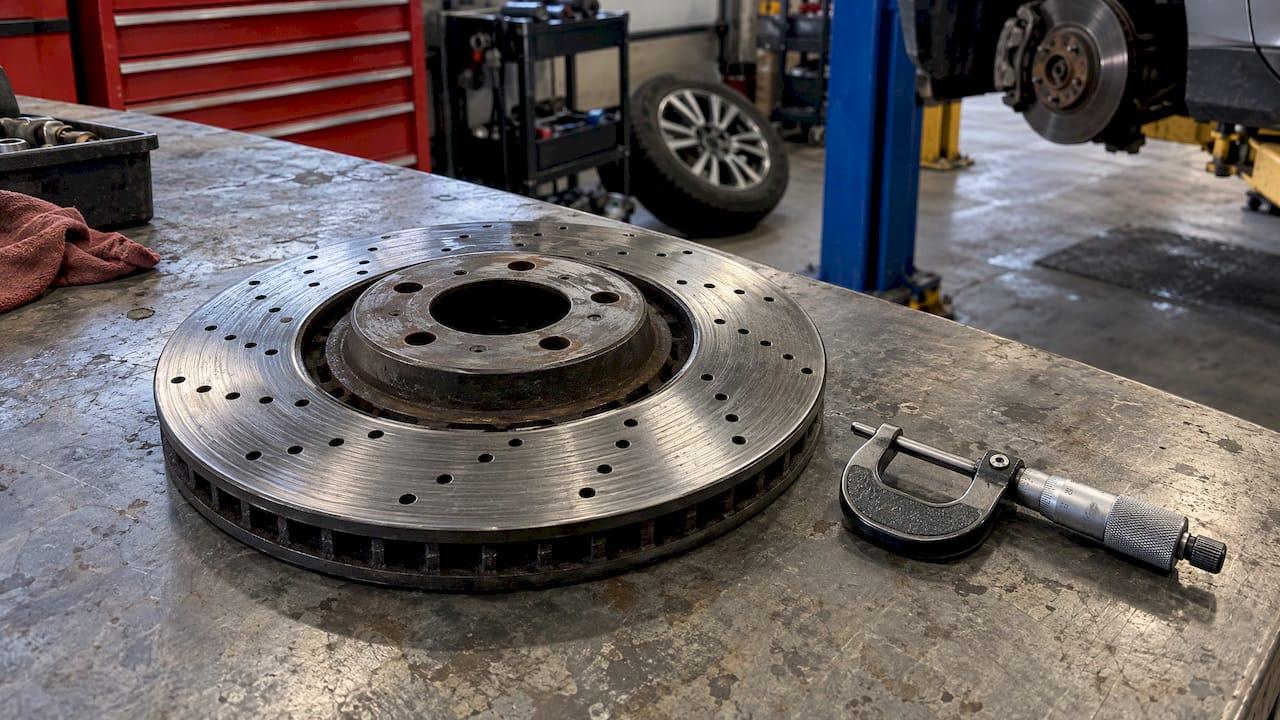
Cross-drilled rotors have no single fixed lifespan. Rotor life depends on driving style, pad choice, road salt and upkeep. One Calgary service guide puts typical rotor life at 50,000 to 80,000 km in ideal conditions, and 40,000 to 60,000 km in Calgary driving. That range is a sound planning figure for a daily-driven vehicle. Street use stays well below the temperatures that stress a drilled rotor. In Canada, rust usually decides the replacement date before heat does.
DBC Brakes manufactures cross-drilled rotors and brake kits in Canada. The rotors are engineered to resist warping and to last. This page covers the numbers, the factors, the wear signs and the habits that extend rotor life.
TL;DR
- Planning range for rotors in Canadian conditions: about 40,000 to 60,000 km. Ideal conditions can reach 50,000 to 80,000 km.
- Road salt and freeze-thaw cycles are the main Canadian life-shorteners. Rust often ends a rotor before wear does.
- Street driving rarely heats rotors to the 1,200 to 1,800°F range linked to heat cracking. That is a track-use concern.
- Replace a rotor at its stamped minimum thickness, or when pulsation, scoring or deep corrosion appear. Drilled rotors are replaced, not machined.
- Pad choice, bedding-in and rinsing off salt all add life.
Table of Contents
- How long cross-drilled rotors last
- Heat and cracking: where it applies
- Canadian conditions: salt, freeze-thaw and rust
- Do drilled rotors wear faster than plain rotors?
- Signs a rotor is near the end of its life
- How to get more life from cross-drilled rotors
- Planning a replacement budget
- Our perspective
- Replacement rotors and kits from DBC
- FAQ
- Sources
How long cross-drilled rotors last
Rotor life is measured in distance, but the distance moves a lot. Three groups of factors set it:
- Driving style. Hard, late braking from speed wears pads and rotors faster than steady, early braking.
- Conditions. City stop-and-go, mountain grades, towing and gravel roads all add load.
- Climate. Salt, moisture and large temperature swings add corrosion and thermal stress.
The Calgary figures above come from a Canadian city with heavy stop-and-go traffic, road salt and 20 to 30°C temperature swings in a single day. Many drivers there see rotors need attention between 40,000 and 60,000 km. Milder routes with highway miles sit at the upper end of the range.
A useful way to think about it: the rotor surface is a wear item, like a tire. It is built to be replaced at a measured point, not to last forever.
What the drilled pattern does
Cross-drilling started as a way to vent gas that built up between pad and rotor. MOTOR Magazine explains that gas buildup is less of an issue with modern high-performance pads, and that weight savings are now a main reason for drilling. Holes also give water and dust a path off the braking surface. That helps in the rain and slush common across Canadian winters.
The design matters for life in one more way. Drilled rotors are made as engineered parts, and quality of the casting, hole finish and coating decides how well they hold up. A drilled rotor from a manufacturer that designs for the vehicle and the climate is a different part from a cheap unbranded copy.
Heat and cracking: where it applies
Heat cracking comes up in almost every lifespan discussion. The facts are narrow.
Road & Track reports that even spirited street driving rarely pushes rotor temperatures above about 500°F, and only briefly, such as a hard stop off a highway off-ramp. The same article places real cracking risk at 1,200 to 1,800°F. That range belongs to track driving, where repeated hard stops with no cooldown build heat lap after lap.
For a daily driver, a commuter or a weekend canyon driver, rotor temperatures stay far from that zone. For track and autocross use, the habits are different. Cool-down laps, high-temperature pads and a regular inspection after each event are standard. DBC covers that topic separately in why drilled rotors crack on track.

Canadian conditions: salt, freeze-thaw and rust
In most of Canada, corrosion shortens rotor life more than mileage does. Several effects stack up over a winter.

Road salt and brine. DrivingWithUs.ca notes that in Alberta, salt and brine speed rust on rotor faces and hubs. Rust makes pad contact uneven, which shows up as pulsation.
Freeze-thaw cycles. A Toronto repair shop states that Ontario sees 30 to 50 freeze-thaw cycles each winter, and each cycle drives salt water deeper into gaps and cracks. The same source says corrosion can move from light to severe within one to two seasons if left alone.
Pitting and edge scaling. A 2026 Ontario guide says rotors often fail from heavy rust on the swept area or outer edge before thickness wear alone ends them. Once pitting is deep, machining no longer makes financial sense.
Sand and gravel. Road sand acts like sandpaper between pad and rotor. The Alberta guide describes it etching surfaces and speeding wear.
Cold-to-hot swings. Overnight lows below -20°C and daytime rotor heat above 200°C create a wide thermal range. A seized caliper pin from frozen components also keeps a pad pressed on the rotor and generates abnormal heat that speeds wear.
The result: a rotor in Saskatoon, Winnipeg or Toronto ages by season as much as by kilometre. A vehicle parked for a winter with a wet, salted rotor surface can show surface rust by spring.
DBC publishes detailed guides on salt on brake rotors, rust on brake rotors and rust-resistant rotor choices. For the wider vehicle, road salt protection for cars covers what limits salt damage on paint and underbody parts.
Do drilled rotors wear faster than plain rotors?
Drilled rotors have less surface material than a blank rotor of the same size, and the hole edges bite into the pad. That gives strong initial bite and good wet-weather response. Pad wear and rotor wear are linked, so pad compound matters most. A pad matched to the rotor and the driving use keeps both in a healthy range.
Two practical points follow:
- Choose the pad deliberately. Pad temperature range, rotor size and vehicle weight should line up. DBC sells carbon performance brake pads and kits that pair rotors and pads together.
- Match the kit to the vehicle. A fitted kit built for the make, model and year keeps pad contact even across the rotor face. Uneven contact is a common cause of early pulsation.
Noise is a smaller point. Drilled or slotted rotors can produce a faint hum at highway speed on some vehicles, a trait of the pattern and not of wear.
Signs a rotor is near the end of its life
Four signs point to replacement:
- Pedal pulsing. A pulsing pedal during a stop, or a steering wheel that shakes as braking pressure builds, means the rotor surface is no longer running true. Light braking at city speed may feel normal while harder braking shakes the wheel.
- Minimum thickness reached. Every rotor has a minimum thickness figure stamped on it. A 2018 BMW bulletin reminds technicians that the figure is stamped on the rotor, and prohibits pad replacement when the rotor is below it. The same Jalopnik report says GM's 2013 bulletin calls for replacement only when a rotor fails the minimum thickness spec.
- Deep scoring or heavy corrosion. Grooves you can catch a fingernail in, or pitting across the swept area, mean the surface is finished.
- Visible cracks. Cracks beyond hairline surface marks at hole edges call for immediate replacement and an inspection by a licensed technician before the vehicle is driven further.
Any braking symptom that appears suddenly, such as a pull to one side, a soft pedal or grinding, needs a technician's inspection the same day.
Resurfacing
Plain rotors above minimum thickness can sometimes be machined. GM's guidance lists turning for severe scoring over 1.5 mm, runout over 0.080 mm, or thickness variation over 0.025 mm. Drilled rotors work differently. Drilled rotors cannot be resurfaced on a brake lathe, so once glazed they are replaced. With a drilled rotor the plan is simple: run it to its life, then fit a new matched set. That removes machining fees and the thickness lost in each cut.
How to get more life from cross-drilled rotors
Small habits add up over a winter and a summer.
Bed the brakes in
New pads and rotors need a controlled series of stops to lay down an even transfer layer. Skipping it invites vibration and uneven wear. The steps are in DBC's guide to why performance brakes need bedding.
Clean new rotors before fitting
New rotors carry a protective oil film from manufacture. It needs to come off before the pads touch the surface. See how to clean new rotors before installation.
Rinse salt off in winter
A rinse of the wheels and undercarriage after salted drives removes the brine before it dries onto the rotor face. A short drive with a few gentle stops afterward dries the surface.
Avoid long parking on wet brakes
After a wet or salted drive, a few light stops before parking help dry the rotor. A vehicle parked on wet rotors develops surface rust fast.
Keep the caliper moving
Caliper pins and slides need free movement. A seized pin holds a pad against the rotor and adds heat and wear. Include them in each pad change.
Brake early and smoothly
Smooth, early braking lowers rotor temperatures and spreads wear. On long grades, a lower gear shares the load with the engine.
Inspect at each tire change
Seasonal tire swaps are the natural time to check rotor surfaces, pad thickness and the stamped minimum figure.
Planning a replacement budget
A rotor change is predictable. Use this simple method:
- Note the kilometres at the last brake job.
- Add 40,000 to 60,000 km for Canadian salt-belt driving, or up to 80,000 km for mostly highway use. These are planning figures, not guarantees.
- Inspect early in that window, and again before winter.
- Replace rotors and pads together as a matched set.
Buying a full kit gives one order, one fit guide and a matched pad and rotor pairing. DBC lists brake kits and front and rear rotors by make and model on its vehicle selector.
Our perspective
Rotor life in Canada is a question of corrosion and heat control. Most owners never reach track temperatures. Most do meet salt, slush and freeze-thaw every year.
That is why we build and sell cross-drilled rotors as engineered parts. They are designed to resist warping and to last, and they come as kits matched to the vehicle. Fitment is guaranteed. A matched kit keeps pad contact even, and even contact is what keeps a pedal smooth for years.
Our advice is practical. Pick a kit for the vehicle and how it is driven. Bed it in. Rinse off the salt. Check the stamped thickness at every tire change. Replace at the limit, as a set.
We price kits with no hidden fees and we answer questions with real people, not automated replies.
Sam
Replacement rotors and kits from DBC
DBC Brakes makes cross-drilled rotor kits in Canada for cars, trucks and performance vehicles. Product lines include Performance XDB, Premium Black Kote and Performance SS. Pricing is inclusive, with no hidden fees. Orders over $100 ship free within Canada. Expedited shipping is $29.99 per order, and details are on the shipping information page.
The next step is to pick the vehicle on the make selector and view the matching brake kits. Questions on fitment go to DBC support, staffed by people who know brakes.
FAQ
How many kilometres do cross-drilled rotors last?
Expect roughly 40,000 to 60,000 km in salted, stop-and-go Canadian driving. Ideal conditions can reach 50,000 to 80,000 km. Driving style, pad choice and rust decide where a given rotor lands in that range.
Can cross-drilled rotors be resurfaced?
No. Drilled rotors cannot be turned on a brake lathe. They are replaced when worn to the stamped minimum thickness or when pulsation, scoring or corrosion appear. Replacing rotors and pads as a matched set gives the cleanest result.
Do rotors need to be replaced with every pad change?
Not always. A rotor needs replacing when it is at or below its stamped minimum thickness, or when it shows pulsation, deep scoring or heavy rust. Measure thickness at each pad change. With drilled rotors, a new matched set is the usual route once the surface is finished.
Does road salt shorten rotor life?
Yes. Salt and brine speed rust on rotor faces and hubs, which causes uneven pad contact and pulsation. Rinsing the wheels after salted drives and drying the brakes with a few light stops before parking slow the process.
Sources
- How Long Do Brake Rotors Last in Calgary Driving Conditions?
- Cross-Drilled Brake Rotors Aren't Just Form Over Function, Road & Track
- Performance Perspectives: Brake Rotors, MOTOR Magazine
- Brake Pads vs. Rotors: Alberta Driver's Guide
- Tesla Brake Rust & Corrosion Repair Toronto
- When to Replace Brake Rotors: A 2026 Guide for Drivers
- When To Resurface Brake Rotors, Jalopnik
- Brake Rotors, MOTOR Magazine (2004)
- Don't Waste Your Money on Drilled Brake Rotors, The Drive
- Road salt protection for cars