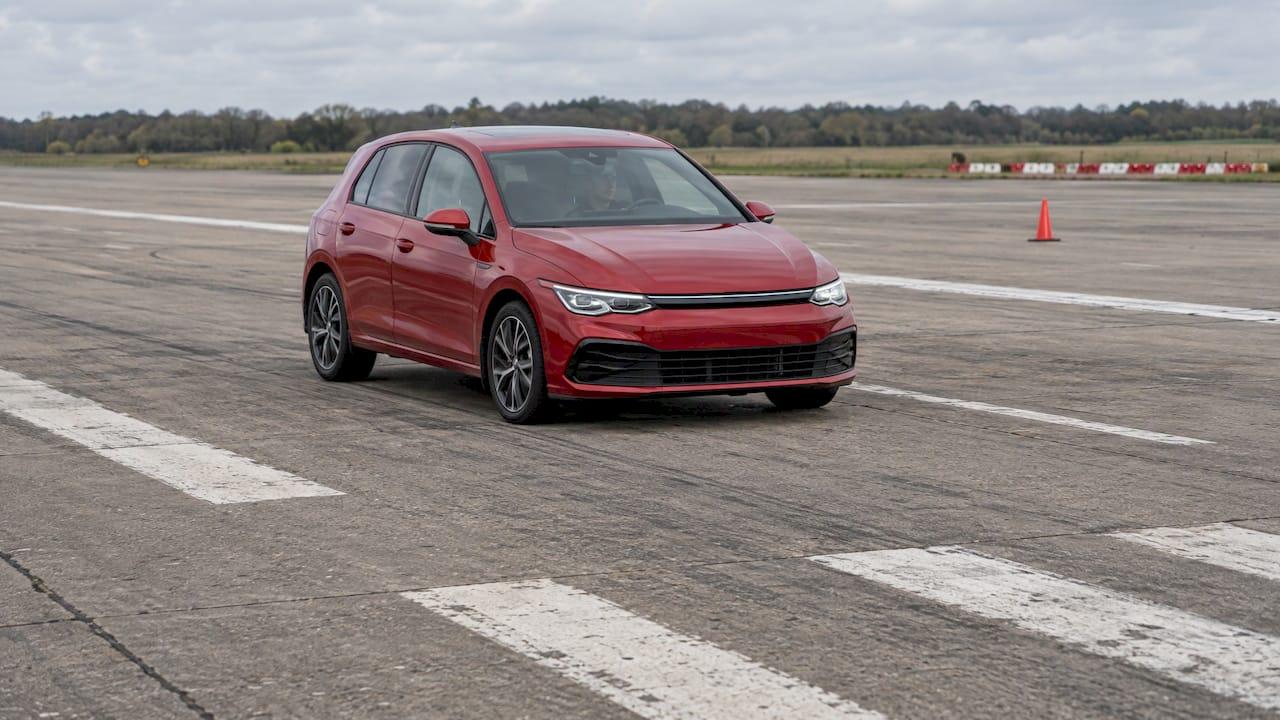
Tires and brakes do not compete. Brakes turn motion into heat. Tires turn that braking force into grip on the road. Stopping distance is the result of both, plus speed and reaction time. A worn part on either side adds metres. For Canadian drivers, the practical answer is to keep both in good condition and to match brake hardware to the vehicle. DBC Brakes builds cross-drilled rotor kits in Canada for that purpose.
TL;DR
- Total stopping distance is reaction distance plus braking distance. Braking distance depends on speed, brake condition and tire grip.
- Tires set the limit of grip. Brakes decide how reliably the vehicle uses that grip, stop after stop.
- Winter tires can shorten braking distances by as much as 25%, according to Ontario.
- Speed matters most. Distance grows much faster than speed does.
- Worn rotors, pads and tires each add distance. Replace them as a matched set of parts.
Table of Contents
- Total stopping distance, in three parts
- Worked example: how far at common speeds
- What tires control
- What brakes control
- The combined effect: tires and brakes together
- Comparison: which part changes what
- Checks before the next drive
- Speed, load and reaction time
- Brake kits for Canadian vehicles
- Perspective
- FAQ
- Sources
Total stopping distance, in three parts
Stopping distance is not only what happens after the brake pedal goes down. It has stages:
- Perception: the driver notices the hazard.
- Reaction: the foot moves from the accelerator to the brake.
- Braking: the vehicle slows from the moment the brakes engage until it stops.
The Newfoundland and Labrador government's brake manual puts driver reaction time at about three-quarters of a second. It also says braking distance depends on three things: the friction the lining can produce, the ability of the brake parts to shed heat, and the tires' grip on the road. That one sentence answers the keyword. Brakes and tires appear on the same list.
The Queensland Government uses a reaction time of about 1.5 seconds for an average driver in an emergency. Its figures assume a modern vehicle with good brakes and tires, able to stop at roughly 7 m/s². Dry sealed road has a friction coefficient of about 1. Wet sealed road is about 0.7.
Worked example: how far at common speeds
The table uses the Queensland assumptions: 1.5 seconds of reaction time and 7 m/s² of braking on dry pavement. The wet column scales that braking rate by the 0.7 wet-road friction figure, about 4.9 m/s². These are calculated estimates for a vehicle in good condition, not test results. Real vehicles vary.
| Speed | Reaction distance | Braking distance, dry | Total, dry | Braking distance, wet | Total, wet |
|---|---|---|---|---|---|
| 50 km/h | 21 m | 14 m | 35 m | 20 m | 41 m |
| 60 km/h | 25 m | 20 m | 45 m | 28 m | 53 m |
| 80 km/h | 33 m | 35 m | 69 m | 50 m | 84 m |
| 100 km/h | 42 m | 55 m | 97 m | 79 m | 120 m |
Two patterns stand out. Reaction distance grows in step with speed. Braking distance grows with the square of speed, which the Queensland page describes as an exponential increase. From 50 to 100 km/h, speed doubles and braking distance roughly quadruples.
The wet column shows the tire side of the equation. Nothing about the brakes changed. The road surface changed, and the tires had less to grip.

What tires control
Braking force can only slow the vehicle as much as the tires can transmit to the road. The Québec auto insurer SAAQ states that the same vehicle at the same speed takes longer to stop on a wet surface than a dry one, and longer again on ice. It adds that poor tire traction may demand a much greater braking distance or cause loss of control.
Three tire factors matter most.
Tread depth and condition
The HowStuffWorks stopping-distance guide notes that tires with little or no tread skid more easily under heavy braking, which lengthens braking distance. Hydroplaning is part of this. Service Nova Scotia says partial hydroplaning begins at about 55 km/h in a standard passenger car. In a severe rainstorm, tires can lose all contact with the road at 85 km/h.
Pressure
SAAQ advises checking tire pressure at least once a month, with cool tires, meaning the vehicle has not run for at least 3 hours or more than 2 km. It also advises rotating tires every 10,000 km. Ontario adds that cold weather can lower tire pressure, so winter calls for regular checks.
Tire type and temperature
Transport Canada says all-season and summer tires begin to lose elasticity and traction below 7°C. Winter tires keep their elasticity and grip at much lower temperatures. It advises installing winter tires in sets of four and not using tires worn close to 4 mm (5/32 inch) on snow-covered roads.
The size of the effect on snow and ice is large. Service Nova Scotia states that stopping on snow and ice, without chains, takes 3 to 12 times the distance of stopping on dry concrete. A Canadian workplace road-safety document reports that at 20 km/h on ice, four matched winter tires stop a vehicle 33% sooner than all-season tires.
What brakes control
Brakes decide how much force reaches the tire, how quickly, and how consistently. The same HowStuffWorks guide says worn drums, rotors, pads or shoes, and leaky brake lines, have an adverse effect on braking. The Newfoundland and Labrador manual lists the brake parts' ability to shed heat as one of the three braking-distance factors.
Heat is where rotor design matters. Every stop converts speed into heat in the rotors and pads. Repeated stops, long downhills, towing and a loaded vehicle all raise that heat load. Queensland lists vehicle weight and towing as factors that affect stopping distances. Rotors that cope with heat help the pads keep working as designed.
DBC's cross-drilled rotors are engineered to prevent warping and to improve durability. A warped rotor gives uneven contact, and that works against smooth, repeatable stopping. DBC supplies rotors, pads, full brake kits, and wheel bearings and hubs, so the whole brake corner can be handled in one order.
The combined effect: tires and brakes together
The clearest evidence that both matter comes from a test of both. The DEKRA 2022 Road Safety Report replaced worn all-season tires (4 to 4.8 mm tread) with new winter tires. It also fitted new brakes and shock absorbers. Braking distance from 100 km/h fell from 44.4 m to 38.7 m. From 160 km/h it fell from 111 m to 98.3 m. A DEKRA accident researcher said that safe arrival depends crucially on the condition of the brakes, the chassis and the tires.

The lesson: a vehicle's stopping distance is a system result. Fresh tires on tired brakes leave distance on the table. New brakes on bald tires do the same. Renewing both gives the best result.
Comparison: which part changes what
| Factor | Tires | Brakes |
|---|---|---|
| Main job | Transfer braking force to the road | Create braking force and manage heat |
| Wear that adds distance | Low tread, low pressure, age, wrong season type | Worn pads, worn or warped rotors, leaking lines |
| Most sensitive to | Wet, snow, ice, cold below 7°C | Heat from repeated or heavy stops, load, towing |
| Check interval | Pressure monthly, rotation every 10,000 km (SAAQ) | Visual inspection at regular service and when noise or vibration appears |
| Seasonal action | Winter set of four | Inspect before winter and before heavy-load driving |
Checks before the next drive
These checks apply to any vehicle.
- Pressure: check monthly on cool tires, and more often in cold snaps.
- Tread: on snow-covered roads, do not rely on tires worn close to 4 mm (5/32 inch), per Transport Canada.
- Set of four: install winter tires as a matched set of four. Ontario also advises against mixing tire types on one vehicle.
- Brakes: look at pad thickness and rotor surface, and listen for grinding or squeal. DBC's guide to telling wheel bearing noise from brake noise covers the common sounds.
- Follow distance: Transport Canada advises leaving more distance than normal on slippery roads and avoiding forceful braking or sudden steering jerks.
For a longer routine, see three quick tire checks that improve stopping power and the brake replacement safety checklist. Seasonal reading is in the cold-weather brake guide and the wet weather braking guide.
Safety note: a vehicle that pulls to one side, vibrates under braking, has a soft pedal or shows a brake warning light needs inspection by a qualified technician before further driving.
Speed, load and reaction time
No hardware removes the effect of speed. The SAAQ states that vehicle weight and speed both influence stopping distance. Queensland lists driver factors too: attention, fatigue, impairment, vision, age and experience. A tired driver adds reaction distance before either tires or brakes start working.
The practical rule is a gap that suits the speed and the surface. Cutting speed by 20 km/h on a wet road saves more distance than most hardware changes. DBC's article on maintenance that improves stopping distance starts from that point.
Brake kits for Canadian vehicles
DBC makes brake kits with cross-drilled rotors for cars, trucks and performance vehicles. Product lines include Performance XDB, Premium Black Kote and Performance SS. Fitment is guaranteed. Pricing is inclusive, with no hidden fees. Orders over $100 ship free within Canada. Expedited shipping is $29.99 per order. Support is by people, not automated replies.
To start, pick the vehicle on the make selector. Rotors, pads and full kits are on the brake kits collection. Heavier vehicles and drivers who tow can look at big brake kits.
A complete kit replaces rotors and pads together. That keeps both friction surfaces new and matched, which is the point of the DEKRA result above.
Perspective
Tires get the attention in stopping-distance talk because they are what touches the road. Brakes get less attention because they are out of sight. In practice they depend on each other.
A driver with new tires and worn rotors has half a solution. A driver with new brakes and tired tires has the other half. We build kits for people who want the brake side done right: cross-drilled rotors engineered to resist warping and last, kits that fit the vehicle, one price with nothing added at checkout.
We are a Canadian manufacturer, and we answer questions with people who know brakes. If you are unsure which kit suits a vehicle and how it is driven, ask us before you order.
Sam
FAQ
Do tires or brakes matter more for stopping distance?
Neither works alone. Braking distance depends on lining friction, brake heat management and tire grip together, as the Newfoundland and Labrador manual states. Tires set the grip limit on the road surface. Brakes deliver the force. Keep both in good condition.
How much do winter tires shorten braking distance?
Ontario says winter tires shorten braking distances by as much as 25% in frost, snow and icy conditions. Transport Canada says all-season and summer tires start losing traction below 7°C. Install winter tires in a set of four.
What is total stopping distance?
It is perception distance, plus reaction distance, plus braking distance. Average reaction time is about three-quarters of a second in the Newfoundland and Labrador manual. Queensland uses about 1.5 seconds for an emergency. At 80 km/h on dry pavement, the estimate above is about 69 m in total.
How often should tires and brakes be checked?
SAAQ advises checking tire pressure monthly on cool tires and rotating tires every 10,000 km. Brakes need a visual inspection at regular service, and sooner if there is noise, vibration or a longer pedal. Replace rotors and pads as a matched set.
Sources
- Winter driving, Ontario.ca
- Air brake manual, Government of Newfoundland and Labrador
- Stopping distances: speed and braking, Queensland Government
- Driving a Passenger Vehicle, SAAQ
- How to Test Vehicle Stopping Distance, HowStuffWorks
- Safe driving, Service Nova Scotia
- Using winter tires, Transport Canada
- Vehicles Take Longer to Stop in Poor Conditions, Road Safety at Work
- Keeping Vehicle Systems and Components in Good Condition, DEKRA