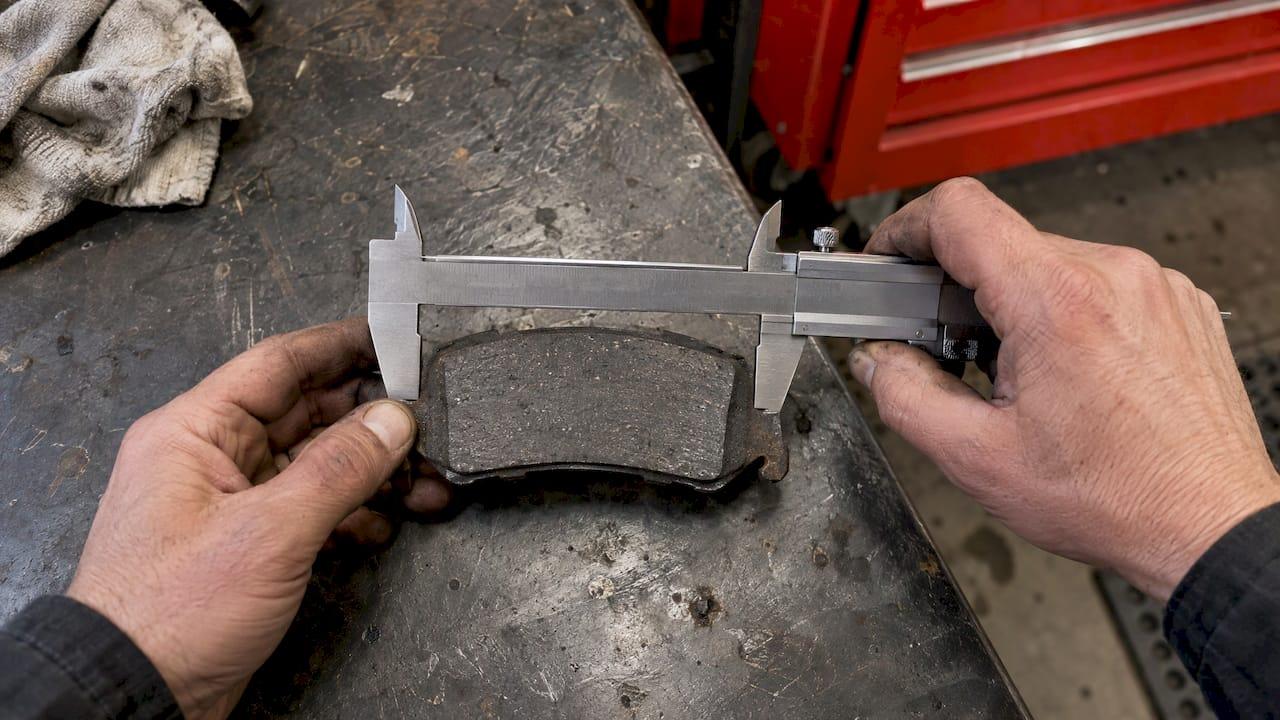
The legal minimum for bonded brake pad lining in Ontario and Quebec is about 1.5 to 1.6 mm. That is a floor for passing an inspection, not a target for replacement. Most drivers should plan new pads well before that point, at roughly 3 to 4 mm of friction material, and follow the vehicle manufacturer's own limit when it is stated. Pads that reach the legal floor have little material left to protect the rotor. This guide covers the numbers, how to measure, and what to do at each reading.
If pads are due, DBC supplies brake pads for Canadian vehicles with a hardware kit. Fitment is guaranteed, and orders over $100 ship free within Canada.
TL;DR
- Legal floor: 1.5 mm in Ontario's safety regulation, 1.6 mm in the Ontario inspection standard and in Quebec's regulation. Measured at the thinnest point of the lining.
- Replacement point: plan pads at about 3 to 4 mm. The manufacturer's service limit for the vehicle comes first.
- At 2 mm or less, replace now. Grinding means the friction material is gone.
- Measure the friction material only, not the steel backing plate, on all four wheels.
- Pads and rotors wear together. Check rotor condition at every pad change.
Table of Contents
- What "brake pad thickness" means
- The legal minimum in Canada
- Legal minimum is not replacement point
- Reading the measurement: what each thickness means
- How to measure brake pad thickness
- Warning signs that arrive before the number does
- Check the rotors every time
- Choosing replacement pads
- Our view: change pads and rotors as a set
- Ready to replace
- FAQ
- Sources
What "brake pad thickness" means
Brake pad thickness is the amount of friction material left on the pad. It is measured in millimetres from the surface that touches the rotor to the flat face of the steel backing plate. The backing plate is the reference point and is not part of the measurement.
New pads usually start around 10 to 12 mm of friction material. The exact figure depends on the pad and the vehicle. Thickness goes down with every stop. Heavy city traffic, towing, steep grades and aggressive driving all shorten the life of a set.
The pad is the part that wears away on purpose. The rotor is the part it clamps. When the pad is gone, the backing plate is the part that meets the rotor, and the rotor takes the damage.
The legal minimum in Canada
There is no single national number. Brake inspection rules are set by each province. The two best documented are Ontario and Quebec.
Ontario
Ontario's Safety Inspections regulation says bonded brake lining may not be thinner than 1.5 mm, measured at the thinnest point. A riveted lining surface may not be closer than 0.8 mm to the rivet head.
The ministry's light-duty vehicle inspection standard uses a 1.6 mm figure (2/32 of an inch). It requires lining thickness to be measured at the thinnest point and recorded on the inspection report. A shoe lining that is bonded and under 1.6 mm is rejected. So is a riveted lining under 1.6 mm above the rivet.

What this means in practice: if the thinnest spot on any pad is near 1.5 to 1.6 mm, the vehicle is at risk of failing a safety inspection.
A Safety Standards Certificate is the paper proof that the vehicle met minimum standards on the day of inspection. Ontario's page on the certificate says it is issued at a licensed inspection centre and is valid for 36 calendar days. You cannot put licence plates on a vehicle without one, so brakes found short at inspection mean a delay and a repair before the certificate is issued.
Quebec
Quebec's vehicle regulation requires bonded brake linings on hydraulic or electric braking systems to be at least 1.6 mm thick. The measurement is taken at the thinnest point and excludes the bevelled part of the pad. A brake disc must also not be thinner than the dimension stamped on it or specified by the manufacturer.
That last point matters for the rest of this guide. The pad limit and the rotor limit are separate checks.
Other provinces
Other provinces set their own inspection rules, and some update them. British Columbia, for example, has its own inspection standards that include rotor minimum thickness. The provincial transportation ministry's page is the place to confirm the current rule where you live. The 1.5 to 1.6 mm range in Ontario and Quebec is a useful reference for what a legal minimum looks like.
Legal minimum is not replacement point
A legal minimum is the last point at which a vehicle can still pass. It is not advice on when to change pads.
Mitsubishi Motors Canada advises that pads be measured against the manufacturer's remaining-material specification. It says pads typically need replacing while a few millimetres remain, even if braking feels fine, and that brakes should be checked at least twice a year. It also notes that wear is gradual, so a small loss of stopping performance on each stop can go unnoticed.
Two practical conclusions follow:
- The number in the vehicle's service manual or owner's manual is the one that counts. It is vehicle-specific.
- If you cannot find that number, replace pads well above the legal floor, not at it.
Reading the measurement: what each thickness means
The table below is a working guide for planning. It is not a legal rule. Where your manufacturer's limit is higher, use that.
| Friction material left | What it means | What to do |
|---|---|---|
| 8 to 12 mm | New or lightly worn | Nothing. Check again at the next tire change |
| 6 to 7 mm | About half worn | Monitor. Order parts if you drive hard or tow |
| 4 to 5 mm | Getting low | Plan the replacement within the next few months |
| 3 mm | Replace now | Book the job and order pads and hardware |
| 2 mm or less | Overdue | Replace right away. Rotor damage is likely soon |
| 1.5 to 1.6 mm | Legal floor in Ontario and Quebec | Fails inspection. Do not drive on these |
| 0 mm, grinding | Backing plate on the rotor | Stop driving. The rotor is being damaged |
Is 7 mm okay?
Yes. About a quarter of an inch is a common point to start paying attention. At that reading the pad is roughly half used. It is a reason to look again soon, not a reason to replace.
Is 4 mm okay?
It works, with little time left. Many drivers who see 4 mm at a seasonal tire swap will not make it through the next season on those pads. Order them now so the job is not rushed.
Is 3 mm okay?
At 3 mm the sensible choice is to replace. There is little margin for a hot, hard stop, and the chance of rotor damage rises as the lining thins. On the rear axle, where pads often last longer, 3 mm still means the same thing.
Can you drive with 2 mm?
It is not advisable. At 2 mm the pad is close to the legal floor, stopping performance drops and the rotor is at risk. Replace the pads immediately. If you hear grinding, the friction material is gone and the rotor is being cut by the backing plate.
How to measure brake pad thickness
You can get a good reading in a few minutes with the wheel on or off.
- Park on level ground and let the brakes cool. Hot rotors and calipers burn.
- Look through the wheel spokes with a flashlight. On many cars the outer pad is visible against the rotor. This gives a quick read, but it only shows the outer pad.
- Remove the wheel for an accurate reading. Use a brake pad gauge or a small steel ruler with millimetre marks. Measure the friction material only, from the surface to the steel backing plate.
- Measure at more than one point on each pad. Pads wear unevenly, and the legal limit applies at the thinnest point. Remove any clip-on shim first. A shim that is attached to the pad can stay.
- Check inner and outer pads. The inner pad, the one pushed by the piston, often wears faster. Compare both.
- Check all four wheels. Front pads usually wear faster than rear ones, but a sticking caliper can wear one corner much faster than the rest.
- Compare with the manufacturer's limit. Write the figures down with the date so you can see the rate of wear.
A simple field test: if the friction material is as thin as the steel backing plate or thinner, the pads are finished. A visual check from the driveway cannot confirm that the car will meet braking performance requirements. If a car is going in for a safety inspection, the inspector measures the pads and tests the system.
Warning signs that arrive before the number does
Thickness tells you what is left. These signs tell you the pads are already at the end:
- High-pitched squeal. Many pads have a wear indicator, a small metal tab that touches the rotor when the lining is low. Book service soon.
- Grinding. The lining is gone. Stop driving and replace pads, and expect to inspect or replace the rotors.
- Pulsing pedal. Often a rotor issue, and one more reason to check the rotor at pad time.
- Pulling to one side. Can indicate uneven wear or a sticking caliper.
- Soft or spongy pedal. Have it inspected immediately. If the pedal goes to the floor, do not drive.
- Brake warning light. Diagnose the same day.
- Burning smell near one wheel. Pull over safely and have the vehicle towed.
In Canadian winters, road salt can corrode a wear indicator and keep it from squealing. Do not rely on noise alone. Look at the pads through the spokes at each tire change and at least twice a year.
For a deeper look at what each sound means, see our guide on what brake pad wear tells you.
Check the rotors every time
Pads at the end of their life are the main reason rotors get scored, overheated and worn below their limit. A rotor has its own minimum thickness, stamped on it, and Quebec's regulation refers to it directly. Measure the rotor with a micrometer and compare it with the stamp. Look for grooves, a lip at the outer edge, blue heat marks and cracks.
If the rotor is under its limit or heavily scored, replacing only the pads leaves the new pads working against a poor surface. Our guide to when to inspect and replace brake discs covers the checks in order.
Choosing replacement pads
Match the pad to how the vehicle is used. A daily commuter wants a pad that matches factory behaviour. A performance car or a loaded truck wants a pad built for higher temperatures.
DBC lists two pad families on the site:
- OE Formula pads, an original-formula pad supplied with a hardware kit. Example: Rear OE Formula Brake Pads OEF-85149489.
- Carbon Performance pads, supplied with a hardware kit for drivers who want more from their brakes. Example: Front Carbon Performance Brake Pads CARB-86788820.
Pick by vehicle, not by pad name. The shop by make page narrows the list to parts that fit your make and model. If the pads are worn right down, the same page lists matching rotors and complete kits. Our Canadian buyer's guide to brake parts explains how pads, rotors and hardware fit together.
Keep the receipt. Our article on the Canadian brake parts warranty explains why.
Our view: change pads and rotors as a set
We build brake kits in Canada, and the question we hear most is how thin is too thin. Our answer is that the legal number and the useful number are different. A pad at 1.6 mm can pass an inspection and still leave little to protect the rotor. We would rather see a driver replace at 3 to 4 mm and spend a little less overall.
The reason is cost. Pads that run to the backing plate cut grooves in the rotor, and a scored rotor cannot always be reused. Fresh pads on a fresh rotor bed in together and wear evenly. That is why we sell pads, rotors and kits together, with the hardware in the box.
Our cross-drilled rotors are engineered to resist warping and to last, and our pricing is inclusive, with no hidden fees. If you are not sure which pad or rotor fits your vehicle, our support team answers questions without automated replies. Fitment is guaranteed.
Sam
Ready to replace
When the measurement says it is time, start from the brake pads collection or the brake kits collection if the rotors need replacing too. Free shipping applies within Canada on orders over $100. Expedited shipping is $29.99 per order. International shipping is $129.99 per brake kit. Details are on the shipping information page.
FAQ
What is the legal minimum brake pad thickness in Canada?
There is no national figure. Ontario's regulation sets 1.5 mm for bonded lining at the thinnest point, and its inspection standard uses 1.6 mm. Quebec's regulation sets 1.6 mm. Confirm the rule with your own province before an inspection.
When should I replace brake pads based on thickness?
Plan replacement at about 3 to 4 mm of friction material, or at the limit in your vehicle's manual if it is higher. Replace at once at 2 mm or less, or if you hear grinding.
Is 3 mm on brake pads okay?
It is still above the legal floor, but it is the point to book the job. Little material is left, and the risk of rotor damage rises as the lining thins.
How often should brake pads be checked?
Mitsubishi Motors Canada recommends brakes be checked at least twice a year. A seasonal tire swap is a convenient time to measure all four wheels and check the rotors.
Sources
- R.R.O. 1990, Reg. 611, Safety Inspections, ontario.ca
- Passenger / Light-Duty Vehicle Inspection Standard, ontario.ca
- Safety standards certificate, ontario.ca
- Légis Québec, C-24.2, r. 32
- Signs You Need New Brake Pads, Mitsubishi Motors Canada