
Most brake parts warranties in Canada cover defects in material or workmanship, not normal wear. Pads and rotors typically fall outside coverage unless a covered defect caused them to fail early. The single most important thing you can do right now is keep your proof of purchase and installation records, then contact your point of sale or the manufacturer to start a claim before you replace anything.
TL;DR:
- Warranties typically cover only manufacturing defects, not normal wear on parts like pads and rotors, which are excluded regardless of part age or mileage.
- A successful claim depends on documented evidence of a mechanical defect, with installation errors and wear-related causes often leading to claim denial.
- Proper documentation, including receipts, repair orders, and diagnostic notes, is crucial to proving the cause of failure and securing warranty coverage.
- Installing aftermarket brake parts does not automatically void warranty, but the manufacturer must prove the part or installation caused the failure for a claim to be denied.
- Professional installation creates a stronger paper trail and is often a requirement for lifetime warranties, whereas DIY installation shifts the burden of proof onto the vehicle owner.
Table of Contents
- Brake parts warranty Canada coverage: what's usually included
- Common exclusions: wear items and causes that void coverage
- How aftermarket parts affect your warranty rights in Canada
- How to file a brake parts warranty claim in Canada
- Typical warranty lengths and Canadian OEM examples
- Why DBC Brakes keeps warranty claims simple
- How your vehicle type changes brake warranty terms
- How to verify your brake parts are authentic before you buy
- Comparing warranty terms across Canadian brake brands
- Your consumer rights under Canadian warranty law
- Professional installation versus DIY: what changes for your warranty
- Author perspective: a short checklist for protecting your coverage
- Get warranty-backed brakes built for Canadian roads
- Sources
Brake parts warranty Canada coverage: what's usually included
A brake parts warranty covers manufacturing defects, not the natural consequences of driving. If a caliper seizes because a seal was moulded wrong, that is a workmanship defect. If a rotor wears thin after 80,000 kilometres of city driving, that is normal wear, and no warranty in the country will replace it for that reason alone.
The distinction matters because it decides who gets a free part and who gets a bill. ACDelco Canada's parts warranty policy states plainly that replacement is tied to a defect in material or workmanship, with claims administered at the point of purchase. That is the standard structure across most Canadian brake warranties, whether from an OEM parts counter or a retail installer.
Coverage windows also depend on when the clock starts and whether it follows the part or the original buyer. Some policies transfer to a second owner automatically; others require the new owner to register the vehicle or produce the original receipt.
Typical coverage includes:
- Manufacturing defects in calipers, master cylinders, and brake lines
- Premature failure of a component traced to a defect, not mileage
- Parts damaged as a direct result of another covered component's failure
- Workmanship issues from factory assembly, not installation errors made after purchase
Common exclusions: wear items and causes that void coverage
Pads, rotors, and drums wear out. Every Canadian brake warranty treats that as expected, not defective, and excludes it accordingly. GMC Canada's warranty guidance confirms that base and powertrain warranties commonly exclude wear items like brake pads and rotors, and points owners to the warranty manual for the specific limits that apply to their vehicle.
Several other causes routinely void a claim, regardless of how new the part is:
- Track use, racing, or aggressive driving beyond the part's design intent
- Corrosion from road salt neglect or long-term storage without maintenance
- Improper installation, including wrong torque specs or missing hardware
- Contamination from oil, brake fluid leaks, or aftermarket coatings not approved by the manufacturer
Some OEM booklets carve out a narrow exception: pads and rotors are covered if they were rendered unusable by the failure of another covered part, such as a seized caliper that chewed through a rotor. Stellantis's warranty documentation spells this out directly for Chrysler, Dodge, Jeep, and Ram owners.
A denied claim usually looks like worn pads with no other failure attached. An accepted one usually has a documented mechanical cause, like a leaking caliper, behind the wear.
Pro Tip: Ask your technician to note the root cause on the repair order, not just "pads replaced." That single line is often what separates an approved claim from a denied one.
How aftermarket parts affect your warranty rights in Canada
Installing aftermarket brake parts does not automatically cancel your vehicle's warranty. Canadian consumer protection principles require the manufacturer to prove the aftermarket part, or its installation, actually caused the failure before denying a claim. Nissan Canada's warranty booklet states this exact standard: the manufacturer bears the burden of showing causation, not just correlation.
That burden shifts fast if your paperwork is thin. A review of aftermarket sector dynamics notes that disputes over parts origin and installation quality are common friction points between owners and warrantors, which is exactly why documentation carries so much weight in a claim.
Warranty disputes in the aftermarket space commonly centre on proving who installed the part and how. Certified technicians and clear repair orders often decide the outcome, since diagnostic notes become the evidence a warrantor actually reviews.
Protect yourself with:
- A dated repair order naming the parts installed and the shop that did the work
- Torque specs and fluid bleed confirmation noted on the invoice
- A technician's diagnostic report if a failure happens later and you need to show cause
- Receipts kept separately from the vehicle, since glove-box paper degrades or disappears
How to file a brake parts warranty claim in Canada
Filing a claim is mostly a paperwork exercise. Get the right documents together before you call anyone, and the process moves quickly.
- Confirm your warranty period. Check whether you're inside the time or kilometre limit, whichever comes first.
- Gather proof of purchase. Your original receipt or invoice, showing the date and part numbers.
- Get a certified inspection. A repair order from a licensed shop stating the failure and probable cause.
- Contact your point of sale or the OEM. Most parts warranties are administered where you bought the part, per ACDelco Canada's policy.
- Follow their claim instructions. Some require the failed part returned for inspection before approval.
| Evidence to gather | Why it matters |
|---|---|
| Original receipt or invoice | Confirms purchase date and starts the warranty clock |
| Installation repair order | Shows certified installation and torque compliance |
| Technician's diagnostic notes | Establishes root cause, not just symptom |
| Odometer reading at failure | Confirms you're within the kilometre limit |
| Photos of the failed part | Supports the claim if the part must be shipped or discarded |
Outcomes vary. Some claims result in a straight replacement, others in a prorated credit if the part is partway through its service life, and some are denied outright if the cause traces back to wear or misuse. If a shop denies your claim and you disagree, ask for the denial in writing and escalate to the OEM's customer relations line, referencing your brake shop service records as supporting evidence.
Typical warranty lengths and Canadian OEM examples
Warranty length in Canada ranges widely depending on who backs the part and what it's made of. Retailer-installed brakes often carry the longest windows because labour and parts are bundled together.
| Warranty type | Typical duration | Source example |
|---|---|---|
| Basic parts defect warranty | 90 days to 1 year | Standard OEM parts counter policy |
| Remanufactured component warranty | Around one year or a high kilometre limit | SBS Brakes Inc. |
| Retailer-installed parts and labour | Multi-year warranty with kilometre limits in the medium range | Kal Tire brake warranty |
| "Lifetime" brake pad programme | Life of ownership, with conditions | Ford Canada lifetime pad warranty |
"Lifetime" rarely means unconditional. Ford's programme, for example, requires dealer installation and proof of purchase to stay eligible, which is a common pattern across lifetime marketing language. Prorating also comes into play on remanufactured parts: a component that fails at month 10 of a 12 month window might get full replacement, while one that fails at month 11 of a 100,000 km limit already logged at 95,000 km may only qualify for a partial credit.
Why DBC Brakes keeps warranty claims simple
Warranty friction usually comes down to two things: missing paperwork and unclear parts sourcing. DBC Brakes built its process around avoiding both.
- Every kit uses engineered cross-drilled rotors designed to resist warping, which cuts down on the premature-wear disputes that plague cheaper aftermarket rotors
- Inclusive pricing means no hidden fees show up after the sale, so what you paid is what your receipt says, with nothing to reconcile later during a claim
- Free shipping on orders over $100 applies across Canada, and support comes from knowledgeable staff rather than automated ticketing systems
Keep your DBC order confirmation and any installation notes together from day one. Because pricing is transparent, matching your invoice to the part number on a warranty request takes minutes, not a back-and-forth with a parts desk trying to figure out what you actually bought.
How your vehicle type changes brake warranty terms
A compact sedan and a half-ton pickup do not wear brakes the same way, and Canadian OEMs write their warranty terms accordingly. Heavier vehicles, particularly trucks and SUVs rated for towing, often carry shorter wear-item intervals baked into maintenance schedules, which indirectly shrinks the practical window where a "defect" claim is even plausible before normal wear takes over.
Performance and European vehicles frequently ship with more exotic pad and rotor materials, and manufacturers sometimes attach tighter kilometre limits to those parts because they're engineered for higher heat tolerance rather than longevity. A performance rotor rated for aggressive stopping power under repeated hard braking is a different warranty conversation than a economy car's basic rotor.
Commercial and fleet vehicles usually fall under separate warranty schedules entirely, since duty cycles (stop-and-go delivery routes versus highway commuting) affect wear rates dramatically. If you're running a work truck, check whether your brake components fall under a commercial-use exclusion, since several OEMs write those clauses specifically to limit claims on vehicles used for towing, hauling, or extended idling.
Electric vehicles complicate things further. Regenerative braking reduces mechanical brake wear substantially, which means some EV owners go years longer between pad replacements than they expect, but it also means a warranty claim on early pad wear draws more scrutiny, since the OEM knows the part should have lasted longer under typical EV use patterns.
How to verify your brake parts are authentic before you buy
Counterfeit and mislabelled brake parts are a real problem in the aftermarket space, and a fake part voids any warranty claim outright since there's no legitimate manufacturer standing behind it.
Start with the packaging. Legitimate brake components carry part numbers that match the manufacturer's published catalogue, and the box typically includes a batch or lot number you can cross-reference if you contact the seller. If a listing shows a suspiciously low price for a premium rotor or pad set, treat that as a warning sign rather than a deal.
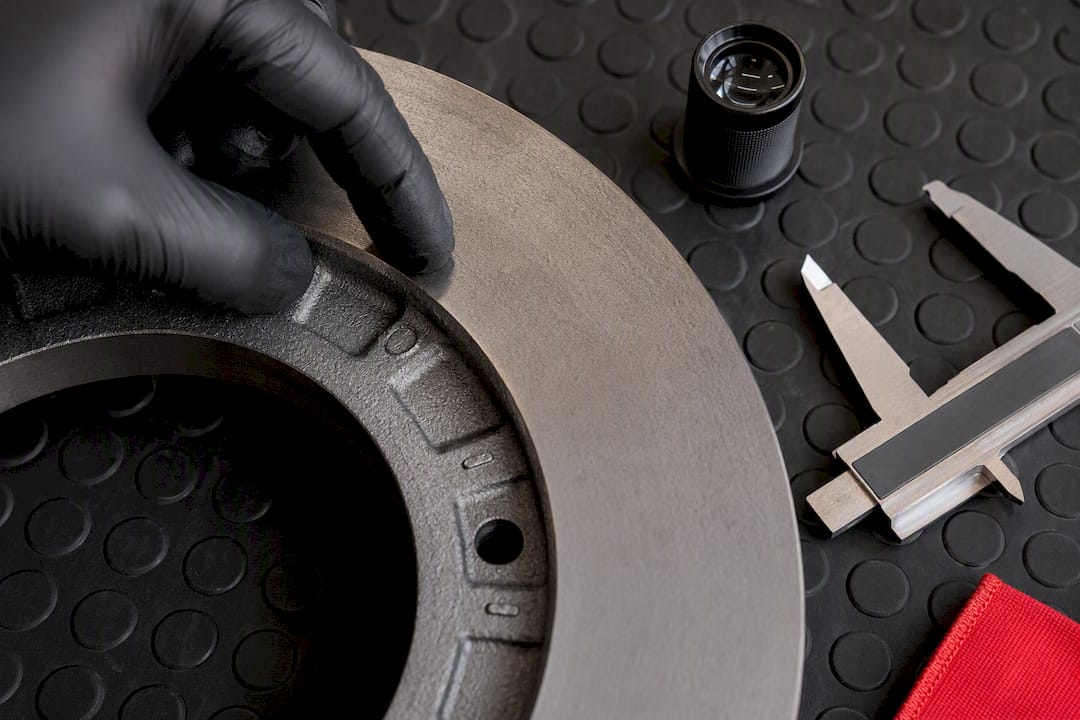
Check the casting marks directly on the metal. Genuine rotors and calipers are stamped with manufacturer codes, and a part with no markings, or markings that don't match what the seller claims, is a red flag worth walking away from.
Buy from the manufacturer's direct site or an authorized retailer whenever possible. DBC Brakes, for instance, sells directly to Canadian customers, which means the part you receive traces straight back to the source with no reseller layer to complicate a future claim.
Keep every piece of packaging until you're confident the install went well. If a warranty dispute ever comes up, the box, the invoice, and the part number together form a paper trail that's far harder to dispute than a memory of where you bought something eighteen months ago.
Comparing warranty terms across Canadian brake brands
Not every brake warranty in Canada reads the same way, and the differences show up in three places: duration, what triggers coverage, and who administers the claim.
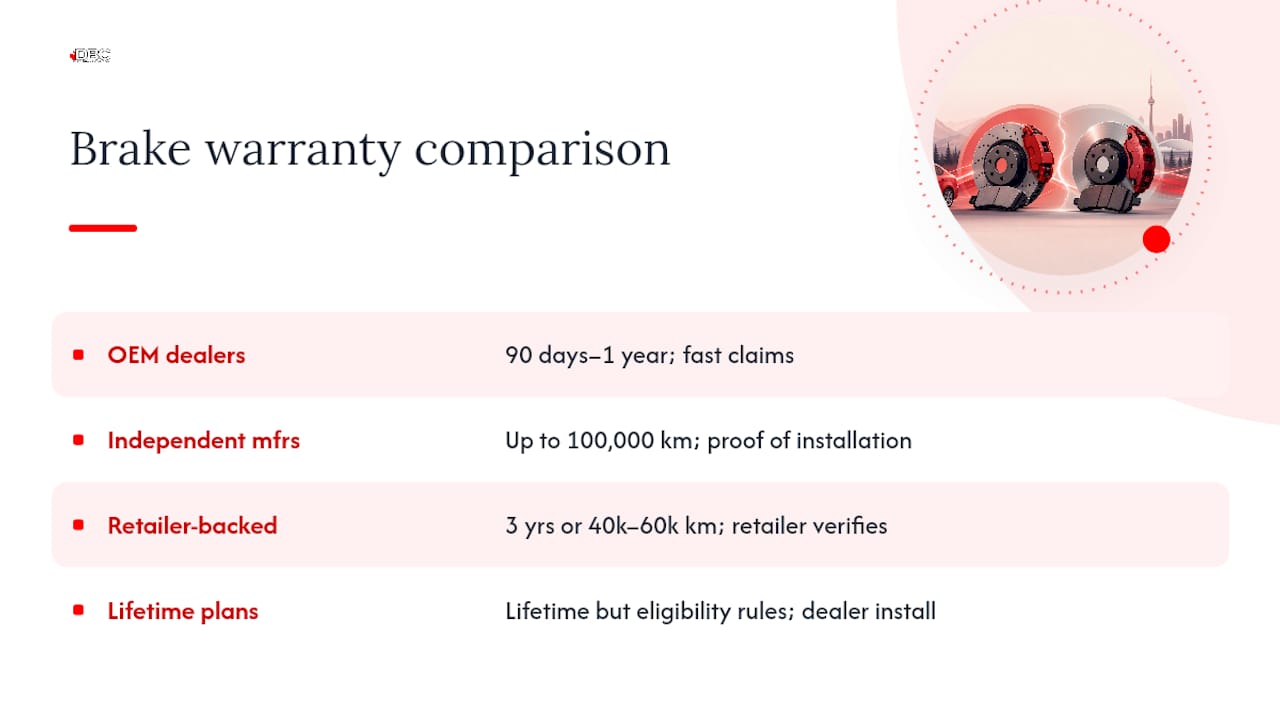
OEM dealer parts counters tend to offer the shortest windows, often 90 days to one year, but they process claims quickly because the paperwork trail already exists in the dealer's system from the original vehicle sale. Independent parts manufacturers, like remanufactured component suppliers, often extend further, sometimes to 100,000 kilometres, but they place more weight on proof of correct installation since they don't control who does the work.
Retailer-backed warranties, the kind bundled with installation at a tire and service chain, frequently offer the longest simple coverage, in the 3 year or 40,000 to 60,000 kilometre range, because the retailer controls both the part and the labour and can verify installation quality directly.
Lifetime programmes sit in their own category. They sound the most generous on paper, but they almost always carry eligibility conditions, dealer installation requirements being the most common, that narrow who actually qualifies. Read the fine print before you assume "lifetime" means what it sounds like.
The practical takeaway: a shorter, clearly worded warranty with a straightforward claims process often serves you better than a longer one buried in conditions you'll only discover after a part fails.
Your consumer rights under Canadian warranty law
Provincial consumer protection legislation across Canada generally requires that goods be reasonably fit for their intended purpose and match the description under which they were sold, regardless of what a manufacturer's warranty booklet says. This baseline protection exists independently of any written warranty, meaning a brake part that fails almost immediately after purchase may give you recourse even outside the manufacturer's specific terms.
Written warranties add specific promises on top of that baseline, but they cannot legally take away your existing provincial consumer protections. If a warranty document tries to disclaim all liability outright, provincial consumer protection offices in most jurisdictions would view that disclaimer skeptically.
The burden-of-proof principle matters here too. As Nissan Canada's warranty terms make clear, a manufacturer must actually demonstrate that an aftermarket part or poor installation caused a failure before denying coverage. The onus isn't on you to prove your innocence; it's on them to prove the cause.
If a dealer or retailer denies a claim you believe is valid, your provincial consumer protection office or small claims court remain available options. Keep every piece of correspondence in writing, since verbal promises from a service desk carry little weight if a dispute escalates.
Professional installation versus DIY: what changes for your warranty
Who installs your brake parts can matter as much as the parts themselves when a warranty claim comes up.
Professional installation by a certified technician creates a paper trail almost automatically. The shop documents torque specs, fluid bleed procedures, and any anomalies found during the job, and that repair order becomes your strongest piece of evidence if something fails later. Programmes like Ford's lifetime brake pad warranty explicitly require dealer installation as a condition of eligibility, which shows how much weight OEMs place on who did the work.
Self-installation doesn't void your parts warranty outright, since the defect standard still applies to the part itself. But if a failure happens and the warrantor suspects installation error, the burden shifts to you to show the job was done correctly. Without a professional's documentation, that's a harder case to make.
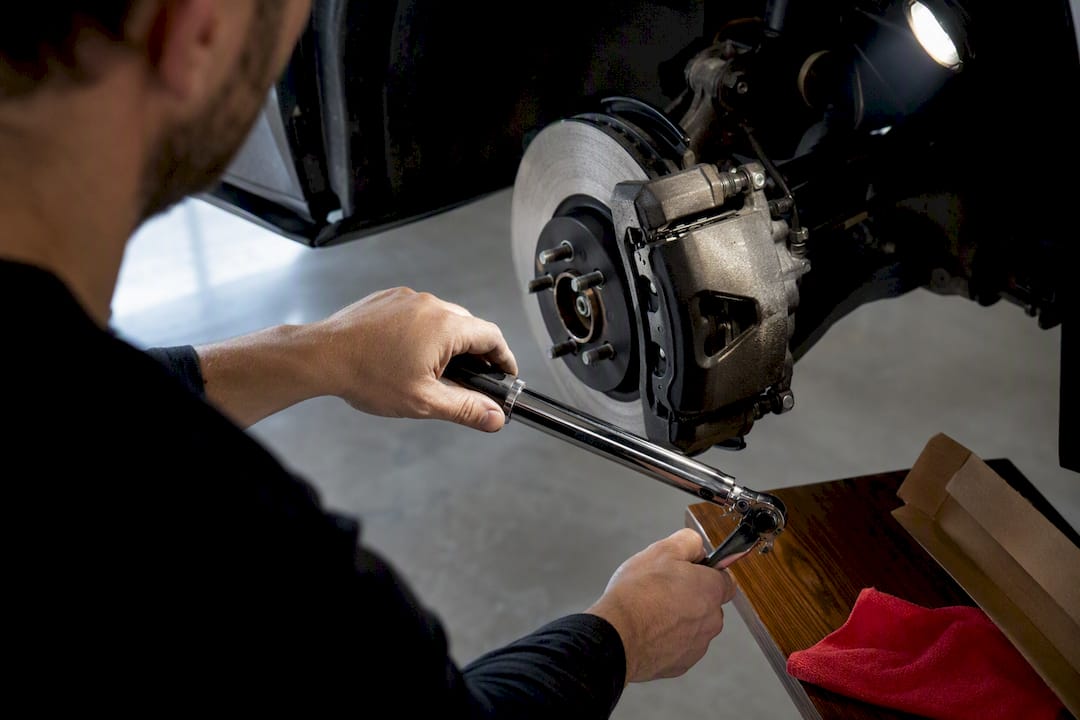
If you're comfortable installing your own brake kit, take photos during the process, keep your torque wrench settings recorded, and hold onto every packaging label. It won't match a certified shop's repair order, but it gives you something to point to if a claim ever gets questioned.
Author perspective: a short checklist for protecting your coverage
If I had to boil this down to one habit, it would be this: treat your brake parts receipt like a warranty document, because that's exactly what it is. Store it with your vehicle records, not in a random glove box pile.
Use a certified technician for anything warranty-sensitive, note the odometer reading at the time of any brake work, and write down anything unusual you notice beforehand, a pulling sensation, a grinding sound, a soft pedal. That detail often becomes the difference between a claim that gets approved and one that gets questioned.
If you ever need help walking through a claim, DBC Brakes's support team can point you toward the right documentation before you call anyone else.
— Sam
Get warranty-backed brakes built for Canadian roads
DBC Brakes is the direct alternative to piecing together aftermarket parts from unclear sellers and hoping the warranty paperwork sorts itself out later. Every kit ships with engineered cross-drilled rotors built to resist warping, inclusive pricing with no hidden fees to reconcile after the sale, and knowledgeable Canadian support staff instead of an automated help desk.
That combination matters most at claim time. When your receipt is clear and your parts trace directly back to the manufacturer, there's no reseller layer muddying the paper trail if something ever needs replacing under warranty. Orders over $100 ship free anywhere in Canada, and every kit is built to fit a wide range of daily drivers and performance vehicles alike.
Browse the current performance brake kit lineup or check the full brake kit collection to find the right fit for your vehicle, and keep your order confirmation on file from day one so any future warranty conversation starts with a clean paper trail instead of a guessing game.
Sources
- 2024 Nissan All Models Warranty Booklet
- Parts Warranty | ACDelco Canada
- 2026 Chrysler, Dodge, Jeep, Ram ProMaster Warranty Information CA E1
- About your warranty | GMC Canada