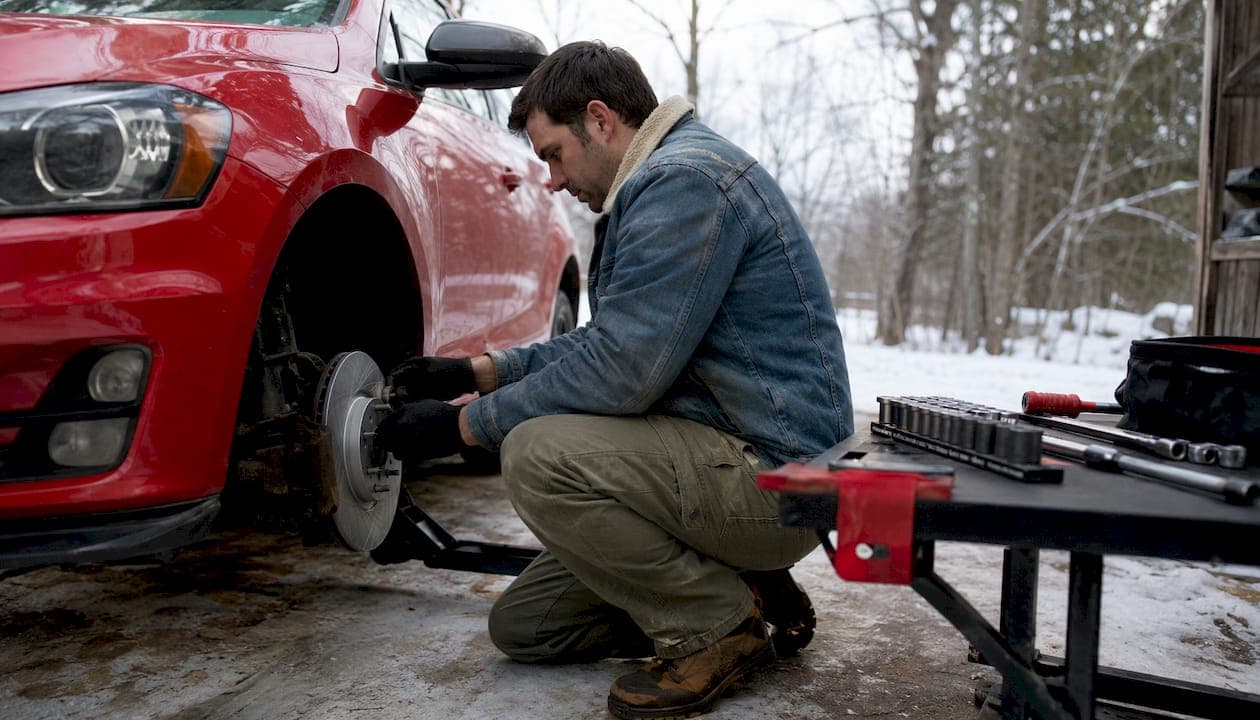
The fastest way to get reliable replacement brake parts in Canada is to buy a matched rotor and pad kit from a domestic supplier that offers VIN-based fitment lookup, a clear warranty, and free shipping. DBC Brakes, available at CrossDrilledRotors.ca, machines and coats its rotors in Canada and sells matched kits with full product specifications. Confirm your year, make, model, and trim before checkout. Order rotors and pads together as a kit.
Quick checklist before you order:
- Confirm fitment using year/make/model/trim or VIN lookup
- Check warranty length and what it covers (parts, labour, or both)
- Review the return policy, including restocking fees and return window
- Check estimated ship time and whether stock is held domestically
Pro Tip: Order rotors and pads as a matched kit. Mixing brands or compounds means longer bedding-in time and uneven wear from the first stop.
Table of Contents
- What do brake kits actually include?
- How do you pick the right brake parts for your vehicle?
- DIY or professional installation: what does it cost in Canada?
- Where should you buy brake parts in Canada?
- Why DBC Brakes suits Canadian buyers
- What trust signals should you check before buying?
- Key takeaways
- The case for buying Canadian brake parts instead of cross-border
- Order DBC brake kits from CrossDrilledRotors.ca
- Useful sources and further reading
What do brake kits actually include?
Brake parts fall into a few clear categories. Knowing what each one does helps you compare listings accurately and avoid buying incomplete sets.
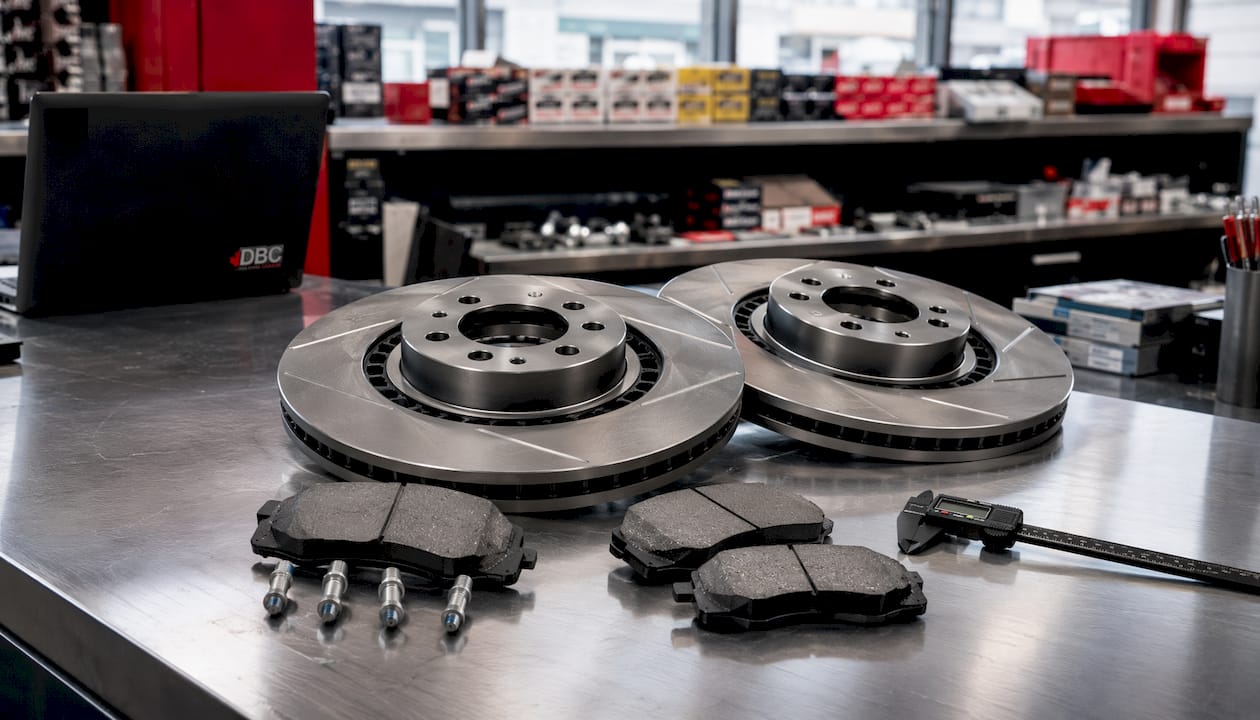
Rotors (also called brake discs) are the metal discs the pads clamp against to slow the vehicle. Pads are the friction material that contacts the rotor. Shoes serve the same function in drum brake systems, typically on rear axles of older or economy vehicles. Calipers are the hydraulic clamps that press the pads against the rotor. Hardware covers clips, shims, and pins that hold pads in place and reduce noise. A full brake kit bundles rotors, pads, and hardware together; some kits also include calipers.
Rotor types at a glance
- Solid (plain): Standard OEM-style, quiet and cost-effective for everyday commuting
- Slotted: Channels cut into the rotor face to clear gas and debris; better heat management under load
- Cross-drilled: Holes drilled through the rotor face for additional cooling and reduced weight; DBC Brakes engineers these to resist warping
- Coated/painted: Zinc or e-coat finish to resist surface rust, common on Canadian-market rotors exposed to road salt
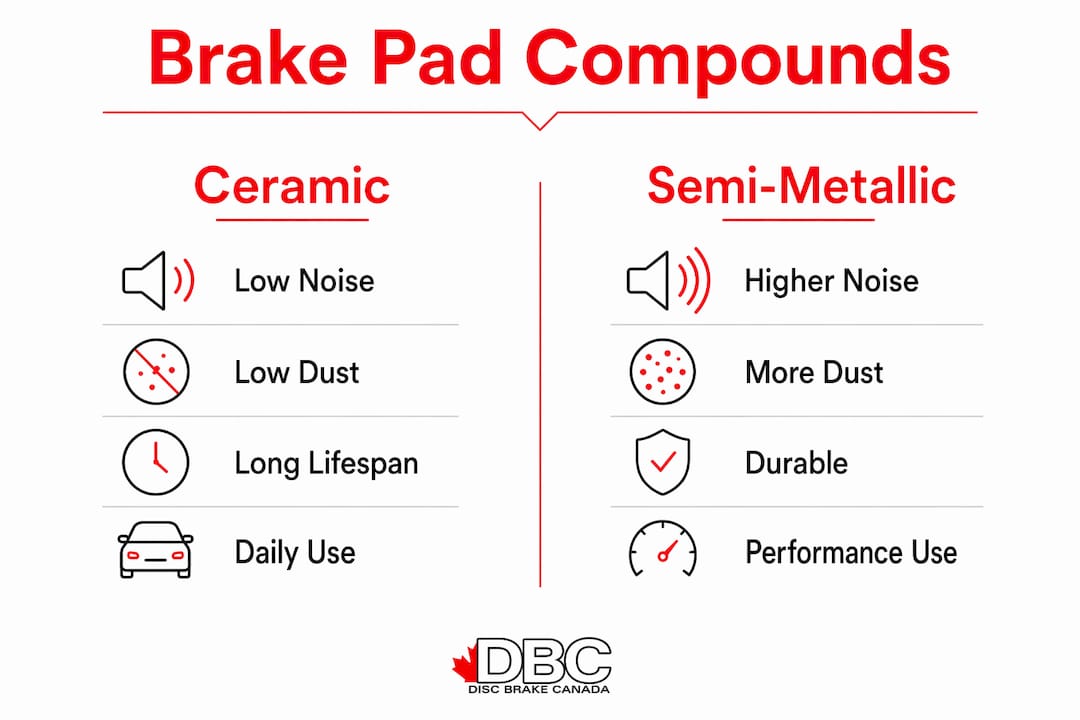
Pad compounds compared
| Compound | Noise | Dust | Lifespan | Best for |
|---|---|---|---|---|
| Ceramic | Low | Low | Long | Daily driving, light trucks |
| Semi-metallic | Moderate | Moderate | Medium–long | Performance, towing, cold starts |
| Organic | Very low | Low–moderate | Shorter | Light vehicles, low-heat use |
C.M. Brake manufactures heavy-duty brake shoes domestically in Canada using OEM-approved formulations, which matters for truck and fleet owners sourcing drum-brake components locally.
How do you pick the right brake parts for your vehicle?
Fitment comes first. A rotor that is 1 mm too thin or 2 mm off in bolt pattern will not seat correctly, and no amount of pad quality compensates for that. Use a year/make/model/trim selector or enter your VIN directly on the supplier's product page. Matched kits reduce the risk of mismatched tolerances between rotor and pad.
Material and design considerations
Once fitment is confirmed, choose rotor type and pad compound based on how the vehicle is used:
- Daily commuter: Solid or cross-drilled rotors with ceramic pads. Low dust and quiet operation.
- Towing or hauling: Semi-metallic pads with slotted or cross-drilled rotors for better heat dissipation.
- Cold-weather driving: Suppliers that publish cold-weather brake performance data and bedding procedures are worth prioritising. Rotor coating matters in Canadian winters; zinc-coated rotors resist salt corrosion longer than bare cast iron.
- Performance or track use: Slotted rotors with semi-metallic or performance ceramic pads.
OEM vs aftermarket: when does it matter?
OEM parts come from the vehicle manufacturer's supply chain and carry factory fit tolerances. Aftermarket parts vary widely. The tradeoffs:
- Warranty: OEM parts typically carry a manufacturer warranty tied to the dealer. Quality aftermarket suppliers offer comparable or longer warranties independently.
- Fit tolerance: OEM is machined to the original spec. Reputable aftermarket suppliers publish thickness and runout specs so you can verify the match.
- Cost: Aftermarket is generally less expensive. For a standard daily driver, a quality aftermarket kit from a Canadian supplier performs comparably to OEM at a lower price.
- Testing: Look for suppliers that publish spec sheets or reference OEM-approved formulations. Domestic Canadian manufacturers are more likely to publish this data than grey-market importers.
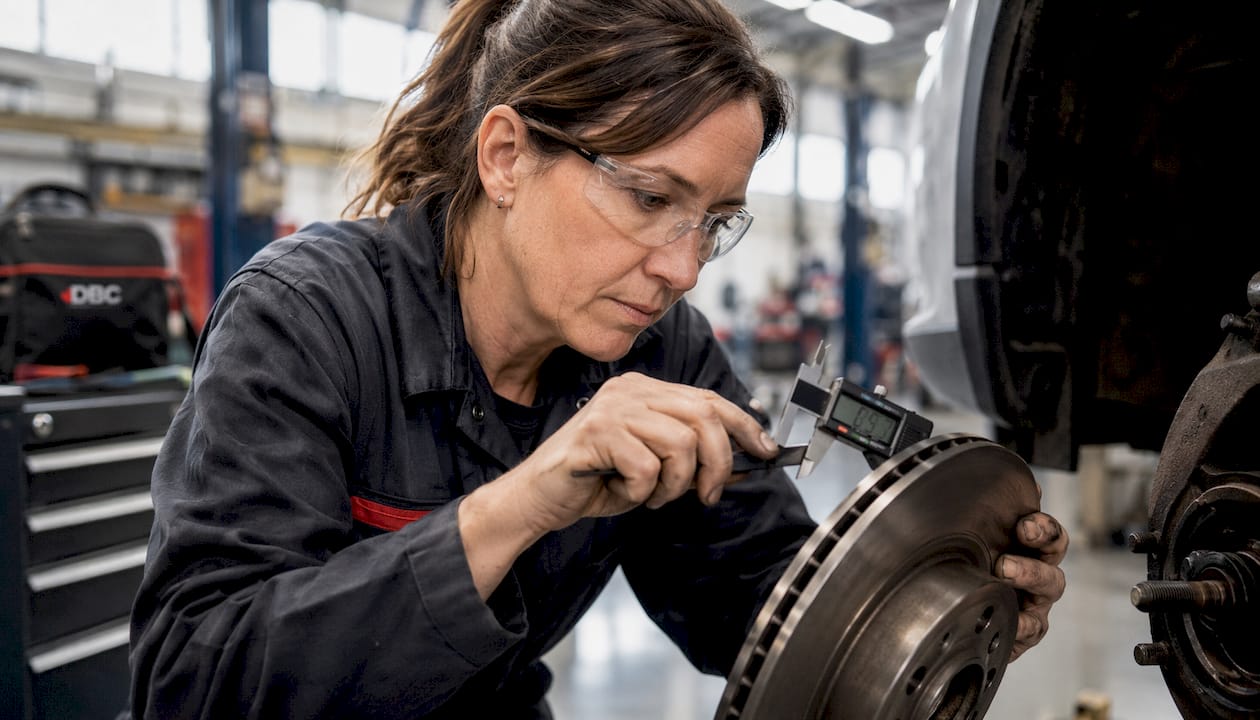
Pro Tip: Check the rotor's minimum thickness (discard thickness) and lateral runout spec before installing. Installing a rotor already near minimum thickness causes vibration within a few thousand kilometres, regardless of pad quality.
DIY or professional installation: what does it cost in Canada?
A rotor and pad swap is one of the more accessible DIY jobs for a competent home mechanic. The tools required are specific but not expensive.
DIY tools and safety checklist:
- Floor jack and two jack stands rated for the vehicle's weight
- Torque wrench (for wheel nuts and caliper bolts)
- Caliper piston tool or C-clamp to compress the piston
- Brake cleaner spray and clean rags
- Thread locker for caliper bracket bolts (where specified)
- Vehicle's torque specifications (owner's manual or OEM service data)
A front axle swap typically takes a competent DIYer 1.5–2 hours. A rear axle with an electronic parking brake adds time and may require a specialised reset tool. After installation, follow the rotor and pad manufacturer's bedding-in procedure: a series of controlled stops from moderate speed to seat the pad material evenly across the rotor face. Skip this step and you risk uneven deposits and vibration.
Typical Canadian costs
| Item | Estimated cost (CAD) |
|---|---|
| Parts only (rotors + pads, one axle) | Varies by vehicle and supplier |
| Mobile brake pad replacement (starting price) | Starting from $119.99 |
| Mobile complete brake job (pads, rotors, hardware) | Starting from $349.99 |
Mobile brake services in Canadian cities offer complete brake jobs (pads, rotors, and hardware) starting from $349.99 CAD, and standalone brake pad replacement services starting from $119.99 CAD, depending on vehicle. Some mobile providers also include a 12-month warranty on brake work, which reduces the risk gap between DIY and professional installation.
When to hire a pro instead of doing it yourself:
- Caliper replacement (hydraulic line work, bleeding required)
- ABS sensor replacement or brake system bleeding
- Electronic parking brake reset (requires a scan tool)
- Unknown fitment issue or brake fade with no clear cause
- Any job where the correct torque spec is unavailable
Timeline: purchase to road-ready
Order placed → parts arrive (1–5 business days for domestic stock) → installation (2–4 hours per axle, depending on vehicle and skill) → bedding-in procedure (30–45 minutes of controlled driving) → full braking capacity confirmed.
Where should you buy brake parts in Canada?
Five main channels exist for Canadian buyers. Each has different strengths on price, fitment support, and shipping speed.
Main purchase channels:
- Canadian online specialists (e.g., CrossDrilledRotors.ca): VIN fitment lookup, matched kits, domestic stock, free shipping thresholds, knowledgeable support
- National parts chains: Wide SKU range, in-store pickup, variable fitment support
- OEM dealers: Factory-spec parts, highest cost, slower availability for non-common vehicles
- Local independent stores: Regional availability, variable stock, useful for urgent needs
- Mobile service providers: Parts and labour bundled; convenient for owners without tools or workspace
What to compare between suppliers
| Factor | What to check |
|---|---|
| Fitment lookup | VIN or year/make/model/trim selector available? |
| Warranty | Length, coverage (parts only vs. parts and labour) |
| Return policy | Window, restocking fee, who pays return shipping |
| Stock location | Domestic warehouse or cross-border? |
| Shipping cost | Free threshold, estimated transit days |
| Support | Phone or live chat with technical knowledge |
Buying through Canadian specialist networks gives faster access to fitment support and technical documentation than cross-border marketplaces. Domestic distributors like CBS Parts maintain regional warehouses across provinces to reduce lead times for shops and fleet operators. For individual buyers, the practical benefit is the same: domestic stock ships faster and avoids cross-border duties.
Pro Tip: Prefer suppliers that list rotor thickness, runout tolerances, and coating type in the product spec sheet. If that data is absent, the supplier cannot confirm the part meets the spec for your vehicle.
Checking free shipping thresholds matters. CrossDrilledRotors.ca lists free shipping on orders over $100 and a 30-day return window, which lowers the risk of a wrong-fit order. Cross-border purchases from US retailers add duty, brokerage fees, and longer transit times that often erase any apparent price advantage.
Why DBC Brakes suits Canadian buyers
DBC Brakes machines and coats its rotors in Canada, drawing on multi-decade manufacturing experience and documented engineering improvements. That domestic production matters for two practical reasons: coating adhesion is better on freshly machined surfaces, and domestic machining processes reduce the corrosion risk that Canadian road salt accelerates on imported rotors reworked overseas.
What DBC offers Canadian buyers:
- Cross-drilled rotors engineered to resist warping, machined and coated domestically
- Matched rotor and pad kits with published product specifications
- Free shipping on orders over $100
- Knowledgeable customer support (not automated responses) for fitment confirmation
- Clear warranty and returns policy
For DIYers, the matched kit approach reduces the guesswork of pairing rotors and pads from different suppliers. Spec sheets confirm thickness and runout tolerances before the part ships. If fitment is uncertain, support staff can confirm compatibility using VIN or vehicle details.
DBC Brakes provides cross-drilled rotors machined and coated in Canada, sold as matched kits with full product specifications and a clear warranty. Free shipping applies on orders over $100, and knowledgeable support is available to confirm fitment by VIN before purchase.
Pro Tip: Contact DBC Brakes support with your VIN before ordering if your vehicle has a non-standard trim or a recent model-year update. Trim-level differences in rotor diameter and pad thickness are common and easy to miss in a standard year/make/model lookup.
What trust signals should you check before buying?
Any Canadian brake supplier worth buying from should make the following information easy to find before checkout.
Key trust signals checklist:
- Warranty length and coverage: Minimum one year on parts; confirm whether labour is included
- VIN or fitment lookup: A working selector that returns specific part numbers, not generic listings
- Product spec sheets: Rotor thickness, minimum discard thickness, lateral runout tolerance, coating type
- Verified customer reviews: Look for before/after feedback on fitment and noise, not just star ratings
- Live or phone support: Ability to speak with someone who can answer a technical fitment question
- Return window and policy: 30 days is standard; check who pays return shipping on wrong-fit orders
- Restocking fees: Some suppliers charge 15–20% on returned parts; confirm before ordering
Fleet-focused suppliers publish engineering and quality control data for heavy-duty braking components and remanufactured calipers, including OEM-approved production facility references. For passenger vehicle buyers, the equivalent is a product page that lists spec data rather than just a photo and a price.
For return and shipping policies, confirm the return window, whether the supplier covers return shipping on fitment errors, and whether a restocking fee applies. A supplier that hides this information until after purchase is a practical risk.
Key takeaways
DBC Brakes, available at CrossDrilledRotors.ca, is the clearest Canadian-made option for matched brake kits with VIN fitment lookup, domestic stock, and a transparent warranty.
| Point | Details |
|---|---|
| Confirm fitment first | Use VIN or year/make/model/trim lookup before ordering to avoid wrong-fit returns. |
| Buy matched kits | Ordering rotors and pads together reduces bedding-in time and ensures compound compatibility. |
| DIY vs. pro decision | DIY suits pad and rotor swaps; hire a pro for caliper work, ABS bleeding, or electronic parking brake resets. |
| Check warranty and returns | Confirm warranty length, coverage, return window, and restocking fees before checkout. |
| DBC Brakes recommendation | DBC Brakes offers Canadian-machined rotors, matched kits, free shipping over $100, and knowledgeable fitment support. |
The case for buying Canadian brake parts instead of cross-border
The conventional advice is to shop wherever the price is lowest. For brake parts in Canada, that logic has a real cost that rarely shows up in the comparison.
Cross-border orders from US retailers add brokerage fees, import duties, and transit time. A part listed at $40 USD less can arrive two weeks later with $30 in fees attached, and if it is the wrong fit, the return process crosses a border. More practically, a US-based supplier's support team cannot confirm fitment for a Canadian-market trim variant with the same confidence as a domestic specialist who stocks that SKU.
The other underrated factor is coating. Canadian roads use road salt heavily from November through March. A rotor with a thin or inconsistent zinc coating corrodes at the hat and vane edges within one winter, which accelerates wear and causes the surface rust that produces brake shudder on cold mornings. Domestic machining and coating, as DBC Brakes applies, produces better adhesion than import rework because the coating goes on a freshly finished surface. That is not a marketing claim; it is basic metallurgy.
For cold-weather driving, the brake upgrade guide for Canadian road conditions is worth reading before selecting rotor type. Slotted and cross-drilled designs clear water and debris faster, which matters on wet spring roads as much as on dry summer pavement.
Buy Canadian, confirm fitment by VIN, and match the rotor and pad in one order. That sequence eliminates most of the post-install problems that show up in brake forums.
Order DBC brake kits from CrossDrilledRotors.ca
DBC Brakes offers Canadian-machined cross-drilled rotors and matched brake kits with free shipping on orders over $100. No hidden fees, no automated support. The ordering process is straightforward: confirm your vehicle's year, make, model, and trim using the fitment selector on CrossDrilledRotors.ca, select the matched rotor and pad kit for your axle, and place the order. If your trim level is non-standard or you want fitment confirmed before purchase, contact DBC Brakes support directly with your VIN. Domestic stock means most orders ship within one to two business days. Warranty and return policy details are listed on the product page before checkout.
Useful sources and further reading
Resources used in this article and recommended for readers who want additional technical detail:
- CrossDrilledRotors.ca: DBC Brakes product pages, matched kits, fitment lookup, warranty and shipping information
- Canada brake rotor buying guide: Deep-dive on rotor specifications and fitment tips for Canadian driving conditions
- Brake kit features for reliability: Explains which kit features affect long-term maintenance and how to evaluate them
- Cold-weather brake performance guide: Practical guidance on material selection and bedding procedures for Canadian winters
- MRBrakes — mobile brake services: Canadian mobile brake service pricing and warranty information for urban markets
- Vehicle glass and safety maintenance: General vehicle safety system maintenance guidance from an automotive service partner