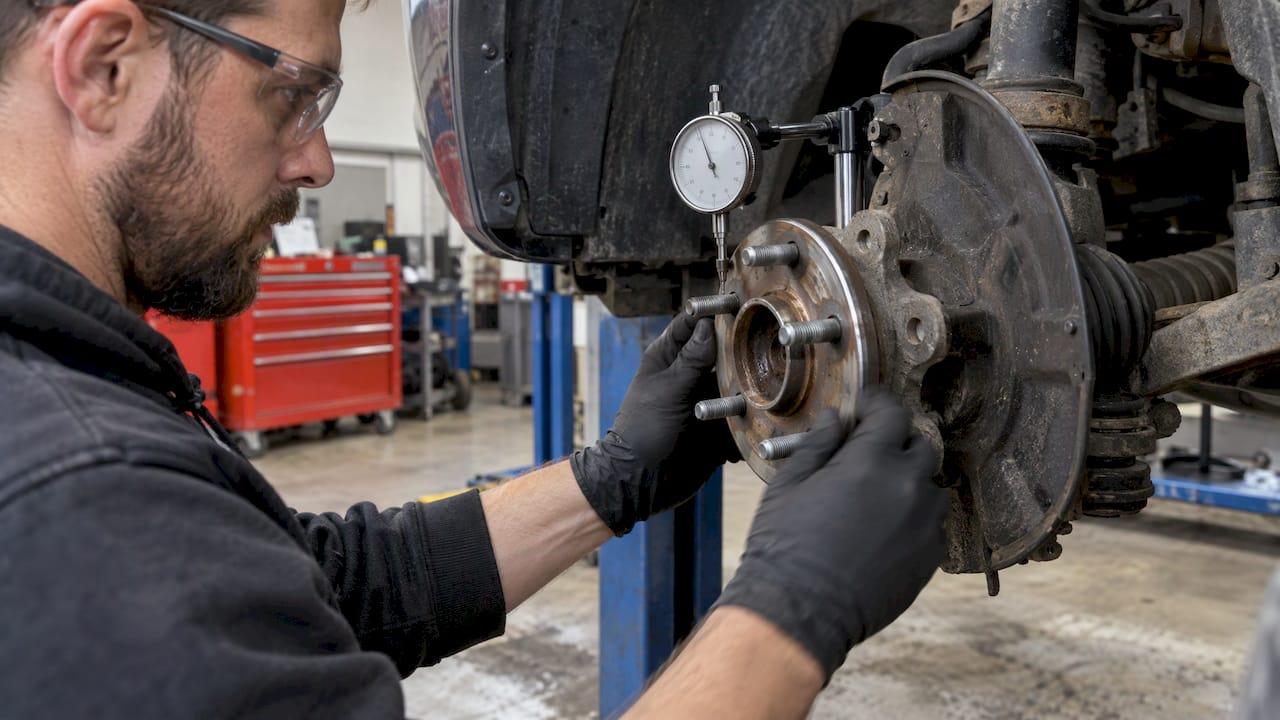
Hub runout is wobble in the wheel hub flange, the flat face the rotor bolts to. The main causes are impacts such as curb strikes and potholes, over-torqued hub or bearing hardware, rust between rotor and flange, a worn wheel bearing, and uneven lug nut torque. The rotor magnifies the wobble, so a small hub error becomes a brake pulsation that a new rotor alone does not fix. DBC Brakes supplies wheel bearings and hubs and engineered rotors for Canadian vehicles, so the hub and the rotor can be handled as one job.
TL;DR
- Hub runout is wobble at the flange where the rotor mounts. A tiny amount at the flange grows at the rotor face.
- Common causes: impacts, over-torque, corrosion on the mating surface, worn bearings, uneven lug nut torque.
- The result is uneven pad contact, thickness variation in the rotor, and a pulsing pedal or steering wheel.
- Pulsation that returns after new rotors points to the hub, not the rotor.
- Measure with a dial indicator. Replace the hub or bearing unit when the reading cannot be brought into spec.
Table of Contents
- What hub runout is
- The main causes of hub runout
- Why a small hub error becomes a pulsing pedal
- Signs the hub or bearing is involved
- How to measure hub runout
- When to replace the hub or bearing
- Safety: when a hub problem stops being a comfort issue
- Prevention
- Perspective
- Replacing the hub and rotors together
- FAQ
- Sources
What hub runout is
Runout is how far a surface moves side to side while it turns. A flat flange spins in one plane. A flange with runout wobbles slightly, like a coin spinning off-level.
Two measurements matter:
- Hub flange runout. Measured near the outer edge of the cleaned flange.
- Rotor (disc) runout. Measured on the rotor face, about 0.5 in. (13 mm) from its edge.
The two are linked. MOTOR states that 0.0005 in. at the flange can result in 0.001 in. at the disc. Flange and disc tolerances can also stack. A rotor that reads out of spec may be fine itself and simply sit on a bad flange.
Tomorrow's Technician reports that most rotors are made with 0.0005 to 0.001 in. of lateral runout, and that most hubs should have less than 0.002 in. A rotor and hub that are each in tolerance can still add up to a problem.
The main causes of hub runout
Curb strikes and pothole impacts
A hard hit can bend the flange or damage the bearing seat. The wheel still turns, so the damage is easy to miss. The only sign may be a vibration under braking weeks later. Canadian roads in late winter, with frost heave and potholes, give this cause plenty of opportunity.
Over-torqued hubs and bearings
Too much torque on the axle nut or hub hardware can distort the flange. Tomorrow's Technician reports that damage from an over-torqued hub or bearing is permanent. Re-torquing the axle nut does not correct it. Most flange runout specifications fall between 0.0015 in. and zero, and many manufacturers now specify zero runout and zero end play.
Rust and pitting where the rotor meets the flange
Scale between the rotor hat and the flange holds the rotor off-plane. Brake & Frontend states that pitting and corrosion at this joint can induce runout. If the corrosion is too great, the flange or bearing should be replaced. Road salt keeps this joint wet and corroding through a Canadian winter. See the guide on rust on brake rotors to tell surface film from real damage.
The same article notes that cutting too much material off a rotor on an on-car lathe to compensate for runout can leave the rotor thermally unbalanced.
Worn or loose wheel bearings
A bearing with play lets the hub move on its axis. Brake & Frontend lists wheel-bearing runout among the root causes of rotor runout. Bearing play also shows up as end play, which is movement along the axle when the wheel is pushed and pulled.
Uneven or excessive lug nut torque
Lug nuts tightened in the wrong order, or with an impact gun and no torque stick, can distort the rotor hat and the flange. The same source lists uneven lug-nut torque and wheel loading distortions among the root causes. The fix is a hand-torqued star pattern to the vehicle's specification.
Poor resurfacing and manufacturing tolerance
Sloppy rotor resurfacing and ordinary manufacturing variation are also on that list. Factory specs have tightened over 30 years from as high as 0.015 in. to 0.000 in. on some vehicles, per the same Brake & Frontend article. Tight tolerances leave little room for error anywhere in the stack.
Why a small hub error becomes a pulsing pedal
The rotor is much larger than the flange. Any wobble at the centre grows toward the edge. Brake & Frontend gives an example: 0.001 in. of flange runout on a 10-inch rotor can yield 0.003 in. of total runout.
The same article works out what happens next. On 205/55R16 tires, the high spot passes the caliper about 836 times per mile, and over 5 million times in 6,000 miles. At each pass the pad drags a little harder on that spot. Over time pad material transfers unevenly and the rotor wears into a thicker and thinner pattern. This is disc thickness variation.
That is the real story behind most "warped rotor" complaints. Chris Crowell of Brake & Frontend explains that a rotor running out of spec cannot receive even pad friction, so the rotor becomes thicker in spots. The root cause is lateral runout, not heat warping. A related DBC guide covers the rotor warping myth.
The amounts are small. A paper from the PHM Society reports that thickness variation above about 20 micrometers (0.0008 in.) creates noticeable judder for an experienced driver.

Signs the hub or bearing is involved
The symptoms overlap with other brake problems. These point toward the hub side:
- Pulsation returns after new rotors and pads.
- Pulsation comes back within a few thousand kilometres.
- A hum or growl that changes with speed.
- Looseness or play when the wheel is rocked by hand.
- The vehicle pulls to one side when braking.
A pad change can also cause pulsation. See brake pulsation after a pad change to rule that out first.
What the Canadian inspection standard rejects
The Vehicle Inspection Manual 2025 rejects hubs that are bent, broken, cracked, damaged or distorted. It also rejects a loose bearing cup or enlarged or damaged stud holes. Without an OEM or industry standard, axial end play below 0.02 mm (0.001 in.) or above 0.13 mm (0.005 in.), or binding or roughness when the bearing turns, is a reject.
How to measure hub runout
A dial indicator gives a number. The steps are short:
- Clean the surface. Wire-brush the flange. MOTOR says to clean it before measuring. Rust left on the face gives a false reading.
- Mount the indicator. Fix it to a stationary point such as the strut or caliper bracket.
- Position the plunger. Put it near the outer edge of the flange, perpendicular to the machined surface.
- Turn the hub slowly. Note the high and low readings. The difference is the runout.
- Compare with the specification. Use the vehicle manufacturer's figure when it exists.
MOTOR treats flange runout above 0.002 in. as needing corrective action. For the rotor face, Vehicle Service Pros gives a rule of thumb of 0.001 to 0.002 in. maximum for most applications.
When the rotor is mounted, all wheel fasteners must be installed and fully torqued before measuring. Using only two or three can produce a falsely high reading, according to Vehicle Service Pros. DBC's guide on accurate rotor runout measurement covers the rotor side in more detail.
Worked example
A driver replaces rotors and pads, and the pedal pulses again after a few months. The dial indicator reads 0.004 in. at the flange. That is above the 0.002 in. action level and above the 0.0015 in. ceiling of most flange specs. Cleaning the flange and re-torquing does not bring it down. The flange is damaged, so the hub or bearing unit is replaced before the next rotors go on.
MOTOR adds that bearing end play over 0.004 in. on a dial indicator makes the bearing suspect. Flange runout above 0.005 in. cannot be corrected by shimming, because the disc, shim and flange combination could prevent the disc from turning freely. At that point replacement is the route.

When to replace the hub or bearing
Replace the hub or bearing unit when:
- Runout stays above spec after cleaning rust and checking torque.
- The flange is bent or has damaged stud holes.
- End play falls outside the inspection limits above.
- The bearing is rough, loose or noisy.
Surface rust that cleans off is a different case. Pitting that cannot be cleaned off is not.
Safety: when a hub problem stops being a comfort issue
A pulsing pedal is a nuisance. A failing bearing can be a hazard. SAAQ Québec says any lubricant trace on the wheel hub means the bearings may be under-lubricated and the vehicle is not safe to drive. Other signs it lists are a burnt smell, smoke from inside the wheel, and strong heat near a wheel. In extreme cases defective bearings can lead to wheel separation.
A vehicle with these signs should not be driven. Loud grinding, steering looseness, an ABS light with wheel noise or a tilted wheel call for stopping and having a licensed mechanic inspect it. A vehicle with a mild hum and no play can be booked in for service.
Prevention
Most hub runout causes can be avoided at installation:
- Clean the flange and the rotor hat contact area every time a rotor comes off.
- Torque lug nuts by hand in a star pattern to the specified value.
- Torque axle nuts and hub hardware to specification, never past it.
- Inspect the flange after any hard impact.
- Measure runout at each brake job, not only when pulsation appears.
The guide on preventing rotor warping lists habits that apply here too.
Perspective
Most complaints about brake pulsation reach us as a rotor problem. Often the rotor is the visible part, not the cause. A rotor can only be as true as the surface it sits on.
Our cross-drilled rotors are engineered to prevent warping and to hold up in use. A hub flange with runout still shows up in the pedal. For that reason, we treat the hub, the bearing and the rotor as one system. A flange measured and found in spec gives a rotor a fair start.
We also sell wheel bearings and hubs next to rotors, pads and kits. A customer fixing a pulsation problem can order the hub-side part and the rotors in one checkout. Pricing is inclusive, with no hidden fees, and our support team answers questions with real people, not automated replies.
Sam
Replacing the hub and rotors together
When the measurement says the hub is the cause, the repair has two parts: the hub or bearing, then the rotors. DBC offers wheel bearings and hubs, brake rotors and brake kits for cars, trucks and performance vehicles. Fitment is guaranteed, and the vehicle can be selected by make on the make page.
DBC is a Canadian manufacturer. Orders over $100 ship free within Canada. Expedited Shipping is $29.99 per order. International Shipping is $129.99 per brake kit. Details are on the shipping information page.
For a vehicle that needs a full refresh, the Performance XDB, Premium Black Kote and Performance SS lines are listed on the home page. Rotors and pads come in matched sets, and the guide on matching pads and rotors explains why that matters for judder.
FAQ
What causes hub runout?
The common causes are impacts from curbs and potholes, over-torqued hub or bearing hardware, rust or pitting between rotor and flange, a worn wheel bearing and uneven lug nut torque. Poor resurfacing and manufacturing tolerance also contribute. Any of them can leave the flange out of plane.
How much hub runout is too much?
MOTOR treats flange runout above 0.002 in. (about 0.05 mm) as needing corrective action. Many manufacturers specify zero or near-zero runout, so the vehicle's own specification comes first. Rotor face runout is usually held to 0.001 to 0.002 in.
Can hub runout cause brake pulsation after new rotors?
Yes. A flange that wobbles makes the new rotor wobble too, and the rotor magnifies it. Uneven pad contact then builds thickness variation, and the pulsation returns. Measure the flange before the next set of rotors goes on.
Is it safe to drive with a bad hub or wheel bearing?
It depends on the symptoms. A mild hum with no play can wait for a booked repair. Grinding, looseness, heat, a burnt smell or lubricant on the hub means the vehicle should not be driven, per SAAQ guidance. Have a licensed mechanic inspect it.
Sources
- Brake Shop: Measuring Brake Discs & Hub Flanges, MOTOR
- Brake Rotor Specs: Measurement and Service Techniques, Tomorrow's Technician
- Torque and Runout: Measure Twice, Install Once, Tomorrow's Technician
- When Should the Wheel Bearing Flange Be Replaced?, Brake & Frontend
- Warped Rotors: Service Brakes, Runout, Disc Thickness, Brake & Frontend
- Why Do Some Bearings Rarely Fail, Brake & Frontend
- Health Indicators to Estimate Brake Rotor Thickness, PHM Society
- Brake Rotor Runout, Vehicle Service Pros
- Vehicle Inspection Manual 2025
- Wheel loss due to faulty bearings, SAAQ