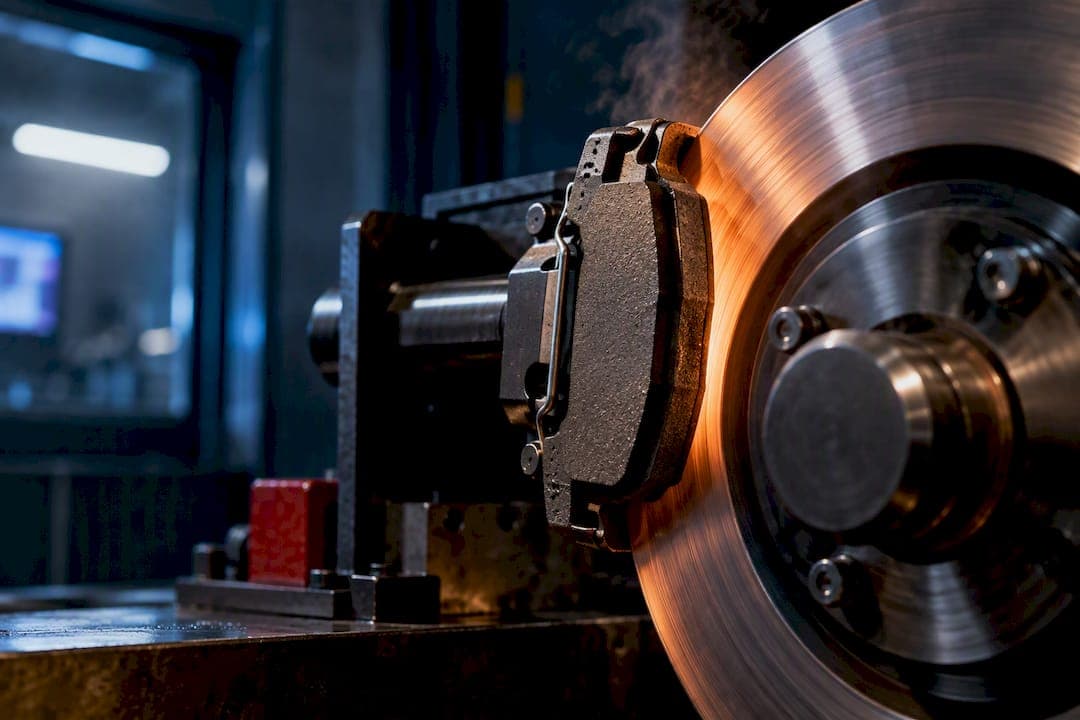
Ceramic pads handle high heat well within the limits their manufacturer actually tested, but there's no single safe number to memorize. Automotive friction pads and industrial ceramic heating elements use completely different ratings for completely different jobs. The reliable answers come from SAE J2522 friction data and SAE J160 swell testing, not a headline temperature on a box.
TL;DR:
- Ceramic brake pads typically maintain stable friction within a broad temperature range, but fade can occur during sustained heavy or repeated braking.
- Industrial ceramic heating elements rated around 800 to 1,200°C are not indicative of a brake pad’s heat handling capacity, as they measure different properties.
- A pad's real-world heat tolerance depends on factors like formulation, rotor size, ventilation, and how well it is bedded, rather than just its datasheet maximum temperature.
- SAE J2522 and SAE J160 testing provide detailed friction curves and swell data; single temperature ratings without supporting test data are unreliable for assessing heat performance.
- For accurate evaluation, request full test curves, confirm proper bedding, and consider your vehicle's duty cycle rather than relying solely on marketing claims.
Table of Contents
- What "heat tolerance" actually means for ceramic pads
- How hot do ceramic pads actually get in real use?
- What changes a ceramic pad's real-world heat tolerance
- What SAE J2522 and SAE J160 actually measure
- Fade, wear, and what to actually check on your vehicle
- Why heating-element ratings don't apply to brake pads
- What to ask suppliers before you buy
- Our take on reading heat-tolerance claims
- Editorial takeaway: matching pads to duty, not to marketing
- Where to find tested ceramic pads with real support behind them
- Sources
- FAQ
What "heat tolerance" actually means for ceramic pads
Heat tolerance isn't one property. It's a bundle of behaviours that all shift as temperature climbs, and a pad can pass on one measure while failing another.
Friction stability describes whether a pad grips the rotor consistently as things get hot. Fade is what happens when that friction drops off, usually under heavy braking or repeated hard stops. Thermal swell and hot compressibility describe how much the pad material grows and softens under heat, which affects pedal feel and stopping distance. The backing plate and the adhesive bonding the friction material to it have their own separate temperature ceilings.
This matters more once you compare product categories:
- Automotive friction pads get evaluated on friction-versus-temperature curves under SAE J2522, plus swell and compressibility under SAE J160.
- Industrial ceramic heating elements get rated on a completely different scale, often cited around 800 to 1,200°C for certain designs.
- A heater element's temperature rating tells you nothing about how a brake pad performs under braking loads, torque, and vibration.
The confusion happens because both products use the word "ceramic" and both get marketed with a maximum temperature. They're not measuring the same thing, and treating one rating as proof of the other is where a lot of buying decisions go wrong.
How hot do ceramic pads actually get in real use?
Most genuine ceramic composite friction materials hold stable friction through a broad mid-range of braking temperatures, with fade typically showing up only under sustained heavy-duty cycles like towing, mountain descents, or repeated track laps. That's a qualitative pattern seen across dynamometer testing, not a fixed threshold, because rotor mass, cooling airflow, and pad formulation all shift where fade actually starts.
Here's the number that trips people up: some flexible ceramic heating elements carry documented ratings of roughly 800 to 1,200°C for specific industrial designs. That figure describes a heater element's wire and bead construction, not a brake pad's friction surface, and it should never be quoted as evidence for how a brake pad handles heat.
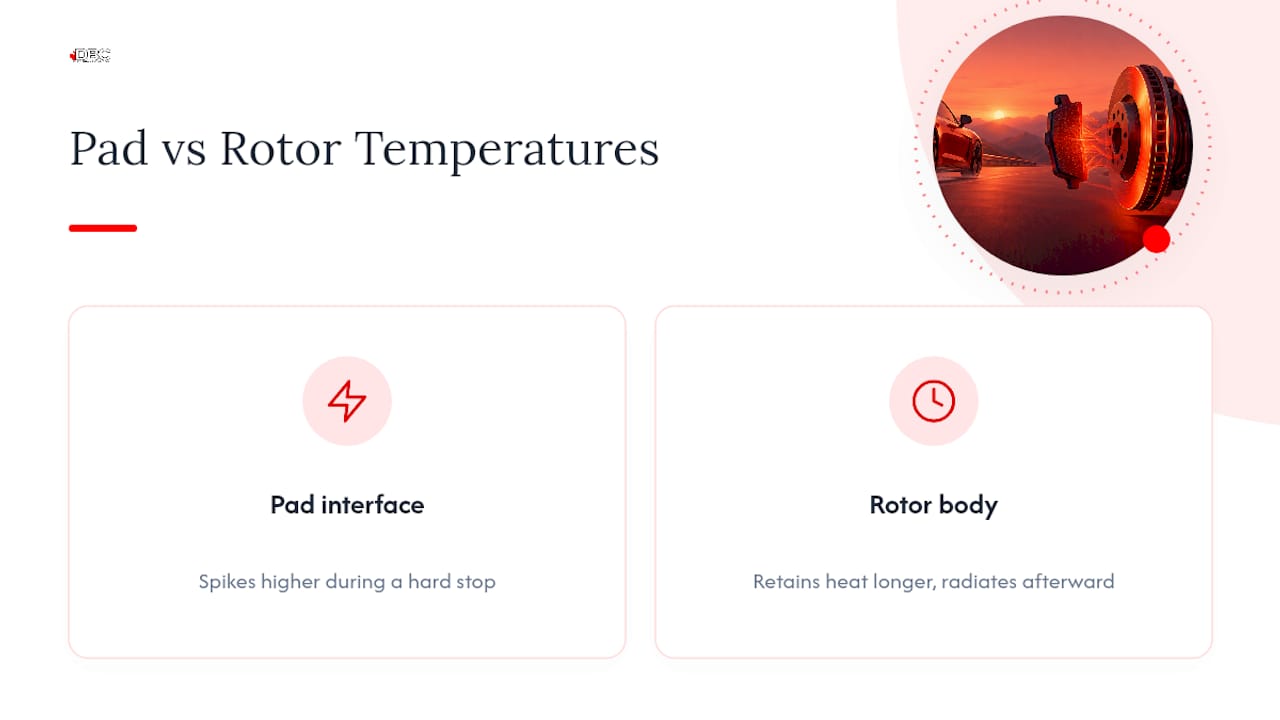
The other detail worth knowing: pad interface temperature and rotor temperature are not the same reading. The friction surface can spike higher than the rotor body during a hard stop, then the rotor holds heat longer afterward as it radiates it away. Testing under SAE J160 treats these as separate measurements because they behave differently, and a supplier who quotes only one number is telling you half the story.
What changes a ceramic pad's real-world heat tolerance
The formulation on the datasheet is the starting point, not the answer. A pad's actual heat tolerance in your vehicle depends on several variables working together, and any one of them can undercut a pad that tested well on a bench.
- Formulation and fillers: the ceramic fibres and binding agents determine how well the pad conducts heat away from the friction surface and how long it holds friction as temperature rises.
- Rotor mass and ventilation: a larger, better-vented rotor pulls heat away faster, which keeps the pad interface cooler for longer under the same driving.
- Caliper heat soak and fluid condition: heat migrates into the caliper and brake fluid over a long descent or a track session, and degraded fluid boils at a lower temperature than fresh fluid.
- Pad thickness and bedding quality: a properly bedded pad transfers friction material evenly onto the rotor, while a poorly bedded one develops hot spots that accelerate fade.
- Duty cycle: towing, aggressive driving, and track days push heat into the system far faster than daily commuting ever will.
Pro Tip: Bedding is the one variable almost every driver skips, and it's the cheapest fix available. A pad that never gets bedded properly will fade sooner than an identical pad that went through a proper bedding procedure, because the friction material hasn't transferred evenly onto the rotor surface yet.
What SAE J2522 and SAE J160 actually measure
Two standards do the heavy lifting when it comes to verifying ceramic pad heat performance, and neither one produces a single maximum-temperature figure.
- SAE J2522 runs an inertia-dynamometer test that cycles the pad through defined pressure, temperature, and speed combinations, then reports friction-versus-temperature curves showing where friction stays flat and where it drops.
- SAE J160 measures thermal swell, growth, and hot compressibility, with Method A applying heat directly to the pad material to track how much it grows or softens at elevated temperatures.
If you're evaluating a pad, ask the supplier for the actual outputs behind these tests: the friction-versus-temperature curve itself, the temperature range where friction stays within a defined band, the hot compressibility percentage at peak test temperature, and the thickness change recorded during swell testing. A single "rated to X degrees" claim, with no curve or test schedule behind it, tells you almost nothing.
Fade, wear, and what to actually check on your vehicle
Fade shows up as a soft or sinking pedal under repeated hard braking, with stopping distance quietly growing longer even though your foot pressure hasn't changed. That's different from glazing, which leaves a hard, shiny surface on the pad from overheating without enough cooling recovery time, and different again from a hydraulic problem, which usually shows up as a spongy pedal that doesn't improve as speed drops.
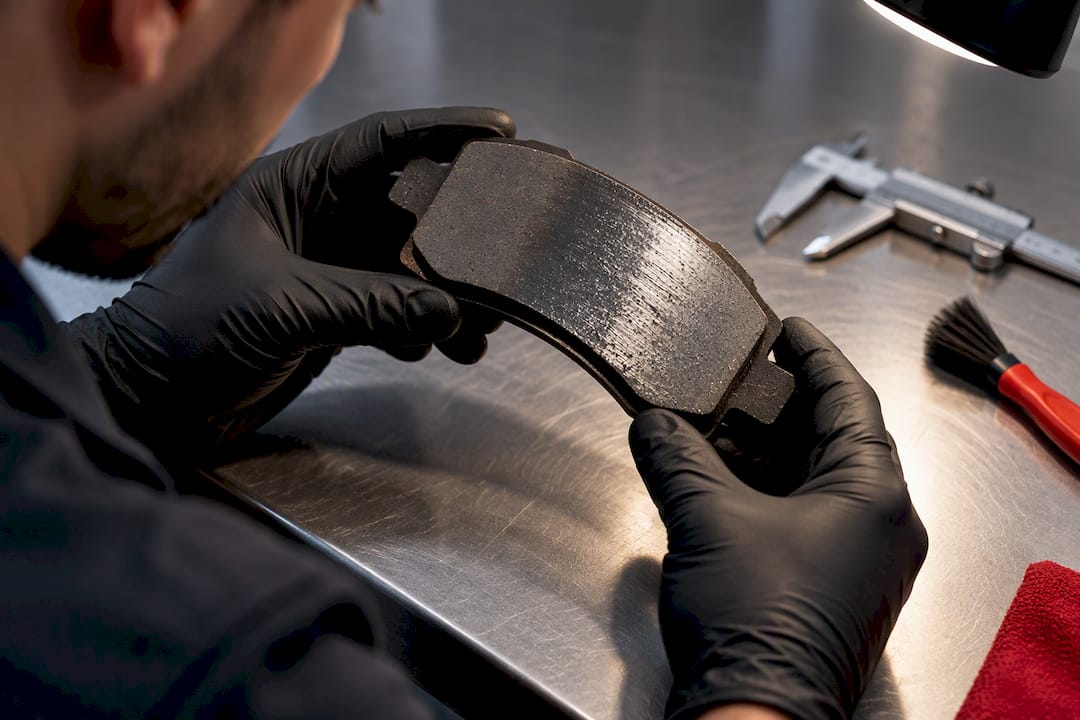
Genuine ceramic composite pads generally produce lower wear and less noise than semi-metallic pads under standard dynamometer testing, but that comes with a trade-off. Because ceramic material absorbs less heat than some metallic compounds, more of that heat passes into the rotor and the rest of the braking system rather than staying in the pad itself.
Practical checks worth running:
- Confirm bedding was done correctly using a documented partial-stop procedure before judging pad performance.
- Check brake fluid condition and age, since moisture content lowers the boiling point over time.
- Inspect hardware torque and pad thickness at regular intervals, especially after towing or track use.
Pro Tip: If a pad feels fine cold but fades noticeably on the second or third hard stop in a row, that's a strong sign of heat buildup rather than a defective pad. Check for glazing before assuming the pad itself is bad.
Why heating-element ratings don't apply to brake pads
Datasheets for industrial ceramic heating elements sometimes list very specific lifecycle limits, like a documented 50 uses at 1,050°C before a specially supplied variant is needed to reach 1,200°C. That number describes bead and wire construction inside a heater assembly built for a fixed number of high-temperature cycles, not a rotating friction surface under braking load.
A brake pad and a heating element share a material category and nothing else. One gets rated for how many times it can survive an extreme temperature cycle in a stationary application; the other gets rated for how consistently it grips a moving rotor across thousands of stops. Match the product type to the job, and don't let one rating number borrow credibility from the other.
What to ask suppliers before you buy
A pad's marketing copy will always sound confident. The test data behind it is what actually tells you whether it fits your driving.
- Request the full friction-versus-temperature curve from SAE J2522 testing, not just a summary line.
- Ask for hot compressibility and thermal swell figures from SAE J160 Method A testing, including the temperature at which they were recorded.
- Confirm the backing plate and adhesive limits specific to that pad assembly, since these often fail before the friction material does.
- Ask whether the pad was validated for your use case, whether that's towing, commuting, or track sessions, and what bedding procedure the manufacturer recommends.
- Check the warranty language around heat-related failures, since some warranties exclude fade or glazing outright.
Once you have that data, match pad chemistry to your actual duty cycle rather than the highest-sounding number on the page. A ceramic pad tuned for daily commuting won't necessarily hold up on a mountain pass with a loaded trailer, and no amount of marketing changes that.
Our take on reading heat-tolerance claims
DBC Brakes builds its premium ceramic pad lines around this same principle: verified test data matters more than a single advertised number. Every duty cycle puts different demands on a pad, so matching pad chemistry to how the vehicle actually gets driven produces better results than chasing the highest temperature rating on a spec sheet.
Customers researching ceramic pad options get access to knowledgeable support rather than automated replies, along with resources like the bedding-in guide and the pad-selection checklist for matching pad type to driving style. DBC Brakes also sells engineered cross-drilled rotors designed to manage heat as part of the full braking system, not just the pad in isolation.
Editorial takeaway: matching pads to duty, not to marketing
Ceramic pads suit most daily driving and moderate performance use well, especially where low dust and quiet operation matter. Towing, aggressive track use, and very cold climates deserve a harder look at semi-metallic alternatives, since ceramic's lower heat absorption pushes more heat into the rotor under sustained heavy loads. The smarter move is always asking for the friction curve and the swell data before assuming a headline number tells the whole story.
— Sam
Where to find tested ceramic pads with real support behind them
DBC Brakes gives Canadian drivers something most brake retailers don't: engineered kits backed by transparent pricing, with no hidden fees added at checkout. Every kit ships with guaranteed fitment information up front, and orders over $100 get free shipping across Canada, so you're not stacking a shipping surprise on top of a heat-performance decision you already spent time researching.
If you've read this far, you already know a pad's real heat performance shows up in test curves, not marketing copy. DBC Brakes carries Performance XDB, Premium Black Kote, and Performance SS kits built around that same standard, paired with cross-drilled rotors engineered to manage heat across the whole braking system rather than the pad alone. Browse the premium ceramic pad collection, check fitment for your vehicle, and talk to a real person on the support line before you commit to a set.
Sources
For deeper technical grounding, review SAE J2522 for friction-versus-temperature methodology and SAE J160 for thermal swell and hot compressibility testing. The SAE paper on genuine ceramic pad formulations covers material science in more depth, and drivers dealing with brake dust on wheels can also check this guide to protecting alloy wheels.
- J2522_202312: Inertia Dynamometer Disc and Drum Brake Effectiveness Test Procedure - Recommended Practice
- J160_202505: Thermal Swell, Growth, and Hot Compressibility of Brake Friction Materials and Noise Insulators - Technical Standard
- Flexible ceramic heating elements — Cooper Heat Equipment product pages
- What's the difference between ceramic & metallic brake pads? — Bridgestone
FAQ
Can ceramic withstand high heat?
Ceramic friction pads handle high heat well within the range covered by their SAE J2522 test data, but "high heat" means different things for brake pads versus industrial heating elements. Always check the friction-versus-temperature curve rather than relying on a single advertised number.
What's the downside of ceramic brake pads?
Ceramic pads absorb less heat than some metallic compounds, so more heat passes into the rotor and braking system during sustained heavy use, according to Bridgestone. That makes them less ideal for extreme towing, aggressive track sessions, or very cold climates compared to some semi-metallic alternatives.
What is the maximum temperature carbon ceramic brakes can handle?
There's no single agreed maximum figure, because carbon ceramic performance is reported through friction-versus-temperature curves and hot compressibility data under SAE J160 rather than one number. The relevant question is where friction stays stable across a defined test cycle, not what ceiling the material technically survives once.
What is the maximum temperature a brake pad can reach?
Pad interface temperature can spike well above rotor temperature during hard braking, since the two are measured separately under SAE J160 testing. The exact figure depends on pad formulation, rotor mass, cooling, and how the vehicle is driven, which is why test curves matter more than a single quoted maximum.