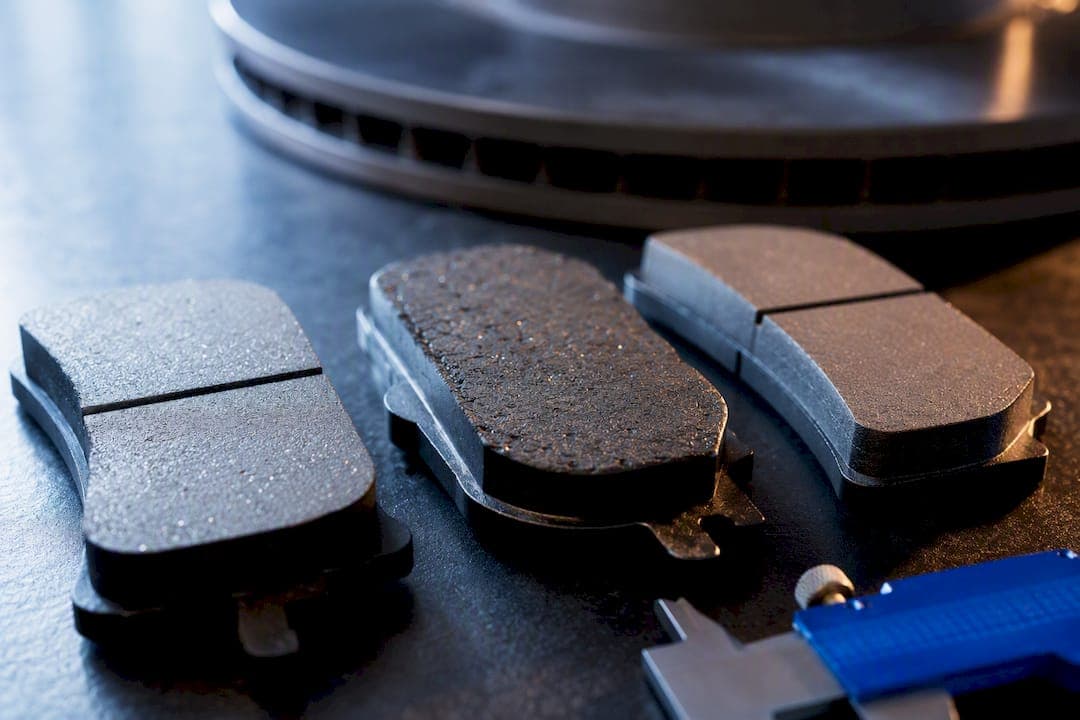
Commuters and family drivers get the longest life and quietest ride from ceramic pads. Towing, hauling, or performance driving calls for semi-metallic pads and their higher heat tolerance. Occasional, low-stress driving on a budget suits organic pads best. Whichever type fits your profile, confirm fitment and check rotor condition before you order.
TL;DR:
- Choosing the right brake pads depends on your driving profile, with ceramic suited for daily commuting, semi-metallic for towing or performance, and organic for light use.
- Confirm fitment and inspect rotors before installing new pads, as mismatched parts or worn rotors can cause noise, vibration, and uneven wear.
- Brake pad performance is primarily determined by heat resistance, initial bite, wear life, dust and noise output, and accurate friction ratings using edge codes.
- Pad material influences how electronic systems like ABS respond, so sticking to OEM friction categories ensures predictable feedback without affecting safety functions.
- Long-term costs favor ceramic pads for most drivers, but semi-metallic pads are essential for high-heat applications, and eco-friendly options focus on dust reduction and longer service life.
Table of Contents
- How to choose brake pads: what they are and how they work
- What makes a good brake pad?
- Ceramic, semi-metallic, or organic: which pad material wins?
- Matching pad type to your driving profile
- Fitment, rotors, and a pre-order checklist
- When to replace pads and how to bed them in
- What DBC Brakes' engineering means for your pad decision
- Do brake pads affect ABS and electronic brake control?
- What safety certifications should you look for in brake pads?
- Are ceramic, semi-metallic, or organic pads the better value?
- Are there eco-friendly brake pad options?
- Author perspective: Sam's short rule of thumb
- DBC Brakes options that match your driving profile
- Sources
- FAQ
How to choose brake pads: what they are and how they work
A brake pad has two parts: a steel backing plate and a friction material bonded to it. That friction material presses against the rotor when you brake, converting motion into heat through friction. The pad sits inside the caliper, and the caliper clamps it against the rotor every time you press the pedal.
That friction generates both heat and dust, and the amount of each depends on the material. Rotors take the same punishment pads do, just in a different way: they absorb heat and develop wear grooves that match whatever pad has been riding against them.
- The backing plate provides structure; the friction compound provides stopping power.
- Heat and dust output vary by material, not by brand alone.
- Pads and rotors wear as a matched pair, so a full brake job usually means looking at both.
Because pads and rotors condition each other over time, a new set of pads on badly worn rotors will not perform the way the pad was designed to.
What makes a good brake pad?
Four measurable factors separate a good pad from a mediocre one, and none of them are marketing claims. Heat resistance and fade resistance determine whether your brakes stay firm on a long downhill grade or a hot track lap, or whether the pedal goes soft when the pads overheat. Initial bite is how quickly the pad grabs once you press the pedal, which matters most in emergency stops.
Wear life and rotor friendliness go together. A pad that eats through itself quickly is usually also harder on the rotor surface it rides against. Noise and dust affect daily comfort and wheel cleanliness more than safety, but they're still a legitimate buying factor for anyone who details their car.
Fitment accuracy rounds out the list, and it's the one buyers skip most often. Every pad carries an edge code, a friction rating stamped into the backing plate that tells you how the compound performs at standard and hot temperatures. Edge codes give buyers a quantifiable way to match a pad's friction behaviour to their driving needs instead of guessing from a product description.
- Heat and fade resistance under sustained braking
- Initial bite and pedal feel
- Wear life measured against rotor wear
- Noise and dust output
- Edge code and friction rating accuracy for your intended use
Pro Tip: Check the edge code stamped on the pad's backing plate before buying. Two pads from the same "performance" category can carry very different hot-friction ratings.
Ceramic, semi-metallic, or organic: which pad material wins?
Every brake pad on the market falls into one of three friction categories, and each one trades off differently between quiet operation, heat tolerance, and cost.
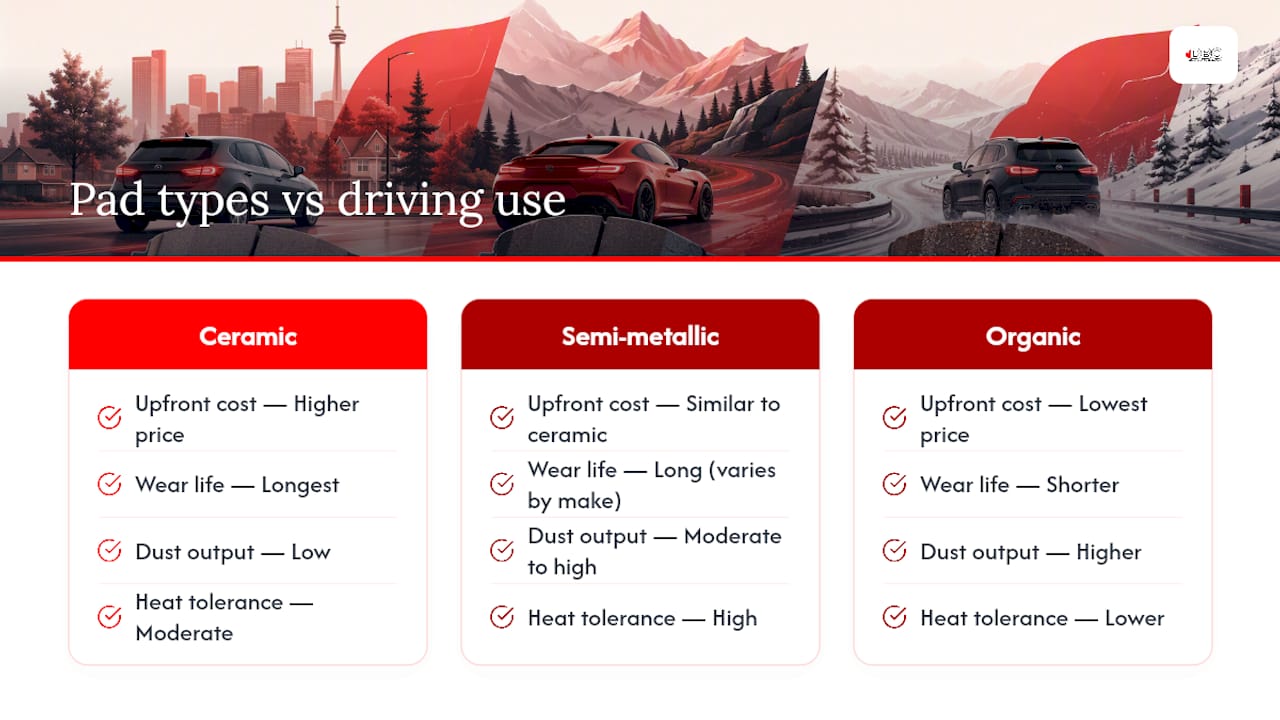
- Ceramic pads. Ceramic pads run quiet, produce little visible dust, and hold up over a long service life, making them the default choice for most daily drivers. Their weak point is cold bite: in freezing temperatures, ceramic compounds can feel less responsive until they warm up, and they're not built for sustained heavy towing.
- Semi-metallic pads. Semi-metallic pads deliver strong initial bite and higher heat tolerance, which is why they're the go-to for towing, heavy loads, and performance driving. The trade-off is dust and rotor wear. They produce darker dust that clings more visibly to wheels than ceramic dust does, and the harder compound can accelerate rotor wear over time.
- Organic (NAO) pads. Organic pads run quiet and treat rotors gently, but they wear faster and carry lower heat resistance, so they fit light, low-stress driving best rather than anything demanding.
A commuter doing mostly city driving in moderate weather will rarely notice ceramic's cold-bite weakness. A pickup owner towing a trailer every weekend will notice semi-metallic dust on their wheels, but they'll also notice the pedal stays firm on a long grade. An older sedan used a few times a week for errands is a reasonable candidate for organic pads, since the lighter load rarely stresses the compound.
Matching pad type to your driving profile
Your daily routine tells you more about the right pad than any spec sheet does. Here's how the main profiles break down.
- Daily commuting and family driving: quiet operation, low dust, and long service life matter most. Ceramic pads are the practical fit here, and they handle stop-and-go traffic without excess brake dust on your wheels.
- Performance driving and occasional track use: you need consistent bite under repeated hard stops and resistance to fade when the rotors get hot. Semi-metallic pads, or a track-oriented ceramic blend, handle that heat load better than a standard commuter pad.
- Towing, heavy loads, and fleet use: sustained heat tolerance under load is non-negotiable. Semi-metallic pads are built for this kind of continuous stress and hold up where a lighter compound would fade.
Mileage pattern shifts the calculation too. Mostly highway driving with light braking is gentler on any pad material. Heavy city driving with constant stop-and-go wears pads faster regardless of type, which pushes the case toward a longer-life ceramic compound even for drivers who don't tow or race.
Pro Tip: If your driving splits evenly between city commuting and occasional trailer hauling, don't split the difference with a "do everything" pad. Pick semi-metallic and accept the extra dust, since heat tolerance under load protects you more than quiet operation does.
Fitment, rotors, and a pre-order checklist
Getting the wrong pad because you skipped the fitment step is the most common and most preventable mistake. Confirm your make, model, and year against the manufacturer's fitment chart, and check the pad's part number or edge code against what your caliper actually takes. A brake kit compatibility check before ordering saves a return shipment and a delayed repair.
Rotor condition matters just as much as the pad you pick. Installing new pads on worn, grooved, or warped rotors causes noise, vibration, and uneven wear, and shortens the life of the new pads. Inspect the rotor surface for deep grooves or visible warping, and decide whether resurfacing or full replacement makes more sense before the new pads go in.
- Confirm make, model, year, and pad code against the manufacturer's fitment chart.
- Inspect rotors for grooves, lip buildup, or warping.
- Resurface lightly worn rotors; replace rotors that are grooved, cracked, or below minimum thickness.
- Browse brake rotors built to pair with new pad sets if your rotors need replacing anyway.
When to replace pads and how to bed them in
Watch the pad thickness, not just the mileage on your last service.
- Replace around 3 mm of remaining friction material. Waiting until pads reach bare metal risks rotor damage and a much more expensive repair, so treat 3 mm as your practical trigger point rather than the absolute minimum.
- Watch for warning signs between inspections. Squealing, grinding, a soft or sinking pedal, or the car pulling to one side under braking all point to pads that need attention now, not at the next scheduled service.
- Bed in every new pad set. A short, controlled bedding procedure improves the pad's initial contact surface and reduces uneven early wear, and skipping it is one of the most common reasons new pads underperform in the first few hundred kilometres.
- Keep dust and buildup down between services. Regular wheel cleaning limits dust buildup near the caliper and makes wear inspections easier to read at a glance.
For the full step-by-step version of the bedding process, including how many partial stops to run and at what speed, the detailed bedding procedure walks through it in order.
What DBC Brakes' engineering means for your pad decision
DBC Brakes builds cross-drilled rotors engineered to resist warping, which matters because a pad performs only as well as the rotor surface it rides against. Pricing includes no hidden fees, and orders over $100 ship free within Canada. Customer support comes from people who know the products, not a script, which counts for a lot when you're trying to confirm fitment before you order.
Do brake pads affect ABS and electronic brake control?
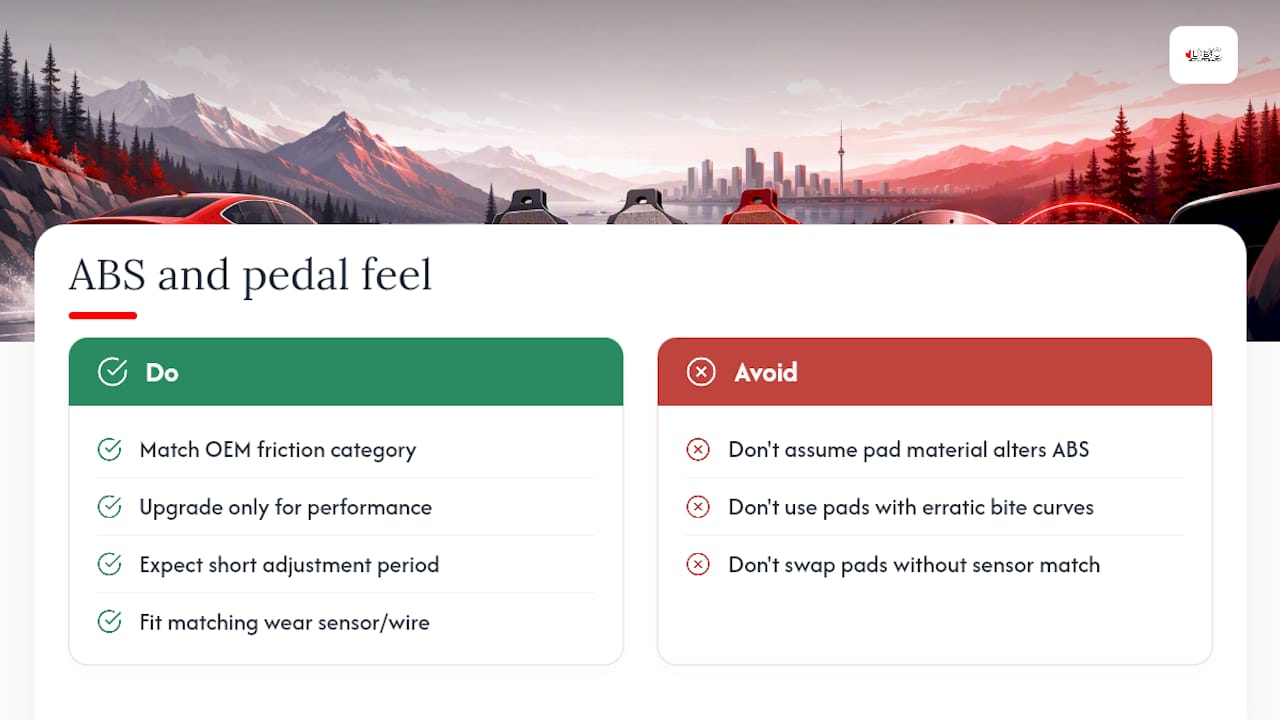
Brake pad material doesn't interfere with how ABS or electronic brake-force distribution (EBD) systems function, but pad behaviour does affect how those systems feel to the driver. ABS relies on wheel-speed sensors and a consistent, predictable friction response to modulate braking during a skid. A pad with an erratic or unpredictable bite curve, common in poorly manufactured aftermarket compounds, can make ABS engagement feel grabbier or less smooth than the vehicle's original pads did, even though the electronics themselves are unaffected.
Electronic brake control systems, including electronic parking brakes and brake-by-wire assist features on newer vehicles, are calibrated around the factory pad's friction profile during initial vehicle development. Switching to a pad with a significantly different friction rating, particularly a jump from organic to an aggressive semi-metallic compound, can shift how quickly the system perceives braking force being applied. This rarely causes a fault code, but it can change pedal feel enough that some drivers notice a firmer or softer initial response.
The practical takeaway is straightforward: stick with a pad that matches the OEM friction category for your vehicle unless you're deliberately upgrading for performance, and if you do upgrade, expect a short adjustment period as you get used to the new bite characteristics. None of this affects the safety function of ABS or EBD. It only affects how the pedal communicates with you. If your vehicle has a brake-pad wear sensor built into the caliper hardware, make sure the replacement pad set includes a matching sensor or wire, since a mismatched sensor is a common reason dashboard warning lights stay on after a pad swap.
What safety certifications should you look for in brake pads?
Two certification marks carry real weight when you're comparing pads: the edge code and regional emissions or asbestos-free compliance markings. The edge code, stamped directly into the pad's backing plate, is a standardized friction rating that shows how the compound performs at normal and elevated temperatures. It's not a marketing badge. It's a manufacturer-tested number you can compare directly between competing pads.
Beyond the edge code, look for confirmation that the pad meets applicable regional friction material regulations, which in North America generally means compliance with asbestos-free and reduced-copper formulations. Most reputable manufacturers state this compliance directly on the packaging or product page. A pad that lists neither an edge code nor a compliance statement is harder to evaluate honestly, and that gap in information is itself worth treating as a caution flag.
Fitment certification matters too, though it's easy to overlook. A pad marketed as a "universal fit" for a wide range of makes and models is rarely tested to the same tolerance as one built for a specific vehicle platform. When a listing gives you a precise part number tied to your make, model, and year rather than a broad fitment range, that's a sign the manufacturer tested the pad against your actual caliper geometry rather than approximating it. None of these certifications replace a physical fitment check against your vehicle's caliper, but together they give you a reasonable way to filter out low-quality pads before you even get to installation.
Are ceramic, semi-metallic, or organic pads the better value?
Sticker price only tells part of the story. Organic pads are usually the cheapest pad type up front, but their shorter wear life means more frequent replacement, which adds labour costs over the life of the vehicle if you're paying a shop each time. For a car that sees light, occasional use, that trade-off can still work out fine, since the total number of replacements over several years stays low regardless.
Ceramic pads sit at a higher price point than organic pads but typically outlast them by a wide margin, and their gentler wear pattern reduces how often rotors need attention too. For a daily driver racking up regular kilometres, the cost per kilometre often favours ceramic once you account for fewer replacement cycles and less rotor wear over time.
Semi-metallic pads land in a similar price range to ceramic but carry a different value equation. Their heat tolerance protects you from a much more expensive failure. Faded brakes on a loaded trailer or a track day are a safety and cost problem that dwarfs the price difference between pad types. For anyone towing or driving hard regularly, semi-metallic isn't the budget option or the premium option. It's the pad that matches the actual stress the brakes are under.
The honest comparison isn't ceramic versus semi-metallic versus organic on price alone. It's matching material to how the vehicle is actually driven, then buying the best-quality version of that material you can find rather than the cheapest one. A well-made pad in the right category consistently outperforms a premium-priced pad in the wrong category.
Are there eco-friendly brake pad options?
Brake dust is a bigger environmental factor than most drivers realize, since it settles on wheels, road surfaces, and eventually washes into storm drains. Pad manufacturers have moved away from copper-heavy and asbestos-containing formulations over the past two decades, largely in response to regional regulations limiting copper content in friction materials due to its impact on waterways.
Ceramic pads offer an indirect environmental benefit simply through lower dust output. Less dust released means less material entering the environment over the life of the pad, even though ceramic compounds aren't marketed specifically as "green" products. Organic (NAO) pads also tend to use fewer heavy metals in their friction compound, though that comes with the wear-life trade-off already covered.
If wheel cleanliness and dust reduction matter to you beyond the pad choice itself, protecting the wheel surface reduces how much dust residue actually bonds to it. Ceramic coatings on alloy wheels make brake dust easier to rinse off before it bakes onto the surface, which cuts down on the harsh cleaning chemicals many owners reach for otherwise.
There's no pad on the market today marketed as fully biodegradable or zero-impact, and any claim that goes that far should be treated with skepticism. The realistic eco-conscious choice is picking a low-dust, long-life pad suited to your driving profile and reducing how often worn components need replacing at all.
Author perspective: Sam's short rule of thumb
Match the pad to how you actually drive, not to what sounds impressive on a parts shelf. Fitment and rotor condition decide more about your stopping performance than any brand name does.
— Sam
DBC Brakes options that match your driving profile
Brake kit options cover various driving profiles. Everyday commuting and family driving pair well with a quieter, longer-wearing setup, while enthusiasts and drivers pushing harder braking loads lean toward options designed for heat handling. Some kits target drivers who want corrosion resistance alongside daily performance, and others suit owners chasing a firmer, track-capable pedal feel.
Many kits include cross-drilled rotors designed to resist warping, enhancing rotor durability as part of the brake system. Pricing is transparent, and orders over a minimum amount often qualify for free shipping within Canada. If you're ready to confirm fitment for your vehicle, check the brake pad collection or browse performance brake kits built to match your make and model before you order.
Sources
For deeper technical detail, review the edge code and friction rating explainer and the step-by-step bedding procedure referenced throughout this guide.
- What's the difference between ceramic & metallic brake pads | Bridgestone
- What kind of brake pads should I buy? | AutoZone DIY
- How to choose the right brake pads | CarRepairGuru
FAQ
Which brand of brake pads is best?
No single brand outperforms every other one across the board. The pad material that matches your driving profile, paired with a manufacturer that publishes clear edge codes and fitment data, matters more than the name on the box.
Is it better to get ceramic or metallic brake pads?
Ceramic pads suit most daily commuters best because they run quiet, produce little dust, and last longer. Semi-metallic pads are the better choice for towing, heavy loads, or performance driving because they tolerate higher heat without fading.
Is 3 mm on brake pads okay to drive?
Around 3 mm of remaining friction material is generally the point to schedule replacement, not the point to push past. Waiting until the pad wears down to bare metal risks damaging your rotors and turns a routine pad swap into a more expensive repair.
Which is better, ceramic or carbon brake pads?
Ceramic pads are the practical choice for most everyday drivers due to their low dust, quiet operation, and long service life. Carbon-based performance pads are built for extreme heat loads in racing applications and aren't necessary, or even ideal, for typical street driving.