
A big brake kit (BBK) is worth it when heat and repeated high-energy braking are the limiting factor, not single panic stops. For most daily drivers, the stock system already has more stopping power than the tyres can use. Where a BBK earns its cost is in sustained braking: track days, mountain descents, heavy towing, or high-power builds where the factory rotors overheat and fade lap after lap. If your only concern is shortening one emergency stop, better tyres and pad compound deliver more value at a fraction of the price.
Key facts to hold before reading further:
- Thermal capacity, not caliper size, determines whether a BBK helps your specific situation.
- ABS and tyre grip set the floor for single-stop distance; a larger rotor cannot override that limit.
- Total project cost often runs well above the kit price once wheels, pads, fluid, and labour are included.
Pro Tip: Before pricing a BBK, measure your current wheel's inner clearance. Many buyers order a kit, then discover they need new wheels to clear the larger caliper, adding hundreds to the budget.
Key takeaways
A big brake kit is worth it when heat and repeated braking are the limiting factor; for most daily drivers, tyres, pads, and fresh fluid deliver better value first.
| Point | Details |
|---|---|
| BBKs target thermal limits, not single stops | Fade resistance and lap-to-lap consistency improve; single-stop distance is usually tyre-limited. |
| Upgrade sequence matters | Check tyres, replace pads and fluid, then consider a BBK only if fade persists. |
| Hidden costs are common | Wheels, spacers, fluid, lines, and labour can double the kit price; budget the full project. |
| Track and heavy-duty use justify the cost | Repeated high-energy braking on track or while towing is where a BBK earns its price. |
| DBC Brakes for Canadian buyers | Inclusive pricing, vehicle-specific fitment support, and free shipping over $100 within Canada. |
Table of Contents
- How big brake kits change braking: the physics and measurable effects
- Benefits and trade-offs of big brake kits
- When a big brake kit helps: daily driving, towing, modified cars, and track use
- What a big brake kit includes and common component choices
- Typical cost ranges and installation time for Canada
- Decision checklist: is a big brake kit the right upgrade for you?
- What real tests show: testing approach and DBC-sourced observations
- A Canadian brake specialist's perspective
- DBC Brakes: Canadian fitment support and premium kits
- Sources
How big brake kits change braking: the physics and measurable effects
Stopping force comes from braking torque, which depends on three variables: rotor radius (the lever arm), pad contact area, and caliper clamping force. A larger rotor increases the lever arm, so the same hydraulic pressure generates more torque at the wheel. A multi-piston fixed caliper spreads clamping force more evenly across a larger pad, improving modulation and reducing hot spots.
What changes and what does not:
- Fade resistance: Larger rotors carry more thermal mass, absorbing more heat before rotor and pad temperatures reach the fade threshold. This is the primary measurable gain from a BBK.
- Lap-to-lap consistency: Published engineering analyses confirm BBKs improve repeatability under repeated braking cycles more than single-stop distance.
- Pedal modulation: Fixed multi-piston calipers flex less than floating single-piston units, giving a firmer, more progressive pedal.
- Single-stop distance: On a modern ABS-equipped car, stopping distance in one panic stop is almost always tyre-limited. If the factory system already triggers ABS at maximum deceleration, a bigger caliper adds nothing to that number.
Statistic callout: Testing consistently shows that single-stop distances on ABS-equipped vehicles remain essentially unchanged after a BBK upgrade when tyre compound and pressure are held constant. The measurable gains appear in repeated-stop sequences, where factory rotors begin to fade and BBK-equipped cars maintain consistent deceleration.
The interaction with ABS is worth understanding. ABS modulates brake pressure to keep the tyre at the slip ratio that maximises friction. If the factory caliper already generates enough clamping force to trigger ABS, adding more clamping force from a larger caliper does not change the outcome. The tyre is still the ceiling. This is why upgrading tyres and pads first often produces a shorter stopping distance than a BBK on a street car.
Benefits and trade-offs of big brake kits
Core benefits
- Fade resistance: The primary reason to upgrade. Larger rotors and better-ventilated designs absorb and dissipate heat before pad glazing or rotor warping occurs.
- Pedal feel and modulation: A well-matched BBK gives a firmer, more linear pedal response, which is especially noticeable in spirited driving.
- Pad selection range: Larger calipers accept a wider range of pad compounds, from quiet street formulas to aggressive track compounds.
- Aesthetics and resale: Large calipers visible through open-spoke wheels have genuine appeal for enthusiasts and can support resale value on modified vehicles.
Core drawbacks
- Cost: BBKs carry significantly higher upfront and maintenance costs than OEM-oriented upgrades. Track-compound pads wear faster and cost more per set.
- Unsprung and rotational mass: A heavier rotor adds unsprung weight, which affects ride quality and handling. Two-piece rotors (aluminium hat, steel ring) reduce this penalty but cost more.
- Wheel clearance: Larger calipers require more inner wheel clearance. Many stock wheels will not clear a BBK without spacers or replacement.
- Noise: Aggressive pad compounds produce more noise and dust on cold starts and low-speed stops.
- ABS calibration: In rare cases involving extreme caliper upgrades, brake bias or ABS sensor calibration may need adjustment. This is uncommon on street builds but worth confirming with a shop.
Pro Tip: For a car that sees both street and occasional track use, choose a street-oriented pad compound (such as a high-performance street formula) rather than a full race compound. You get meaningfully better fade resistance without the cold-bite noise and dust of a track pad on your daily commute.
A matched system matters. Rotor type, pad compound, and cooling all determine how much of the BBK's potential you actually use. A premium caliper paired with the wrong pad compound will underperform a well-matched stock-size upgrade. Aftermarket brake upgrades improve fade resistance and modulation most reliably when the full system is specified together.
When a big brake kit helps: daily driving, towing, modified cars, and track use
The honest answer is that use case determines value more than any other factor.
Use cases where a BBK provides clear, measurable benefit:
- Frequent track days or time-attack events, where repeated high-speed braking causes factory rotors to overheat within a few laps.
- High-power engine swaps or significant weight additions that push braking energy beyond the factory system's thermal design.
- Heavy SUVs, trucks, or EVs used in hilly terrain or regular towing, where sustained braking on long descents generates heat the stock system was not sized for.
- Spirited mountain or canyon driving with repeated, hard braking zones.
Use cases where a BBK is unlikely to help:
- Short urban commutes with occasional hard stops. The factory system rarely reaches its thermal limit in this pattern.
- Drivers whose primary concern is shortening one emergency stop. For most street-driven vehicles, pads, fluid, and better tyres deliver more meaningful improvement than a full BBK.
- Vehicles with worn or mismatched tyres. No brake upgrade compensates for inadequate tyre grip.
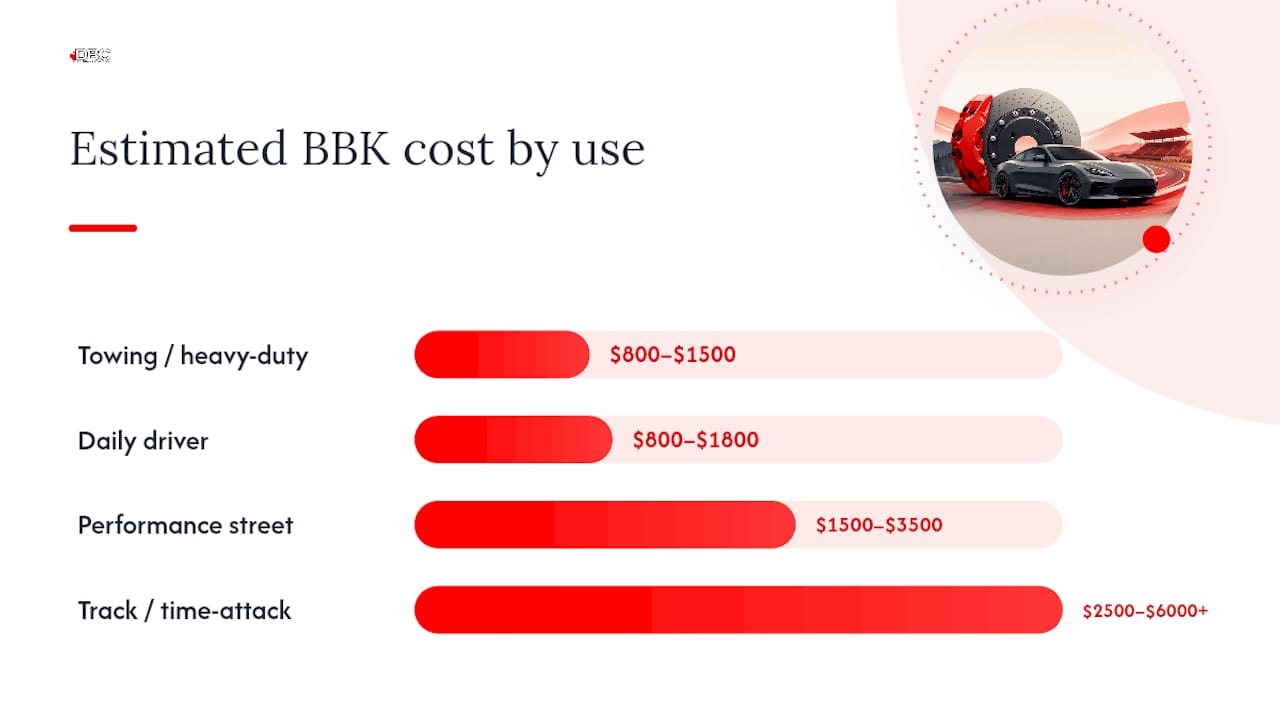
| Who benefits | Expected cost range (CAD) | Performance impact |
|---|---|---|
| Daily driver (stock power, city use) | $800–$1,800 parts + labour | Minimal; pads/fluid upgrade more cost-effective |
| Performance street (modified, spirited driving) | $1,500–$3,500 parts + labour | Moderate; improved pedal feel and fade on hard runs |
| Track / time-attack | $2,500–$6,000+ parts + labour | High; consistent lap-to-lap braking, reduced fade |
| Towing / heavy-duty (trucks, SUVs) | $800–$1,500 parts + labour | High on sustained descents; fade resistance is the key gain |
What a big brake kit includes and common component choices
Understanding what comes in the box helps set realistic expectations for cost and maintenance. A complete brake kit typically contains:
- Rotors: Available as one-piece (cast iron, heavier but affordable) or two-piece (aluminium hat with a steel or iron ring, lighter and better for heat management). Surface finishes include cross-drilled, slotted, or a combination. Cross-drilled rotors improve outgassing and heat dissipation; slotted surfaces continuously clean the pad face. Coated rotors resist corrosion between uses.
- Calipers: Floating (single or dual piston, lower cost, adequate for most street use) or fixed (multi-piston, stiffer, better modulation, preferred for track). Forged aluminium calipers save weight versus cast iron.
- Pads: Street compounds operate effectively from cold; track compounds need heat to reach peak friction. Matching the pad to the intended use is critical.
- Hats and adapters: Bracket adapters mount the caliper to the upright. Hat dimensions must match hub bore and bolt pattern exactly.
- Braided stainless lines: Replace rubber OEM lines to reduce expansion under pressure, giving a firmer pedal.
- Hardware: Caliper bolts, pad retaining clips, and anti-squeal shims.
Component trade-offs at a glance:
- Two-piece rotors save unsprung mass but add cost; worthwhile for track use, optional for street.
- Cross-drilling affects bedding procedure and can reduce rotor longevity under extreme repeated heat cycling compared to slotted-only designs.
- Pad compound temperature range must match the application. A cold-intolerant track compound on a daily driver produces inconsistent braking in Canadian winters.
- Extreme caliper upgrades occasionally require a bespoke master cylinder or proportioning valve adjustment. Confirm with a qualified shop before ordering.
For rotor construction details and caliper materials, the construction quality of the hat-to-ring interface on two-piece rotors is a key reliability indicator.
Typical cost ranges and installation time for Canada
What to budget
Total project cost grows quickly once all required items are included. A realistic Canadian budget by tier:
- Entry-level kit (one-piece rotors, floating caliper, street pads): $800–$1,500 for parts. Add $200–$400 for labour at a competent shop.
- Mid-range kit (two-piece rotors, fixed caliper, performance street pads): $1,800–$3,500 for parts. Labour $300–$600.
- Premium kit (forged caliper, two-piece rotor, full hardware): $3,500–$6,000+ for parts. Labour $500–$900.
Additional costs that many buyers overlook:
- New wheels or spacers if stock wheels do not clear the larger caliper: $600–$2,500+.
- High-performance brake fluid (DOT 4 or DOT 5.1): $30–$80 per flush.
- Braided lines (if not included): $150–$350.
- Alignment check after suspension disturbance: $80–$150.
Cross-border purchases from U.S. suppliers may attract duties and brokerage fees. Canadian-sourced kits avoid this and simplify warranty claims.
Installation timeline
- Confirm fitment: verify rotor diameter, caliper bracket fitment, hub bore, bolt pattern, and wheel clearance before the car goes on the lift.
- Parts preparation: inspect all components, torque-check hardware, and confirm brake line routing.
- Installation: remove stock components, mount adapter brackets, install caliper and rotor, connect braided lines.
- Bleed and bed: bleed the system fully, then perform a proper bedding sequence (graduated stops from moderate speed) to transfer an even pad layer onto the rotor surface.
- Road test: verify pedal feel, listen for noise, and confirm no pull or pulsation.
Typical labour time at a shop familiar with BBK installs is 3–5 hours for a straightforward fitment. Complex builds with custom brackets or line routing run longer. Choose a shop with documented experience on performance brake installs, not just routine pad swaps.
Decision checklist: is a big brake kit the right upgrade for you?
Work through this sequence before committing to a purchase.
- Identify the symptom. Is the problem fade (pedal going soft or long after repeated hard stops) or a single long stopping distance? Fade points to a thermal limit; a long single stop usually points to tyres or pads.
- Check tyres first. Tyre compound, tread depth, and inflation pressure set the grip ceiling. No brake upgrade overcomes worn or mismatched tyres.
- Upgrade pads and fluid. A high-performance street pad and fresh DOT 4 or DOT 5.1 fluid resolve fade in many cases at a fraction of BBK cost. This upgrade sequence is the recommended first step for most drivers.
- Measure wheel clearance. With the stock wheel on, measure the gap between the inner barrel and the existing caliper. A BBK caliper is typically 20–50 mm larger in diameter. If clearance is marginal, budget for new wheels.
- Estimate total budget. Add kit price, pads, fluid, lines, potential new wheels, labour, and alignment. Compare that total to the value of the performance gain for your use case.
- Confirm rotor and caliper fitment. Ask the vendor for a fitment guarantee specific to your year, make, and model. Verify hub bore, bolt pattern, and adapter bracket availability.
Questions to ask your vendor or mechanic:
- What is the rotor construction (one-piece vs two-piece) and what is the unsprung weight difference versus stock?
- Which pad compounds do you recommend for my primary use (street, street-track, full track)?
- Does the kit require any master cylinder or ABS bias adjustment for my vehicle?
- What is the warranty on calipers and rotors, and what does it cover?
- Is there a fitment guarantee or return policy if the kit does not clear my wheels?
Signs a BBK is the right call rather than a smaller upgrade: persistent fade after fresh pads and fluid, a high-power build that exceeds the factory system's design limits, or regular track use where lap-to-lap consistency matters. For common fitment mistakes to avoid, review the wheel clearance and offset requirements before ordering.
What real tests show: testing approach and DBC-sourced observations
How braking performance is measured
Valid brake testing controls for variables that would otherwise skew results. The methodology used by technical reviewers and performance shops includes:
- Consistent entry speed: All emergency-stop runs begin from the same speed (typically 100 km/h) to allow direct distance comparisons.
- Repeated-lap sequences: Multiple consecutive hard stops reveal fade behaviour. A single stop tells you little about thermal limits.
- Rotor temperature logging: Infrared or thermocouple measurement confirms whether the rotor is reaching fade-inducing temperatures.
- Tyre and pressure control: The same tyre compound and inflation pressure across all test configurations, so the brake hardware is the only variable.
Without these controls, headline "X metres shorter" claims are unreliable. A tyre change between test runs, for example, can produce a larger distance difference than any brake hardware change.
Typical outcomes from published tests
Consistent findings across published engineering analyses and technical reviews:
- Single-stop distances on ABS-equipped vehicles show little or no change after a BBK upgrade when tyre and pressure variables are controlled.
- Repeated-stop sequences show clear improvement: BBK-equipped vehicles maintain consistent deceleration across multiple stops where factory systems begin to fade.
- Pedal feel improves noticeably with fixed multi-piston calipers, particularly in the mid-pedal range.
DBC Brakes provides vehicle-specific fitment support and customer reviews from Canadian buyers who have installed their kits on a range of platforms. Checking ABS module condition before a BBK install is a practical step that shops sometimes skip; a marginal ABS module can produce inconsistent results that get incorrectly attributed to the new hardware.
A Canadian brake specialist's perspective
The most common mistake Canadian drivers make is treating a big brake kit as a safety upgrade for everyday driving. It is not, for most of them. The factory brake system on a modern car is sized to trigger ABS before the tyre loses grip. That means the limiting factor is already the tyre, not the caliper. Spending $3,000 on a BBK before replacing worn all-seasons is spending money in the wrong order.
The upgrade sequence that actually works: tyres first, then pads and fresh fluid, then braided lines if the pedal still feels soft. Most drivers who follow that sequence find the fade problem they thought required a BBK is gone. The ones who still have fade after that are the ones who genuinely need a bigger system: track drivers, owners of heavily modified cars, and people towing or descending grades regularly.
When a BBK is the right call, pair it with compatible wheels confirmed before ordering, a full fluid flush to DOT 5.1, and a proper bedding sequence. In Canada, sourcing locally matters: cross-border kits can arrive with duties and brokerage fees that erase any price advantage, and warranty claims across the border are slow. A Canadian supplier with a fitment guarantee and real phone support is worth paying for.
The aesthetics argument is real, too. A set of large calipers visible through open-spoke wheels has genuine appeal, and on a modified car it supports resale. That is a legitimate reason to upgrade, as long as the buyer understands it is the primary benefit for a daily driver.
DBC Brakes: Canadian fitment support and premium kits
Cross-drilled rotors engineered to resist warping, multi-piston calipers matched to your specific vehicle, and inclusive pricing with no hidden fees: that is what DBC Brakes brings to a Canadian BBK purchase.
DBC's fitment process starts with your year, make, and model. Their team confirms rotor diameter, caliper bracket compatibility, hub bore, and wheel clearance before the order ships. Free shipping applies to orders over $100 within Canada, which removes the cross-border duty and brokerage risk that catches many buyers off guard. Expert support is available by phone, not an automated queue, so fitment questions get answered before the kit arrives. For Canadian buyers ready to move forward, visit Crossdrilledrotors to check fitment for your vehicle and place an order with inclusive pricing confirmed upfront.
Sources
- Are Big Brake Kits Worth It? Complete BBK Engineering Analysis Guide – AME Motorsport
- Are big brake kits worth it? (Jalopnik feature)
- Why You Don’t Need a Big Brake Kit - THEGIGARAGE
When reading any test or review, check whether the methodology controlled for tyre compound and pressure. A result that changed tyres between configurations is measuring tyres, not brakes.