
Reviews should strongly influence your brake purchase decision, but only as one input alongside fitment verification and professional advice. Use them to flag real-world problems — fitment mismatches, early wear, noise, heat fade, and poor post-sale support — then confirm against OEM specs before ordering.
Quick checklist before you buy:
- Confirm exact fitment by year, make, model, trim, and drivetrain
- Prioritise verified purchase reviews dated within the last several months
- Call a parts counter or mechanic before placing an order to confirm fitment and suitability
Table of Contents
- What do reviews actually tell you about brake parts?
- Which review signals matter most when choosing brake pads or rotors?
- How do you spot fake, biased, or irrelevant reviews?
- How do you combine user reviews with mechanic and parts-counter advice?
- Canada-specific steps before buying brakes online or in-store
- How DBC Brakes models good review use and seller transparency
- Key takeaways
- Reviews matter, but fitment data matters more
- DBC Brakes simplifies the brake-buying process for Canadian drivers
- Useful sources
What do reviews actually tell you about brake parts?
Reviews reliably surface key issues such as fitment problems, early failure patterns, and post-purchase support experiences. When multiple buyers report the same shimmy after installation, or describe packaging damage on arrival, that pattern is useful data. Consumer feedback on brakes now functions as a proxy for the shop check that online buyers skip — reviewers flag fitment errors and support issues that only appear after installation.
What reviews cannot reliably show: precise stopping distances, controlled fade measurements, or unit-to-unit manufacturing consistency. A reviewer describing "great stopping power" is not running a controlled test. The primary value of reviews is understanding how a material behaves under heat, heavy load, and stop-and-go traffic — not identifying an absolute best product.
"Parts counter staff can report which pads get returned most. Blanket endorsements are unreliable because brake performance varies by vehicle application." — Andrew Markel, Tire Review Magazine
That point matters for Canadian drivers especially. A pad that earns five stars on a light sedan in Vancouver may perform differently on a half-tonne truck doing winter highway driving in Saskatchewan. Reviews complement technical specs; they do not replace them.
Which review signals matter most when choosing brake pads or rotors?
Work through this checklist when scanning a product's review page:
- Verified-purchase badge — unverified reviews carry no accountability
- Date within 6–12 months — supplier specs change frequently; older feedback may not reflect current production
- Exact vehicle match — year, trim, and drivetrain, not just make and model
- Repeated symptoms across multiple buyers — one complaint is noise; five independent buyers describing the same vibration is a pattern worth investigating
- Photos or video — images confirming part labels, fitment, and wear patterns add credibility
- Driving context — daily commuter, heavy hauler, towing, or track use
Watch for material-specific language. Phrases like "more dust but firmer pedal" describe a normal ceramic-to-semi-metallic trade-off. "Glazed after two weeks" or "faded on a mountain descent" point to a heat-management problem worth taking seriously. A review noting "squealing in the first 500 km" may simply describe the bedding-in period, not a defect. Understanding the noise versus performance trade-off helps you read those comments accurately.
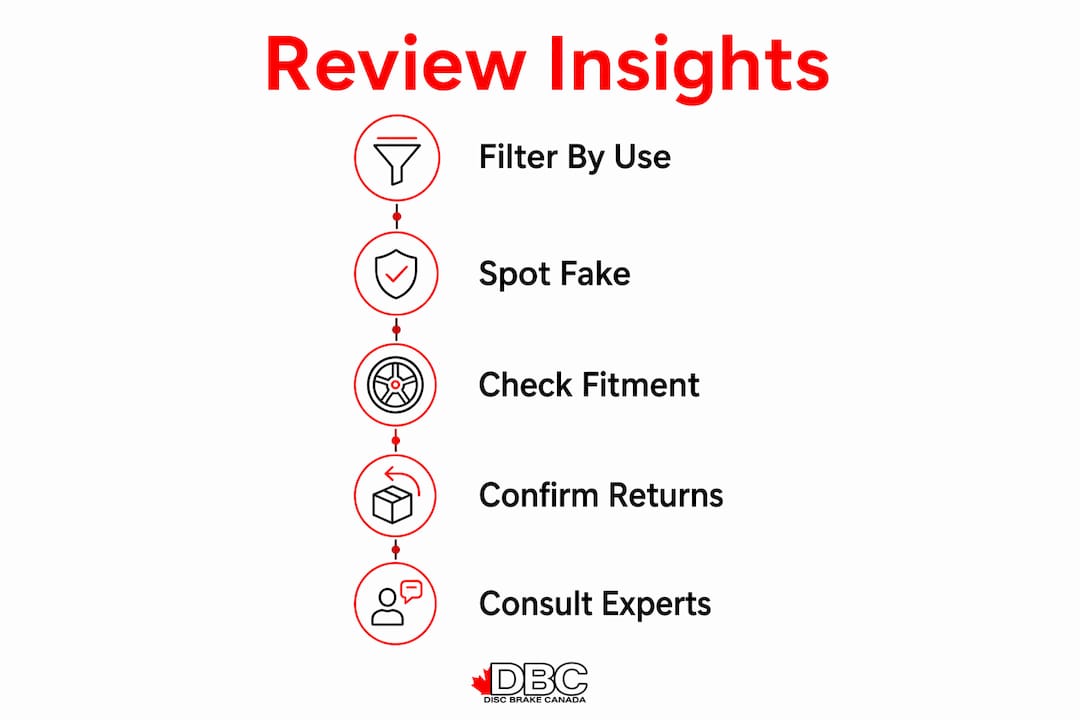
Pro Tip: Filter reviews by driving pattern before reading. A tow-vehicle owner's experience with a pad compound is not relevant to a city commuter, and vice versa. Ignore any review that does not specify the vehicle trim or driving load.
How do you spot fake, biased, or irrelevant reviews?
Red flags are usually visible once you know what to look for. Identical phrasing across multiple reviews, extreme one-line praise with no installation detail, and review histories that only ever post about a single brand are all warning signs. A sudden cluster of five-star ratings posted within a few days — with no corresponding cluster of purchases — suggests manipulation.
Credibility signals run the other way: photos of the actual part installed, installation dates noted, pad thickness measured after a specific number of months, and multiple independent buyers describing the same symptom. Patterns across several recent reviews provide statistically useful guidance; a single glowing review does not.
Many negative brake reviews stem from fitment mismatches — parts that technically fit the make and model but not the specific trim, drivetrain, or towing package — rather than product defects. Filtering by vehicle trim before drawing conclusions is the most reliable way to separate real quality issues from installation errors.
Cross-check marketplace reviews with forum threads on marque-specific communities. If the forum is quiet on an issue that dominates the product page, the product-page reviews may be unreliable. If both sources flag the same symptom, treat it as confirmed.
How do you combine user reviews with mechanic and parts-counter advice?
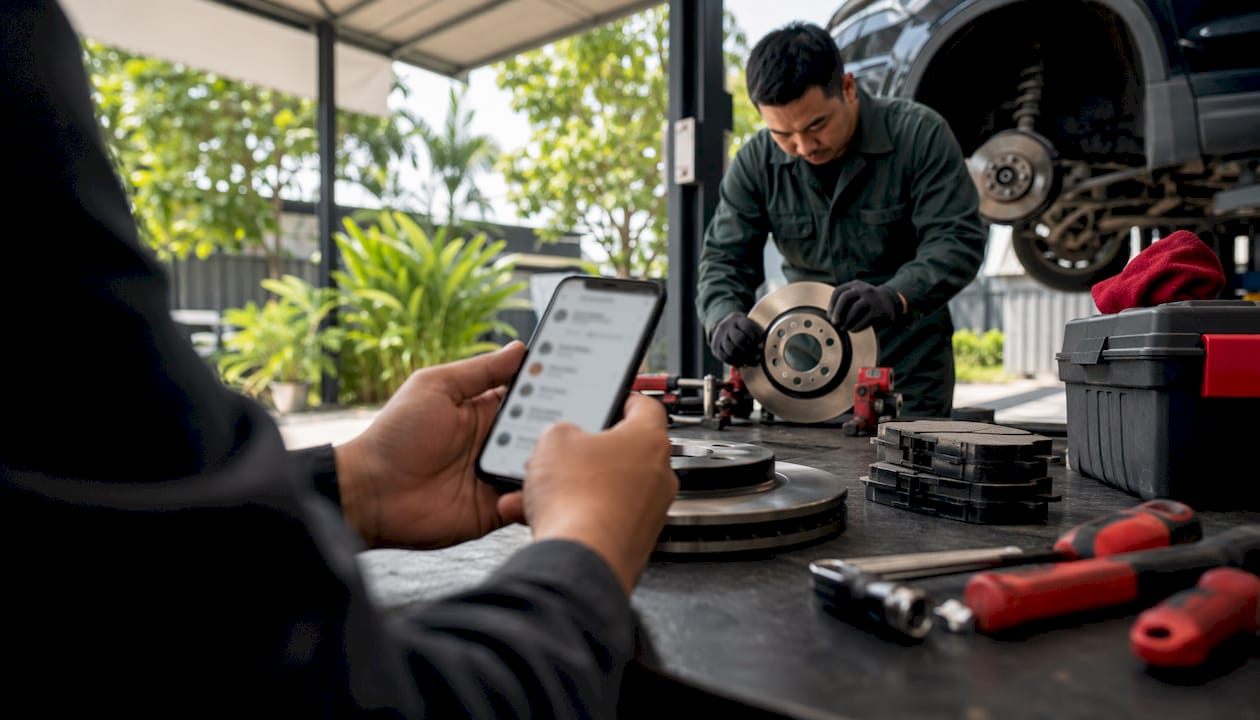
Reviews and professional advice serve different purposes. Reviews document real-world arrival condition, fitment, and early failure patterns. Mechanics and parts-counter staff see return rates and installation failure modes that never appear online. Parts-counter staff can tell you which pads come back most often and whether returns match the complaints in reviews or trace back to installation errors.
Before ordering, bring a printout or screenshot of the reviews you found and ask the parts counter:
- Does this part fit my exact trim and brake package?
- Are there known fitment caveats for my drivetrain?
- What is the typical bedding behaviour for this compound?
- Have you seen warranty claims or returns on this product recently?
A counterperson who recognises a product will often confirm or contradict what the reviews say in under two minutes. That conversation is free and takes less time than reading another hundred reviews.
Pro Tip: Ask specifically about return rates, not just "is this a good pad?" A parts counter that sees high returns on a product will tell you — that signal is more reliable than aggregate star ratings.
Canada-specific steps before buying brakes online or in-store
Canadian driving conditions add variables that reviews from other markets may not capture. Salt corrosion, cold-start braking, and wet-stopping performance in freeze-thaw cycles are worth filtering for specifically.
- Confirm OEM or aftermarket fitment for your exact trim, engine, and drivetrain before anything else — see the Canadian brake buyer's guide for fitment terminology
- Prioritise reviews from similar climates — look for reviewer locations or mentions of winter driving, salt exposure, or cold-weather performance
- Check warranty terms and return policy in Canada; cross-border sellers may have different return processes and duties that affect total cost
- Verify shipping timelines — a cross-border order can add days or weeks and may attract import duties
- Budget for a professional inspection — a 30-minute professional inspection costs roughly $50–$100 and can prevent significantly more expensive repairs later
- Read for salt and corrosion notes — rotor surface rust after a wet winter is normal, but reviewers describing premature rotor pitting or caliper seizure in Canadian winters are flagging a real durability concern
For rotor selection specific to Canadian road conditions, the brake upgrade guide for Canadian roads covers climate-specific considerations in detail.
How DBC Brakes models good review use and seller transparency
A product page that supports good review-based decisions has clear spec sheets, a contactable manufacturer, and recent verified reviews tied to specific vehicle trims. DBC Brakes, operating through CrossDrilledRotors.ca, provides a useful reference for what that looks like in practice.
Key signals on a trustworthy Canadian brake product page:
- Engineered cross-drilled rotors with documented specs — not just marketing language
- Inclusive pricing with no hidden fees, so the price in the review matches what you pay
- Knowledgeable, non-automated support — a real person who can answer fitment questions before you order
- Free shipping on orders over $100 within Canada, with clear return terms
- Verified customer reviews referencing specific vehicle trims and stopping performance improvements
When a seller publishes specs, answers fitment questions directly, and has recent verified reviews from Canadian drivers describing real-world outcomes, the review-vetting workload drops considerably. The product page itself becomes a credibility signal.
Key takeaways
Reviews are most useful as a red-flag tool for fitment and early failure patterns, but they must be validated against OEM specs, parts-counter knowledge, and transparent seller information before any brake purchase.
| Point | Details |
|---|---|
| Use reviews as a red-flag tool | Look for repeated fitment or failure patterns across multiple verified buyers, not single opinions. |
| Prioritise recent feedback | Reviews older than 6–12 months may not reflect current production specs or supplier changes. |
| Validate with a parts counter | Staff see return rates and installation failure modes that online reviews rarely capture. |
| Apply Canadian filters | Prioritise reviews noting salt, cold-start, or wet-stopping performance for accurate local relevance. |
| DBC Brakes as a reference | DBC Brakes offers clear specs, verified reviews by trim, and direct support — reducing review-vetting effort for Canadian buyers. |
Reviews matter, but fitment data matters more
The conventional wisdom is that more reviews equal better information. That is only partially true for brake components. A product with 2,000 reviews is not automatically safer than one with 200 if the majority of those reviews come from a different vehicle trim, a different climate, or a different driving load than yours.
The more useful frame: treat reviews as a screening tool, not a verdict. They are best at surfacing patterns — repeated fitment failures, consistent noise complaints, recurring shipping damage — that a spec sheet will never show. They are poor at measuring absolute performance, because no reviewer is running a controlled stopping-distance test.
What actually closes the gap is combining that pattern recognition with a five-minute parts-counter conversation and a seller whose specs and warranty terms are written down clearly — understanding more about vehicle performance helps make sense of those trade-offs. For safety-critical components, that combination is more reliable than any star rating.
DBC Brakes simplifies the brake-buying process for Canadian drivers
Sorting through reviews, cross-checking fitment data, and verifying warranty terms takes time. DBC Brakes, available at CrossDrilledRotors.ca, reduces that workload by providing engineered cross-drilled rotors with documented specs, transparent all-in pricing, and direct support from knowledgeable staff — not automated responses.
Free shipping applies to orders over $100 within Canada, and return terms are clearly stated on the product pages. Verified reviews on the site reference specific vehicle trims and real-world stopping performance, so the pattern-recognition work described in this guide is already partly done for you. Check product pages, confirm your fitment, and reach out to the support team with any questions before ordering at CrossDrilledRotors.ca.
Useful sources
- Choosing the Right Brake Pad for the Right Customer — Tire Review Magazine: parts-counter return-rate insight and the limits of blanket brand endorsements; used in sections 2 and 5
- Brake performance reviews guide — CrowdTrust: what reviews can and cannot measure; used in sections 2 and 4
- Why current customer reviews are essential when shopping for car brakes online — Othmar: recency, fitment matching, pattern recognition, and post-purchase support signals; used in sections 1, 2, 3, 4, and 6
- Best brakes and rotors: an in-depth buyer's guide — Simi Valley CDJR Blog: fitment mismatch as a source of negative reviews; used in sections 3 and 4
- DIY brake inspection vs professional brake service — Rohnert Park Transmission: 30-minute professional inspection reference; used in section 6