
Brake horsepower loss is power stolen from your wheels by drag inside the brake system, not the engine's rated output. Pads that never fully retract, seized guide pins, or a parking brake that stays lightly applied all create resistance the engine has to push through on every rotation. Even a few newton-metres of that resistance adds up over thousands of wheel turns per kilometre.
The physics is simple: power equals torque multiplied by angular velocity. A caliper dragging with 5 Nm of resistance at highway wheel speed converts to a measurable, continuous power drain, one that shows up as lower fuel economy, reduced EV range, and slower acceleration.
- Definition: brake drag subtracts usable power at the wheel, separate from engine-rated horsepower.
- Formula: Power (W) = Torque (Nm) × Angular velocity (rad/s); divide by 745.7 to get horsepower.
- Example: 5 Nm of drag torque at 100 rad/s equals 500 watts, or roughly 0.67 hp, lost per dragging wheel.
Vehicle-level testing backs this up. Even small drag torques increase energy consumption and pad wear, a finding that regulatory bodies now track given its effect on fuel economy, EV range, and brake particle emissions.
Key Takeaways
Brake horsepower loss comes from drag torque at the wheel, and even a few newton-metres of unwanted resistance can cost measurable horsepower and range.
| Point | Details |
|---|---|
| Definition matters | Brake horsepower loss means power lost to brake-system drag, separate from engine horsepower. |
| Formula to remember | Power (W) = torque × angular velocity; divide by 745.7 for horsepower. |
| Severity varies widely | Drag can cost under 0.3 hp per wheel when light, or over 13 hp per wheel when severe. |
| Check it yourself | A jack-and-spin test and post-drive hub temperature check catch most drag issues early. |
| Replace with durability in mind | DBC Brakes' cross-drilled rotor kits are engineered to resist warping, a common drag trigger. |
Table of Contents
- How does brake drag physically cause horsepower loss?
- How do you calculate horsepower lost to brake drag?
- What symptoms suggest your brakes are dragging?
- How do shops measure and confirm brake drag?
- What repairs fix brake drag and prevent it from returning?
- When should you DIY a brake drag fix versus calling a shop?
- If you need a durable replacement: DBC brake kits
- Sources
How does brake drag physically cause horsepower loss?
Brake drag happens when the pad never fully clears the rotor after you release the pedal. That residual contact keeps friction working against wheel rotation, all day, every drive.
Several mechanical faults cause this:
- Residual pad contact from worn hardware or a stretched retraction spring
- Poor piston retraction, often from degraded caliper seals
- Seized or corroded guide pins that let the caliper hang crooked
- Torn dust boots, which let in moisture and grit that binds the piston
- A parking brake cable or shoe that never fully releases
- Warped or glazed rotors that create uneven, constant contact
Insufficient piston return capacity is one of the most common root causes identified in commercial and passenger vehicle testing, ahead of most other single fault types. Once contact is continuous rather than momentary, the drag torque at that wheel becomes a fixed tax the engine pays on every rotation, regardless of throttle position. That is fundamentally different from braking force, which you apply on purpose. Drag torque is force you did not ask for and cannot switch off without a repair.
Pro Tip: After a short, easy drive with light braking, carefully feel each wheel hub with the back of your hand. One noticeably hotter than the others usually means that caliper is dragging.
How do you calculate horsepower lost to brake drag?
The math only needs three numbers: drag torque in newton-metres, wheel angular velocity in radians per second, and a conversion constant. Angular velocity depends on wheel speed and tire radius, but for a rough estimate at highway speed, a typical passenger car wheel spins at roughly 70 to 100 rad/s.
- Measure or estimate drag torque (Nm) — this can come from a bench test or reported research values.
- Multiply torque by angular velocity (rad/s) to get power in watts.
- Divide by 745.7 to convert watts to horsepower.
Worked example: research on commercial disc brakes recorded drag torque as high as 111.87 Nm under prolonged, medium-to-low-speed braking conditions, versus roughly 2.3 Nm under normal cool conditions. At 90 rad/s, that 111.87 Nm of drag equals about 10,068 watts, or roughly 13.5 hp, lost at a single wheel under that worst-case scenario. The 2.3 Nm baseline case, by comparison, costs closer to 0.28 hp.
| Drag severity | Typical torque range | Approximate power cost |
|---|---|---|
| Light (normal cool caliper) | 1–3 Nm | Under 0.3 hp per wheel |
| Moderate (partial retraction issue) | 5 Nm | approximately 0.3 hp per wheel |
| Severe (seized pin, hot glazed pad) | up to roughly 112 Nm | 6–14+ hp per wheel |
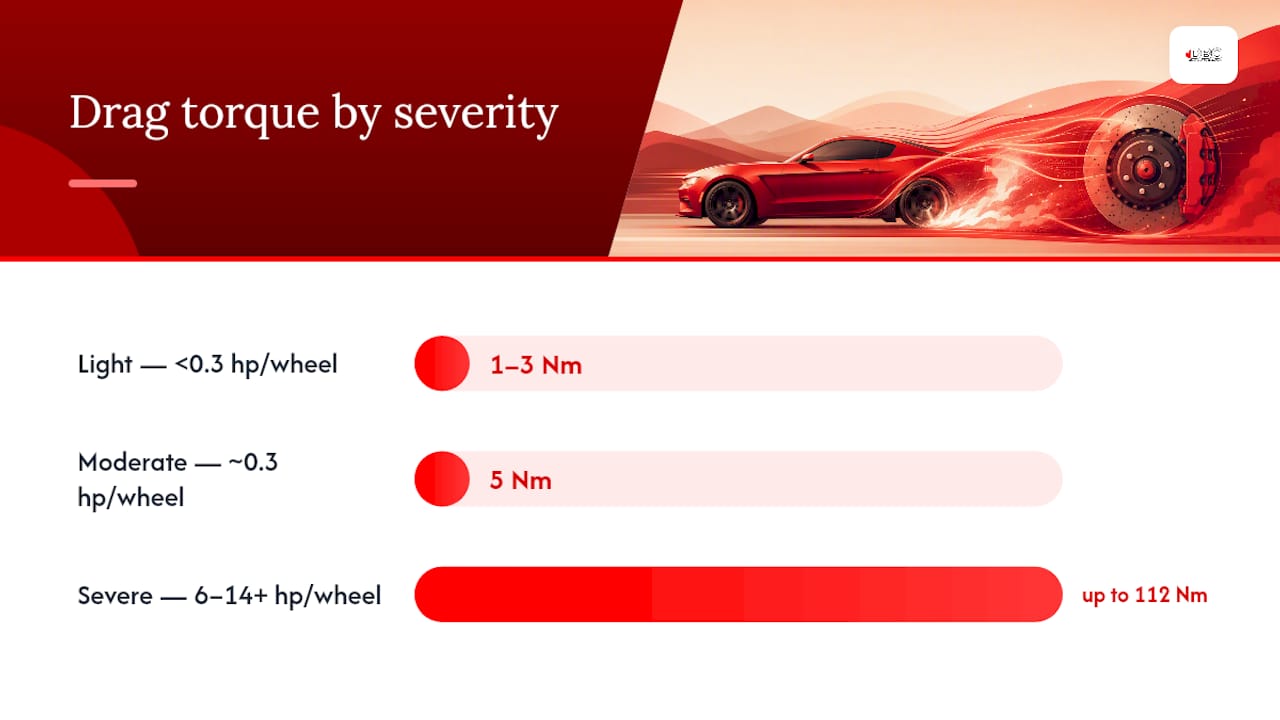
Multiply any of these by four wheels, and a severe drag condition on even one axle becomes a noticeable, measurable hit to what reaches the road.
What symptoms suggest your brakes are dragging?
A dragging brake rarely stays quiet for long. Watch for a wheel that runs distinctly hotter than the others, a pull to one side under light acceleration, or fuel economy (or EV range) that has crept down without an obvious cause.
Other signs include a faint scraping or rubbing noise at low speed, pads or a rotor wearing unevenly faster than their opposite-side counterpart, and acceleration that feels flatter than it used to, especially from a stop.
Three checks take less than fifteen minutes:
- Jack-and-spin test: raise the wheel, spin it by hand, and feel for resistance beyond normal bearing drag.
- Temperature check: after a short drive, compare hub temperatures across all four wheels.
- Visual inspection: look for a torn dust boot, rust streaking on the guide pins, or a parking brake cable that looks taut at rest.
Caliper degradation rarely self-corrects; a wheel running hot today usually runs hotter next month. If a wheel is too hot to touch, if you smell burning, or if the pull is strong enough to fight the steering wheel, stop driving, let the wheel cool fully, and get it inspected before your next trip.
Pro Tip: Don't drive on a wheel that's too hot to touch for more than a few seconds. That heat can warp a rotor or damage a wheel bearing in a single trip.
How do shops measure and confirm brake drag?
Technicians confirm brake drag with a mix of vehicle-level and component-level tests, since each catches problems the other misses.
- Chassis dynamometer coastdown measures how quickly the vehicle decelerates with brakes released, isolating parasitic resistance from engine braking.
- Wheel-off inspection lets a technician directly check pad clearance, piston position, and guide-pin condition.
- Caliper piston return tests confirm the piston retracts fully after pedal release rather than hanging against the pad.
- Guide-pin play checks test for corrosion or seizing that lets the caliper sit crooked under load.
- Drag-torque sensor measurement on a bench gives a precise Nm figure, the same kind of data used in commercial vehicle research.
Bench tests isolate one component under controlled conditions, useful for pinpointing a specific fault, while vehicle-level testing captures how components interact under real driving loads, which matters because caliper behaviour varies with heat, speed, and load in ways a bench alone won't show.
| Test condition | Reported drag torque | What it indicates |
|---|---|---|
| Normal, cool caliper | ~2.3 Nm | Healthy piston return |
| Prolonged medium-low speed braking | approximately 111.87 Nm | High piston sliding resistance, thermal effects |
If a jack-and-spin test shows resistance, or a wheel runs noticeably hot after a short drive, book a shop visit rather than waiting for the next scheduled service.
What repairs fix brake drag and prevent it from returning?
Most brake drag traces back to a handful of fixable parts, and catching it early usually means a smaller job.
- Clean and re-lubricate guide pins with brake-rated grease
- Replace torn or cracked dust boots before moisture reaches the piston
- Rebuild or replace a caliper that won't retract properly
- Replace pads and rotors when wear is uneven or a rotor is glazed
- Inspect and adjust the parking brake assembly and cable
- Fit anti-rattle hardware and pad springs to maintain consistent air gap
Timelines vary by job. A guide-pin service typically runs one to three hours per axle. A full caliper rebuild or replacement, paired with new pads and rotors, usually takes two to six hours for a front axle. Costs range widely by region and parts quality, so treat any number as a starting point and confirm local labour rates before booking.
A simple prevention routine goes a long way: a periodic wheel-off inspection once a year, regular brake-fluid service on the interval your manual specifies, and avoiding long stretches of light, dragging brake application at low speed where possible. Optimized piston seals and pad-return springs are proven fixes at the component level, though full validation still needs real-world driving to confirm the fix holds under heat and load.
When pads and rotors are due regardless, that's the moment to weigh a reliable replacement kit against a rebuild. A worn or glazed rotor paired with new pads rarely solves the underlying drag problem. Understanding how clamping force affects overall brake performance also helps explain why a full kit, rather than a single component swap, often gives more consistent results.
When should you DIY a brake drag fix versus calling a shop?
Guide-pin cleaning and light surface rust removal are within reach for a competent home mechanic with basic tools and a torque wrench. Seized pistons, drag-torque measurement, or anything touching the hydraulic brake-fluid system belongs with a trained technician.
Three quick rules of thumb help decide: if a wheel is dangerously hot, pulls hard, or makes grinding noise, stop and call a shop immediately. If the fix needs specialty tools or brake-fluid bleeding, it's a shop job. If it's a warranty or new-kit installation, professional installation protects that warranty.
If you need a durable replacement: DBC brake kits
If your inspection turned up a warped rotor, a glazed pad surface, or a caliper too far gone to rebuild affordably, DBC Brakes builds kits specifically to reduce the conditions that cause drag in the first place. The engineered cross-drilled rotors are designed to resist warping under heat, and every kit ships with inclusive pricing, meaning the price you see at checkout is the price you pay, with free shipping on orders over $100.
Before you check out, confirm your kit matches your exact make, model, and trim, since rotor diameter and caliper bracket fitment vary even within the same model year. If you're also replacing worn caliper hardware or want higher-durability rotors for heavier daily driving, the premium brake kit lineup is built for exactly that. Browse the full performance brake kit collection to find the right fit for your vehicle and get your order in before your next drive.
Sources
- Investigation on brake-drag-optimization on vehicle-level (SAE Mobilus)
- Piston retraction-induced braking drag mechanism of commercial vehicle disc brake under dynamic working conditions (Vehicles, MDPI)