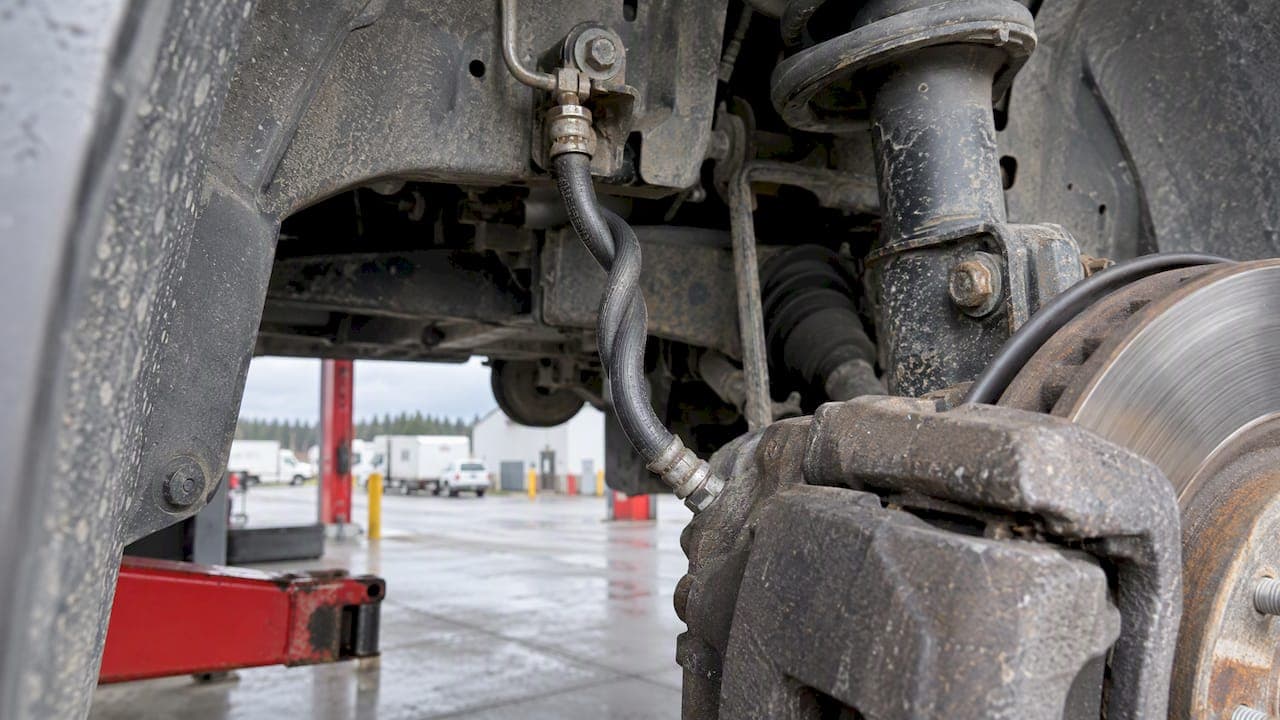
A twisted brake hose usually shows up as a brake that does not fully release. Typical signs are a vehicle pulling to one side, one wheel running hot, a burning smell from one corner and pads that wear faster on one side. A twist can also hide a restricted hose, which looks fine outside and still traps pressure at the caliper. This guide lists the symptoms, explains the cause, shows how to check the hose and covers repair costs in Canada.
TL;DR
- A twisted or collapsed brake hose commonly causes brake drag, pulling, a hot wheel and uneven pad wear on one corner.
- A straight print line (lay-line) along the hose should not spiral. A spiral means the hose is twisted.
- A hose can look normal outside and be restricted inside. Check it with the pedal applied, not only at rest.
- Do not replace a caliper before the hose is ruled out. The same symptoms return if the hose is the cause.
- Rubber hoses are estimated to last about six years. Replace a twisted, cracked, bulging or leaking hose before further driving.
Table of Contents
- What a twisted brake hose does
- Twisted brake hose symptoms
- Why hoses end up twisted
- How to check a brake hose
- When to replace the hose
- What brake hose repair costs in Canada
- Damage a dragging brake leaves behind
- Braided lines as a replacement option
- Our view on brake drag diagnosis
- Brake kits once the hose is sorted
- Quick reference: what to do next
- FAQ
- Sources
What a twisted brake hose does
A flexible brake hose connects the rigid brake line on the body to the caliper. It has to move with the suspension and steering. It carries fluid under high pressure when the pedal is applied, and it must let that fluid return when the pedal is released.
A twist puts the hose under constant stress. A hose installed with a spiral in it is not at its neutral position, and the stress shortens its life. A twist can also pinch or fold the inner liner. A restricted liner can act like a one-way valve: fluid goes through to the caliper, but returns slowly or not at all. The caliper then stays partly applied after the pedal is released.
This is the reason the symptoms look like a seized caliper. Technicians report that many calipers diagnosed as seized are in fact held by a restricted hose.

Twisted brake hose symptoms
No single sign confirms a twisted hose. The pattern points to it, and an inspection confirms it.
Brake drag and a hot wheel
The most common sign. After a normal drive, one wheel is much hotter than the others. The hub or rotor may be too hot to hold a hand near. A burning smell from one corner is common. Fuel economy can also fall because the vehicle works against a brake that is partly applied.
Pulling to one side
If a front hose restricts, the dragging brake on that side slows that wheel. The vehicle pulls toward the dragging side, with the brake pedal released. A restricted hose can also cause the opposite: the brake on that corner applies late or weakly, and the vehicle pulls toward the other side under braking. Brake and Front End notes that a collapsed hose is an often-misdiagnosed cause of pull and that the outside of the hose can look fine.
Uneven pad and rotor wear
A brake that stays lightly applied wears its pads faster. Inner and outer pads can wear differently. Compare the left and right sides of the same axle. A large difference points to a problem on the worse side: a sticking slider, a seized piston or a restricted hose.
A pedal that feels different
A soft or spongy pedal can come from air in the system, a leaking hose or a swollen hose that expands under pressure. A pedal that feels normal does not rule out a hose problem, since the restriction acts on the return side.
Noise and vibration
The search results for this topic mention shaking from the front, resistance to acceleration and creaking when starting or stopping. These are general brake-line symptoms. They can also come from worn bearings, warped rotors or loose hardware. Treat them as reasons to inspect, not as proof of a hose fault.
| Symptom | What it suggests | Other causes to rule out |
|---|---|---|
| One wheel hot after driving | Brake not releasing | Seized caliper, stuck slider pins |
| Pulling with pedal released | Drag on one side | Alignment, tire pressure, caliper |
| Pulling under braking | Uneven pressure between sides | Contaminated pads, stuck piston |
| Fast wear on one axle side | Constant light contact | Caliper hardware, worn parts |
| Spongy pedal | Air, leak or swollen hose | Low fluid, master cylinder |
| Visible leak at hose ends | Failed hose or fitting | Loose banjo bolt, damaged line |
Why hoses end up twisted
Installation error
The most common cause of a twisted hose is installation. The hose is tightened at one end while it is rotated. A new hose with a twist can look correct until the suspension moves. Installers check the lay-line before tightening the fittings. The BrakeQuip guidance on inspecting brake lines describes the lay-line as the continuous line of print along the hose. If it runs straight, the hose is neutral. If it spirals, the hose is twisted.
A caliper fitted the wrong way
A caliper installed on the wrong side, or flipped, can route the hose through a twist. This happens during brake jobs when parts are swapped between sides. After any caliper or rotor work, compare the hose path with the other side of the vehicle.
Crimping during service
Clamping a hose with vice-grips to limit fluid loss is a known cause of internal damage. The Vehicle Service Pros tech tip explains that the crimp can fracture the inner lining. The fracture creates a one-way effect, and a healthy caliper then looks stuck. Plug the line or use a proper hose clamp tool designed for brake hoses.
Age and weather
Rubber hoses age from the inside. The same BrakeQuip source gives an estimated service life of about six years for a typical rubber hose. Actual life depends on climate and driving habits. Canadian road salt, large temperature swings and winter driving put hoses under more stress than mild climates, so inspect them at least at each seasonal tire change.
How to check a brake hose
The aim is to see the full length of each hose, front and rear, and to test it under pressure. Work with the vehicle on stands on level ground, with the wheels removed.
- Clean the area. Dirt and brake dust hide cracks and weeping fluid. A guide on how to remove brake dust safely helps keep wheels and surrounding parts clean before the inspection.
- Find the lay-line. Follow the print line along the hose from the body fitting to the caliper. A straight line means no twist. A spiral means the hose is twisted.
- Check the path. Turn the steering fully each way. The hose should not stretch, rub, kink or touch the tire, spring or wheel.
- Look for damage. Cracks, cuts, chafing, bulges and wet fittings all mean replacement. Compare the left and right hoses.
- Test under pressure. Have an assistant press the pedal firmly while the hose is watched. BrakeQuip notes that a clean exterior does not prove the hose is safe, and that a check under hydraulic pressure is the reliable way to find bulging or weakness that is not visible at rest.
- Test for release. With the wheel off the ground, apply and release the pedal. The wheel should spin freely after release. A wheel that stays tight on one corner points to the hose or caliper.
Separating a hose fault from a caliper fault
The symptoms are the same, so use a test. One common method: with the wheel dragging, loosen the bleeder screw slightly. If the wheel frees up and fluid escapes, the restriction is in the hose or line upstream. If the wheel stays tight, the caliper or its hardware is at fault. Do this only with the right wrench, a catch container and a plan to bleed the system afterward. Brake fluid damages paint and is harmful to skin and eyes.

If this is not familiar work, book an inspection with a licensed technician. A brake fluid leak or a hose that fails under load takes away stopping power.
When to replace the hose
Replace the hose when any of the following is found:
- A twist that does not relax when the fitting is loosened and re-set.
- Cracks, bulges, soft spots or chafing.
- Fluid at either end fitting.
- A hose that restricts flow, as shown by a wheel that does not release.
- A hose older than the six-year estimate, especially in salted-road regions, with any visible wear.
Do not keep driving on a hose that leaks or bulges. Replace hoses in pairs on the same axle when age is the reason. After replacement, bleed the brakes and check that each wheel spins freely with the pedal released.
Do not reuse a twisted hose
Loosening a fitting, untwisting the hose and tightening it again can fix a simple installation twist if the inner liner is undamaged. If the hose was twisted for a long time, or was crimped, the liner may already be damaged. In that case, replace it.
What brake hose repair costs in Canada
There is no single Canadian price for a hose replacement, because it depends on the vehicle, the number of hoses and the need to bleed the system. Khench reports that professional labour rates for automotive repair in Canada typically range from $80 to $150 per hour in 2026. Urban centres such as Toronto and Vancouver run 10 to 20% higher. The same guide gives brake system diagnostic fees of about $50 to $130 before parts and repair work.
Hose replacement is usually a short job. Costs add up when the fluid needs a flush, when a caliper has been damaged by the dragging brake, or when pads and rotors have worn unevenly. A hose problem found late can mean pads and rotors on that axle as well.
For context on how those larger jobs are priced, see the guide to the average price of brake replacement in Canada and the breakdown of brake system total cost.
Damage a dragging brake leaves behind
A brake that does not release creates heat. Heat can glaze pads, discolour rotors and age the caliper seals and fluid. If the hose is replaced but the other parts show damage, replace them as well.
Inspect these after the hose is fixed:
- Rotors: blue or dark heat marks, grooves or uneven thickness on the affected side. See how long brake rotors last in kilometres for typical service life.
- Pads: glazed surfaces or a taper from one end to the other.
- Wheel bearings and hub: blue discolouration or play after overheating.
- Brake fluid: darkened fluid after a hot wheel event.
Replace rotors and pads on both sides of the axle, so braking stays balanced.
Braided lines as a replacement option
A hose replacement is a choice between standard rubber hoses and braided stainless lines. Braided lines resist swelling under pressure, which keeps the pedal firm. They still need correct routing and a neutral, untwisted install. For the trade-offs, see the role of braided brake lines. Use hoses that meet the standards for road use in Canada and fit the vehicle.
Our view on brake drag diagnosis
We make brake kits in Canada, and we see the same pattern from the customer side: a driver replaces rotors, pads and a caliper, and the vehicle still pulls or the wheel still runs hot. The parts were not the cause. The hose was.
Our advice is plain:
- Inspect the hydraulic path first, then the hardware. Hose, line, caliper, slider pins, in that order.
- Check both sides of the axle. A comparison with the healthy side finds problems faster than a spec sheet.
- Install new parts in a neutral position. A twist added during a brake job can undo the work.
- Match rotors and pads to the vehicle. A kit gives matched parts so wear stays even from side to side.
- Check that the vehicle is correct before ordering. Fitment depends on the exact year, model and trim.
A new rotor or pad will not cure a hose that does not release. Fix the cause, then replace the worn parts.
— Sam
Brake kits once the hose is sorted
If the hose has been repaired and the rotors and pads show heat damage or uneven wear, replace them as a set. DBC sells brake kits with cross-drilled rotors for cars, trucks and performance vehicles, plus brake pads and wheel bearings. Pricing is inclusive with no hidden fees. Shipping within Canada is free on orders over $100. Expedited shipping is $29.99 per order. Details are on the shipping information page.
Select the vehicle make, model and year on the home page to see the kits that fit.
Quick reference: what to do next
| Situation | Action |
|---|---|
| Wheel hot, vehicle pulling | Stop driving for long distances. Inspect hose and caliper. |
| Lay-line spiralled | Loosen, re-set the fitting, or replace the hose. |
| Hose cracked, bulging or leaking | Replace before driving. Bleed the system. |
| Hose looks fine, symptoms remain | Test under pressure and with the bleeder screw. |
| Rotors or pads heat damaged | Replace both sides of the axle. |
| Hose older than six years | Inspect closely and plan replacement. |
FAQ
Can a twisted brake hose cause a caliper to stick?
Yes. A twist can restrict the hose so that fluid does not return to the master cylinder after the pedal is released. The caliper stays applied and behaves like a seized one. A bleeder screw test helps tell the two apart.
How do you tell if a brake hose is twisted?
Follow the printed lay-line along the hose. A straight line means the hose is neutral. A spiralling line means a twist. Turn the steering lock to lock to check that the hose does not stretch or rub.
Is it safe to drive with a twisted brake hose?
It is not advised. A twisted hose can drag the brake, overheat the wheel and fail early. A leaking or bulging hose can cause loss of braking. Have it inspected before any longer drive.
How long do brake hoses last?
Rubber brake hoses are estimated to last about six years, according to BrakeQuip. Climate and driving habits change that. HowStuffWorks gives the same six-year figure and advises regular inspection.
Sources
- Inspecting Automotive Brake Lines (BrakeQuip)
- Tech Tip: Quickly identify an imploded brake hose (Vehicle Service Pros)
- Finding the Cause of Brake Pulls (Brake and Front End)
- Brake Repair Cost in Canada, 2026 Guide (Khench)
- How to Test Brake Hoses (HowStuffWorks)