
In a modern AWD vehicle, the brake system does far more than stop the car. The ABS module, ESC controller, traction control unit, and brake hydraulic control module work together to manage wheel slip and distribute torque during acceleration and cornering. Without healthy pads, rotors, calipers, wheel-speed sensors, and brake fluid, those systems cannot do their job.
Three things to keep in mind before reading further:
- AWD traction control and torque vectoring depend on the brake hydraulic control module to apply targeted pressure to individual wheels in milliseconds.
- Brake component condition directly affects AWD performance, not just stopping distance.
- Tyres, not the drivetrain, govern how short a stopping distance your vehicle achieves.
Table of Contents
- How modern AWD systems use the brake hydraulic control module
- How AWD integration affects pads, rotors, and calipers
- What to inspect and maintain for AWD braking to work correctly
- How technicians diagnose AWD-related brake faults
- Key Takeaways
- Why brake condition matters more in AWD vehicles than most owners realise
- Quality brake components for AWD vehicles
- Sources and further reading
How modern AWD systems use the brake hydraulic control module
Early AWD systems relied on viscous couplings and mechanical limited-slip components to manage torque between axles. Modern systems delegate that job to electronics, using the brake system as the primary torque-management tool. That shift reduced mechanical complexity and improved response time, but it also made brake health a drivetrain concern, not just a safety one.
The control loop
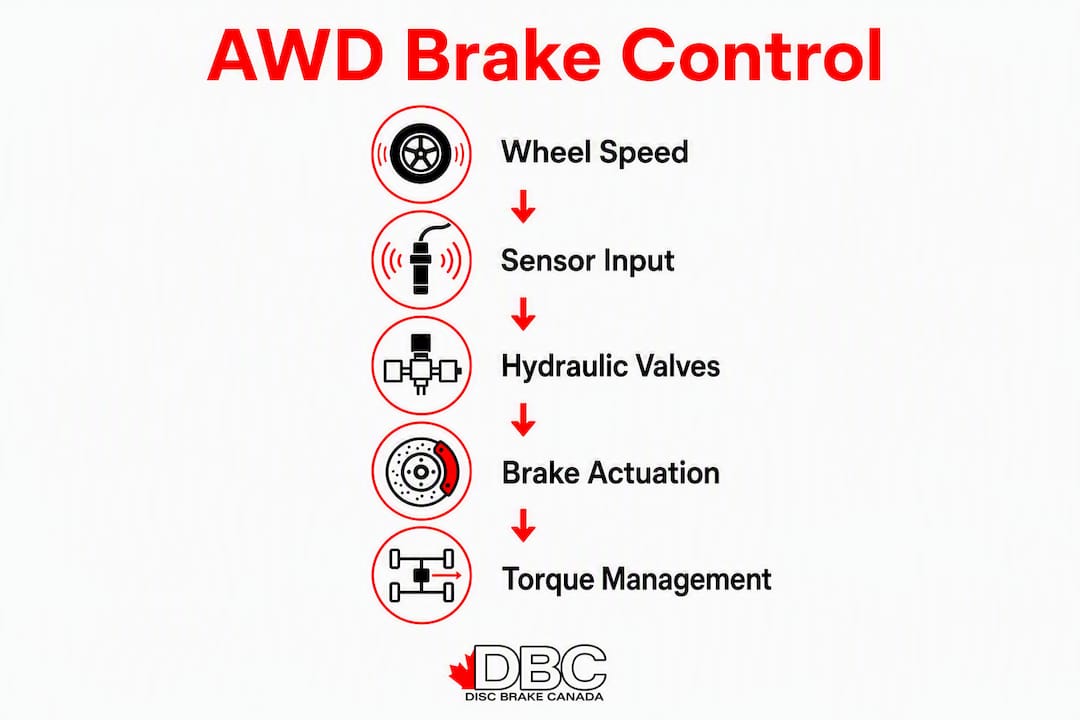
The sequence runs like this: wheel-speed sensors monitor rotational speed at each corner continuously. When a speed discrepancy appears, the ABS/ESC/traction control ECU interprets it as wheel slip. The ECU then signals the brake hydraulic control module, which opens and closes solenoid valves to apply or release hydraulic pressure at specific calipers. The result is a brief, targeted brake pulse at the slipping wheel, which transfers effective torque to the wheels with grip.
The brake hydraulic control module typically features at least 12 valves to support this wheel-by-wheel architecture. Each valve channel handles a distinct function: pressure build, hold, or release at a given corner. That valve count is why the module can manage ABS, ESC, traction control, and brake-limited slip differential (BLSD) simultaneously without conflict.
Functional behaviours in practice
Brake-limited slip differential (BLSD): When one driven wheel loses grip, the module pulses the brake at that wheel. Resistance at the spinning wheel forces the differential to send torque to the wheel with traction. This mimics a mechanical limited-slip differential without the hardware.
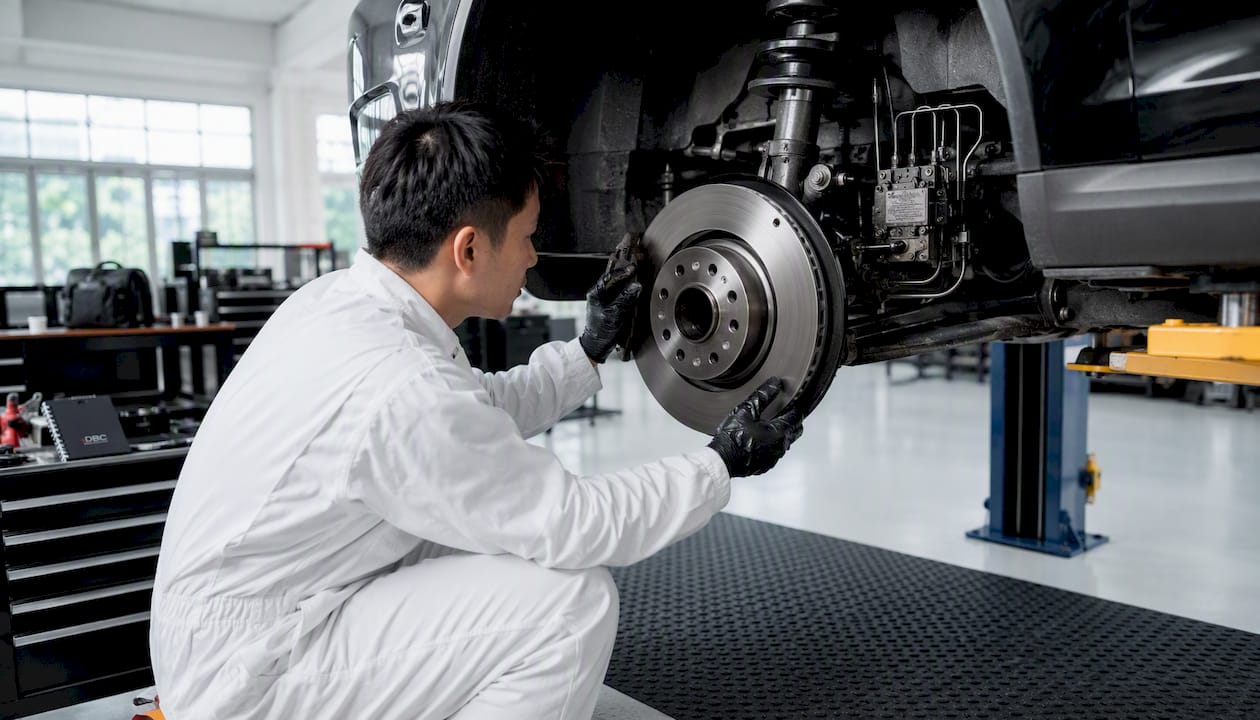
Torque vectoring via braking: Some AWD systems apply light braking to an inside wheel during cornering. This redirects torque to the outside wheel, tightening the vehicle's line through a turn.
Hill-start assist and advanced hill descent control: These functions also rely on integrated brake control, with the ABS/ESC and brake hydraulic module holding or modulating pressure while the drivetrain manages power delivery.
Scenario example: A rear-right wheel loses traction on an icy intersection while accelerating. The wheel-speed sensor at that corner reports a spike in rotational speed. The ECU detects the mismatch within milliseconds, signals the hydraulic module, and pulses the brake at the rear-right caliper. The differential redirects torque to the rear-left wheel. The driver may feel a faint shudder or hear a brief mechanical sound. That is the system working correctly.
"AWD functionality is inseparable from the health of foundation brake components because the brake hydraulic module actively manages torque distribution via braking." — Tire Review
Pro Tip: Wheel-speed sensor signal quality and caliper freedom of movement are the two most critical variables in this control loop. A sensor with corroded wiring sends a false speed reading; a sticking caliper cannot release quickly enough to allow the brief pulse the system requires. Both failures corrupt the AWD correction before the driver notices anything wrong.
How AWD integration affects pads, rotors, and calipers
AWD vehicles do not inherently consume brake pads faster because of the drivetrain alone. The relationship is more specific than that. Traction control interventions, frequent low-speed slip corrections, and driver behaviour all influence where and how wear accumulates.
Where wear patterns differ
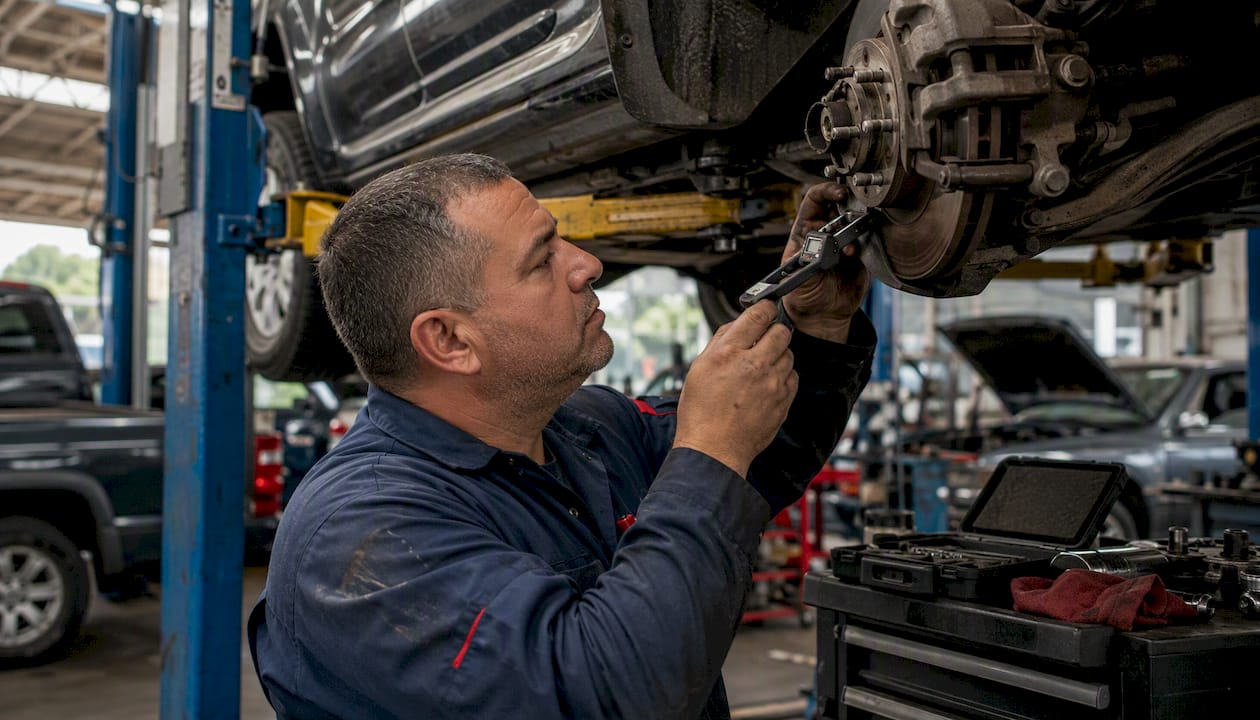
In a front-wheel-drive vehicle, the front brakes handle the majority of braking load. In a rear-wheel-drive vehicle, the rear brakes contribute more during hard stops. AWD distributes braking and torque-management loads across all four corners, which changes the wear profile. Rear pads on an AWD vehicle often wear closer to the rate of the fronts than they would on a comparable FWD platform.
The more significant wear driver is not the drivetrain layout but the frequency of traction control events. A vehicle driven regularly on loose gravel or winter roads in Canada will trigger BLSD corrections far more often than the same vehicle on dry pavement. Each correction applies a brief brake pulse. Over thousands of events, that adds up.
| Scenario | Likely effect on pads/rotors |
|---|---|
| Frequent low-speed slip correction (winter, gravel) | Accelerated pad wear at the corrected corner; minor rotor surface micro-cycling |
| Torque-vectoring events during cornering | Light, repeated contact at inside-wheel caliper; watch for uneven pad thickness side-to-side |
| Seized caliper condition | Continuous pad contact at one corner; rotor overheating, glazing, and accelerated pad wear |
| Aggressive AWD-enabled acceleration on dry pavement | Minimal traction control intervention; wear pattern similar to non-AWD equivalent |
Signs of AWD-related uneven wear
- Pad thickness varies noticeably between the left and right sides of the same axle.
- Brake modulation noise (a faint pulsing or grinding) appears during low-speed acceleration, not just braking.
- One rotor shows glazing or discolouration while the others look normal.
- The traction control warning light activates more frequently on one side of the vehicle.
Pro Tip: Check pad thickness at all four corners during every brake inspection, not just the fronts. On AWD vehicles, rear pad wear that outpaces the front is a useful early signal that traction control is working harder than expected at the rear axle.
What to inspect and maintain for AWD braking to work correctly
Keeping AWD traction and stability features functional comes down to maintaining the foundation brake components that the system depends on. The checklist below covers the items most relevant to AWD integration.
Maintenance checklist
- Pad thickness: Inspect all four corners. Replace pads before they reach the wear indicator; thin pads reduce the friction force the BLSD and traction control systems rely on.
- Rotor condition: Check for scoring, warping, and minimum thickness. A warped rotor creates a speed variation the wheel-speed sensor can misread as slip.
- Caliper operation: Confirm each caliper slides and retracts freely. A sticking caliper or failed wheel bearing can prevent AWD corrections from working properly, and the vehicle's traction and stability may be compromised.
- Wheel-speed sensors: Clean sensor faces and inspect wiring harnesses for corrosion or damage. Sensor signal quality is the first input in the AWD control loop.
- Brake fluid: Check condition and level. Moisture-contaminated fluid lowers boiling point and can cause inconsistent hydraulic pressure in the control module. For detailed guidance on fluid condition and bleeding procedures, see the brake fluid safety guide.
- Wheel bearings: Worn bearings introduce lateral movement that affects both rotor runout and wheel-speed sensor readings.
- ABS/ESC fault codes: Scan for stored codes at every service visit. A dormant fault code can indicate a sensor or module issue that has not yet triggered a warning light.
Consult your vehicle's OEM service schedule for specific intervals. As a general practice, a full brake inspection at every oil change interval is reasonable for Canadian drivers, given the salt, grit, and temperature cycling that accelerate corrosion on sensors and caliper hardware. Cold-weather performance considerations are covered in more detail in the Canadian cold-weather braking guide.
What to tell your mechanic
Describe symptoms in terms of when and where they occur:
- "The car pulses the brakes during acceleration from a stop, not during braking."
- "Traction control activates more on the left rear than the right, even on dry pavement."
- "The ABS light came on after a cold start but cleared after driving for a few minutes."
These descriptions point a technician toward the brake-AWD integration rather than a generic brake inspection.
AWD does not shorten stopping distances. Consumer Reports testing found that vehicles with matched winter tyres stopped in similar distances regardless of drivetrain. Tyre friction governs braking; the drivetrain does not. Prioritise tyre condition alongside brake condition.
How technicians diagnose AWD-related brake faults
When a vehicle shows traction or stability symptoms, the diagnostic path should start at the brake system before assuming a drivetrain fault. Seized calipers and wheel-speed sensor discrepancies are common causes of AWD correction failures that are misattributed to the transfer case or centre differential.
Step-by-step diagnostic workflow
- Retrieve ABS/ESC fault codes. Connect a scan tool and pull all stored and pending codes. Codes describing wheel-speed mismatch or intermittent sensor signal are the most common AWD-related brake faults.
- Check live wheel-speed sensor data. With the vehicle on a lift and wheels spinning, compare live speed readings across all four sensors. A sensor reporting a different speed than the others at the same wheel rotation rate indicates a faulty sensor or damaged tone ring.
- Inspect caliper movement and brake drag. Lift each corner, spin the wheel by hand, and check for resistance. A wheel that does not spin freely points to a sticking caliper or seized slide pin.
- Measure pad thickness and rotor runout. Use a dial indicator to measure rotor runout at each corner. Runout above the OEM specification can produce a false wheel-speed signal that triggers unnecessary AWD corrections.
- Test hydraulic module solenoid operation. A scan tool with bi-directional control can command individual solenoids in the brake hydraulic control module to open and close. Solenoids that do not respond correctly indicate a module or wiring fault.
- Road-test under controlled conditions. Drive on a surface where traction control is likely to activate (a wet or loose surface) and observe whether corrections occur symmetrically. An asymmetric response points to a corner-specific fault.
Fault signatures to discuss with your technician
- Wheel-speed mismatch code: One sensor consistently reads higher or lower than the others. Check the sensor, wiring, and tone ring at that corner before replacing the module.
- Wheel-speed sensor intermittent: The code appears and clears with temperature changes. Corrosion in the connector is the most common cause on Canadian vehicles exposed to road salt.
- Persistent traction control activation on one side: With no fault code present, inspect the caliper at that corner for drag. A caliper that does not fully release creates a constant speed discrepancy the system interprets as slip.
Pro Tip: Ask the technician to display live wheel-speed traces on a scan tool and record a short video of the data while the vehicle is driven. Intermittent faults that clear before the vehicle reaches the shop are much easier to confirm with recorded trace data than with a static code scan.
Live wheel-speed traces and solenoid tests are among the most reliable methods for confirming intermittent AWD-brake integration faults. If a shop cannot perform bi-directional solenoid testing, find one with the appropriate scan tool capability.
For a detailed walkthrough of caliper inspection and common failure modes, the brake caliper operation guide covers the mechanics clearly. If uneven braking is already present, the uneven braking diagnostic guide provides a step-by-step check process.
Key Takeaways
The brake system is an active component of AWD torque management, and its condition directly determines whether traction control, ESC, and BLSD functions work as designed.
| Point | Details |
|---|---|
| AWD relies on brake control | The brake hydraulic control module (typically 12+ valves) manages wheel slip and torque distribution in milliseconds. |
| Brake health affects AWD function | Sticking calipers, worn sensors, or contaminated fluid disrupt the AWD control loop before the driver notices. |
| AWD does not improve stopping | Tyre friction governs braking distance; prioritise tyre condition alongside pad and rotor maintenance. |
| Inspect all four corners | AWD wear patterns differ from FWD/RWD; check pad thickness and rotor condition at every corner, not just the fronts. |
| DBC Brakes kits for AWD vehicles | DBC Brakes cross-drilled rotor kits provide consistent friction and resist warping, supporting reliable AWD brake control. |
Why brake condition matters more in AWD vehicles than most owners realise
Most AWD owners think about their brakes the way they think about brakes on any other vehicle: replace the pads when the wear indicator squeals, check the rotors if there is a vibration. That framing misses something.
In an AWD vehicle, the brake system is doing two jobs. It stops the car, and it actively manages torque distribution every time a wheel loses grip. Those rapid brake pulses during a slippery acceleration event are invisible to the driver, but they depend on the same pads, rotors, calipers, and sensors that handle emergency stops. A sticking caliper that has not yet caused a noticeable braking problem can still be corrupting AWD corrections on every snowy departure.
The practical implication is that AWD owners should treat brake inspections as drivetrain maintenance, not just safety maintenance. Wheel-speed sensor wiring, caliper slide pins, and rotor runout belong on the same checklist as differential fluid and transfer case service. The systems are connected.
One more point worth making: AWD confidence on slippery roads is real, but it applies only to acceleration. Drivers who carry more speed into a corner or braking zone because they trust their AWD system are placing greater demand on the same tyre contact patches that any two-wheel-drive vehicle uses to stop. The brakes do not get an AWD advantage. The tyres do not either.
Quality brake components for AWD vehicles
AWD brake control depends on consistent, reliable friction at every corner. Warped rotors, glazed pads, or inconsistent pad compounds introduce the kind of variability that disrupts the hydraulic control module's ability to apply precise, repeatable brake pulses. That matters more in an AWD vehicle than in a simpler drivetrain.
DBC Brakes supplies premium brake kits with cross-drilled rotors engineered to resist warping and maintain consistent friction under repeated thermal cycling. Kits are available for a wide range of Canadian vehicles, including cars, trucks, and performance platforms, with inclusive pricing and no hidden fees. Free shipping applies to orders over $100 within Canada.
Check fitment and browse compatible kits at CrossDrilledRotors.ca. For questions about compatibility with a specific AWD platform, the support team responds directly without automated queues.
Sources and further reading
- Modern AWD Brake Control Transforms Vehicle Performance — Tire Review
- ABS Controlled AWD Systems Explained — Brake & Front End
- Simplifying AWD Systems — Brake & Front End
- All-wheel drive doesn't mean unlimited grip — Outlook India / Luxe
- FWD vs RWD vs AWD vs 4WD — Consumer Reports
- Technical bulletin: integration of braking and drivetrain control — Mitsubishi Technical Information
- All-Wheel Drive Synergies for Brakes, Transmission and Transfer Case — Tire Review