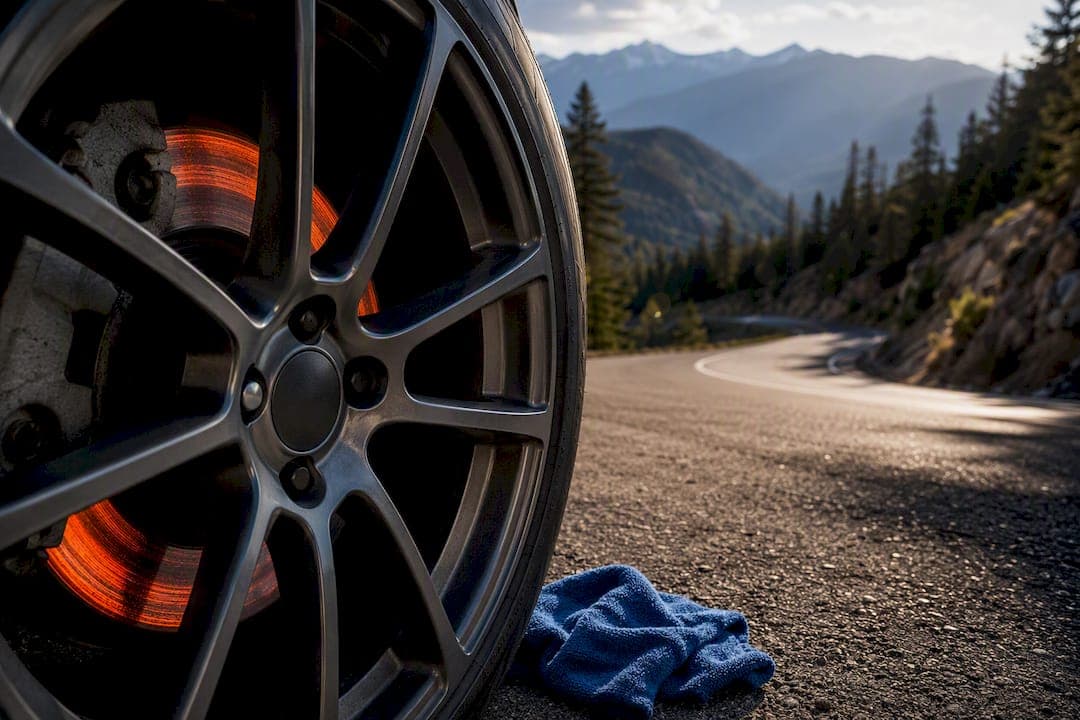
Brake fade is the heat-driven loss of stopping power that happens when pads, rotors, or fluid overheat during sustained braking. The moment you feel it on a descent, downshift, use engine braking, and stop riding the brake pedal. Look for a safe pullout to let everything cool. Fade is almost always heat-related, and regular maintenance plus the right components cut the risk substantially.
TL;DR:
- Regular brake fluid flushes with high-temperature fluid are crucial, as contaminated or old fluid lowers boiling points and accelerates fade.
- Upgrading to high-temperature pads and engineered rotors significantly reduces heat retention and gas buildup on long mountain descents.
- Use engine braking primarily by downshifting early and avoid riding the brake pedal continuously to prevent heat buildup and fade.
- Recognize early warning signs such as a spongy pedal, increased stopping distance, or a burning smell to address fade before it becomes dangerous.
- On steep, hot, or loaded descents, employ firm, intermittent braking and plan pullouts or ramps as cooling points to maintain brake performance.
Table of Contents
- What causes mountain driving brake fade?
- How do you know if your brakes are fading?
- Driving techniques to prevent brake fade on descents
- Brake maintenance for steep terrain: what to check before you go
- What to do if your brakes fade on a descent
- Post-descent checks: what to inspect before you continue
- Environmental factors influencing brake fade severity
- Sam's take: what actually reduces mountain driving brake fade
- Reduce fade risk with the right brake hardware
- Sources
What causes mountain driving brake fade?
Every time you brake, kinetic energy turns into heat at the pad and rotor surface. On a flat road, that heat dissipates before it builds up. On a long mountain grade, it doesn't get the chance. Riding the brakes for kilometres at a time keeps piling heat into components that never get a break, and eventually something gives.
There are two main types of brake fade, and they behave differently.
- Friction (pad) fade happens when pad material gets so hot it starts to glaze or off-gas. The surface hardens and loses grip, so the same pedal pressure produces less stopping force.
- Fluid (vapour) fade happens when brake fluid boils. Water absorbed into older fluid lowers its boiling point, and that creates compressible vapour bubbles in the lines, which is why the pedal suddenly feels soft or sinks toward the floor.
- Mechanical (green) fade is less common on public roads. It shows up on brand new pads that haven't been properly bedded in, and it fades quickly once the surface cures.
Disc brakes shed heat more effectively than drum brakes, but discs still overheat under the wrong conditions. A 2006 heavy-vehicle brake heating study found that temperatures can climb past safe limits on long downhills, and that the descent strategy, not just the equipment, determines whether components stay in a safe range.
Statistic Callout: Modern disc brake systems can reach temperatures above 600°F on a sustained mountain descent, a point where many standard pad compounds begin to lose friction and fluid can start approaching its boiling threshold.
Brake fade is not a malfunction in the traditional sense. It's a predictable physical response to heat, and it's largely preventable once you understand the mechanism behind it.
How do you know if your brakes are fading?
Fade rarely arrives without warning. The first sign is usually subtle: the pedal needs a little more pressure than usual to get the same stopping force. Catching that early moment is the difference between a controlled slowdown and a genuine emergency.
Watch for these signals as you descend:
- A pedal that feels spongy or requires progressively more travel to bite.
- Stopping distances that noticeably increase compared to earlier in the drive.
- A sharp burning smell, sometimes with a hint of smoke near the wheels.
- A pulsing or vibrating sensation through the pedal or steering wheel.
- A pedal that sinks slowly toward the floor under steady pressure.
A gradual increase in pedal effort points to heat buildup, either pad glazing or the early stage of fluid fade. A sudden, complete pedal sink is different. That can mean the fluid has boiled outright, but it can also mean a leak or a failing master cylinder, which is a mechanical issue rather than a heat issue. If your pedal was already soft before the descent even started, don't assume fade. Check the diagnostic steps for a soft brake pedal before you tackle a mountain road, because a hydraulic problem gets worse under heat, not better.
Burning smells without pulsing usually mean pad or rotor overheating. Pulsing alone, especially without a smell, often points to warped rotors from a previous overheating event rather than active fade happening right now.
Driving techniques to prevent brake fade on descents
Most fade is a technique problem before it's a mechanical one. Drivers who ride the brake pedal continuously through a downhill stretch are doing the one thing guaranteed to build heat fastest.
- Choose your gear at the top of the grade, not partway down. Descend in roughly the same gear you'd need to climb the same grade. That keeps your engine doing a share of the slowing work through compression, rather than leaving it all to the pads.
- Use engine braking as your primary control. Lower gears let engine compression absorb speed continuously, with zero heat generated at the rotors. This is the single biggest lever most drivers underuse.
- Snub the brakes instead of riding them. Apply firm, decisive pressure to knock off a chunk of speed, then fully release and let the rotors breathe before the next application. Short firm applications followed by release periods let rotors cool through convection in a way that constant light pressure never allows.
- Enter the descent slower than your climb speed. If you crested the grade at 80 km/h, don't start down at the same speed. Slow before the grade steepens, not after you're already committed.
- Use pullouts and runaway ramps as planned checkpoints, not last resorts. On long grades with marked pullouts, treat them as scheduled cooling stops rather than emergency-only infrastructure.
If you're driving anything heavy, towing a trailer, hauling a loaded truck bed, or piloting an RV, engine retarders and jake brakes do the same job as engine braking but with far more holding force. The one caution: on wet, icy, or gravel surfaces, hard retarder engagement or aggressive snubbing can break traction on the drive wheels. Ease into it on low-grip surfaces rather than snapping to full effect.
Pro Tip: Count your brake applications on a descent. If you're braking more often than every 10 to 15 seconds, you're likely riding the pedal too much between snubs, and heat is accumulating faster than it can escape.
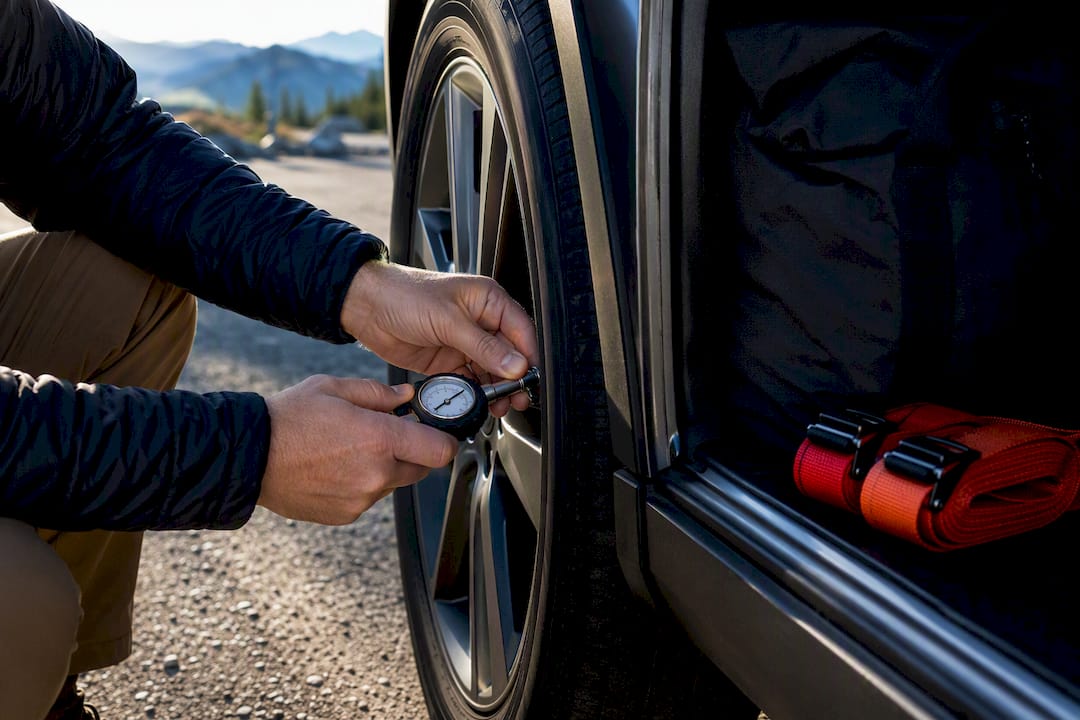
Secure any loose cargo and check tire pressure before you start down. A shifting load changes your braking balance mid-descent, which is the worst possible moment to discover it.
Brake maintenance for steep terrain: what to check before you go
Brake performance in mountains depends heavily on what's already inside the system before you reach the grade. Fluid, pads, and rotors each have a role, and each degrades in ways that matter specifically on long downhills.
Brake fluid is hygroscopic, meaning it absorbs moisture from the air over time. DOT 3 fluid has a lower dry boiling point than DOT 4, and DOT 5.1 sits higher still, but any of them loses boiling resistance as water content rises. That's why manufacturers recommend periodic fluid flushes roughly every two years regardless of mileage. Old fluid that hasn't been flushed is one of the more overlooked causes of fluid fade on descents that shouldn't have been a problem at all.
Pad compound matters just as much:
- Organic (non-metallic) pads are quiet and gentle on rotors but have the lowest heat tolerance of the common options.
- Semi-metallic pads handle more heat and give better fade resistance, a reasonable middle ground for regular mountain driving.
- Ceramic pads run cooler under moderate use but can still fade under sustained heavy braking, so they're not automatically the safest choice for repeated steep descents or towing.
Statistic Callout: Once pad surface temperatures pass roughly 600°F, many standard-compound pads begin to glaze, and glazed material keeps underperforming even after it cools back down.
Rotor design changes how quickly heat leaves the system in the first place. Vented rotors move air through internal channels. Slotted and cross-drilled designs add surface area and help clear gas and debris, which improves heat dissipation when paired with the right pad compound and correct technique. If you tow regularly, drive mountain routes often, or simply want more margin before fade becomes a factor, upgrading to high-temperature pads and engineered rotors is worth the cost.
Before any mountain trip, run this quick check: fluid level and colour, pad thickness, rotor surface for grooves or discolouration, and tire pressure. Five minutes in the driveway beats a surprise halfway down a grade.
What to do if your brakes fade on a descent
If you feel the pedal going soft or notice stopping distance stretching out, the sequence matters. Panic-stomping the brake pedal repeatedly is the wrong move; it just adds more heat.
- Lift off the throttle immediately and let the vehicle's own drag start slowing it.
- Downshift to a lower gear to bring engine braking into play right away. This works even if your brakes are already compromised.
- Pulse the brakes firmly rather than holding steady pressure. Short, hard applications with release in between can still generate stopping force even on a hot system, and each release gives the rotors a moment to shed heat.
- Scan ahead for an escape option. A runaway truck ramp, a wide uphill shoulder, or simply a section of road that climbs will help slow you using gravity instead of your brakes.
- If the pedal fully collapses, steer toward rising terrain or a runaway ramp and use whatever braking response remains combined with gear selection to bring the vehicle to a stop as safely as possible.
Once you're stopped, don't touch the vehicle's brakes again right away. Give the system 10 to 15 minutes to cool evenly before resuming any real speed. If the pedal never firms back up after cooling, that's fluid contamination or a leak, and it needs a tow rather than a continued drive.
Post-descent checks: what to inspect before you continue
Don't set the parking brake the instant you stop after a hard descent. Hot rotors can bond to the pad material or warp under uneven cooling if you clamp them down while they're still radiating heat. Let the vehicle sit in park with the transmission holding it, or chock the wheels if you're on any kind of grade.
Once things have cooled, check for:
- A burning smell that lingers well after the vehicle has stopped moving.
- Visible discolouration, grooving, or a glazed, glassy look on the rotor surface.
- A pulsing pedal on the next drive, which usually means the rotor warped during the heat event.
- Fluid that looks dark or smells scorched when you check the reservoir.
Pro Tip: If your pedal felt fine on flat ground before the descent but got progressively worse the further down you went, that's a strong sign of heat-related fade rather than a pre-existing mechanical fault. Note it and get the system checked regardless.
Any of those signs is reason enough to book a shop visit rather than gamble on your next drive.
Environmental factors influencing brake fade severity
Altitude and ambient temperature both push fade risk higher, sometimes in ways that catch drivers off guard. Mountain roads combine steep, sustained grades with elevation changes that most drivers' braking habits were never built for on flatter routes.
Hot summer days compound the problem directly. Ambient air that's already warm gives your brake components less of a temperature gap to dissipate into, so the same descent that felt manageable in cool spring weather can push components into fade territory in July heat. Towing or carrying a full load adds kinetic energy that has to be absorbed as heat somewhere, and on a hot day, that heat has less room to escape.
Altitude changes matter too, though less predictably. Thinner air at higher elevations affects engine performance, which can reduce the effectiveness of engine braking exactly when you need it most. Cold mountain mornings help by giving components more thermal headroom, but that same cold can mean icy patches on shaded sections of the same road, which limits how aggressively you can use snubbing or engine retarders without losing traction.
The practical takeaway: treat a hot, loaded, high-altitude descent as the highest-risk combination you'll face, and drive it more conservatively than a similar grade on a cool day with an empty vehicle.
Sam's take: what actually reduces mountain driving brake fade
Most advice on this topic treats technique and hardware as separate conversations. They're not. A driver using perfect snubbing technique on worn-out pads and two-year-old fluid is still gambling on a long grade. And a truck with fresh high-temperature pads and cross-drilled rotors, driven by someone riding the brake pedal the whole way down, will still fade.
The conventional wisdom oversells gear selection alone as the fix. It's necessary, but it's not sufficient if your fluid hasn't been flushed or your pads are already glazed from a previous overheating event nobody noticed. Before your next mountain trip, prioritise the fluid check first. It's the cheapest, most overlooked variable, and boiling fluid causes the scariest kind of fade: the sudden, sinking-pedal kind with no warning.
Technique buys you margin. Maintenance and the right components buy you a bigger margin. Do both.
— Sam
Reduce fade risk with the right brake hardware
Snubbing and gear selection only go so far when your rotors can't shed heat fast enough between applications. DBC Brakes builds cross-drilled rotors specifically to move more air and gas away from the pad surface during sustained downhill braking, which matters most on the exact long-grade scenarios covered above.
If you tow regularly, drive mountain routes often, or simply want a wider safety margin on steep descents, check fitment for your vehicle and browse the full performance brake kit lineup. Pricing details and shipping policies vary by supplier; please check the vendor's website for current information. For heavier-duty use, towing setups or frequent mountain trips, the premium brake kit line uses higher-temperature components built for exactly this kind of repeated heat load. Pro installation is recommended for any rotor and pad upgrade. Start by checking which kit fits your vehicle.
Sources
For deeper technical detail beyond this guide, these sources cover the mechanics and procedures referenced throughout:
- Brake fade — Wikipedia
- What causes brakes to overheat (and what to do when it happens) — Jalopnik
- What to do if your brakes overheat on a long descent — Ride Gear Lab
- Brake fade: Symptoms, causes & how to prevent it — Car Care Total