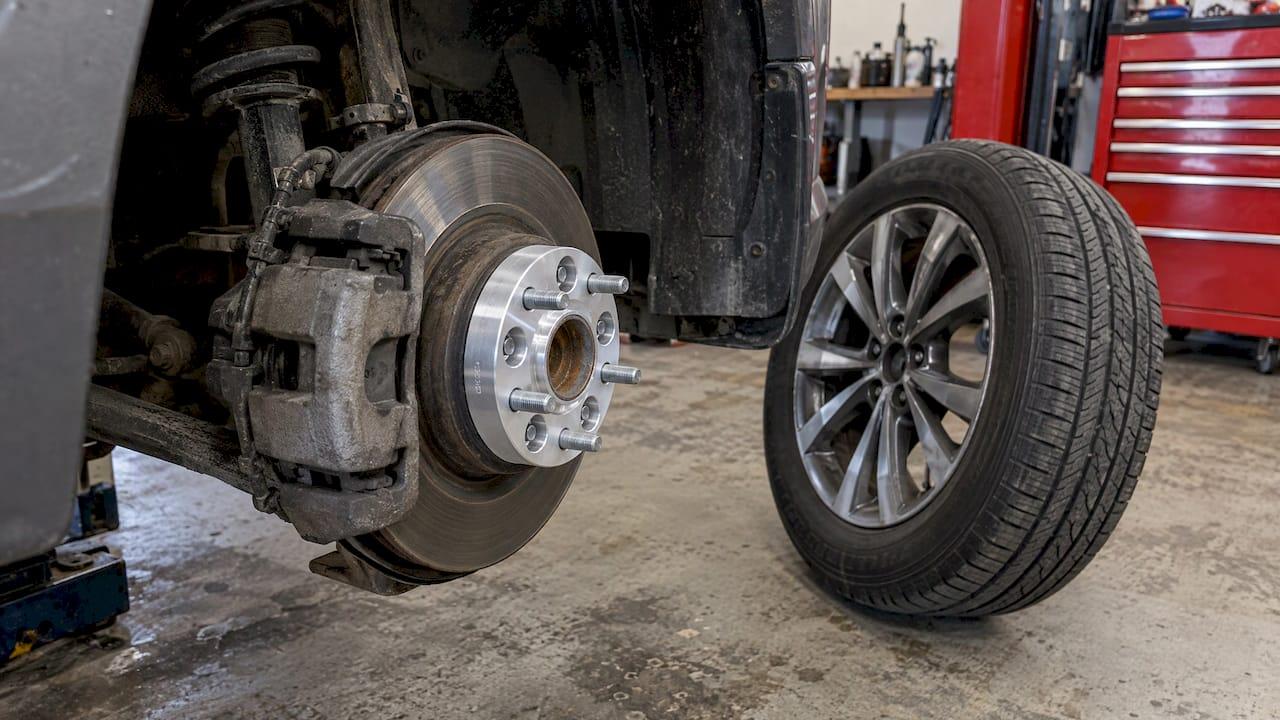
Wheel spacers do not improve braking performance. They move the wheel outward, and that changes the forces the steering, the studs and the wheel bearings carry while the brakes are working. Stopping power comes from the rotors, pads, calipers and tires. A spacer touches none of them. A spacer can solve one narrow problem, a wheel that touches a caliper. Any driver who wants shorter stops should look at the brake kit first.
This guide covers what spacers do under braking, when they are used for caliper clearance, what to check if they are fitted, and what the rules in Canada say.
TL;DR
- Spacers add no stopping power. They change track width and wheel offset, which changes steering forces under braking.
- Extra width raises loads on wheel studs and bearings. Poor fitment can end in stud failure or wheel separation.
- A spacer only helps when the back of a wheel touches a caliper. It does nothing for barrel clearance.
- Road-use rules vary by province. Ontario and Quebec are reported to treat spacers as illegal for road use.
- For better braking, upgrade rotors, pads or the full brake kit. Fitment is guaranteed on DBC kits.
Table of Contents
- What a spacer changes at the wheel
- How spacers change behaviour under braking
- Spacers and brake clearance
- Downsides and risks
- Are spacers legal in Canada?
- Fitment checks if spacers are already installed
- When a spacer is the wrong tool
- What improves braking instead
- Order brake parts that fit the first time
- Our view
- FAQ
- Sources
What a spacer changes at the wheel
A wheel spacer is a flat plate, or adapter, that sits between the hub and the wheel. It pushes the wheel outward by a set distance, often 5 mm to 50 mm. Two numbers change as a result:
- Track width: the distance between the left and right wheels.
- Offset: how far the wheel's mounting face sits from the wheel's centreline. A spacer lowers the effective offset.
The brake system itself stays where it was. The rotor, caliper and pads are bolted to the hub and knuckle. Only the wheel and tire move. That is why a spacer cannot shorten a stop by itself.
How spacers change behaviour under braking
Steering forces
Braking force acts at the tire contact patch. The distance between that point and the steering axis is called scrub radius. Kingpin offset is a related measurement at the hub. Both grow when the wheel moves outward.
A suspension engineer interviewed by The Autopian gives figures. A 50 mm spacer can raise a 15 mm scrub radius to 65 mm, almost five times larger. It can also flip a negative scrub radius to a positive one, which reverses the direction of the steering moment created by braking. The driver then has to resist a bigger force, and sometimes one pushing the other way.

In practice that can feel like a tug at the steering wheel on hard stops. It is stronger when the left and right tires grip differently. One technical write-up on spacers notes that a larger scrub radius can add steering pull during split-friction braking, for example when one side of the car is on wet paint or gravel.
The same write-up puts small spacers in context. A 20 mm to 30 mm track change is small against a total track of about 1,500 mm to 1,700 mm. It treats spacers as a fitment part or a fine chassis adjustment, not a major performance modification. The effects listed include stronger steering feedback, more kickback over potholes and more tramlining.
Extra weight at the hub
A spacer adds mass at the wheel, the worst place for it. Unsprung mass is everything the springs do not carry, and it affects how fast the suspension and wheel respond. One motorsport engineering article states that even 1 lb added at each corner reduces suspension response and braking efficiency on track-focused vehicles. On a daily driver the change is small. On a track car it is one more reason to fix fitment at the wheel rather than add a plate.
Handling myths
A wider track is often said to improve handling on sports cars. The Globe and Mail's Drive section calls this a popular misconception. Wider stance looks good. It does not make the brakes stronger.
Spacers and brake clearance
The one honest braking-related use of a spacer is clearance. Some aftermarket wheels sit too close to a caliper or suspension part. One Canadian spacer retailer's FAQ says some wheels need spacers to clear calipers or suspension components, and that hub-centric spacers may need a minimum chamfer around the wheel's centre bore to sit flush.
There is a limit to what a spacer fixes. A shop's clearance guide for big brake kits explains that a 5 mm hub-centric spacer moves the whole wheel outboard by 5 mm. That widens the gap between the back of the spokes and the caliper face, the most common point of contact. It does nothing for radial clearance between the caliper and the inside of the wheel barrel. The same guide says most performance applications can absorb 3 mm to 5 mm of spacer without practical consequence. Beyond that, the stance is being changed.
The cleaner path is to choose a brake kit and wheel combination that fits without a spacer. DBC brake kits are made for specific vehicles and are sold with guaranteed fitment. Support staff answer questions about a vehicle and wheel setup directly, without automated replies.

Downsides and risks
Moving the wheel outward lengthens the lever acting on the wheel studs and bearings. The Globe and Mail uses a tire-iron analogy: a longer iron multiplies the force. The result is more load on studs, hub threads and bearings, shorter life for each, and in the worst case broken studs, stripped threads and wheel separation.
The Autopian's engineer adds that the larger scrub radius and kingpin offset reduce wheel bearing life. Bearings that would normally last the life of the car can fail early.
Spacers can also push the wheel closer to the caliper. A tight gap can cause rubbing. Rubbing means heat, noise and wear on the wheel and caliper.
If a car already runs spacers and a bearing starts to hum, the hub assembly is the part to replace. DBC lists wheel bearings and hubs in its catalogue next to rotors, pads and kits.
Are spacers legal in Canada?
Rules differ by province and territory. A Canadian retailer's article on spacer safety and legality says road-use requirements and inspection standards vary, and that some inspection standards reject aftermarket spacers even when correctly installed. It advises confirming the rules with the provincial or territorial vehicle authority or an authorized inspection facility before buying for road use.
The Globe and Mail reports that spacers are deemed illegal for road use in Ontario and Quebec. The article is from 2021. Check the current rule with the provincial ministry before fitting anything, and again before a safety inspection.
That step belongs to the authority and the inspection station. A brake kit that bolts on without a spacer avoids the question.
Fitment checks if spacers are already installed
Some vehicles already have spacers. These checks reduce risk. A qualified automotive technician should install and inspect them. The retailer FAQ above advises stopping use if there is unusual vibration, looseness, rubbing or damage.
- Match the part to the vehicle. Check spacer width, bolt pattern, centre bore, thread pitch, seat style and vehicle application, as listed in a manufacturer instruction sheet.
- Clean the mating surfaces. Remove rust and debris from the hub face with a wire brush. A Canadian installation guide also calls for measuring the factory hub lip with calipers, since it can vary by axle.
- Confirm flush seating. The spacer must sit flat on the hub, and the wheel must sit flat on the spacer. If either does not, the vehicle should not be driven.
- Use the specified hardware. Kit-specified extended studs or approved hardware only, with minimum thread engagement verified. Start every nut by hand.
- Torque in stages. Tighten in a star pattern and final-torque with a calibrated torque wrench to the OE or wheel manufacturer specification.
- Check clearance. Turn the steering to full lock in both directions and look at the gap between wheel and caliper. Check through safe suspension travel as well.
- Re-torque. The Canadian guide says to re-check torque after about the first 100 km. The manufacturer sheet gives about 25 miles and again at 500 miles. Confirm there is no rubbing, looseness or vibration.
Checking for contact
Brake dust hides rub marks. Clean the back of the wheel and the caliper area first, using a method to remove brake dust safely. Then look for bright polished spots on the caliper or wheel, scraped paint or fresh metal. Any of these means contact. A caliper that touches a wheel needs a different wheel, a different spacer width or a different brake setup. Driving on it is not a fix.
When a spacer is the wrong tool
| Goal | Does a spacer help? | What changes the result |
|---|---|---|
| Shorter stopping distance | No | Rotors, pads, calipers, tires |
| Less brake fade | No | Pads and rotor design, ventilation |
| Wheel touches caliper | Sometimes, in small widths | A kit and wheel sized to fit |
| Better handling | No | Tires, suspension, alignment |
| Wider look | Yes | A stance change with the risks above |
Most drivers who search this topic want the first row. That is a brake job.
What improves braking instead
Stopping distance depends on the pads, the rotors, the fluid and the tires. Each can be upgraded without changing track width.
- Rotors. DBC's cross-drilled rotors are engineered to resist warping and last longer. The range includes Black Koted rotors in the Performance XDB, Premium Black Kote and Performance SS lines.
- Pads. Carbon performance pads come with a hardware kit on selected listings.
- Full kits. A brake kit pairs parts built for one vehicle, so the pieces fit each other and the wheel.
- Larger calipers. Big brake kits suit performance vehicles and are matched to the vehicle.
Wheel clearance is worth checking before any large-diameter upgrade. Support at DBC can confirm fitment for a vehicle and wheel before the order is placed.
Order brake parts that fit the first time
DBC is a Canadian manufacturer of brake kits for cars, trucks and performance vehicles. Pricing is inclusive, with no hidden fees. Shipping is free in Canada on orders over $100. Expedited shipping is $29.99 per order. International shipping is $129.99 per brake kit, as listed on the shipping information page.
To start, select the vehicle on the make page and compare the kits listed for it.
The full brake kit collection is also open for browsing by type.
Our view
We build brake kits, so this is where we stand. A spacer is a fitment part. It is not a brake part. When a driver asks about spacers and braking, the real question is usually one of two things: a wheel that touches a caliper, or stopping that is not strong enough.
For the second one, the answer is in the brake system. Rotors that resist warping, pads suited to the driving, and parts that fit the vehicle. Our cross-drilled rotors are engineered for that job, and we make kits for specific vehicles so they fit the wheels they are meant to fit.
For the first one, we prefer to solve fitment at the source. A matched kit and wheel keeps the track width as the manufacturer set it. Our support team answers questions from drivers directly, by people who know the parts, not by an automated script.
Send the vehicle, the wheel size and the goal. We will tell you which kit suits it.
Sam
FAQ
Do wheel spacers affect braking performance?
Yes, but not by adding stopping power. They widen the track and increase scrub radius, which can change steering forces during braking. They also add unsprung mass. Brake components stay the same.
Can wheel spacers give clearance for a brake upgrade?
A small hub-centric spacer can move a wheel away from the caliper face. It does not help where the caliper meets the inside of the wheel barrel. A shop guide puts the usual practical range at 3 mm to 5 mm. A kit matched to the wheel is the cleaner route.
Are wheel spacers safe for daily driving?
A Canadian spacer retailer says they can be used safely in suitable applications when correctly selected, installed and maintained. It recommends installation and inspection by a qualified technician. Stop driving if there is vibration, looseness, rubbing or damage, and check provincial rules first.
Are wheel spacers legal in Canada?
It depends on the province. The Globe and Mail reports they are illegal for road use in Ontario and Quebec. Other provinces and territories have their own inspection standards, so confirm with the provincial vehicle authority or an authorized inspection station.
What is the best way to improve braking without spacers?
Upgrade the rotors, pads or the full kit. Parts made for the vehicle keep the original track width and fit the wheels. DBC ships free in Canada on orders over $100.
Sources
- Our Suspension Engineer Talks About The Effects Of Wheel Spacers, The Autopian
- Do aftermarket wheel spacers really improve handling on sports cars?, The Globe and Mail
- Wheel Spacers: Handling, Risks and ITV Requirements, Torque Tuning CDS
- Wheel Spacers Explained, Triton Motorsports
- Wheel Spacer FAQs, Status Performance
- Why Two Wheels With Identical Specs Fit Different Brakes, Performance Plus Tire
- Are Wheel Spacers Safe and Legal?, Status Performance
- Wheel Spacer Instruction Sheet, Eibach Canada
- Installation Instructions, Status Performance
- Remove brake dust safely, Diamondbrite