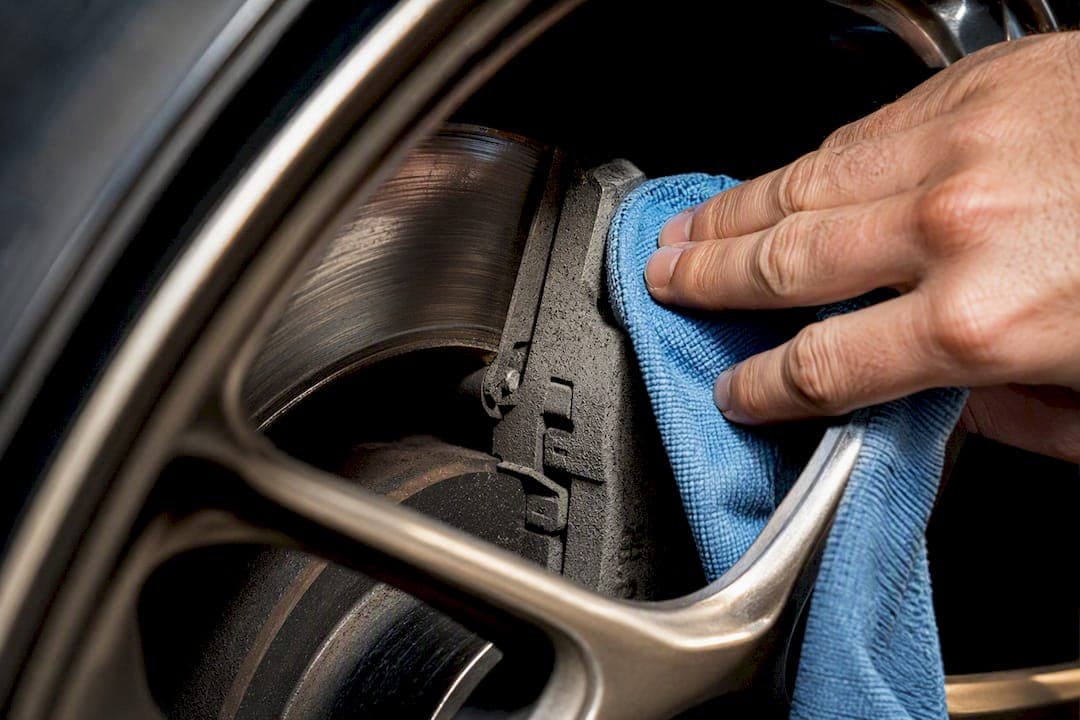
The fastest way to cut visible brake dust is to switch to a matched low-dust pad and rotor kit, then add a sacrificial wheel coating and stick to a routine cleaning schedule. Ceramic or carbon-ceramic pads are the single biggest lever. Coatings and cleaning handle what pads leave behind. None of this brings dust to zero, but the combination is what makes a noticeable, lasting difference.
TL;DR:
- Switching to low-dust ceramic or carbon-ceramic pads can reduce brake dust by 40 to 60 percent compared to semi-metallic options.
- Applying a ceramic wheel coating or sealant helps prevent dust from bonding to wheel surfaces, making cleaning easier and faster.
- Using rotors with protective finishes like E-coating or corrosion resistance significantly cuts rust transfer and dust adhesion over time.
- Regularly cleaning wheels with pH-neutral cleaners and avoiding aggressive acids prevents surface etching and preserves wheel finish.
- Choosing a matched brake kit designed for compatibility and engineered to resist warping offers a practical way to lower dust and improve brake performance.
Table of Contents
- Brake dust reduction: the ranked shortlist that works
- Which pad and rotor materials cut dust the most?
- Do wheel coatings actually stop brake dust from sticking?
- How do you clean brake dust off wheels safely?
- What maintenance schedule keeps brake dust under control?
- How does a matched DBC kit cut dust and simplify all of this?
- What health and environmental risks come from brake dust?
- What's new in brake dust reduction technology?
- Author perspective: what actually moves the needle
- Ready to reduce brake dust? Start with a matched kit
- Sources
- FAQ
Brake dust reduction: the ranked shortlist that works
Owners rarely need a lecture on brake chemistry. They need a list of what to do first. Here is the order that gets results, ranked by expected impact:
- Swap to low-dust ceramic or carbon-ceramic pads. This single change produces the largest visible drop, with consumer roundups reporting dust reductions around 40 to 60 percent versus semi-metallic compounds.
- Apply a wheel sealant or ceramic coating. It doesn't stop dust from forming, but it stops dust from bonding to the finish, which makes cleaning faster and less abrasive.
- Choose rotors with a protective finish. E-coated or corrosion-resistant rotors reduce rust transfer onto the wheel face, a problem plain cast iron doesn't solve.
- Build a safe wheel-cleaning routine. Regular, correctly timed cleaning stops dust from baking onto hot metal, where it etches instead of wiping off.
- Adjust driving and maintenance habits. Smoother braking and proper bedding-in reduce the total wear volume your brakes generate in the first place.
Each tactic compounds the others. Pads alone won't stop dust from sticking. Coatings alone won't reduce how much dust your brakes produce.
Which pad and rotor materials cut dust the most?
Brake dust is mostly worn pad and rotor material, kicked off by friction and baked into fine particulate by heat. The composition of that particulate depends heavily on what the pad is made from, which is why pad choice is the number one owner-controlled variable.
Ceramic pads produce lighter, less abrasive dust that doesn't cling to wheels the way metallic dust does. They run quieter and stay cleaner longer, though they can feel less aggressive on initial cold bite than aggressive semi-metallic compounds.
Semi-metallic pads offer strong heat resistance and reliable stopping power under load, including towing, but they shed darker, more abrasive dust loaded with iron particulate that etches unprotected wheel finishes.
Organic pads run softer and quieter with modest dust output, but they wear faster and lose bite under sustained heat, making them a poor match for track use or heavy hauling.
Carbon-ceramic systems sit at the top end. Owners of these setups often report going weeks between wheel cleans instead of days, because the dust produced is both lighter and less corrosive than iron-based alternatives. They cost more and are typically reserved for performance or luxury applications.
- Ceramic: low dust, quiet, moderate cold bite
- Semi-metallic: higher dust, strong heat capacity, good for towing
- Organic: low dust, shorter lifespan, weak under heat
- Carbon-ceramic: lowest dust and corrosion, premium pricing
Rotor material matters too. Stainless-steel discs paired with inorganic friction materials have shown wear reductions of about 85 percent compared to conventional setups in Fraunhofer IWU testing, a signal that rotor-side engineering is catching up to pad-side gains. For deeper technical comparisons of pad compounds, this guide to high-performance brake compounds breaks down the trade-offs in more detail.
Pro Tip: Expect a temporary spike in visible dust during the first 200 to 300 kilometres on new pads. That's the bedding-in process forming a stable transfer layer on the rotor, and it settles down once the surface finishes seasoning.
Do wheel coatings actually stop brake dust from sticking?
Coatings don't reduce how much dust your brakes generate. What they do is stop that dust from bonding to the wheel surface, which is arguably just as important for keeping wheels looking clean day to day.
Sacrificial sealants are the entry-level option. They form a thin barrier that sheds along with the grime, typically lasting a few weeks per application, and need reapplication after every deep clean.
Polymer coatings last longer, often several months, and give a slicker surface that dust wipes off with less scrubbing.
Ceramic wheel coatings offer the longest protection, sometimes a year or more, and provide the strongest resistance to heat and brake dust adhesion, though they cost more upfront and require careful surface prep.
Rotor-side finishes matter here too. E-coated, zinc-plated, or ceramic-coated rotors resist corrosion better than bare cast iron, which reduces the amount of rust particulate that mixes into your brake dust and stains wheels a rusty orange over time. A rotor material comparison is worth a look if you're deciding between cast iron, stainless, and coated options.
- Sacrificial sealant: cheapest, weeks of protection, easy reapplication
- Polymer coating: moderate cost, months of protection
- Ceramic coating: highest cost, longest protection, the best adhesion resistance
One caution: not every coating suits every wheel finish. Acidic or overly aggressive prep products can strip clear-coated alloys, so match the coating chemistry to your wheel's finish before applying anything.
How do you clean brake dust off wheels safely?
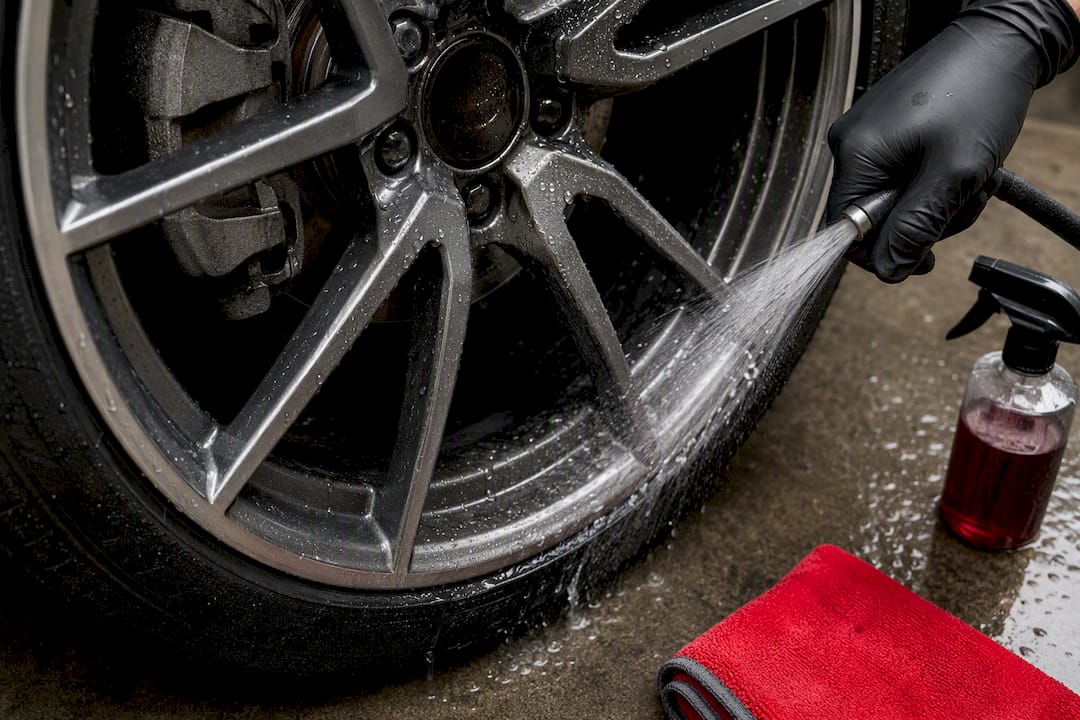
Brake dust turns corrosive when it sits and bakes onto a hot wheel, so the biggest safety rule is simple: let wheels cool fully before you touch them. Work outdoors or in a ventilated space, and wear gloves and eye protection, since brake dust contains fine metallic particulate you don't want on skin or in your eyes.
- Pre-rinse the wheel to knock off loose surface grime before any product touches it.
- Apply a pH-neutral wheel cleaner or iron fallout remover, matched to your wheel's finish.
- Let it dwell for the time stated on the product, usually a couple of minutes.
- Agitate gently with a soft wheel brush, working into lug areas and barrels.
- Rinse thoroughly, then dry with a clean microfibre towel.
- Reapply sealant or coating once dry to reset the protective layer.
Avoid strongly acidic wheel cleaners on polished or clear-coated finishes. They cut through grime fast, but they can also etch the surface permanently if left too long or used on the wrong alloy. Iron fallout removers that change colour on contact are useful for gauging how much bonded dust you're dealing with.
Cleaning frequency depends on pad type. Semi-metallic pad owners often need weekly attention, while ceramic or carbon-ceramic setups can often stretch to every couple of weeks. Between deep cleans, a quick rinse after any dusty drive keeps grime from setting.
Pro Tip: Keep dwell times on the shorter end for iron removers, generally in the two to five minute range, since longer dwell doesn't clean better, it just raises the risk of streaking or spotting on sensitive finishes.
What maintenance schedule keeps brake dust under control?
New pads need a proper bedding-in cycle over the first 200 to 300 kilometres. Expect slightly elevated dust during this window as the pad and rotor form a stable transfer film; once that settles, dust output drops to its normal baseline for that compound.
- Inspect pads and rotors every 10,000 to 15,000 kilometres, or sooner if dust suddenly increases in volume or turns a rusty colour.
- A sudden jump in dust, noise, or a gritty pedal feel usually signals uneven wear or a glazed rotor, not just normal use.
- Cost drivers include pad compound, rotor finish, labour if installed professionally, and any coatings applied afterward.
- DIY installation is reasonable for pads and rotors if you're comfortable with basic hand tools; matched kits with pre-machined rotors simplify the job considerably.
- Professional installation is worth the cost when working with performance calipers, big brake kits, or unfamiliar suspension geometry.
How does a matched DBC kit cut dust and simplify all of this?
Buying pads and rotors separately means gambling on compatibility. A pad compound that's too aggressive for a given rotor finish wears unevenly, which throws off dust output and shortens the life of both parts. Matched kits solve that mismatch by design.
Some manufacturers build kits around engineered cross-drilled rotors designed to resist warping, paired with pad compounds selected to work with specific rotor finishes. Lineups may include various finishes and compounds, giving daily drivers and enthusiasts a range of options without mixing unverified parts.
- Cross-drilled rotors engineered to reduce warping and improve heat dissipation
- Transparent pricing without hidden fees
- Shipping options for orders above a minimum amount
- Customer support provided by knowledgeable representatives
A matched kit like this suits daily drivers who want consistently lower dust and predictable stopping power without guesswork. Track-focused owners chasing extreme heat tolerance may still lean toward specialist carbon-ceramic setups, but for everyday roads, a properly matched pad and rotor pairing is the more practical fix. The performance brake kit lineup is a reasonable starting point for comparing options.
What health and environmental risks come from brake dust?
Brake dust isn't just a cosmetic nuisance. It's airborne particulate, and that particulate doesn't disappear once it settles off your wheels.
Fine particulate from brake wear, particularly PM10 and PM2.5-sized particles, can be inhaled and has drawn growing attention from air quality researchers, since braking emissions occur regardless of what powers the vehicle. That's part of why electric vehicles, despite producing zero tailpipe emissions, still contribute particulate pollution through brake and tyre wear.
Testing on hybrid dust collection systems, combining electrostatic precipitators with inertial separators, found reductions of 60 to 75 percent in PM10 emissions and similar cuts to PM2.5, depending heavily on the pad material tested. That range matters: it confirms pad composition isn't just a wheel-cleanliness issue, it's a measurable factor in how much particulate actually escapes into the air.
Metallic dust also has a corrosive side effect on wheels themselves. Iron-heavy particulate from semi-metallic pads oxidizes quickly, and that rust-tinted residue can etch into alloy finishes if left too long, permanently dulling the surface. This is one more reason pad choice sits at the top of the dust-reduction list rather than treating cleaning as the whole solution.
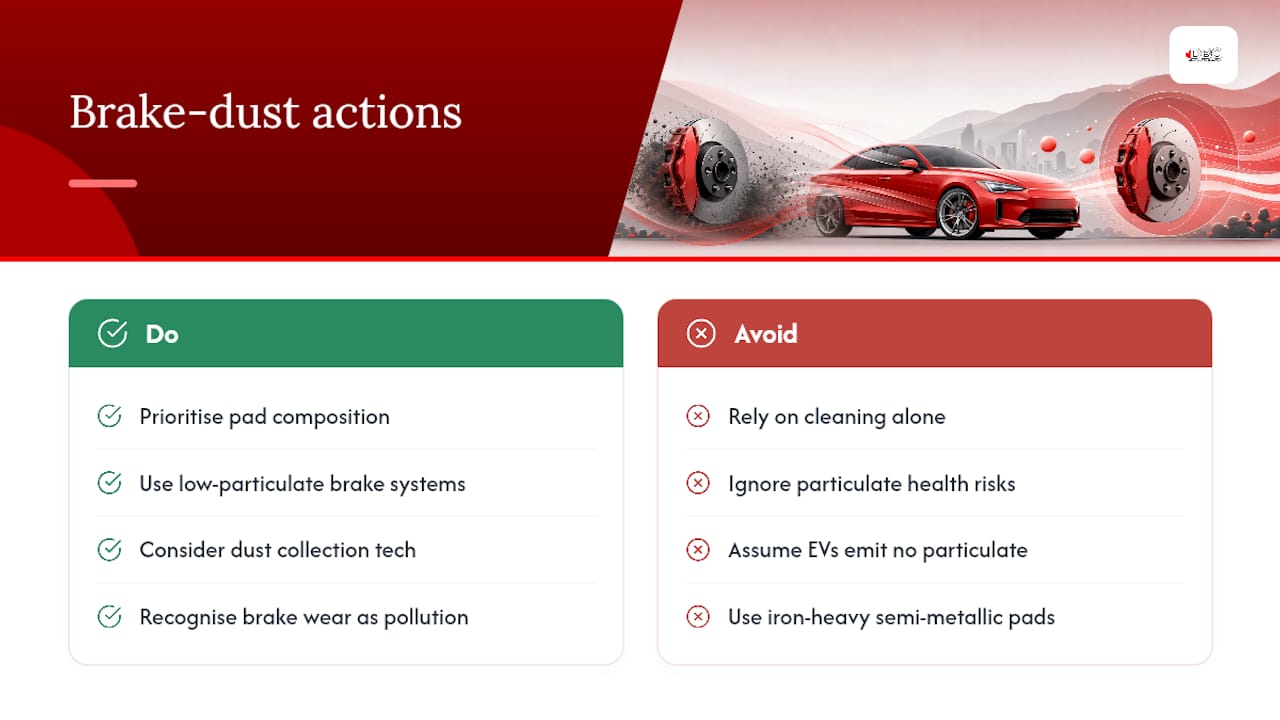
Regulatory bodies have taken notice too. Emerging European emissions frameworks are pushing manufacturers toward brake systems with dramatically lower particulate output, treating brake wear as a pollution source worth regulating, not just a maintenance inconvenience.
What's new in brake dust reduction technology?
The most significant recent development comes from Brembo, whose Greentell system pairs an engineered rotor and pad combination that cuts particulate emissions by roughly 90 percent while also reducing surface corrosion by around 80 percent in testing. That's a substantial jump over incremental pad-material improvements, and it signals where OEM-level braking technology is heading.
Fraunhofer IWU's work on stainless-steel discs points in a similar direction. Pairing stainless rotors with inorganic friction materials cut wear by about 85 percent while meeting stricter particulate targets tied to upcoming Euro 7 regulation. These aren't consumer retrofit products yet, but they show manufacturers treating dust as a design problem to engineer out, not just a cleaning problem to manage.
Hybrid particulate capture, combining electrostatic and inertial separation technology, has demonstrated strong results in lab settings too. None of this is available as an aftermarket bolt-on today. For now, the practical owner-side lever remains pad and rotor material choice, backed by coatings and cleaning, while OEM-level systems slowly filter down into production vehicles over the next several years.
Author perspective: what actually moves the needle
Commuters get the most value from a straightforward rule: prioritize pad compound first, coating second, and treat cleaning frequency as the variable you control weekly, not the fix itself. Enthusiasts running spirited weekend drives can lean harder into rotor finish, since heat cycling matters more for them than for someone doing highway commutes. Tow and haul owners should resist the urge to chase low-dust pads at the expense of heat capacity. A semi-metallic compound that handles load safely is worth more than clean wheels.
Coatings need refreshing every few months. Pads need attention every 10,000 to 15,000 kilometres. Neither replaces the other, and pretending one solves what the other is built for is where most owners waste money.
— Sam
Ready to reduce brake dust? Start with a matched kit
Piecing together a pad from one brand and a rotor from another leaves you're guessing whether they'll wear evenly, and that guesswork is exactly what drives uneven dust output in the first place. Some companies offer matched kits built around cross-drilled rotors engineered to resist warping, paired with pad compounds designed to work with those rotors, featuring transparent pricing without hidden fees.
Browse the Performance XDB, Premium Black Kote, and Performance SS lines to find a kit matched to your vehicle, or head straight to the brake kit collection to check fitment. Orders over $100 ship free within Canada, and if you need expedited or international shipping, those options are listed at checkout. Have a fitment question before you buy? DBC Brakes' support team answers directly, without an automated queue standing between you and a real answer.
Sources
- Brembo develops brakes with almost no brake dust and less wear - Ars Technica
- Development of Dust Collectors to Reduce Brake Wear PM Emissions
- 2026 | Fraunhofer IWU: stainless-steel brake discs significantly reduce emissions
FAQ
What is the 30/30/30 rule for brakes?
It refers to bedding-in guidance where new pads are brought up to temperature gradually over a short initial distance, cooled, and repeated, though exact figures vary by manufacturer. The core idea matters more than the exact numbers: controlled heat cycling builds a stable pad-to-rotor transfer layer before normal driving begins.
Why do German cars have so much brake dust?
Many German performance vehicles use aggressive semi-metallic pad compounds tuned for strong cold bite and high-heat stability, and those compounds naturally shed more abrasive, iron-heavy dust than ceramic alternatives. Switching to a low-dust ceramic pad is the most direct fix if dust volume bothers you more than ultimate stopping performance.
Does WD-40 get rid of brake dust?
WD-40 isn't formulated as a wheel cleaner and can leave an oily residue that attracts more dust rather than less. A pH-neutral wheel cleaner or dedicated iron fallout remover is the safer, more effective choice.
Do ceramic brake pads reduce brake dust?
Yes. Ceramic pads produce lighter, less abrasive dust that doesn't cling to wheel surfaces as readily as semi-metallic dust, and consumer testing puts the reduction around 40 to 60 percent compared to semi-metallic compounds. DBC Brakes' matched kits pair compatible pad and rotor finishes to help keep that reduction consistent over the life of the brakes.