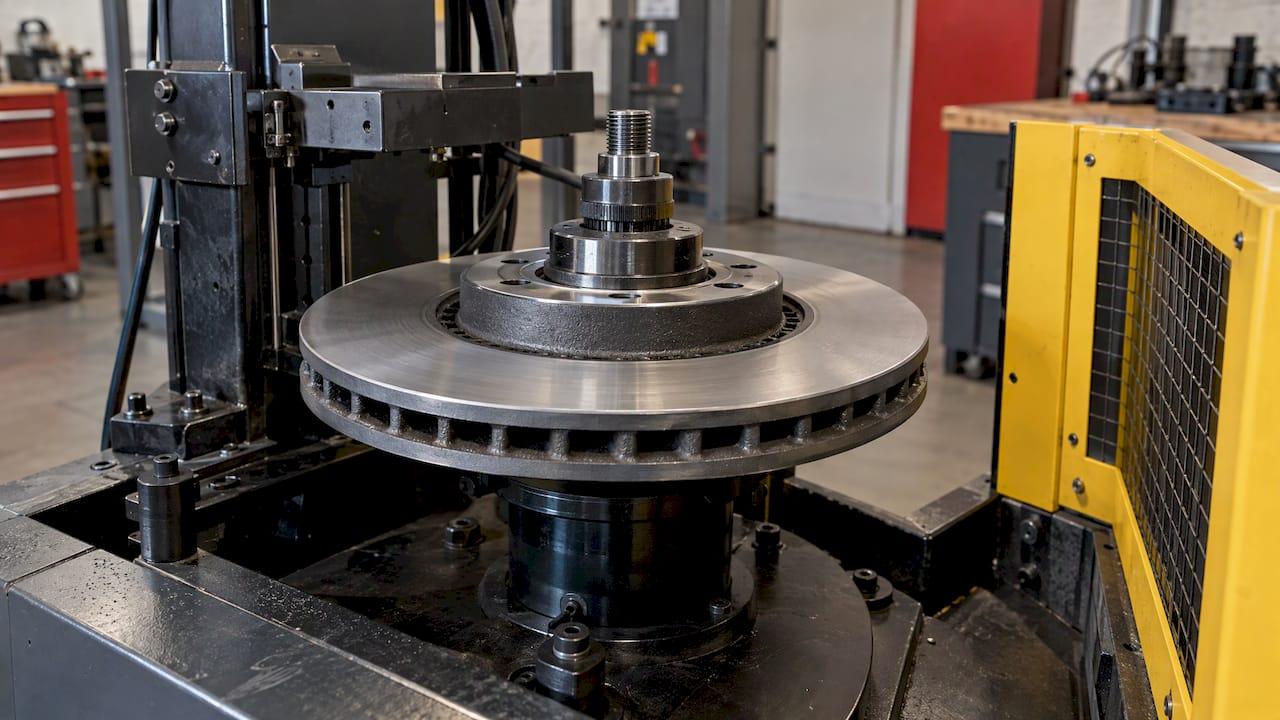
A balanced brake rotor has had its weight distribution corrected so it spins without a heavy spot. Makers do this by milling a small notch or cut into the hat or outer edge. Rotor unbalance is real, but it is rarely the cause of a shaking pedal. Vibration under braking usually comes from thickness variation or lateral runout. This guide covers how balancing works, what a notch means, and what to check after installation.
TL;DR
- Mill balancing removes a small amount of metal from the heavy side of a rotor. The result is a visible notch or cut.
- Unbalance shows up as a shimmy at road speed. Pulsation only when braking points to thickness variation or runout.
- Resurfacing changes a rotor's mass distribution. Balance, if it is done, belongs after final machining.
- Measure runout with the wheel fasteners fully torqued. Specs are commonly 0.002 inch or less.
- Rotors that are well made and installed correctly rarely need extra balancing work.
Table of Contents
- What balanced brake rotors are
- What a notch on a rotor edge means
- Does unbalance cause brake vibration?
- Balancing after machining
- Check runout after installation
- Rotor design and daily or performance use
- Our perspective
- Brake kits for your vehicle
- FAQ
- Sources
What balanced brake rotors are
A rotor is a cast disc that spins with the wheel. If one section is heavier than the rest, it creates a rotating force. That force grows with the square of speed, according to BTI Balance Technology.
Most production rotors are balanced in a single plane. The disc is far wider than it is thick, so one plane is enough. Correction is made by removing material from the hat or the outer edge, or by machining the friction faces. Other methods exist, such as weight addition by welding or weight insertion. High-volume lines measure and correct in one automated cycle, per the same BTI page.
The imbalance starts in the casting. Core shift can leave uneven wall thickness between the two faces of a vented rotor. Vane geometry varies. Porosity and hard carbide regions change density locally. A badly out-of-family casting is often better rejected than corrected.
What a notch on a rotor edge means
A notch or scallop on the outer edge, or a cut on the hat, usually marks mill balancing. A machine spins the rotor, finds the heavy side and mills away a little metal there. TechShop Magazine states that a mill-balanced rotor shows notches or cuts.

The same article adds a warning. If a lot of weight has been added or removed, it points to severe internal problems causing the imbalance. Adding or removing mass can also leave a rotor thermally unbalanced. That creates stress under heat cycling and can lead to runout and thickness variation over time.
A small notch is normal. A deep or multiple cuts on a new rotor are worth a second look before installation.
| What you see | Likely meaning | Action |
|---|---|---|
| One small notch on the edge | Mill balancing | None needed |
| No notch at all | Balanced another way, or within tolerance | None needed |
| Several deep cuts | Heavy correction to a poor casting | Ask the supplier before installing |
| Notch on a used rotor | Original factory balancing | None needed |
Does unbalance cause brake vibration?
Usually not. BTI says unbalance is measurable. It also says the vibration felt through the pedal and wheel under braking is far more often disc thickness variation (DTV) or lateral runout. Unbalance appears as a shimmy at road speed, not only when the brakes are applied.

Judder and thickness variation
A peer-reviewed paper by Hossein Sadjadi separates two types of judder:
- Cold judder: the most common type. It comes from uneven wear, uneven mounting or geometric irregularities of the disc, and can occur at any speed.
- Thermal judder: it comes from uneven thermal expansion of the disc and occurs when slowing from high speed.
The same paper states that thickness variation above about 20 micrometres is noticeable to an experienced driver as judder. That is less than the thickness of a sheet of paper.
Tell the symptoms apart
| Symptom | Common cause |
|---|---|
| Shimmy at highway speed with no braking | Wheel or tire imbalance, or rotor unbalance |
| Pedal pulsing only when braking | Thickness variation or runout |
| Steering wheel shake under braking | Front rotors |
| Pedal pulsing with no wheel shake | Rear rotors, or a hydraulic or ABS issue |
Certified AutoBrokers describes a road test. Accelerate to about 30 to 40 mph and brake steadily. Pulsation that grows above 30 mph or appears only on braking is almost certainly a rotor issue, not a worn pad or suspension fault. The source is American, so it quotes mph. The equivalent is roughly 50 to 65 km/h.
A shimmy at speed with no braking is a job for a wheel balance first. Have a shop check wheels and tires before blaming the rotors.
Our own guide covers this in more detail: do brake rotors need balancing.
Balancing after machining
Resurfacing a rotor changes its balance. Material comes off the friction faces, and if it comes off unevenly, the mass distribution shifts. BTI states that balancing should follow final machining, not precede it.
Machining itself is a legitimate repair when done within limits. HSM University explains that a rotor with thickness variation, grooves or light scoring can be cut on a brake lathe if it stays above the machine-to thickness. The lathe cuts both faces at once, leaving them flat and parallel. Afterward:
- Measure the new thickness and record it on the repair order.
- Confirm it is above the machine-to figure.
- Finish with a light final cut and a few seconds with a sanding pad or scratch-pattern tool on each face, for a smooth, non-directional finish.
Canadian Auto NAPA notes that machined rotors must meet the manufacturer's resurfacing and minimum thickness specifications.
Thin rotors cannot always be machined
Newer vehicles often use thinner, lighter rotors. Arrow Motors points out that shaving metal off a rotor that is not true may leave it thinner than the manufacturer allows. In that case replacement is the only option. A new set of rotors also resets the balance and thickness from a known starting point.
After any brake work, wheels often need a clean. Dust left on the face of the wheel is easy to remove, and this guide on how to remove brake dust safely lists dwell times for cleaner.
Check runout after installation
Runout is the sideways wobble of the rotor face as it turns. It is the most common installation issue behind pulsation. Measure it before test driving.
How to measure it
Vehicle Service Pros gives the method:
- Install all wheel fasteners and torque them to specification first.
- Mount a dial indicator on a stationary part.
- Set it at 90 degrees to the disc surface with about 0.050 inch of preload.
- Place the plunger tip about a half inch inboard from the outer edge of pad contact.
- Turn the rotor and read the total movement.
The rule of thumb is a maximum of about 0.001 to 0.002 inch for most applications. UnderhoodService says most cars specify 0.002 inch or less. Always use the figure in the vehicle's service data.
For a step-by-step version, see our guide to accurate rotor runout measurement.
If runout is too high
- Clean rust and debris from the hub face and the rotor mounting surface first.
- Tapered correction shims between rotor and hub can fix an initial runout of 0.003 to 0.006 inch, per Vehicle Service Pros.
- UnderhoodService gives a range of 0.003 to 0.009 inch for flange runout shims. Runout above 0.005 inch (0.125 mm) at the bearing flange cannot be corrected with a shim. A worn hub or bearing is the likely cause.
- UnderhoodService also says it is permissible to machine a new rotor with an on-the-car lathe when runout exceeds spec after installation. That cuts the rotor in its operating plane, so it matches the hub.
Wheel bearings and hubs matter here. A loose or worn bearing produces runout no rotor can fix. We stock wheel bearings and hubs alongside rotors and pads.
Rotor design and daily or performance use
Balance is one factor. Material, casting quality and design also decide how a rotor behaves.
- Casting quality: TechShop Magazine says cheap castings often use the least iron possible and get only a skin cut at the factory. The outer iron layer is less stable, and porosity and strength problems can build stress and lead to distortion and pulsation.
- Cross-drilled rotors on the road: Road & Track states that cross-drilled rotors are not dangerous on the road. If you track the car, rotors and pads may need replacing more often.
- Heat performance: a synopsis of SAE paper 2006-01-0691 reports that cross-drilled rotors had slightly lower output at low speeds. They showed better temperature stability, and the apparent friction of the cross-drilled front rotor overtook the blank at about 170 °C.
Our perspective
Balance gets a lot of attention online because a notch is easy to see. Most pulsation complaints we hear about come down to runout, hub condition and thickness variation. Those are things to measure.
We build our rotors for Canadian drivers. Our cross-drilled designs are engineered to resist warping and to last. Better heat control and a stable surface are what keep a pedal smooth over time.
We suggest a simple routine. Clean the hub face. Torque the wheel fasteners in the right order. Measure runout. Bed in the pads. Our support team answers fitment questions in person, with no automated replies.
Choose a kit made for your vehicle. A complete rotor and pad set means the parts were selected to work together.
Sam
Brake kits for your vehicle
DBC makes cross-drilled brake kits and rotors for cars, trucks and performance vehicles. Lines include Performance XDB, Premium Black Kote and Performance SS. Pricing is inclusive, with no hidden fees. Shipping is free in Canada on orders over $100. Expedited shipping is $29.99 per order.
Select your make and model to see kits that fit: browse brake kits and rotors by make, or view the full brake rotor range. Rotors and pads are also sold separately in the brake pad collection.
FAQ
Do new brake rotors come balanced?
Many are balanced at the factory, and a notch or cut on the edge is the usual sign. Some rotors are within tolerance without any cut. Balance is only one measure of quality. Runout and thickness variation after installation matter just as much.
Should I balance rotors after resurfacing?
Balancing, if it is done, should follow the final machining pass. Resurfacing removes material and changes mass distribution. Check the finished thickness against the minimum on the repair order.
Can an unbalanced rotor make the steering wheel shake?
It can, but the shake appears as a shimmy at road speed rather than only under braking. Shaking only on braking more often comes from thickness variation or runout. Have wheels and tires balanced as well.
What runout is acceptable on a brake rotor?
A common rule of thumb is 0.001 to 0.002 inch, and most cars specify 0.002 inch or less. Your vehicle's service manual gives the exact figure. Measure with the wheel fasteners fully torqued.
Sources
- Brake Rotor Balancing & DTV Gauging Machines, BTI Balance Technology
- Tech Tip: What Should a Technician Know When Ordering Rotors, TechShop Magazine
- Health Indicators to Estimate Brake Rotor Thickness, PHM Society
- When To Replace Car Brakes, Certified AutoBrokers
- Rotor measurement and machining, HSM University
- Brake Rotor Machining St. Albert, Canadian Auto NAPA
- What's Shakin' with my Brakin', Arrow Motors
- Brake Rotor Runout, Vehicle Service Pros
- Stop Brake Pulsation Comebacks Before They Start, UnderhoodService
- Cross-Drilled Brake Rotors Aren't Just Form Over Function, Road & Track
- Synopsis of SAE paper 2006-01-0691
- Remove brake dust safely