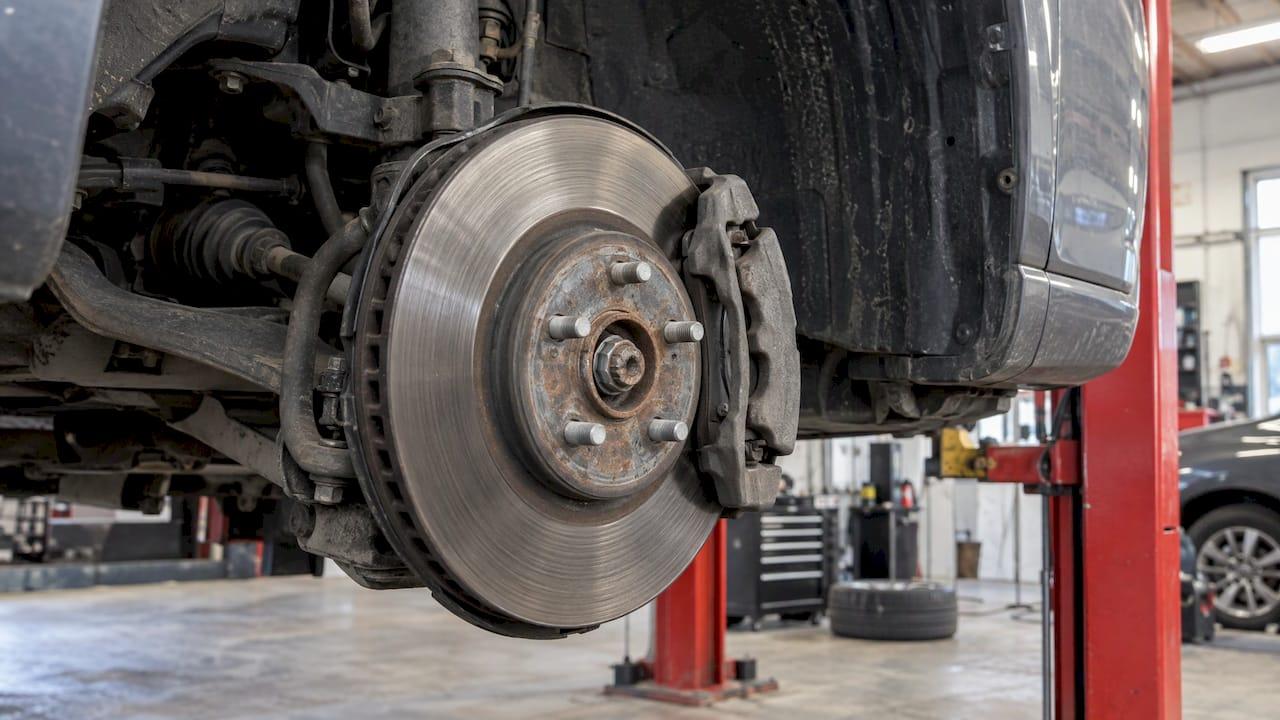
Brake rotors, calipers, pads and hubs are all unsprung weight. This is mass the springs do not carry. It moves with the wheel on every bump. Less of it helps the tire follow the road. More mass in the rotor can help the brakes absorb heat. A good brake upgrade balances the two. It does not chase the lowest number on a scale. DBC Brakes builds engineered cross-drilled rotor kits for Canadian cars, trucks and performance vehicles, with fitment guaranteed for the vehicle.
TL;DR
- Unsprung weight is everything below the springs that moves with the wheel: tires, wheels, rotors, calipers, hubs and bearings.
- Lower unsprung weight helps the tire keep contact on rough roads. Extra mass in a rotor helps it absorb heat.
- Rotor weight depends on vehicle type, diameter, thickness, venting and material. Compact car fronts and truck fronts differ by several times.
- Worn shocks and struts, not rotor weight, are a common cause of a front end that dives or bounces under braking.
- The right upgrade matches the vehicle and the way it is driven. Fitment comes first.
Table of Contents
- What unsprung weight is
- How unsprung weight affects braking and grip
- How much a brake rotor weighs
- Why a lighter rotor is not always a better stopper
- Wheels and tires move the total more than rotors
- Front-end bounce or dive when braking
- Choosing a brake upgrade with unsprung weight in mind
- Our view on unsprung weight
- Brake kits built for Canadian vehicles
- FAQ
- Sources
What unsprung weight is
A vehicle has two kinds of mass. Sprung mass is the body, frame, engine and cabin. The springs carry it. Unsprung mass is everything else that rides with the wheels. In a Canadian college-level suspension course from HSM University, unsprung mass includes tires and wheels, brake rotors and calipers, the hub and knuckle, and part of the mass of springs, dampers and control arms. On a solid rear axle, the axle housing, differential and axle shafts are unsprung too.
Brakes sit in this group because they bolt to the wheel end. The wheel moves up and down, and the rotor and caliper move with it.
Parts that count
| Part | Unsprung? | Note |
|---|---|---|
| Tires and wheels | Yes | Often the largest share at each corner |
| Brake rotors | Yes | Rotating and unsprung |
| Brake calipers and pads | Yes | Mounted at the wheel |
| Hub, knuckle, wheel bearing | Yes | Wear here can add noise and play |
| Springs, dampers, control arms | Partly | Only a share of their mass moves with the wheel |
| Inboard brakes on a driveshaft | No | Rare layout, counted as sprung |
The course gives per-corner examples from shop vehicles. A pickup front corner is about 62 kg. A hybrid front corner is about 36 kg. An EV front corner is about 41 kg. A courier van rear axle is about 95 kg. The same lesson notes that a higher ratio of sprung to unsprung mass means the body is disturbed less when a wheel moves.
How unsprung weight affects braking and grip
A wheel must follow the road surface. When it hits a bump, the suspension pushes it back down. Heavy wheel-end parts have more inertia. They are slower to come back down. The tire can lose contact for a moment.
An overview of unsprung mass describes the effect. A lighter wheel rebounds more readily from small bumps and keeps more constant grip on imperfect roads. The trade-off is that it soaks up less vibration, so more road noise reaches the cabin.
Braking adds a second factor. High unsprung mass can worsen wheel control under hard acceleration or braking. If the wheel is poorly located by the suspension, vertical forces and high unsprung mass can cause wheel hop. Wheel hop is a rapid bouncing of the wheel that cuts traction and steering control.
In daily driving, this shows up on rough pavement, frost-heaved roads and potholes in spring. A tire that stays planted brakes more predictably on those surfaces.
How much a brake rotor weighs
Rotor weight varies widely. Reported ranges from one rotor-weight reference give front rotors about 9 to 15 lb (4 to 7 kg) on compact cars. Mid-size sedans run about 12 to 18 lb (5.4 to 8.2 kg). Light trucks and larger SUVs run about 20 to 40 lb (9 to 18 kg). Front rotors are usually heavier than rears because the front brakes handle more of the braking force.

A trade article on brake discs gives a worked example. A typical 300 mm front disc on a large sedan weighs about 9.5 kg, with the braking band alone near 6 kg. It takes roughly 24 Nm of torque to spin that disc up to 134 km/h and back down. A disc 1 kg lighter needs about 20.5 Nm.
Several design choices set the weight:
- Diameter and thickness. A larger or thicker rotor holds more metal.
- Venting. Vented rotors have an air gap between two faces. They cool better and weigh more than a solid disc.
- Material. Cast iron is the common choice. Lighter materials cost more.
- Drilled or slotted faces. Holes and slots remove some mass and give gas and water a path away from the pad surface.
The weight difference between two rotors for the same vehicle is usually small next to the difference between vehicles. A few hundred grams per corner will not change how a car rides. The wheel and tire choice moves the total far more.
Why a lighter rotor is not always a better stopper
Braking turns motion into heat. The rotor absorbs most of that heat and sheds it into the air. Mass in the disc gives it capacity to absorb heat before it gets too hot.
A MotorTrend tech article on big brake kits makes the point directly. Mass in the brake disc benefits braking performance. It does not benefit acceleration, ride and handling, because it adds unsprung mass. Designers of larger systems look for ways to cut weight while keeping thermal capacity.
That means the goal is balance. A rotor should hold enough mass for the heat of the way the vehicle is driven. Commuting in town is a light load. Towing, mountain grades, track days and spirited driving are heavier loads.
Size matters in a separate way. A brake trade article notes that a larger rotor has better mechanical lever advantage and more swept pad contact area. That can help a driver who complains of longer braking distance. For the limits of that idea on a single cold stop, see why bigger rotors rarely shorten a single cold stop.
Tire grip still sets the ceiling. No rotor can stop a vehicle faster than the tires can hold the road.
Wheels and tires move the total more than rotors
At each corner, the wheel and tire are the biggest unsprung items. The same trade article notes that a large-diameter cast aluminum wheel can weigh more than the stamped steel wheel it replaces. The added mass means more inertia for the shocks to control. If the dampers are worn, the extra weight amplifies negative handling. Upgrading shocks or struts along with wheels can help.
Not every engineer treats unsprung weight as the main issue. A Road & Track piece on big wheels quotes a former Corvette ride-and-handling engineer. Manufacturers manage larger wheels through damping, suspension layout, structural stiffness and geometry. The same article reports an engineer who says tire stiffness has a more noticeable real-world effect on ride and handling than unsprung weight.
The practical reading is simple. Weight matters most when the damping is weak or the road is rough. A well-damped suspension handles a normal rotor upgrade without a noticeable change in ride.
Wheel care is part of keeping a wheel-end in good shape. Brake dust builds up on wheels, and a guide on removing brake dust from wheels covers the dwell time and safe method.
Front-end bounce or dive when braking
Nose dive on braking is often a damping issue. It is not always a rotor issue. Monroe's technical resource on worn shocks and struts says that a front end that dips quickly toward the ground under braking can point to worn shocks and struts. It can lengthen stopping distance. Worn shocks also cause bouncing and uneven tire wear, including cupping.
A quick sorting guide:
- Nose dips hard and the car bounces more than once afterward. Check the shocks and struts first.
- Steering wheel shakes only under braking. Check the brakes. Rotor thickness variation, uneven pad material on the rotor and caliper problems are common causes.
- Clunk from the front over bumps and braking. Check strut mounts, control-arm bushings, tie rods and wheel bearings.
- Uneven front tire wear. Check damping and alignment.
Loose front-end parts can amplify a mild rotor issue. A wheel bearing with play lets the rotor wobble. For that reason, a brake job often includes a look at the wheel bearings and hubs at the same corner.
A vehicle with a brake pedal that feels soft, a pull to one side, or a warning light should be inspected by a licensed mechanic before further driving.
Choosing a brake upgrade with unsprung weight in mind
Use this order when picking parts.
- Match the vehicle. Fitment comes before any other detail. Make, model, year and trim set the rotor size and mounting. DBC lists its kits by make, and its fitment is guaranteed.
- Match the use. Daily commuting, towing and track work place different heat loads on the rotor.
- Choose the rotor design. Cross-drilled rotors from DBC are engineered to resist warping and add durability. Slotted and combined cross-drilled and slotted designs are also available in the brake rotor collection.
- Replace as a set. Rotors, pads and hardware work as a system. A brake kit pairs them so the pads and rotors suit each other.
- Check the wheel end. Replace worn bearings and dampers so the new brakes work with a stable wheel.
- Keep the wheel and tire package sensible. A heavier wheel adds more unsprung mass than a rotor swap changes.
Most drivers see the best result from a complete kit sized for their vehicle. It restores consistent pedal feel and resists the heat-related warping that causes pedal pulsing.
Our view on unsprung weight
Unsprung weight gets treated as a single number to cut. We see it as one factor in a system. A rotor that is too light for the job runs hot. A rotor sized to the job lets the pads work consistently.
We build our cross-drilled rotors to prevent warping and to last. For most vehicles on Canadian roads, that means a rotor with the right size and mass for the vehicle, matched pads and hardware, and a fit that is correct the first time.
Most drivers who ask about unsprung weight are really asking two things: will the car ride worse, and will it stop better? For a properly fitted kit on a vehicle with healthy suspension, the answer to the second is yes, and the ride stays where it was. Rotor mass is a small part of the wheel-end total. Tires and wheels are the larger part.
Our pricing is inclusive, with no hidden fees. Our support staff answer questions about fitment directly, with no automated replies.
Sam
Brake kits built for Canadian vehicles
DBC is a Canadian manufacturer of brake kits with cross-drilled rotors for cars, trucks and performance vehicles. The product lines are Performance XDB, Premium Black Kote and Performance SS. Orders over $100 ship free within Canada. Expedited shipping is $29.99 per order. International shipping is $129.99 per brake kit.
To find a kit, choose the vehicle make and model on the DBC brake kit pages. Rotors, pads, kits, wheel bearings and hubs are listed in one place. Shipping terms are on the shipping information page.
FAQ
What is the difference between sprung and unsprung weight?
Sprung weight is the mass the springs carry: body, frame, engine and cabin. Unsprung weight is the mass that moves with the wheel: tires, wheels, rotors, calipers, hubs and bearings, plus part of the suspension arms and dampers. The lower the unsprung share, the easier it is for the suspension to keep the tire on the road.
Do brake rotors count as unsprung weight?
Yes. On most vehicles, the rotor mounts to the hub at the wheel. It moves with the wheel over bumps. Calipers and pads are unsprung as well. Only brakes mounted inboard on the driveshaft count as sprung, and that layout is uncommon.
How much does a brake rotor weigh?
It depends on the vehicle. Reported figures put compact car front rotors at about 4 to 7 kg and light truck or large SUV fronts at about 9 to 18 kg. Diameter, thickness, venting and material set the weight. The exact figure for a given vehicle depends on the rotor part number.
Why does my front end dive or bounce when I brake?
The most common cause is worn front shocks or struts. They no longer resist the forward weight shift. A bounce test helps: after pushing down on a corner, a healthy car settles within about one bounce. Worn bushings, tie rods and wheel bearings can also add to the movement.
Will a rotor upgrade make my ride worse?
A change in rotor weight of a few hundred grams per corner is small next to the weight of the wheel and tire. With healthy dampers, a correctly sized rotor upgrade does not noticeably change ride quality.
Sources
- HSM University, AUTO-210 Lesson 1: What suspension and steering do
- Unsprung mass overview
- Average brake rotor weight
- Brake discs: is lighter actually better?
- MotorTrend: Breaking Down BBKs
- Brake & Front End: Under Pressure and Pounding
- Road & Track: Big wheels and unsprung weight
- Monroe: Signs of bad shocks and struts